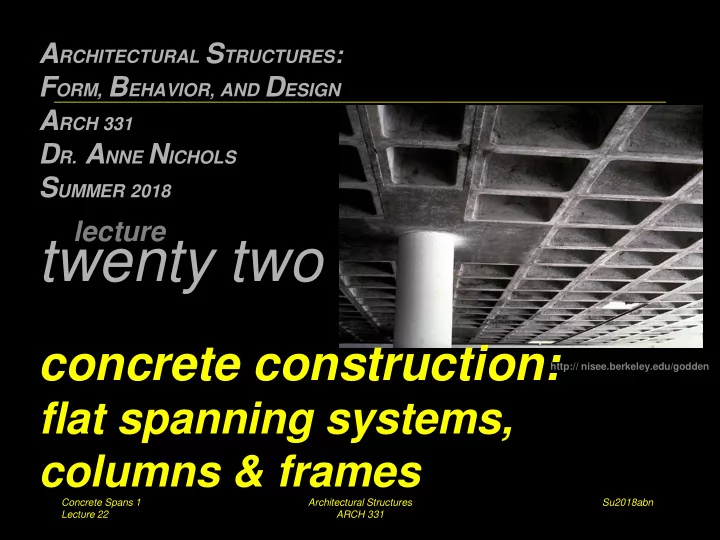
twenty two concrete construction: http:// nisee.berkeley.edu/godden - - PowerPoint PPT Presentation

twenty two
SMART_READER_LITE
LIVE PREVIEW

twenty two concrete construction: http:// nisee.berkeley.edu/godden - - PowerPoint PPT Presentation

A RCHITECTURAL S TRUCTURES : F ORM, B EHAVIOR, AND D ESIGN A RCH 331 D R. A NNE N ICHOLS S UMMER 2018 lecture twenty two concrete construction: http:// nisee.berkeley.edu/godden flat spanning systems, columns & frames Concrete Spans 1


slide-1
SLIDE 1

Su2018abn Concrete Spans 1 Lecture 22 Architectural Structures ARCH 331

ARCHITECTURAL STRUCTURES: FORM, BEHAVIOR, AND DESIGN ARCH 331

  • DR. ANNE NICHOLS

SUMMER 2018 lecture

twenty two

concrete construction:

flat spanning systems, columns & frames

http:// nisee.berkeley.edu/godden

slide-2
SLIDE 2

Su2018abn Concrete Spans 2 Lecture 22 Architectural Structures ARCH 331

Reinforced Concrete Design

  • economical & common
  • resist lateral loads
slide-3
SLIDE 3

Su2018abn Concrete Spans 3 Lecture 22 Architectural Structures ARCH 331

Reinforced Concrete Design

  • flat plate

– 5”-10” thick – simple formwork – lower story heights

  • flat slab

– same as plate – 2 ¼”–8” drop panels

slide-4
SLIDE 4

Su2018abn Concrete Spans 4 Lecture 22 Architectural Structures ARCH 331

Reinforced Concrete Design

  • beam supported

– slab depth ~ L/20 – 8”–60” deep

  • one-way joists

– 3”–5” slab – 8”–20” stems – 5”-7” webs

The Architect’s Studio Companion

slide-5
SLIDE 5

Su2018abn Concrete Spans 5 Lecture 22 Architectural Structures ARCH 331

Reinforced Concrete Design

  • two-way joist

– “waffle slab” – 3”-5” slab – 8”-24” stems – 6”-8” webs

  • beam supported slab

– 5”-10” slabs – taller story heights

slide-6
SLIDE 6

Su2018abn Concrete Spans 6 Lecture 22 Architectural Structures ARCH 331

Reinforced Concrete Design

  • simplified frame analysis

– strips, like continuous beams

  • moments require

flexural reinforcement

– top & bottom – both directions of slab – continuous, bent or discontinuous

slide-7
SLIDE 7

Su2018abn Concrete Spans 7 Lecture 22 Architectural Structures ARCH 331

Reinforced Concrete Design

  • one-way slabs (wide beam design)

– approximate analysis for moment & shear coefficients – two or more spans – ~ same lengths – wu from combos – uniform loads with L/D  3 –  n is clear span (+M) or average of adjacent clear spans (-M)

slide-8
SLIDE 8

Su2018abn Concrete Spans 8 Lecture 22 Architectural Structures ARCH 331

Reinforced Concrete Design

slide-9
SLIDE 9

Su2018abn Concrete Spans 9 Lecture 22 Architectural Structures ARCH 331

Reinforced Concrete Design

  • two-way slabs - Direct Design Method

– 3 or more spans each way – uniform loads with L/D  3 – rectangular panels with long/short span  2 – successive spans can’t differ > longer/3 – column offset no more than 10% span

slide-10
SLIDE 10

Su2018abn Concrete Spans 10 Lecture 22 Architectural Structures ARCH 331

Reinforced Concrete Design

slide-11
SLIDE 11

Su2018abn Concrete Spans 11 Lecture 22 Architectural Structures ARCH 331

Shear in Concrete

  • at columns
  • want to avoid

stirrups

  • can use shear

studs or heads

slide-12
SLIDE 12

Su2018abn Concrete Spans 12 Lecture 22 Architectural Structures ARCH 331

Shear in Concrete

  • critical section at d/2 from

– column face, column capital or drop panel

slide-13
SLIDE 13

Su2018abn Concrete Spans 13 Lecture 22 Architectural Structures ARCH 331

Shear in Concrete

  • at columns with waffle slabs

http:// nisee.berkeley.edu/godden

slide-14
SLIDE 14

Su2018abn Concrete Spans 14 Lecture 22 Architectural Structures ARCH 331

Openings in Slabs

  • careful placement of holes
  • shear strength

reduced

  • bending &

deflection can increase

slide-15
SLIDE 15

Su2018abn Concrete Spans 15 Lecture 22 Architectural Structures ARCH 331

General Beam Design

  • f’c & fy needed
  • usually size just b & h

– even inches typical (forms) – similar joist to beam depth – b:h of 1:1.5-1:2.5 – bw & bf for T – to fit reinforcement + stirrups

  • slab design, t

– deflection control & shear

6

2

bh S 

slide-16
SLIDE 16

Su2018abn Concrete Spans 16 Lecture 22 Architectural Structures ARCH 331

General Beam Design (cont’d)

  • custom design:

– longitudinal steel – shear reinforcement – detailing

slide-17
SLIDE 17

Su2018abn Concrete Spans 17 Lecture 22 Architectural Structures ARCH 331

Space “Frame” Behavior

  • handle uniformly distributed loads well
  • bending moment

– tension & compression “couple” with depth – member sizes can vary, but difficult

slide-18
SLIDE 18

Su2018abn Concrete Spans 18 Lecture 22 Architectural Structures ARCH 331

Space “Frame” Behavior

  • shear at columns
  • support conditions still important

– point supports not optimal

  • fabrication/construction can dominate

design

slide-19
SLIDE 19

Su2018abn Concrete Spans 19 Lecture 22 Architectural Structures ARCH 331

Folded Plates

  • increased bending stiffness with folding
  • lateral buckling avoided
slide-20
SLIDE 20

Su2018abn Concrete Spans 20 Lecture 22 Architectural Structures ARCH 331

Folded Plates

  • common for roofs
  • edges need

stiffening

http:// nisee.berkeley.edu/godden

slide-21
SLIDE 21

Su2018abn Concrete Spans 21 Lecture 22 Architectural Structures ARCH 331

Folded Plates

– State Farm Center (Assembly Hall), University of Illinois – Harrison & Abramovitz 1963 – Edge-supported dome spanning 400 feet wound with 614 miles of one-fifth inch steel wire

www.library.illinois.edu

slide-22
SLIDE 22

Su2018abn Concrete Spans 22 Lecture 22 Architectural Structures ARCH 331

Concrete in Compression

  • crushing
  • vertical cracking

– tension

  • diagonal cracking

– shear

  • c

f 

http://www.bam.de

c

f 

slide-23
SLIDE 23

Su2018abn Concrete Spans 23 Lecture 22 Architectural Structures ARCH 331

Columns Reinforcement

  • columns require

– ties or spiral reinforcement to “confine” concrete (#3 bars minimum) – minimum amount of longitudinal steel (4 bars minimum)

slide-24
SLIDE 24

Su2018abn

u

kL 22 r 

Concrete Spans 24 Lecture 22 Architectural Structures ARCH 331

Slenderness

  • effective length in monolithic with

respect to stiffness of joint:  & k

  • not slender when

*not braced

slide-25
SLIDE 25

Su2018abn Concrete Spans 25 Lecture 22 Architectural Structures ARCH 331

Effective Length (revisited)

  • relative rotation

b c

l EI l EI    

slide-26
SLIDE 26

Su2018abn Concrete Spans 26 Lecture 22 Architectural Structures ARCH 331

Column Behavior

slide-27
SLIDE 27

Su2018abn Concrete Spans 27 Lecture 22 Architectural Structures ARCH 331

Column Design

  • c = 0.65 for ties, c = 0.75 for spirals
  • Po – no bending
  • Pu  cPn

– ties: Pn = 0.8Po – spiral: Pn = 0.85Po

  • nominal axial capacity:

– presumes steel yields – concrete at ultimate stress

st y st g c

  • A

f A A f P     ) ( 85 .

slide-28
SLIDE 28

Su2018abn Concrete Spans 28 Lecture 22 Architectural Structures ARCH 331

Columns with Bending

  • eccentric loads can cause moments
  • moments can change shape and induce

more deflection (P-)

P 

slide-29
SLIDE 29

Su2018abn Concrete Spans 29 Lecture 22 Architectural Structures ARCH 331

Columns with Bending

  • for ultimate strength behavior, ultimate

strains can’t be exceeded

– concrete 0.003 – steel

  • P reduces

with M

s y

E f

slide-30
SLIDE 30

Su2018abn Concrete Spans 30 Lecture 22 Architectural Structures ARCH 331

Columns with Bending

  • need to consider

combined stresses

  • linear strain
  • steel stress at or

below fy

  • plot interaction

diagram

slide-31
SLIDE 31

Su2018abn Concrete Spans 31 Lecture 22 Architectural Structures ARCH 331

Design Methods

  • calculation intensive

– handbook charts – computer programs

slide-32
SLIDE 32

Su2018abn Concrete Spans 32 Lecture 22 Architectural Structures ARCH 331

Design Considerations

  • bending at both ends

– P-  maximum

  • biaxial bending
  • walls

– unit wide columns – “deep” beam shear

  • detailing

– shorter development lengths – dowels to footings