
SLIDE 1
5/30/2017 1 Legal Issues in New Contracting and Risk Sharing Models - What To Know Before You Sign
Alexis Finkelberg Bortniker Foley & Lardner LLP 617-226-3177 Abortniker@foley.com June 2, 2017
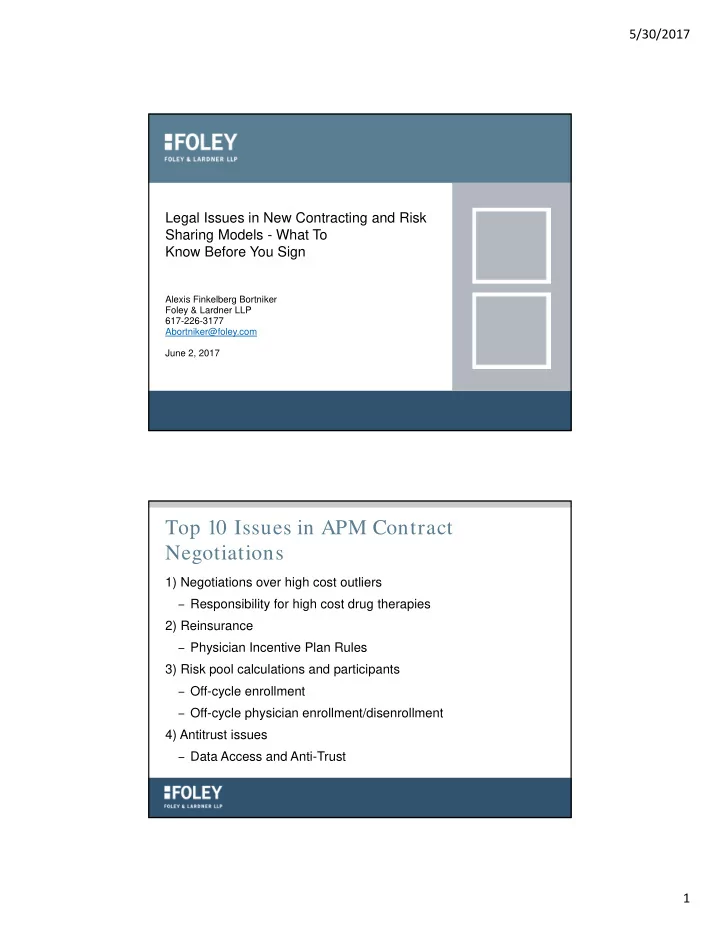
Top 10 Issues in APM Contract Negotiations 1) Negotiations over - - PDF document
5/30/2017 Legal Issues in New Contracting and Risk Sharing Models - What To Know Before You Sign Alexis Finkelberg Bortniker Foley & Lardner LLP 617-226-3177 Abortniker@foley.com June 2, 2017 Top 10 Issues in APM Contract Negotiations
Alexis Finkelberg Bortniker Foley & Lardner LLP 617-226-3177 Abortniker@foley.com June 2, 2017
– http://www.mass.gov/ocabr/government/oca-agencies/doi-lp/risk-certificate-application-
information.html
– A Provider Organization shall not be permitted to enter into an arrangement with either
a Carrier or a Public Health Care Payer whereby the Provider Organization or any entity with which the Provider Organization has a Contracting Affiliation manages the treatment of a group of patients and bears Downside Risk according to the terms of an Alternative Payment Contract, or other alternative payment arrangement as part of an insured health benefit plan network, unless the Provider Organization obtains a Risk Certificate or a Risk Certificate Waiver, as applicable
– Definition of Alternative Payment Methodologies or Methods: “Methods of payment that
are not solely based on fee for service reimbursements; provided, however, Alternative Payment Methodologies may include, but shall not be limited to, shared savings arrangements, bundled payments, and global payments; and further provided, Alternative Payment Methodologies may include fee for service payments, which are settled or reconciled with a bundled or global payment.”
Compliance program requirements applicable to MSSP ACOs.
MSSP ACO’s compliance program have the following elements:
–
A designated compliance officer who is not legal counsel (but who may be a lawyer) and who reports directly to the ACO’s governing body;
–
Mechanisms for identifying and addressing compliance problems related to the ACO’s operations and performance;
–
A method for employees or contractors of the ACO, ACO participants, ACO providers/suppliers and other individuals or entities performing functions or services related to the ACO to anonymously report suspected problems related to the ACO to the compliance officer;
–
Compliance training for the ACO, the ACO participants, and the ACO providers/suppliers; and
–
A requirement for the ACO to report probable violations of law to an appropriate law enforcement agency.
–
The ACO must also update its compliance program periodically to reflect changes in law and regulation.
incorporates the federal Managed Care Organization program integrity requirements at 42 C.F.R. § 438.608. To adhere to the contractual requirements, a MassHealth ACO’s compliance program must include:
– Written policies, procedures, and standards of conduct that articulate the ACO’s commitment to comply with all applicable federal and state standards; – A designated compliance officer and compliance committee that is directly accountable to senior management as described in 42 C.F.R. § 438.608, and a designated fraud and abuse prevention coordinator (who may also be the compliance officer) that manages the fraud and abuse program and is the referral and education point for employees in conjunction with the compliance officer; – Training and education for the compliance officer and the ACO’s employees, as well as providing employees, subcontractors, and agents with information about fraud and abuse laws, false claims, and whistleblower protections including in compliance with 42 U.S.C. § 1396a(a)(68) where applicable; – Effective lines of communication between the compliance officer, fraud and abuse prevention coordinator, and the ACO employees; – Provisions for prompt responses to detected offenses and corrective action initiatives; – Enforcement standards and disciplinary guidelines for compliance violations that are well-publicized; – Provisions for internal monitoring and auditing including provider audits through sampling methods to determine whether represented services were actually delivered by provider and received by enrollees, utilization review, and a mechanism to suspend payments to providers where MassHealth has credible allegation of fraud pursuant to 42 C.F.R. § 455.23; – Communication of suspected violations of state and federal law to government agencies, including overpayments, circumstances affecting an enrollee’s MassHealth eligibility, and circumstances affecting a participating provider’s eligibility to participate in MassHealth; – A fraud and abuse program to prevent and detect program violations, investigate allegations of misconduct, protect reporting employees from retaliation, recover improper or fraudulent payments, implement corrective actions, and comply with MassHealth’s reporting and certification requirements; and – Initial and ongoing screening procedures for the ACO and providers to determine if any individuals or entities are excluded from participation in federal health care programs, and notification of any discovered exclusions to MassHealth
Next Generation ACO
Abuse/PhysicianSelfReferral/Downloads/Next-Generation-ACO-Model-Waiver.pdf
– MSSP Waivers
indirectly, overtly or covertly, in cash or in kind in return for purchasing, leasing, ordering or arranging for or recommending purchasing, leasing, or ordering any good, facility, service,
for or recommend purchasing, leasing, ordering any good, facility, service, or item for which payment may be made in whole or in part under this chapter shall be punished by a fine of not more than ten thousand dollars, or by imprisonment in the state prison for not more than five years or in a jail or house of correction for not more than two and one–half years, or by both such fine and imprisonment.
and appropriately reflected in the costs claimed or charges made by the provider or entity under this chapter or to any amount paid by an employer to an employee, who has a bona fide employment relationship with such employer, for employment in the provision of covered items or services.