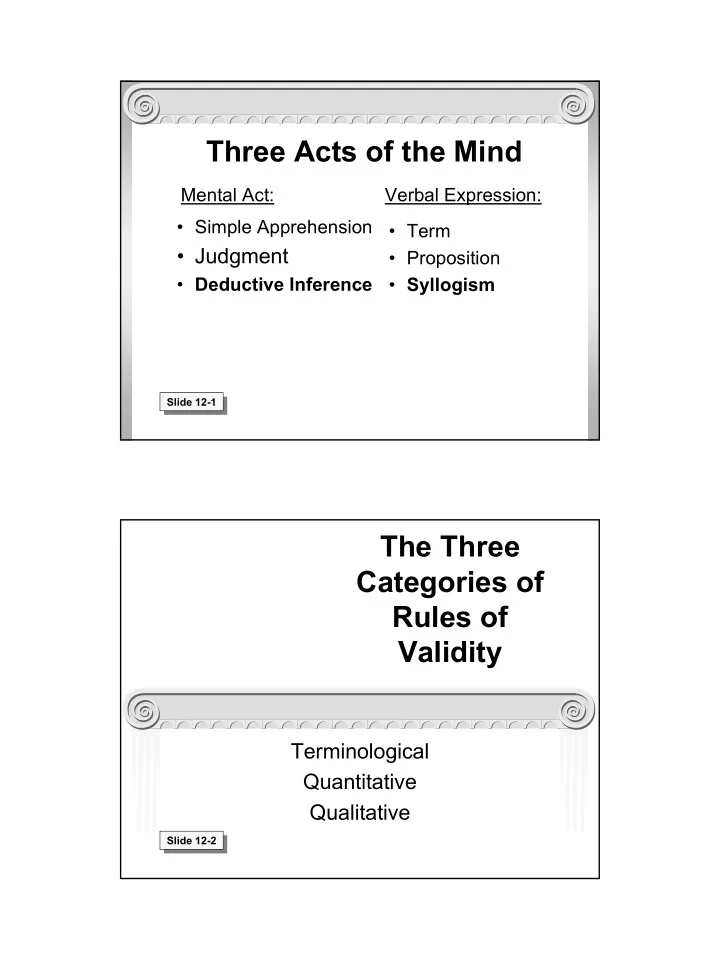
Three Acts of the Mind Mental Act: Verbal Expression: Simple - - PDF document

three acts of the mind
SMART_READER_LITE
LIVE PREVIEW

Three Acts of the Mind Mental Act: Verbal Expression: Simple - - PDF document

Three Acts of the Mind Mental Act: Verbal Expression: Simple Apprehension Term Judgment Proposition Deductive Inference Syllogism Slide 12-1 The Three Categories of Rules of Validity Terminological Quantitative


slide-1
SLIDE 1

1

Three Acts of the Mind

  • Simple Apprehension
  • Judgment
  • Deductive Inference
  • Term
  • Proposition
  • Syllogism

Mental Act: Verbal Expression:

Slide 12-1

The Three Categories of Rules of Validity

Terminological Quantitative Qualitative

Slide 12-2

slide-2
SLIDE 2

2

Quantitative Rules of Validity

  • III. If a term is distributed in the

conclusion, then it must be distributed in the premises.

  • IV. The middle term must be

distributed at least once.

Slide 12-3

Quantitative Rules

These two rules are quantitative because they have to do with the quantity of the statements in the

  • syllogism. (Universal or Particular)

Slide 12-4

slide-3
SLIDE 3

3

Rule III: If a term is distributed in the conclusion, then it must be distributed in the premises.

Slide 12-5

This rule prevents us from trying to say more in the conclusion than is justified by the premises.

The Definition

  • f

Distribution

Distribution is the status of a term in regard to extension.

Slide 12-6

slide-4
SLIDE 4

4

Diagram of the Distribution of Terms

Slide 12-7

Type of Sentence Subject-Term Predicate-Term A I E O Undistributed Undistributed Distributed Distributed Distributed Undistributed Distributed Undistributed

Application of Rule III

All angelsMd are spiritual beingsPu No menSd are angelsMd Therefore, no menSd are spiritual beingsPd

Slide 12-8

slide-5
SLIDE 5

5

The Fallacy of Illicit Process

This fallacy is committed when the extension of a term is greater in the conclusion than in the

  • premises. In other

words, the conclusion says more than is justified by the premises.

Slide 12-9

Two kinds of Fallacy of Illicit Process

The Fallacy of Illicit Major The Fallacy of Illicit Minor

Slide 12-10

slide-6
SLIDE 6

6

The Fallacy of Illicit Major

This fallacy is committed when the major term has greater extension in the conclusion than in the premises—i.e. when the major term is distributed in the conclusion but not the premises.

Slide 12-11

The Fallacy of Illicit Major

All angelsMd are spiritual beingsPu No menSd are angelsMd Therefore, no menSd are spiritual beingsPd

Slide 12-12

slide-7
SLIDE 7

7

Slide 12-13

Spiritual Beings Angels All angelsMd are spiritual beingsPu No menSd are angelsMd Therefore, no menSd are spiritual beingsPd Spiritual Beings Angels Men Men Possibility #1 (premises true& conclusion true): Possibility #2 (premises true & conclusion false:

The Fallacy of Illicit Minor

This fallacy is committed when the minor term has greater extension in the conclusion than in the premises—i.e. when the minor term is distributed in the conclusion but not the premises.

Slide 12-14

slide-8
SLIDE 8

8

The Fallacy of Illicit Minor

All menMd are animalsPu All menMd are mortalSu Therefore, all mortalsSd are animalsPu

Slide 12-15 Slide 12-16

Animals Mortal All menMd are animalsPu All menMd are mortalSu Therefore, all mortalsSd are animalsPu Mortals Animals Men Men Possibility #1 (premises true& conclusion true): Possibility #2 (premises true & conclusion false):

slide-9
SLIDE 9

9

Quantitative Rules of Validity

  • III. If a term is distributed in the

conclusion, then it must be distributed in the premises.

  • IV. The middle term must be

distributed at least once.

Slide 12-17

Rule IV: The middle term must be distributed at least once

An undistributed middle term cannot connect the minor and major terms together, since at least one of either the minor or major term will refer to all of a particular thing.

Slide 12-18

slide-10
SLIDE 10

10

Rule IV: The middle term must be distributed at least once

All angelsPd are spiritual beingsMu All menSd are spiritual beingsMu Therefore, all menSd are angelsPu

Slide 12-19 Slide 12-20

Spiritual Beings Angels All angelsPd are spiritual beingsMu All menSd are spiritual beingsMu Therefore, all menSd are angelsPu Spiritual Beings Angels Men Men Possibility #1 (premises true& conclusion true): Possibility #2 (premises true & conclusion false:

slide-11
SLIDE 11

11

Quantitative Rules of Validity

  • III. If a term is distributed in the

conclusion, then it must be distributed in the premises.

  • IV. The middle term must be

distributed at least once.

Slide 12-21