
SLIDE 1
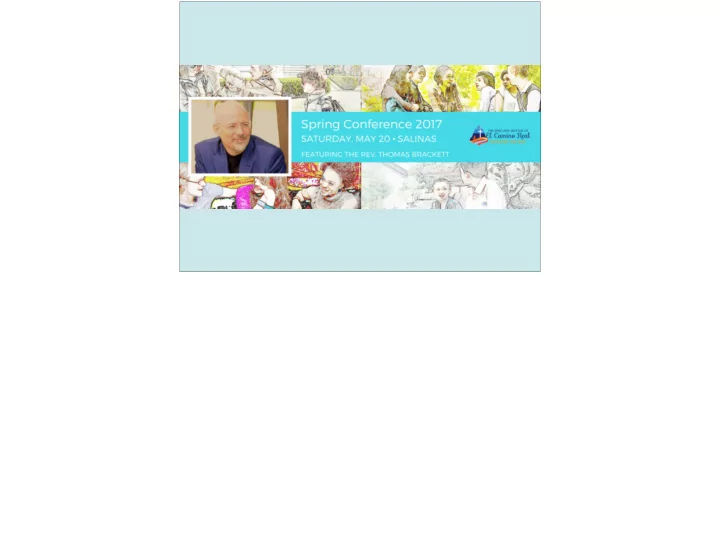
Then Jesus came from Galilee to John at the Jordan, to be baptized - - PowerPoint PPT Presentation
Lectio Divina at tables Then Jesus came from Galilee to John at the Jordan, to be baptized by him. John would have prevented him, saying, I need to be baptized by you, and do you come to me? But Jesus answered him, Let it be so now;
Lectio Divina at tables
Then Jesus came from Galilee to John at the Jordan, to be baptized by him. John would have prevented him, saying, “I need to be baptized by you, and do you come to me?” But Jesus answered him, “Let it be so now; for it is proper for us in this way to fulfill all righteousness.” Then he consented. And when Jesus had been baptized, just as he came up from the water, suddenly the heavens were opened to him and he saw the Spirit of God descending like a dove and alighting on him. And a voice from heaven said, “This is my Son, the Beloved, with whom I am well pleased.”
Then Jesus came from Galilee to John at the Jordan, to be baptized by him. 14 John would have prevented him, saying, “I need to be baptized by you, and do you come to me?” 15 But Jesus answered him, “Let it be so now; for it is proper for us in this way to fulfill all righteousness.” Then he consented. 16 And when Jesus had been baptized, just as he came up from the water, suddenly the heavens were opened to him and he saw the Spirit of God descending like a dove and alighting on him. 17 And a voice from heaven said, “This is my Son, the Beloved, with whom I am well pleased.” Table conversations: Can you remember a moment when you caught a glimpse of your own Belovedness? The gospel tells us that Jesus' public ministry only started after this moment of "Belovedness." How has knowing your own Belovedness changed your understanding of your vocation? In your own experience, which came first … Belonging or Belovedness?
Table conversations: Can you remember a moment when you caught a glimpse of your own Belovedness? The gospel tells us that Jesus' public ministry only started after this moment of "Belovedness." How has knowing your own Belovedness changed your understanding of your vocation? In your own experience, which came first … Belonging or Belovedness? Who am I? Why am I here? Why is this conversation so important to me?
Three Big Questions
Three big questions we all want to ask a presenter from out of town: Who am I? Why am I here? Why is this conversation so important to me? Well, first of all … not this! A sheep farmer is tending his flock when a city slicker rolls up in his BMW, hops out and asks, "Hey, if I tell you exactly how many sheep you have, can I take one?" The farmer nods, so the city slicker opens his laptop, calls up some satellite photos, runs some algorithms, and announces, "You have 1,432 sheep.” Impressed, the farmer says, "You're right. Go ahead and take one." So the city slicker loads one of the animals into the backseat of the car. "Now," says the farmer, "I'll bet all my sheep against your car that I can tell you what you do for a living.” A gaming sort, the city slicker says, “Sure." "You're a consultant," says the farmer. "Wow!" says the consultant. "How'd you know?" "Well," says the farmer, "you come from nowhere even though I never asked you to. You drive a flashy car, and wear a smart suit. You told me something I already knew. And you don't know anything about my business. Now give me back my dog." I live to serve the Spirit in all
compassionate, courageous, playful, outrageous & provocative midwife to the Spirit's life and joy that are longing to be birthed in this moment.
tlb 2000 Who am I? I live to serve the Spirit in all of creation by being a loving, compassionate, courageous, playful, outrageous & provocative midwife to the Spirit's life and joy that are longing to be birthed in this moment. What are the words or phrases that stand out for you in this description I offer? Strategic Objectives for the Diocese of El Camino Real
1: Build Leadership for the Future 2: Cultivate the Treasures Within Our Neighborhoods 3: Strengthen Our Connection with One Another and the Wider World
Why am I here? I found your invitation compelling! You asked me to continue a conversation that we started a year ago. You have publicly committed yourselves to specific Strategic Objectives. These three mean a lot to me. You have invited me to come share learnings from across the the church. 1: Build Leadership for the Future 2: Cultivate the Treasures Within Our Neighborhoods 3: Strengthen Our Connection with One Another and the Wider World I want to be a witness to this path that you are making in the walking of it. … how parishes can be dynamic communities of Jesus by moving from a dependence on institutional authority to a reliance on relational authority.
Why is this conversation so important to me? For thirty-five years of ordained ministry, I have been passionate about healthy communities of faith that practically “engage” the creative work of the Spirit in the world. That passion is all over your strategic objectives. Your leaders have invited me to “engage” that work. You invited me to come share my learnings on … how parishes can be dynamic communities of Jesus by moving from a dependence on institutional authority to a reliance on relational authority. I’m here to share my stories … stories that will be yours to pass on, as you like, after you hear them. Ground Rules: Seek first to understand & then to be understood. Fruits of the Spirit trump everything else. Playful curiosity wins first prize. Periodic silence is golden. Test inferences. Breathe…
First, let’s agree on some basic Ground Rules: Seek first to understand & then to be understood. (St Francis) Fruits of the Spirit trump everything else: Love, joy, peace, patience, kindness, generosity, faithfulness, gentleness, and self-control. Playful curiosity wins first prize. Periodic silence is golden. Test inferences. Breathe… Let’s take a break!
10 minutes? Theme: Moving from a dependence on institutional authority to more of a reliance on relational authority.
Theme: Moving from a dependence on institutional authority to more of a reliance on relational authority. Bert and I: “You can’t get there from here!” Starting with a sense of … Belovedness
Let’s go back to the focus of our Lectio Divine this morning - the story of Jesus’ Baptism Everything worthy of our attention starts with this sense of Belovedness. I keep forgetting that - always tempted to skip over this part - assuming you will already have a handle on this. Your colleagues across the church constantly remind me that this is the wellspring for the rest of the conversation! Without this sense, nothing else is worth it. a story about us
A story: Recently I heard that this scruffy guy with an accent showed up at one of our cathedrals and started a weekday morning teaching series that quickly gathered a pretty remarkable following. He was a little bit of a concern to the Cathedral Chapter since he had more people showing up for his teaching series than attended there on Sunday Where are you located in this midrash on Luke 20? Where does the energy in this story emerge for you? Do you personally know of a rector that would have allowed Jesse to use their baptismal font, in this way? What would it take for you to feel OK about giving Jesse permission to gather community around Belovedness, shared meals and free healing?
Questions for discussion (… pick one …) Where are you located in this midrash on Luke 20? Where does the energy in this story emerge for you? Do you personally know of a rector that would have allowed Jesse to use their baptismal font, in this way? What would it take for you to feel OK about giving Jesse permission to gather community around Belovedness, shared meals and free healing? The term institution commonly applies to both informal institutions (customs, or behavioral patterns important to a society), and also applies to formal institutions created by entities such as religious, educational and public services.
https://en.wikipedia.org/wiki/Institution The term institution commonly applies to both informal institutions (customs, or behavioral patterns important to a society), and also applies to formal institutions created by entities such as religious, educational and public services. https://en.wikipedia.org/wiki/Institution … most
t h e time, in m o s t c a s e s , m o s t people …
Here is my emerging thesis: most of the time, in most cases, most people don’t really ask whether or not the institution approves of those moments when God’s provision breaks through and changes their lives. Instead, they make sense of it, via their significant relationships. So, let’s explore this midrash with a few questions, OK? … most of the time, in most cases, most people don’t really pay much attention to the relationship of the institution to God’s Provision in their lives. Would Nahal have refused the healing because it didn’t come through “proper diocesan channels?” As best we can tell, Jesse’s followers weren’t too concerned about where he was canonically resident. Would you have been? Would having an MDiv. have made Jesse’s ministry more effective or credible? Credible to whom? What are we supposed to do with the ways by which this story challenges us? Some questions: Would Nahal have refused the healing because it didn’t come through “proper diocesan channels?” Best we can tell, Jesse’s followers weren’t too concerned about where he was canonically resident. Would you have been? Would having an MDiv. have made Jesse’s ministry more effective or credible? Credible to whom? What are we supposed to do with the ways by which this story challenges us?
Beyond “the pale” …
“beyond the pale” In the nominally English territory of 17th century Ireland, only “the Pale” fell genuinely under the authority of English law, hence the terms “within the pale” and “beyond the pale.” The paling fence is significant as the term 'pale' came to mean the area enclosed by such a fence and later just figuratively 'the area that is enclosed and safe'. So to be 'beyond the pale' was to be outside the area accepted as ‘home’ and therefore protected or safe. https://en.wiktionary.org/wiki/beyond_the_pale Beyond the pale … … for the sake of love!
For the sake of love, Jesus’ life and teachings went beyond the safe territories of Jewish tradition and Roman rule. He chooses the muddy river of John’s baptism (Very bad career choice - very bad) He chooses relationship over piety - in fact he redefines piety as right-relatedness. He defies the purity code of his day in favor of staying physically and emotionally connected with those whom he served. He chose the vulnerability of a mendicant lifestyle (as opposed to Paul, who later refused). He gave power away instead of hoarding it. And why? Jesus chooses love over power - even to the point of his own death (Matthew 26:53) After lunch, let’s explore how we are called to go “beyond the pale,” for the sake of love! https://en.wiktionary.org/wiki/beyond_the_pale Question for lunchtime discussion: When have you experienced God’s generosity from an unexpected source?
Question for lunchtime discussion: When have you experienced God’s generosity from an unexpected source? This could be an unexpected source inside an institution, as well!) Beyond the pale … … for the sake of love
We might say that for the sake of love, Jesus invites US to go “beyond the pale” of our reliance on institutional certainties, like … ? Meeting Jesus on the Yoga Mat
Greta Ronningen describes herself as looking for God behind bars in the LA County jails. She is RE-WiLDING the church! She talks about Jesus the revolutionary! Meeting Jesus on the Yoga Mat: the Greta Roninger story about seeking ordination for a life sentence female inside the prison system. Her COM are the guards, sister prisoners, and the prison administration. The Church as institution has the high calling to bless what they have already done; not to really assess it or try to squeeze that discernment into Beyond the pale …
towards a new Holy Orders process
We might say that for the sake of love, Jesus invites US to go … “beyond the pale” of the safety and security of our present Holy Orders process. Let’s take a break!
10 minutes? that brown paper bag liturgy
Angel liturgy. We learned to assess the efficacy of the liturgy, not on the basis of institutional approval, but instead, on the basis of the impact it has on the communities that we are called to serve. Here is a video recording of this story: https://vimeo.com/154479316 The story starts at 53:15. Where did this story first go beyond the pale? What approval did it take to offer the institution’s best gifts to a community formed strictly on relational authority? Mom could not return to her church but she referred to the institution’s text for a blessing
know how to honor.
Where did this story first go beyond the pale? What approval did it take to offer the institution’s best gifts to a community formed strictly on relational authority? Mom could not return to her church but she referred to the institution’s text for a blessing on a life that the Church as institution did not know how to honor. Beyond the pale …
towards a new Holy Orders process
“just get him into the box!”
The Maine EMS story illustrates the shift from institutional to relational to institutional authority in a beautiful way. You can find a recording of this story, over here: https:// www.youtube.com/watch?v=qeUVi5X7jKA The outcome described in this story relied on both expressions of authority, but in the right moments!
The Maine EMS story illustrates the shift from institutional to relational to institutional authority in a beautiful way. Where does each expression of authority show up? When might one authority have gotten in the way of the outcomes waiting to emerge? And the other? Can you see how that a strict reliance on institutional authority and security might have killed Bruce? Beyond the pale …
towards a new Holy Orders process
Beyond the pale …
towards a new Holy Orders process
… and all for the sake of love!
There is nothing tricky about this … it’s a switch to relational authority for the sake of love: for God. for the world. for all of creation. for all that is being birthed in our times. God’s first story God's first word Our first impulse
The first story is always the baptismal story. God's first word is always "You are my beloved." Those words ought to be our first words, as well. You might ask, how do we go off track so quickly? My sense is that people come to us in search of a glimpse of their own belovedness. Because we don't know what to do with that, we will often trade them a sense of importance. We train them to act important, instead of acting “beloved.” Peter Block’s Six Conversations
Resources:
Community: the structure of belonging by Peter Block Life of the Beloved: Spiritual Living in a Secular World by Henri Nouwen Rabbi Jesus: An Intimate Biography by Bruce Chilton Theory U: Leading from the Future as It Emerges by C. Otto Scharmer The Rev. Thomas Brackett
Manager for Church Planting & Mission Development Presiding Bishop’s Staff, Episcopal Church 815 2nd Ave. New York, NY 10017 646-203-6266 tbrackett@episcopalchurch.org http://about.me/tombrackett Schedule a phone call or meeting with Tom here: https://www.timetrade.com/book/46C8G Skype: thomasbrackett Twitter: @tombrackett "The real gift of rigorous inquiry is the discovery of questions you didn't know to ask, rather than the answer to the question that brought you along."