Themes of CSE 351 Interfaces and abstracDons So far: - - PowerPoint PPT Presentation

themes of cse 351
SMART_READER_LITE
LIVE PREVIEW

Themes of CSE 351 Interfaces and abstracDons So far: - - PowerPoint PPT Presentation

University of Washington University of Washington Themes of CSE 351 Interfaces and abstracDons So far: some abstrac8ons in C code The


slide-1
SLIDE 1

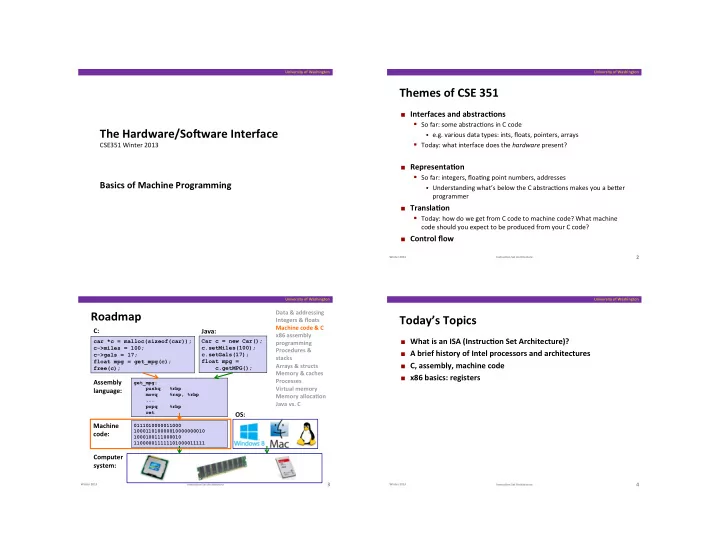
University ¡of ¡Washington ¡

Basics ¡of ¡Machine ¡Programming ¡

The ¡Hardware/So<ware ¡Interface ¡

CSE351 ¡Winter ¡2013 ¡

University ¡of ¡Washington ¡

Themes ¡of ¡CSE ¡351 ¡

 Interfaces ¡and ¡abstracDons ¡

  • So ¡far: ¡some ¡abstrac8ons ¡in ¡C ¡code ¡
  • e.g. ¡various ¡data ¡types: ¡ints, ¡floats, ¡pointers, ¡arrays ¡
  • Today: ¡what ¡interface ¡does ¡the ¡hardware ¡present? ¡

 RepresentaDon ¡

  • So ¡far: ¡integers, ¡floa8ng ¡point ¡numbers, ¡addresses ¡
  • Understanding ¡what’s ¡below ¡the ¡C ¡abstrac8ons ¡makes ¡you ¡a ¡beJer ¡

programmer ¡

 TranslaDon ¡

  • Today: ¡how ¡do ¡we ¡get ¡from ¡C ¡code ¡to ¡machine ¡code? ¡What ¡machine ¡

code ¡should ¡you ¡expect ¡to ¡be ¡produced ¡from ¡your ¡C ¡code? ¡

 Control ¡flow ¡

Winter ¡2013 ¡

2 ¡

InstrucDon ¡Set ¡Architecture ¡

University ¡of ¡Washington ¡

Roadmap ¡

3 ¡ car *c = malloc(sizeof(car)); c->miles = 100; c->gals = 17; float mpg = get_mpg(c); free(c); Car c = new Car(); c.setMiles(100); c.setGals(17); float mpg = c.getMPG();

get_mpg: pushq %rbp movq %rsp, %rbp ... popq %rbp ret

Java: ¡ C: ¡ Assembly ¡ language: ¡ Machine ¡ code: ¡

0111010000011000 100011010000010000000010 1000100111000010 110000011111101000011111

Computer ¡ system: ¡ OS: ¡

Data ¡& ¡addressing ¡ Integers ¡& ¡floats ¡ Machine ¡code ¡& ¡C ¡ x86 ¡assembly ¡ programming ¡ Procedures ¡& ¡ stacks ¡ Arrays ¡& ¡structs ¡ Memory ¡& ¡caches ¡ Processes ¡ Virtual ¡memory ¡ Memory ¡allocaDon ¡ Java ¡vs. ¡C ¡

Winter ¡2013 ¡ InstrucDon ¡Set ¡Architecture ¡

University ¡of ¡Washington ¡

Today’s ¡Topics ¡

 What ¡is ¡an ¡ISA ¡(InstrucDon ¡Set ¡Architecture)? ¡  A ¡brief ¡history ¡of ¡Intel ¡processors ¡and ¡architectures ¡  C, ¡assembly, ¡machine ¡code ¡  x86 ¡basics: ¡registers ¡

Winter ¡2013 ¡

4 ¡

InstrucDon ¡Set ¡Architecture ¡

slide-2
SLIDE 2

University ¡of ¡Washington ¡

Winter ¡2013 ¡

5 ¡

InstrucDon ¡Set ¡Architecture ¡

What ¡makes ¡programs ¡run ¡fast? ¡

Hardware

User program in C Assembler C compiler

Code ¡Time ¡ Compile ¡Time ¡ Run ¡Time ¡

.exe file .c file

TranslaDon ¡

University ¡of ¡Washington ¡

TranslaDon ¡Impacts ¡Performance ¡

 The ¡Dme ¡required ¡to ¡execute ¡a ¡program ¡depends ¡on: ¡

  • The ¡program ¡(as ¡wriJen ¡in ¡C, ¡for ¡instance) ¡
  • The ¡compiler: ¡what ¡set ¡of ¡assembler ¡instruc8ons ¡it ¡translates ¡the ¡C ¡

program ¡into ¡

  • The ¡instruc4on ¡set ¡architecture ¡(ISA): ¡what ¡set ¡of ¡instruc8ons ¡it ¡makes ¡

available ¡to ¡the ¡compiler ¡

  • The ¡hardware ¡implementa4on: ¡how ¡much ¡8me ¡it ¡takes ¡to ¡execute ¡an ¡

instruc8on ¡ ¡

 There ¡is ¡a ¡complex ¡interacDon ¡among ¡these ¡

Winter ¡2013 ¡

6 ¡

InstrucDon ¡Set ¡Architecture ¡

University ¡of ¡Washington ¡

InstrucDon ¡Set ¡Architectures ¡

 The ¡ISA ¡defines: ¡

  • The ¡system’s ¡state ¡(e.g. ¡registers, ¡memory, ¡program ¡counter) ¡
  • The ¡instruc8ons ¡the ¡CPU ¡can ¡execute ¡
  • The ¡effect ¡that ¡each ¡of ¡these ¡instruc8ons ¡will ¡have ¡on ¡the ¡system ¡state ¡

Winter ¡2013 ¡

7 ¡

InstrucDon ¡Set ¡Architecture ¡

CPU ¡ Memory ¡

PC Registers

University ¡of ¡Washington ¡

General ¡ISA ¡Design ¡Decisions ¡

 InstrucDons ¡

  • What ¡instruc8ons ¡are ¡available? ¡What ¡do ¡they ¡do? ¡
  • How ¡are ¡they ¡encoded? ¡

 Registers ¡

  • How ¡many ¡registers ¡are ¡there? ¡
  • How ¡wide ¡are ¡they? ¡

 Memory ¡

  • How ¡do ¡you ¡specify ¡a ¡memory ¡loca8on? ¡

Winter ¡2013 ¡

8 ¡

InstrucDon ¡Set ¡Architecture ¡

slide-3
SLIDE 3

University ¡of ¡Washington ¡

x86 ¡

 Processors ¡that ¡implement ¡the ¡x86 ¡ISA ¡completely ¡dominate ¡

the ¡server, ¡desktop ¡and ¡laptop ¡markets ¡

 EvoluDonary ¡design ¡

  • Backwards ¡compa8ble ¡up ¡un8l ¡8086, ¡introduced ¡in ¡1978 ¡
  • Added ¡more ¡features ¡as ¡8me ¡goes ¡on ¡

 Complex ¡instrucDon ¡set ¡computer ¡(CISC) ¡

  • Many ¡different ¡instruc8ons ¡with ¡many ¡different ¡formats ¡
  • But, ¡only ¡small ¡subset ¡encountered ¡with ¡Linux ¡programs ¡
  • (as ¡opposed ¡to ¡Reduced ¡Instruc8on ¡Set ¡Computers ¡(RISC), ¡which ¡use ¡

simpler ¡instruc8ons) ¡

Winter ¡2013 ¡

9 ¡

InstrucDon ¡Set ¡Architecture ¡

University ¡of ¡Washington ¡

Intel ¡x86 ¡EvoluDon: ¡Milestones ¡

Winter ¡2013 ¡

10 ¡

InstrucDon ¡Set ¡Architecture ¡

¡Name ¡Date ¡Transistors ¡MHz ¡

 8086

¡1978 ¡29K ¡5-­‑10 ¡

  • First ¡16-­‑bit ¡processor. ¡Basis ¡for ¡IBM ¡PC ¡& ¡DOS ¡
  • 1MB ¡address ¡space ¡

 386

¡1985 ¡275K ¡16-­‑33 ¡ ¡

  • First ¡32 ¡bit ¡processor, ¡referred ¡to ¡as ¡IA32 ¡
  • Added ¡“flat ¡addressing” ¡
  • Capable ¡of ¡running ¡Unix ¡
  • 32-­‑bit ¡Linux/gcc ¡targets ¡i386 ¡by ¡default ¡

 PenDum ¡4F

¡2005 ¡230M ¡2800-­‑3800 ¡

  • First ¡64-­‑bit ¡Intel ¡x86 ¡processor, ¡referred ¡to ¡as ¡x86-­‑64 ¡

University ¡of ¡Washington ¡

 Machine ¡EvoluDon ¡

  • 486

¡1989 ¡1.9M ¡ ¡

  • Pen8um

¡1993 ¡3.1M ¡

  • Pen8um/MMX ¡1997

¡4.5M ¡

  • Pen8umPro

¡1995 ¡6.5M ¡

  • Pen8um ¡III

¡1999 ¡8.2M ¡

  • Pen8um ¡4

¡2001 ¡42M ¡

  • Core ¡2 ¡Duo

¡2006 ¡291M ¡

  • Core ¡i7

¡2008 ¡731M ¡

 Added ¡Features ¡

  • Instruc8ons ¡to ¡support ¡mul8media ¡opera8ons ¡
  • Parallel ¡opera8ons ¡on ¡1, ¡2, ¡and ¡4-­‑byte ¡data ¡
  • Instruc8ons ¡to ¡enable ¡more ¡efficient ¡condi8onal ¡opera8ons ¡
  • More ¡cores! ¡

11 ¡

Winter ¡2013 ¡ InstrucDon ¡Set ¡Architecture ¡

Intel ¡x86 ¡Processors ¡

Intel ¡Core ¡i7 ¡

University ¡of ¡Washington ¡

More ¡informaDon ¡

 References ¡for ¡Intel ¡processor ¡specificaDons: ¡

  • Intel’s ¡“automated ¡rela8onal ¡knowledgebase”: ¡
  • hJp://ark.intel.com/ ¡
  • Wikipedia: ¡
  • hJp://en.wikipedia.org/wiki/List_of_Intel_microprocessors ¡

Winter ¡2013 ¡

12 ¡

InstrucDon ¡Set ¡Architecture ¡

slide-4
SLIDE 4

University ¡of ¡Washington ¡

x86 ¡Clones: ¡Advanced ¡Micro ¡Devices ¡(AMD) ¡

 Historically ¡

  • AMD ¡has ¡followed ¡just ¡behind ¡Intel ¡
  • A ¡liJle ¡bit ¡slower, ¡a ¡lot ¡cheaper ¡

 Then ¡

  • Recruited ¡top ¡circuit ¡designers ¡from ¡Digital ¡Equipment ¡and ¡other ¡

downward ¡trending ¡companies ¡

  • Built ¡Opteron: ¡tough ¡compe8tor ¡to ¡Pen8um ¡4 ¡
  • Developed ¡x86-­‑64, ¡their ¡own ¡extension ¡of ¡x86 ¡to ¡64 ¡bits ¡

Winter ¡2013 ¡

13 ¡

InstrucDon ¡Set ¡Architecture ¡

University ¡of ¡Washington ¡

Intel’s ¡TransiDon ¡to ¡64-­‑Bit ¡

 Intel ¡afempted ¡radical ¡shi< ¡from ¡IA32 ¡to ¡IA64 ¡(2001) ¡

  • Totally ¡different ¡architecture ¡(Itanium) ¡and ¡ISA ¡than ¡x86 ¡
  • Executes ¡IA32 ¡code ¡only ¡as ¡legacy ¡
  • Performance ¡disappoin8ng ¡

 AMD ¡stepped ¡in ¡with ¡evolu4onary ¡soluDon ¡(2003) ¡

  • x86-­‑64 ¡(also ¡called ¡“AMD64”) ¡

 Intel ¡felt ¡obligated ¡to ¡focus ¡on ¡IA64 ¡

  • Hard ¡to ¡admit ¡mistake ¡or ¡that ¡AMD ¡is ¡beJer ¡

 Intel ¡announces ¡“EM64T” ¡extension ¡to ¡IA32 ¡(2004) ¡

  • Extended ¡Memory ¡64-­‑bit ¡Technology ¡
  • Almost ¡iden8cal ¡to ¡AMD64! ¡

 Today: ¡all ¡but ¡low-­‑end ¡x86 ¡processors ¡support ¡x86-­‑64 ¡

  • But, ¡lots ¡of ¡code ¡out ¡there ¡is ¡s8ll ¡just ¡IA32 ¡

Winter ¡2013 ¡

14 ¡

InstrucDon ¡Set ¡Architecture ¡

University ¡of ¡Washington ¡

Our ¡Coverage ¡in ¡351 ¡

 IA32 ¡

  • The ¡tradi8onal ¡x86 ¡

 x86-­‑64 ¡

  • The ¡emerging ¡standard ¡– ¡all ¡lab ¡assignments ¡use ¡x86-­‑64! ¡

15 ¡

Winter ¡2013 ¡ InstrucDon ¡Set ¡Architecture ¡

University ¡of ¡Washington ¡

DefiniDons ¡

 Architecture: ¡(also ¡instrucDon ¡set ¡architecture ¡or ¡ISA) ¡ ¡

The ¡parts ¡of ¡a ¡processor ¡design ¡that ¡one ¡needs ¡to ¡understand ¡ to ¡write ¡assembly ¡code ¡

  • “What ¡is ¡directly ¡visible ¡to ¡sokware” ¡
  • Includes: ¡instruc8on ¡set ¡specifica8on, ¡registers, ¡memory ¡model ¡

 Microarchitecture: ¡ImplementaDon ¡of ¡the ¡architecture ¡

  • Includes: ¡CPU ¡frequency, ¡cache ¡sizes, ¡other ¡implementa8on ¡details ¡

 The ¡ISA ¡is ¡an ¡abstrac4on ¡of ¡the ¡microarchitecture ¡

Winter ¡2013 ¡

16 ¡

InstrucDon ¡Set ¡Architecture ¡

slide-5
SLIDE 5

University ¡of ¡Washington ¡

CPU ¡

Assembly ¡Programmer’s ¡View ¡

 Programmer-­‑Visible ¡State ¡

  • PC: ¡Program ¡counter ¡
  • Address ¡of ¡next ¡instruc8on ¡
  • Called ¡“EIP” ¡(IA32) ¡or ¡“RIP” ¡(x86-­‑64) ¡
  • Register ¡file ¡
  • Heavily ¡used ¡program ¡data ¡
  • Condi8on ¡codes ¡
  • Store ¡status ¡informa8on ¡about ¡most ¡

recent ¡arithme8c ¡opera8on ¡

  • Used ¡for ¡condi8onal ¡branching ¡

PC ¡ Registers ¡

Memory ¡

Object ¡Code ¡ Program ¡Data ¡ OS ¡Data ¡ Addresses ¡ Data ¡ Instruc8ons ¡

Stack ¡

CondiDon ¡ Codes ¡

 Memory ¡

  • Byte ¡addressable ¡array ¡
  • Code, ¡user ¡data, ¡(some) ¡OS ¡data ¡
  • Includes ¡stack ¡used ¡to ¡support ¡ ¡

procedures ¡(we’ll ¡come ¡back ¡to ¡that) ¡

Winter ¡2013 ¡

17 ¡

InstrucDon ¡Set ¡Architecture ¡

University ¡of ¡Washington ¡

text ¡ text ¡ binary ¡ binary ¡

Compiler ¡(gcc ¡-S) ¡ Assembler ¡(gcc ¡or ¡as) ¡ Linker ¡(gcc ¡or ¡ld) ¡ C ¡program ¡(p1.c p2.c) ¡ Asm ¡program ¡(p1.s p2.s) ¡ Object ¡program ¡(p1.o p2.o) ¡ Executable ¡program ¡(p) ¡ StaDc ¡libraries ¡(.a) ¡

Turning ¡C ¡into ¡Object ¡Code ¡

 Code ¡in ¡files p1.c p2.c  Compile ¡with ¡command: ¡ gcc -O1 p1.c p2.c -o p

  • Use ¡basic ¡op8miza8ons ¡(-O1) ¡
  • Put ¡resul8ng ¡binary ¡in ¡file ¡p ¡

Winter ¡2013 ¡

18 ¡

InstrucDon ¡Set ¡Architecture ¡

University ¡of ¡Washington ¡

Compiling ¡Into ¡Assembly ¡

Winter ¡2013 ¡

19 ¡

InstrucDon ¡Set ¡Architecture ¡

C ¡Code ¡ ¡int sum(int x, int y)

{ int t = x+y; return t; }

Generated ¡IA32 ¡Assembly ¡ ¡sum:

pushl %ebp movl %esp,%ebp movl 12(%ebp),%eax addl 8(%ebp),%eax movl %ebp,%esp popl %ebp ret

Obtain ¡with ¡command ¡ gcc -O1 -S code.c Produces ¡file ¡code.s

University ¡of ¡Washington ¡

Three ¡Basic ¡Kinds ¡of ¡InstrucDons ¡

 Perform ¡arithmeDc ¡funcDon ¡on ¡register ¡or ¡memory ¡data ¡  Transfer ¡data ¡between ¡memory ¡and ¡register ¡

  • Load ¡data ¡from ¡memory ¡into ¡register ¡
  • Store ¡register ¡data ¡into ¡memory ¡

 Transfer ¡control ¡

  • Uncondi8onal ¡jumps ¡to/from ¡procedures ¡
  • Condi8onal ¡branches ¡

Winter ¡2013 ¡

20 ¡

InstrucDon ¡Set ¡Architecture ¡

slide-6
SLIDE 6

University ¡of ¡Washington ¡

Assembly ¡CharacterisDcs: ¡Data ¡Types ¡

 “Integer” ¡data ¡of ¡1, ¡2, ¡4 ¡(IA32), ¡or ¡8 ¡(just ¡in ¡x86-­‑64) ¡bytes ¡

  • Data ¡values ¡
  • Addresses ¡(untyped ¡pointers) ¡

 FloaDng ¡point ¡data ¡of ¡4, ¡8, ¡or ¡10 ¡bytes ¡  What ¡about ¡“aggregate” ¡types ¡such ¡as ¡arrays ¡or ¡structs? ¡

  • No ¡aggregate ¡types, ¡just ¡con8guously ¡allocated ¡bytes ¡in ¡memory ¡

Winter ¡2013 ¡

21 ¡

InstrucDon ¡Set ¡Architecture ¡

University ¡of ¡Washington ¡

Code ¡for ¡sum ¡ ¡

0x401040 <sum>: 0x55 0x89 0xe5 0x8b 0x45 0x0c 0x03 0x45 0x08 0x89 0xec 0x5d 0xc3

Object ¡Code ¡

Winter ¡2013 ¡

22 ¡

InstrucDon ¡Set ¡Architecture ¡

 Assembler ¡

  • Translates ¡.s ¡into ¡.o
  • Binary ¡encoding ¡of ¡each ¡instruc8on ¡
  • Nearly-­‑complete ¡image ¡of ¡executable ¡code ¡
  • Missing ¡links ¡between ¡code ¡in ¡different ¡files ¡

 Linker ¡

  • Resolves ¡references ¡between ¡object ¡files ¡

and ¡(re)locates ¡their ¡data ¡

  • Combines ¡with ¡sta8c ¡run-­‑8me ¡libraries ¡
  • E.g., ¡code ¡for ¡malloc, ¡printf
  • Some ¡libraries ¡are ¡dynamically ¡linked ¡
  • Linking ¡occurs ¡when ¡program ¡begins ¡

execu8on ¡

  • Total ¡of ¡13 ¡bytes ¡
  • Each ¡instrucDon ¡ ¡

1, ¡2, ¡or ¡3 ¡bytes ¡

  • Starts ¡at ¡address ¡

0x401040

  • Not ¡at ¡all ¡obvious ¡

where ¡each ¡instrucDon ¡ starts ¡and ¡ends ¡

University ¡of ¡Washington ¡

Machine ¡InstrucDon ¡Example ¡

Winter ¡2013 ¡

23 ¡

InstrucDon ¡Set ¡Architecture ¡

 C ¡Code: ¡add ¡two ¡signed ¡integers ¡  Assembly ¡

  • Add ¡two ¡4-­‑byte ¡integers ¡
  • “Long” ¡words ¡in ¡GCC ¡speak ¡
  • Same ¡instruc8on ¡whether ¡signed ¡
  • r ¡unsigned ¡
  • Operands: ¡

x: ¡Register ¡%eax y: ¡Memory ¡M[%ebp+8] ¡ t: ¡Register ¡%eax

  • Return ¡func8on ¡value ¡in ¡%eax ¡

 Object ¡Code ¡

  • 3-­‑byte ¡instruc8on ¡
  • Stored ¡at ¡address ¡0x401046

int t = x+y; addl 8(%ebp),%eax 0x401046: 03 45 08 Similar ¡to ¡expression: ¡ x += y More ¡precisely: ¡ int eax; int *ebp; eax += ebp[2]

University ¡of ¡Washington ¡

Disassembled ¡ ¡00401040 <_sum>:

0: 55 push %ebp 1: 89 e5 mov %esp,%ebp 3: 8b 45 0c mov 0xc(%ebp),%eax 6: 03 45 08 add 0x8(%ebp),%eax 9: 89 ec mov %ebp,%esp b: 5d pop %ebp c: c3 ret

Disassembling ¡Object ¡Code ¡

 Disassembler ¡

  • bjdump -d p
  • Useful ¡tool ¡for ¡examining ¡object ¡code ¡(man 1 objdump) ¡
  • Analyzes ¡bit ¡paJern ¡of ¡series ¡of ¡instruc8ons ¡(delineates ¡instruc8ons) ¡
  • Produces ¡near-­‑exact ¡rendi8on ¡of ¡assembly ¡code ¡
  • Can ¡be ¡run ¡on ¡either ¡p ¡(complete ¡executable) ¡or ¡p1.o ¡/ ¡p2.o ¡file ¡

Winter ¡2013 ¡

24 ¡

InstrucDon ¡Set ¡Architecture ¡

slide-7
SLIDE 7

University ¡of ¡Washington ¡

Disassembled ¡ ¡

0x401040 <sum>: push %ebp 0x401041 <sum+1>: mov %esp,%ebp 0x401043 <sum+3>: mov 0xc(%ebp),%eax 0x401046 <sum+6>: add 0x8(%ebp),%eax 0x401049 <sum+9>: mov %ebp,%esp 0x40104b <sum+11>: pop %ebp 0x40104c <sum+12>: ret

Alternate ¡Disassembly ¡

Winter ¡2013 ¡

25 ¡

InstrucDon ¡Set ¡Architecture ¡

 Within ¡gdb ¡debugger ¡

gdb p disassemble sum (disassemble ¡func8on) ¡ x/13b sum (examine ¡the ¡13 ¡bytes ¡star8ng ¡at ¡sum)

Object ¡ ¡

0x401040: 0x55 0x89 0xe5 0x8b 0x45 0x0c 0x03 0x45 0x08 0x89 0xec 0x5d 0xc3

University ¡of ¡Washington ¡

What ¡Can ¡be ¡Disassembled? ¡

 Anything ¡that ¡can ¡be ¡interpreted ¡as ¡executable ¡code ¡  Disassembler ¡examines ¡bytes ¡and ¡reconstructs ¡assembly ¡source ¡

Winter ¡2013 ¡

26 ¡

InstrucDon ¡Set ¡Architecture ¡

% objdump -d WINWORD.EXE WINWORD.EXE: file format pei-i386 No symbols in "WINWORD.EXE". Disassembly of section .text: 30001000 <.text>: 30001000: 55 push %ebp 30001001: 8b ec mov %esp,%ebp 30001003: 6a ff push $0xffffffff 30001005: 68 90 10 00 30 push $0x30001090 3000100a: 68 91 dc 4c 30 push $0x304cdc91

University ¡of ¡Washington ¡

What ¡Is ¡A ¡Register? ¡

 A ¡locaDon ¡in ¡the ¡CPU ¡that ¡stores ¡a ¡small ¡amount ¡of ¡data, ¡

which ¡can ¡be ¡accessed ¡very ¡quickly ¡(once ¡every ¡clock ¡cycle) ¡

 Registers ¡are ¡at ¡the ¡heart ¡of ¡assembly ¡programming ¡

  • They ¡are ¡a ¡precious ¡commodity ¡in ¡all ¡architectures, ¡but ¡especially ¡x86 ¡

Winter ¡2013 ¡

27 ¡

InstrucDon ¡Set ¡Architecture ¡

University ¡of ¡Washington ¡

Integer ¡Registers ¡(IA32) ¡

Winter ¡2013 ¡

28 ¡

InstrucDon ¡Set ¡Architecture ¡

%eax %ecx %edx %ebx %esi %edi %esp %ebp

general ¡purpose ¡

accumulate counter data base source index destination index

stack pointer base pointer Origin ¡ (mostly ¡obsolete) ¡ 32-­‑bits ¡wide ¡

slide-8
SLIDE 8

University ¡of ¡Washington ¡

Integer ¡Registers ¡(IA32) ¡

Winter ¡2013 ¡

29 ¡

InstrucDon ¡Set ¡Architecture ¡

%eax %ecx %edx %ebx %esi %edi %esp %ebp

%ax %cx %dx %bx %si %di %sp %bp %ah %ch %dh %bh %al %cl %dl %bl 16-­‑bit ¡virtual ¡registers ¡ (backwards ¡compaDbility) ¡ general ¡purpose ¡

accumulate counter data base source index destination index

stack pointer base pointer Origin ¡ (mostly ¡obsolete) ¡

University ¡of ¡Washington ¡

%rax %rbx %rcx %rdx %rsi %rdi %rsp %rbp

x86-­‑64 ¡Integer ¡Registers ¡

Winter ¡2013 ¡

30 ¡

InstrucDon ¡Set ¡Architecture ¡

  • Extend ¡exis8ng ¡registers, ¡and ¡add ¡8 ¡new ¡ones; ¡all ¡accessible ¡as ¡8, ¡16, ¡32, ¡64 ¡bits. ¡

%eax %ebx %ecx %edx %esi %edi %esp %ebp

%r8 %r9 %r10 %r11 %r12 %r13 %r14 %r15

%r8d %r9d %r10d %r11d %r12d %r13d %r14d %r15d 64-­‑bits ¡wide ¡

University ¡of ¡Washington ¡

Summary: ¡Machine ¡Programming ¡

 What ¡is ¡an ¡ISA ¡(InstrucDon ¡Set ¡Architecture)? ¡

  • Defines ¡the ¡system’s ¡state ¡and ¡instruc8ons ¡that ¡are ¡available ¡to ¡the ¡

sokware ¡

 History ¡of ¡Intel ¡processors ¡and ¡architectures ¡

  • Evolu8onary ¡design ¡leads ¡to ¡many ¡quirks ¡and ¡ar8facts ¡

 C, ¡assembly, ¡machine ¡code ¡

  • Compiler ¡must ¡transform ¡statements, ¡expressions, ¡procedures ¡into ¡low-­‑

level ¡instruc8on ¡sequences ¡

 x86 ¡registers ¡

  • Very ¡limited ¡number ¡
  • Not ¡all ¡general-­‑purpose ¡

Winter ¡2013 ¡

31 ¡

InstrucDon ¡Set ¡Architecture ¡