THEME: LOCAL DEVELOPMENT PRIORITIES INTRODUCTION The thrust of - - PDF document

theme local development priorities
SMART_READER_LITE
LIVE PREVIEW

THEME: LOCAL DEVELOPMENT PRIORITIES INTRODUCTION The thrust of - - PDF document

TALKING NOTE OF HONORABLE JOHN HENJEWELE THE DISTRICT COMMISSIONER FOR SERENGETI DISTRICT TO TECHNOLOGY TRANSFER ALLIANCE (TTA) WORKSHOP HELD AT PEACOCK HOTEL 5 TH JUNE 2014. DAR ES SALAAM THEME: LOCAL DEVELOPMENT PRIORITIES INTRODUCTION


slide-1
SLIDE 1

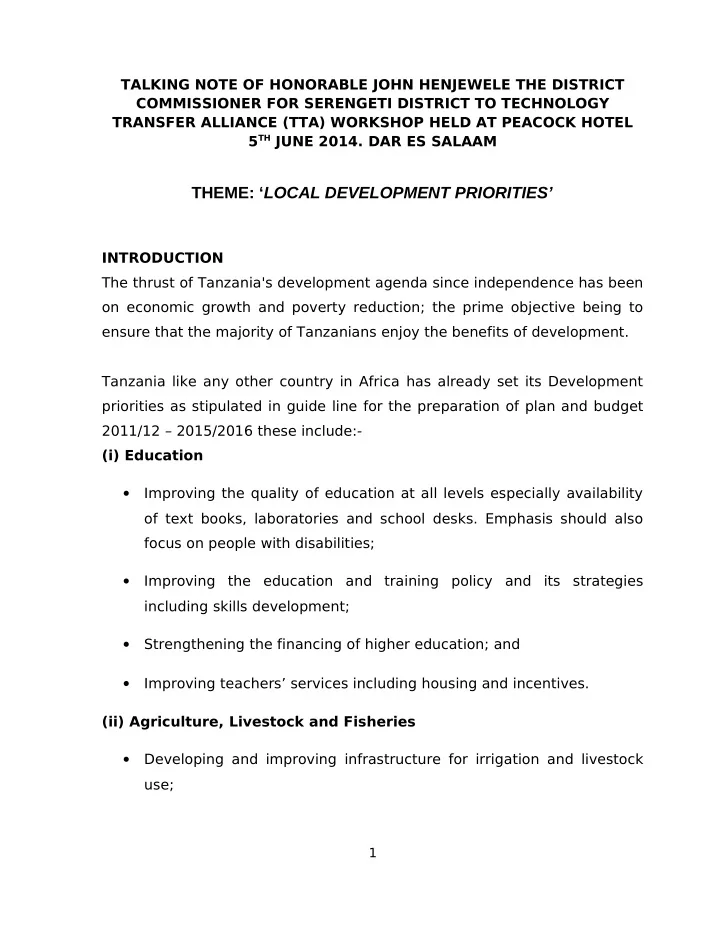
TALKING NOTE OF HONORABLE JOHN HENJEWELE THE DISTRICT COMMISSIONER FOR SERENGETI DISTRICT TO TECHNOLOGY TRANSFER ALLIANCE (TTA) WORKSHOP HELD AT PEACOCK HOTEL 5TH JUNE 2014. DAR ES SALAAM

THEME: ‘LOCAL DEVELOPMENT PRIORITIES’

INTRODUCTION The thrust of Tanzania's development agenda since independence has been

  • n economic growth and poverty reduction; the prime objective being to

ensure that the majority of Tanzanians enjoy the benefits of development. Tanzania like any other country in Africa has already set its Development priorities as stipulated in guide line for the preparation of plan and budget 2011/12 – 2015/2016 these include:- (i) Education

  • Improving the quality of education at all levels especially availability
  • f text books, laboratories and school desks. Emphasis should also

focus on people with disabilities;

  • Improving the education and training policy and its strategies

including skills development;

  • Strengthening the financing of higher education; and
  • Improving teachers’ services including housing and incentives.

(ii) Agriculture, Livestock and Fisheries

  • Developing and improving infrastructure for irrigation and livestock

use;

1

slide-2
SLIDE 2
  • Increasing availability and utilization of inputs and implements for

agriculture, livestock and fisheries;

  • Strengthening research and extension services;
  • Empowering the private sector to invest in agriculture, livestock and

fishing; and

  • Improving market access and agro-processing.

(iii) Energy

  • Increasing level of production of electricity by using different sources
  • f power;
  • Strengthening and expanding infrastructure for generation,

transmission and distribution of electricity in the country;

  • Continue with studies and exploration of natural gas and oil; and
  • Expanding natural gas infrastructures.

(iv) Transport and Infrastructure Development

  • Construction and rehabilitation of roads, bridges and ferries;
  • Establishment of Road Development Fund and expanding revenue

base for the Road Maintenance Fund;

  • Construction and rehabilitation of Government buildings and houses,

including development of newly established administrative areas (Regions, Districts and LGAs) such as administration blocks, staff houses, police posts, prisons, courts and hospitals;

  • Construction and rehabilitation of the railways to meet international

standard;

2

slide-3
SLIDE 3
  • Improving air transport services including rehabilitation and

construction of airports; and

  • Construction and rehabilitation of ports and ship assembling.

(v) Health

  • Enhancing quality of curative, preventive and rehabilitative services

at all levels;

  • Construction and rehabilitation of health facilities at all levels;
  • Improving housing and incentives for public health workers; and
  • Training and recruiting new medical doctors, nurses and paramedical

graduates. (vi) Water

  • Implementing Rural Water Supply and Sanitation Programme;
  • Implementing a special program for improving water supply and

sewerage services in Dar es Salaam City;

  • Continue to implement ongoing water projects and facilitate Urban

Water Authorities to control water leakages and rehabilitate water supply infrastructure.

  • Extending the implementation of Lake Victoria - Shinyanga – Kahama

Water Project to neighboring districts of Nzega, Igunga and Tabora including villages and townships along the project. (vii) Lands, Housing and Settlements

  • Establishing the National satellite direct receiving station to facilitate

land use planning;

3

slide-4
SLIDE 4
  • Strengthening and expanding ICT infrastructure for land information

system to facilitate provision of efficient land services including address and postcode system;

  • Establishment of Mortgage Financing Fund; and
  • To facilitate land surveying, mapping and issuance of title deeds; and
  • Establishment of institution responsible for management of land

bank. (viii) Science and Technology

  • Improving ICT infrastructure and services including completion of the

construction, and create awareness on the use of the national backbone (optical fibre);

  • Strengthening Science, technology and innovation institutional

infrastructure including technical institutions, Science parks and incubators; and

  • Enhancing Research and Development (R&D) and commercialization
  • f research results.

(ix) Financial Services

  • Reviewing the micro finance policy and improving provision of credits;
  • Conducting public Education Programs for Financial Markets and

promote citizens’ participation in Dar es salaam Stock Exchange;

  • Improving the management of social security funds with emphasis in

efficient, profitable and risk free investments; and

  • Developing and implementing a comprehensive PFMRP IV Medium

Term Strategic Plan;

4

slide-5
SLIDE 5
  • Conducting public Education Programs on financial services and

entrepreneurship;

  • Establishing regulatory office for micro finance institutions.

(x) Cross Cutting Issues

  • Improving environmental conservation including legislative

enforcement, public education, and sustainable management of natural resources;

  • Enhancing good governance including rule of law, combating

corruption and improving transparence and accountability at all levels;

  • Promote gender interventions through implementation of gender

policy and elimination of harmful traditional practices and violence against women and vulnerable groups;

  • Establishment of HIV/AIDS Control Fund and improving interventions

at all levels in line with the National HIV and AIDS Multi-Sectoral Strategic Framework; and

  • Strengthening the existing economic empowerment initiatives.

LOCAL DEVELOPMENT PRIORITIES SETTING AT GRASSROOT (case of Serengeti) Aim of the local government reform process in Tanzania is to ensure that citizens at the grassroots level are involved in the planning and implementation of development programmes in their local areas. Through participatory planning and budgeting, the reforms envisage that

5

slide-6
SLIDE 6

development programmes will be relevant to local needs and engender a sense of ownership to facilitate implementation. Propelled by the decentralization of responsibility and financial resources for delivering public services from central government to local government authorities (LGAs), Article 146 (1) of the constitution defines the purpose of having local government authorities as “the transfer of authority to the people”. According to the article “Local government authorities shall have the right and power to participate, and to involve the people, in the planning and implementation of development programmes within their respective areas and generally throughout the country”. Article 146 (2) of the constitution provides: “Without prejudice to the generality of sub article (1) of this Article, a local government authority, in conformity with the provisions of the law establishing it, shall have the following functions: (a) To perform the functions of local government within its area; (b) To ensure the enforcement of law and public safety of the people; and

(c) To consolidate democracy within its area and to apply it to accelerate the development of the people.”

Serengeti is one among of rural district in Tanzania where Over 90% of its population lives in rural areas whereby their livelihood mostly depends on agriculture and livestock activities. Development Priority setting builds on the foundation created by the situational analysis that involved community stakeholders and is "owned" by the community serves as a basis for making decisions on priorities. Priorities are established with an understanding of the resources that are available to help achieve the required outcomes and impact. Resources

6

slide-7
SLIDE 7

may be local, statewide, national or even international. The availability of resources or lack of resources may be a major factor in selecting type of

  • priority. In order to make resources available are equitably shared within

the community every member of the community has an equal chance to be involved in planning process.

Serengeti district uses the Opportunities and Obstacles to Development

(O&OD) planning approach that was initiated in 2002. This methodology was expected to promote transparency and accountability in community development through the introduction of participatory processes to identify priorities of community needs. By the use of this approach the district comes up with following development priorities:- (i) Education. Serengeti has not been doing well; as naturally people of Serengeti are agro-pastoralists this type livelihood played a big role of preventing children joining school. By now there are 106 primary schools and 24 secondary schools. Despite the effort done still this sector is facing the shortage of 176 teachers, class rooms pupil ratio 1:60 instead 1:45, teacher house ratio 1:3 instead of 1:1, book pupil ratio 1:3 instead of 1:1. On secondary schools there are only 1 public secondary school that offers ordinary and advanced level. Only 2 secondary schools are connected to power grid. The rest will be connected with power grid through Rural Energy Agency. The major intervention that could minimize challenges is the use of

  • ICT. May I take this opportunity to commend DIT, COSTECH

and KTH Sweden for their effort made through ICT4RD, whereby more than 100 students were made able to use 5 computers to exchange learning questions and materials that were up loaded in main saver. These students were from Kambarage, Mugumu and Serengeti Secondary

7

slide-8
SLIDE 8

schools) tend together in Serengeti Council resource centre. (ii) Agriculture and livestock development The majority of the poor people lives in rural areas and depends on agriculture for their livelihood. In this regard, agricultural development has the potential to impact on extreme poverty and hunger, which affects most rural population. Serengeti is potential as the soil is so fertile so much that supports various varieties of food crops (Cassava, sweet potatoes, Maize, Sorghum, finger millet and beans), cash crops ( tobacco, sunflower and cotton) But there has been an increase in food insecurity in the district due to factors such as the Collapse of some of the institutions which used to provide services in rural areas leaving farmers with no guaranteed access to markets and credit. Though the Food Reserve Agency is present in the crop marketing, the impact is minimal because of inadequate financial resources. Access to key services such as credit, marketing and information has been problematic especially to small-scale farmers in outlying

  • areas. Some of the services such as veterinary services that

previously used to be offered to farmers have now to be costly and

inadequately available.

Again there is a need of appropriate technology transfer in terms

  • f mechanization, agricultural inputs and market information

network through ICT; these can improve agriculture status and productivity in the district. (iii) Health Services There are 51 health facilities in the district that comprised by 1 District Designated Hospital, 7 health centers and 43 dispensaries. There is shortage of health staff by 43.1%, 2 ambulances are used

8

slide-9
SLIDE 9

transport patients to the referral health service level. With this effort, health status of Serengeti district is improving as compared to national records. Example; Infant Mortality rate for Serengeti is 30/1000 while national wise is 51/1000, Maternal Mortality rate is 174/100000 while National is 454/100000, Under five mortality for Serengeti is 35/1000 but national records stands at 81/1000, Doctor population ratio is 1:6,469 but it suppose to be 1:30. Health facility within radius of 5km is 75%. The major challenge here is poor road network as there are no tarmac road so for emergency cases like maternal mothers do face transport challenges when they are ought to be attended to the District hospital. Quick and easy solution to these problems is using telemedicine technology, where one doctor can attend many patients by leading health facility in charge the best alternative of rescuing many lives

  • f those who can not reach him/her in time.

A gain I can not go without commending ICT4RD for the program started in 2011 where Natta health center was able to communicate with Nyerere Hospital by using a simple camera (Serengeti) (iv) Good governance Good governance is another important aspect of development priority in Serengeti district, good government consist of accountability, transparence and transparence. As I said earlier Serengeti is sparsely populated therefore communication network village level to district headquarter may not be simple, likewise from district to village needs a lot of resources. In general there is gap of communication. ICT4RD created a repository system that could help Natta Ward Executive Officer to submit monthly report to District Planning Officer electronically. Either DC or DED to address

9

slide-10
SLIDE 10

rural meetings through VoP phones. In fact we are in need

  • f technology than it was before.

These are four among many local development priorities set in Serengeti district, they stand as road map with mile stone to development of people

  • f Serengeti.

This bottom–up planning systems enables every mature member of the community to directly involved in the process and finally all identified development priorities are officially indorsed by village council committee and then village assembly Since we have introduced this approach communities has benefited as:

  • Communities can manage the participatory planning process because

it uses participatory tools that are easy to follow. It therefore, fosters community’’s ownership.

  • It promotes transparency and accountability to community

development activities.

  • It removes dependency and strengthens self--reliance.
  • It motivates communities to own the outcomes of their decisions
  • It commits both the central and local governments to be accountable

to the people

  • It provides a foundation for community initiatives in their efforts to

reduce poverty.

  • It enhances the ability of the Local Government Authorities to

coordinate development partners programmes Conclusion As we come to conclusion, we still know that despite the good intentions of O&OD, there are gaps to be bridged. Media for fast tracking technology transfer is of paramount. Local development priorities can be fairly made but quick implementation can be hindered due to lack or poor technologies

10

slide-11
SLIDE 11

in place. However, it is good news that in next financial year 62 villages which include schools, health facilities and village/ward offices will be connected with electricity through Rural Energy Agency, this project will

  • vercome the challenge of lack of electricity in rural villages in Serengeti

District. I appeal to this important workshop as you discuss and plan for technology transfer think on how to boost Information communication technologies in rural areas, especially strengthening ICT4RD project launched in Serengeti and Bunda District. Thank you for your attention!

11