The Texas Experience I mplementing Electricity Customer Choice I n - - PDF document

the texas experience
SMART_READER_LITE
LIVE PREVIEW

The Texas Experience I mplementing Electricity Customer Choice I n - - PDF document

5/9/2017 The Texas Experience I mplementing Electricity Customer Choice I n Nevada May 10, 2017 Pat Wood III Principal, Wood3 Resources Former Chairman, PUC Texas & FERC The Utility Business Todays Competitive Transmission &


slide-1
SLIDE 1

5/9/2017 1

I mplementing Electricity Customer Choice I n Nevada

May 10, 2017

Pat Wood III

Principal, Wood3 Resources Former Chairman, PUC Texas & FERC

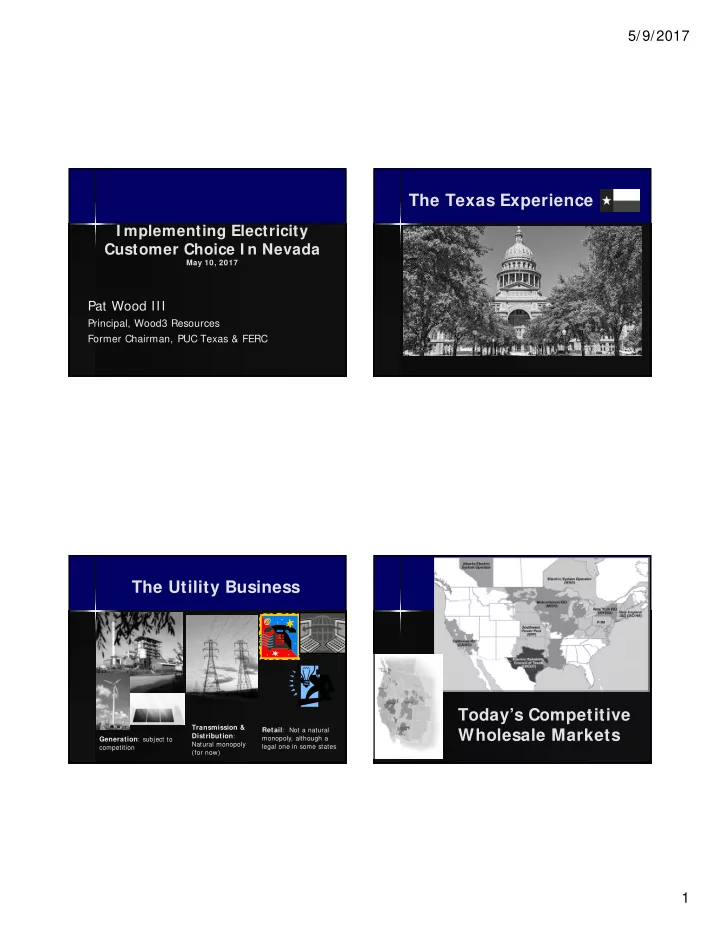
The Texas Experience The Utility Business

Generation: subject to competition Retail: Not a natural monopoly, although a legal one in some states Transmission & Distribution: Natural monopoly (for now)

Today’s Competitive Wholesale Markets

slide-2
SLIDE 2

5/9/2017 2

Precursors to Competitive Texas Market

 1995: Wholesale competition bill

– Non utilities allowed to generate/sell

 1996: ERCOT was nation’s first

independent system operator

– Open access across grid

 No more regulated generation  Rates held up to pay down generation

in advance of retail competition

Key Features of Texas SB 7 (1999)

 All IOU customer classes open to

competitive choice: 1/1/2002 (30 mos)

 Competitive businesses/costs unbundled  Stranded generation cost calculation  Market based renewable portfolio std  System benefit wires charge (low

income, efficiency, customer education)

 Coops, munis not opened up, opt-in

Cost Unbundling

7

Key Texas SB7 Aspects

 Customers start with affiliated retailer.

Initial rates capped for 5 years (Price To Beat). No discounting permitted.

 Price Cap could rise if natgas costs did  Headroom for competition: key goal  Uniform terms/cond’ns wires co. tariffs  ISO: switching/billing clearinghouse

slide-3
SLIDE 3

5/9/2017 3

Other Key SB7 Features

 Power To Choose website; Facts Label  PUC led Education Campaign  Property Tax and Union provisions  Provider of Last Resort bid out  Retailer certification

First Five Years

 PTB price changes due to higher gas

cost created headroom

 Customer switching became very

robust after 2005 Hurricane season

 Stranded costs calculated, securitized  State budget cuts Low Inc/education $  Retailer bankruptcies; customers

moved to Provider of Last Resort

Second Five Years

 Full freedom for affiliated retailers  Feb ‘08 power outage: forecasting  Energy market price cap moved up  June 2008 Natgas price shock  Smart meters installed statewide  First statewide transmission planning

process begun under CREZ

 Huge influx of wind energy investment

Last Five Years

 CREZ $7b transmission built  Energy Futures (TXU) bankruptcy  Capacity Market debate  Wind hits 18 GW; Solar market entry  Abundant retailer offerings

slide-4
SLIDE 4

5/9/2017 4

Results: Retail Prices

AEPC 5.6 Infuse Energy 9.6

  • 42%

12.77 ‐57% AEPN 5.0 Frontier Utilities 10.0

  • 50%

13.20 ‐63% CenterPoint 5.2 Summer Energy 10.4

  • 50%

13.7 ‐63% Oncor 4.5 Summer Energy 9.7

  • 54%

12.8 ‐66% TNMP 5.0 Frontier Utilities 10.6

  • 53%

14.0 ‐65%

13

As of 10/13/16 for 1000 kWh, 12 mo fixed residential rate product; courtesy PUCT Chmn. Donna Nelson

Results: Wholesale Prices

ERCOT IMM Report, 12/13/2016

Why Do This?

 Better Customer Price & Service  Economic Development  Technology Innovation

Why Do This Here?

 NV already has smart meters: enables

clean energy deployment, empowers customers to embrace energy efficiency & load shifting

 Great location in Western Grid = Gen

Hub

 Size doesn’t matter

– Successful retail choice in Rhode Island, Delaware, D.C.

16
slide-5
SLIDE 5

5/9/2017 5

Basics for a Nevada Market

– Stakeholder involvement w decisionmakers’ oversight – Wholesale market foundation (or equivalent independent market facilitator) – Transition period – Separate regulated wires business from competitive businesses – Unbundle rates, modernize wires tariffs – Stranded cost recovery – Default service (Texas model vs. other states) – Customer education campaign

17

Who Would/ Could Do What?

FUNCTI ON WHO HANDLES or DECI DES? Generation Siting PUCN or purely local Distributed Generation Competitive providers, distr utility Gen Dispatch/Financial Settlements FERC via RTO/ISO/wholesale mkt Wholesale Power Market Oversight FERC Transmission Siting PUCN (also regional plan process) Transmission Rates FERC Distribution Siting & Rates PUCN Retail Service Provider Certification PUCN Retail Rates/Service Offerings Competitive Retailer Retail Power Market Oversight PUCN Renewable, Efficiency, Low Income PUCN (or other state agency) Customer Education PUCN, Competitive Retailers

What To Worry About

 Inadequate customer education  Timing of generation investment  Coordination with neighboring states  Inadequate prep for disruptive

technology

 Political interference

slide-6
SLIDE 6

5/9/2017 6

Robust I nfrastructure Reliability Regions

are separate entities