The Seven Turrets of Babel: Parser anti-patterns & how to - - PowerPoint PPT Presentation

the seven turrets of babel parser anti patterns how to
SMART_READER_LITE
LIVE PREVIEW

The Seven Turrets of Babel: Parser anti-patterns & how to - - PowerPoint PPT Presentation

The Seven Turrets of Babel: Parser anti-patterns & how to expunge them Sergey Bratus with Falcon Momot Sven Hallberg Meredith L. Patterson Economics Pen test, code audit "2+2" : 2 persons, 2 weeks Attackers have

slide-1
SLIDE 1

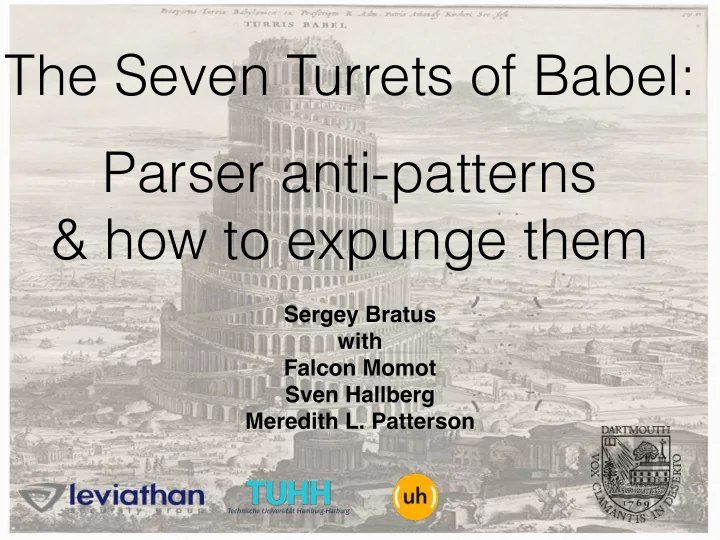
The Seven Turrets of Babel: Parser anti-patterns 
 & how to expunge them

Sergey Bratus with Falcon Momot Sven Hallberg Meredith L. Patterson

slide-2
SLIDE 2

Economics

  • Pen test, code audit "2+2": 2 persons, 2 weeks
  • Attackers have "infinite" time to find just 1 vuln
  • Proofs of exploitability take weeks, even when

weakness is evident

  • Confirming departures from safe design

practices is more helpful than proof of exploitability

slide-3
SLIDE 3

A set of CWEs to say:


  • this parser is trouble
  • this data format is trouble
  • this protocol spec is trouble

"A bad feeling is not a finding"

slide-4
SLIDE 4

A bad feeling is not a finding

slide-5
SLIDE 5

Our program

  • Give the "bad feeling" a solid theory
  • Why parsers/protocols that look like trouble are trouble
  • Enhance CWE-398 "Indicator of poor code quality"
  • Give auditors a weapon against anti-patterns in parser

code / data format design:

  • Enable LangSec CWE findings, with a taxonomy
  • Show actual mechanisms behind CWE-20 "Improper

input validation" etc.

slide-6
SLIDE 6

2009$CWE/SANS$Top$25$ 2010$CWE/SANS$Top$25$ 2011$CWE/SANS$Top$25$ (and$s6ll$current)$

Existing CWEs: 20, 78, 79, 89, ...

slide-7
SLIDE 7

What's wrong with existing CWEs?

  • "Improper input neutralization" in shell command,

SQL, and web contexts (CWE-{78,79,89})

  • Mechanism, not root cause
  • Wrong level of abstraction. Consequence of bad

design, not description of one.

  • Almost the proof of the vuln (expensive to find)
slide-8
SLIDE 8

What is input validation and what good is it?

  • Everyone is telling everyone else to "validate inputs

for security". But what does it mean?

  • Implication: "valid" == "safe".
  • Not all ideas of "valid" are helpful: compiling &

running valid C on your system is not safe!

  • "Safe" means predictably not causing unexpected
  • perations
slide-9
SLIDE 9

Security: "valid" must mean predictable, or it's useless

  • Being valid should be a judgment about behavior
  • f inputs on the rest of the program
  • Note: CWE's "neutralization" implies input is


active, must be made "inert" to be safe

  • "Every input is a program". Judging programs is

very hard, unless they are very simple.

slide-10
SLIDE 10

(Valid => predictable) || useless

  • Make the judgment as simple as possible
  • i.e., checkable by code that can't run away &

can be verified

  • In general, "non-trivial" properties of Turing-

complete programs can't be verified

  • but programs for simpler automata can be

automatically verified

slide-11
SLIDE 11

"Data format is code's destiny" "Everything is an interpreter (=parser)" "Every sufficiently complex input processor 
 is indistinguishable from a VM 
 running inputs as bytecode"

Data 
 format Parser
 Structure

"trouble"/
 weakness

slide-12
SLIDE 12

What is "trouble"?

P { Q } R ⊇ P' { Q' } R' ⊇ P'' { Q'' } R'' ⊇ ...

Your program is a CPU/VM for adversary-controlled inputs You must prevent run-away computation (a.k.a. exploit) You must formulate & verify assumptions Even strict C.A.R. Hoare-style verification is brittle if any 
 assumptions are violated

slide-13
SLIDE 13

"Babel", a CWE

"Failure to communicate assumptions to interacting modules" P {M1 } R P' {M2} R' P'' {M3} R'' P''' {M4} R'''

slide-14
SLIDE 14

"Computation is not stable w.r.t. proofs"

Is the P { Q } R chain like this:

  • r like this?
slide-15
SLIDE 15

Recognizer Pattern to combat brittleness

Input&

Processing:&&

  • nly&well3typed&
  • bjects,&

no&raw&inputs&& &

Recognizer& for&input& language& Language grammar& Spec& Reject&& invalid& inputs& Only&valid/expected&inputs,& semanCc&acCons&past&this&line&

slide-16
SLIDE 16

Anti-patterns

  • 1. Shotgun parsing
  • 2. Input language > DCF
  • 3. Non-minimalistic input-

handing

  • 4. Parser differentials
  • 5. Incomplete specification
  • 6. Overloaded fields
  • 7. Permissive processing of

invalid input

Christopher Ulrich, "Alchemy"

slide-17
SLIDE 17
  • 1. "Shotgun parser"
  • Parsing and input-validating code is mixed with

and spread across processing code

  • Input checks are scattered throughout the program
  • No clear boundary after which the input can be

considered fully checked & safe to operate on

  • It's unclear from code which properties are being

checked & which have been checked

slide-18
SLIDE 18

Heartbleed is a "shotgun parser"
 bug

SSL3_RECORD

HeartbeatMessage

hbtype payload

slide-19
SLIDE 19

Where OpenSSL's parser went wrong

slide-20
SLIDE 20

Premature processing of unvalidated input

slide-21
SLIDE 21
  • 2. Input languages more

powerful than DCF

  • "Validating input" is judging what effect it will have on code
  • "Is it safe to process?" == "Will it cause unexpected

computation on my program?"

  • Make the judgment as simple as possible: 


"regular or context-free, syntactically valid == safe"

  • Comp. power of recognizer rises with language's syntactic

complexity (Chomsky hierarchy)

  • Rice's theorem, halting problem: you can't judge effects of

Turing-complete inputs. Don't even try!

slide-22
SLIDE 22

Ethereum DAO disaster

"To find out 
 what it does,
 you need 
 to run it"

Recursion is trouble

slide-23
SLIDE 23
  • 3. Non-minimalistic input handling
  • Input-handling code should do nothing more than

consume input, validate it (correctly) & deserialize it

  • Use the exact complexity needed to validate &

create well-typed objects

  • Reflection, evaluation, etc. don't belong in input-

handling code (even if "sanitized")

  • Any extra computational power exposed is privilege

given away to attacker

slide-24
SLIDE 24

CVE-2015-1427

"Sanitized" Groovy scripts in inputs + 
 JVM Reflection = Pwnage

slide-25
SLIDE 25

"Ruby off Rails"

  • "Why parse if we can eval(user_input)?"
  • Oh so many. Joernchen of Phenoelit Phrack 69:12,

Egor Homakov ("Don't let YAML.load close to any user input"), ...

  • CVE-2016-6317, "Mitigate by casting the

parameter to a string before passing it to Active Record"

slide-26
SLIDE 26

"Shellshock" CVE-2014-6271
 parse_and_execute(CGI_input)

CVE-2014-6271, CVE-2014-6277, CVE-2014-6278, CVE-2014-7169, CVE-2014-7186, CVE-2014-7187

slide-27
SLIDE 27

Recognizer must be equal in power to input language

http://stackoverflow.com/questions/1732348/regex-match-open-tags-except-xhtml-self- contained-tags

slide-28
SLIDE 28
  • 4. Parser differentials
  • Parsers in a distributed system disagree about what a

message is

  • X.509 /ASN.1 "PKI Layer cake":


CA sees (and signs) a different CN in CSR than client in the signed cert

  • Android Master Key bugs: Java package verifier sees

different package structure than C++ installer (~signed vs unsigned ints in zipped stream)

  • Also, an instance of overly complex input format 


(must deal with complexity of unzip before validating!)

slide-29
SLIDE 29
  • 5. Incomplete specification
  • Leads to parser differentials (X.509 redux)
  • Without clear assumptions, the C.A.R. Hoare's 


P {Q} R chain of assumptions & checks breaks

  • What is "valid" input? What's to be rejected?
  • Doomed if more than one module (or programmer)


is involved

  • Cf.: OpenSSL CVE-2016-0703, LibNSS CVE-2009-2404, ...
slide-30
SLIDE 30
  • 6. Overloaded fields
  • Magic values cannot be consistently validated


  • What language grammar includes them? 

  • What type system captures them?
  • E.g.: CVE-2015-7871: NTP's crypto key field

  • verloaded to mean "auth not required"
slide-31
SLIDE 31
  • 7. Permissive processing of

invalid inputs

  • Reject, don't "fix" invalid input. You cannot guarantee its

computational behavior on your system.

  • famous example: IE8 anti-XSS created XSS vulns
  • PDF rewriting by Acrobat makes it hard to judge PDFs
  • Your program's attempts to "fix" invalid input will 


become a part of the attacker's exploit machine

  • Postel's Robustness principle is trouble!
  • Rewriting is a powerful computation model! 


Don't give the attacker any of it.

slide-32
SLIDE 32

CWEs

  • 1. Shotgun parsing
  • 2. Input language > DCF
  • 3. Non-minimalistic input-

handing

  • 4. Parser differentials
  • 5. Incomplete specification
  • 6. Overloaded fields
  • 7. Permissive processing of

invalid input

Christopher Ulrich, "Alchemy"

slide-33
SLIDE 33

See paper for more :)

"The Seven Turrets of Babel: A Taxonomy of 
 LangSec Errors and How to Expunge Them", 


Falcon Darkstar Momot, Sergey Bratus, Sven M. Hallberg, Meredith L. Patterson, 
 in IEEE SecDev 2016, Nov. 2016, Boston

http://langsec.org/papers/langsec-cwes- secdev2016.pdf

slide-34
SLIDE 34

Part of a the solution: Recognizer Pattern

Input&

Processing:&&

  • nly&well3typed&
  • bjects,&

no&raw&inputs&& &

Recognizer& for&input& language& Language grammar& Spec& Reject&& invalid& inputs& Only&valid/expected&inputs,& semanCc&acCons&past&this&line&

slide-35
SLIDE 35

Thank you!

4th IEEE Security & Privacy LangSec Workshop
 
 May 25, 2017
 San Jose, CA http://spw17.langsec.org http://langsec.org Join us for