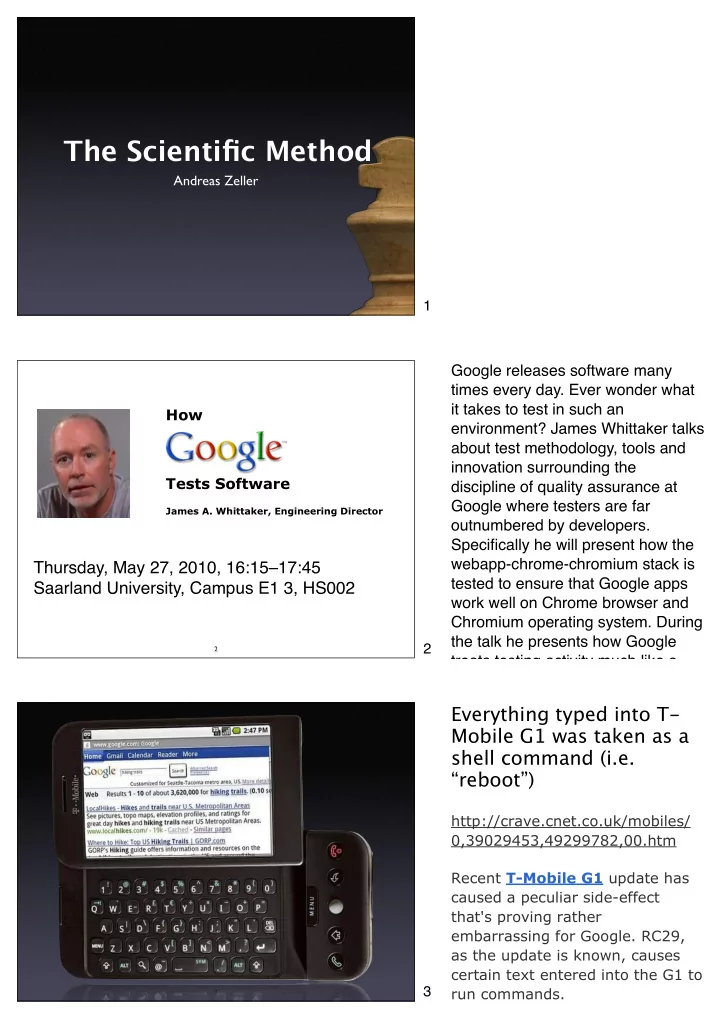
The Scientific Method Andreas Zeller 1 Google releases software - - PDF document

the scientific method
SMART_READER_LITE
LIVE PREVIEW

The Scientific Method Andreas Zeller 1 Google releases software - - PDF document

The Scientific Method Andreas Zeller 1 Google releases software many times every day. Ever wonder what it takes to test in such an How environment? James Whittaker talks about test methodology, tools and innovation surrounding the Tests


slide-1
SLIDE 1

Andreas Zeller

The Scientific Method

2

How

Thursday, May 27, 2010, 16:15–17:45 Saarland University, Campus E1 3, HS002

James A. Whittaker, Engineering Director

Tests Software

3

1

Google releases software many times every day. Ever wonder what it takes to test in such an environment? James Whittaker talks about test methodology, tools and innovation surrounding the discipline of quality assurance at Google where testers are far

  • utnumbered by developers.

Specifically he will present how the webapp-chrome-chromium stack is tested to ensure that Google apps work well on Chrome browser and Chromium operating system. During the talk he presents how Google treats testing activity much like a

2

Everything typed into T- Mobile G1 was taken as a shell command (i.e. “reboot”)

http://crave.cnet.co.uk/mobiles/ 0,39029453,49299782,00.htm Recent T-Mobile G1 update has caused a peculiar side-effect that's proving rather embarrassing for Google. RC29, as the update is known, causes certain text entered into the G1 to run commands. 3

slide-2
SLIDE 2

4

A Sample Program

sample 9 8 7 $ Output: 7 8 9 sample 11 14 $ Output: 0 11 Where’s the error that causes this failure?

5

int main(int argc, char *argv[]) { int *a; int i; a = (int *)malloc((argc - 1) * sizeof(int)); for (i = 0; i < argc - 1; i++) a[i] = atoi(argv[i + 1]); shell_sort(a, argc); printf("Output: "); for (i = 0; i < argc - 1; i++) printf("%d ", a[i]); printf("\n"); free(a); return 0; }

6

static void shell_sort(int a[], int size) { int i, j; int h = 1; do { h = h * 3 + 1; } while (h <= size); do { h /= 3; for (i = h; i < size; i++) { int v = a[i]; for (j = i; j >= h && a[j - h] > v; j -= h) a[j] = a[j - h]; if (i != j) a[j] = v; } } while (h != 1); }

4 5 6

slide-3
SLIDE 3

7

Errors

What’s the error in the sample program?

  • An error is a deviation from what’s

correct, right, or true. (IEEE glossary) To prove that something is an error, we must show the deviation:

  • Simple for failures, hard for the program

Where does sample.c deviate from – what?

8

Causes and Efgects

What’s the cause of the sample failure?

  • The cause of any event (“effect”) is a

preceding event without which the effect would not have occurred. To prove causality, one must show that

  • the effect occurs when the cause occurs
  • the effect does not occur when the cause

does not.

9

Establishing Causality

In natural and social sciences, causality is

  • ften hard to establish.
  • Did drugs cause the death of Elvis?
  • Does CO₂ production cause global

warming?

  • Did Saddam Hussein cause the war in Iraq?

7 8 9

slide-4
SLIDE 4

10

Repeating History

  • To determine causes formally, we would

have to repeat history – in an alternate world that is as close as possible to ours.

  • Since we cannot repeat history, we have to

speculate what would have happened.

  • Some researchers have suggested to drop

the concept of causality altogether

11

Repeating Runs

In computer science, we are luckier:

  • Program runs can be controlled and

repeated at will

(well, almost: physics can’t be repeated)

  • Abstraction is kept to a minimum – the

program is the real thing.

12

“Here’s the Bug”

  • Some people are good at guessing causes!
  • Unfortunately, intuition is hard to grasp:
  • Requires a priori knowledge
  • Does not work in a systematic and

reproducible fashion

  • In short: Intuition cannot be taught

10 11 12

slide-5
SLIDE 5

13

The Scientific Method

  • The scientific method is a general pattern of

how to find a theory that explains (and predicts) some aspect of the universe

  • Called “scientific method” because it’s

supposed to summarize the way that (experimental) scientists work

14

The Scientific Method

  • 1. Observe some aspect of the universe.
  • 2. Invent a hypothesis that is consistent with

the observation.

  • 3. Use the hypothesis to make predictions.
  • 4. Tests the predictions by experiments or
  • bservations and modify the hypothesis.
  • 5. Repeat 3 and 4 to refine the hypothesis.

15

A Theory

  • When the hypothesis explains all

experiments and observations, the hypothesis becomes a theory.

  • A theory is a hypothesis that
  • explains earlier observations
  • predicts further observations
  • In our context, a theory is called a diagnosis

(Contrast to popular usage, where a theory is a vague guess)

13 14 15

slide-6
SLIDE 6

16

Mastermind

  • A Mastermind game is

a typical example of applying the scientific method.

  • Create hypotheses

until the theory predicts the secret.

Scientific Method

Hypothesis

Problem Report Code Run More Runs

Prediction Experiment

Hypothesis is supported: refine hypothesis Hypothesis is rejected: create new hypothesis

Diagnosis

Observation + Conclusion

18

A Sample Program

sample 9 8 7 $ Output: 7 8 9 sample 11 14 $ Output: 0 11 Let’s use the scientific method to debug this.

16 17 18

slide-7
SLIDE 7

19

Initial Hypothesis

Hypothesis Prediction Experiment Observation Conclusion

“sample 11 14” works. Output is “11 14” Run sample as above. Output is “0 11” Hypothesis is rejected.

20

int main(int argc, char *argv[]) { int *a; int i; a = (int *)malloc((argc - 1) * sizeof(int)); for (i = 0; i < argc - 1; i++) a[i] = atoi(argv[i + 1]); shell_sort(a, argc); printf("Output: "); for (i = 0; i < argc - 1; i++) printf("%d ", a[i]); printf("\n"); free(a); return 0; }

Does a[0] = 0 hold?

21

Hypothesis 1: a[]

Hypothesis Prediction Experiment Observation Conclusion

The execution causes a[0] = 0 At Line 37, a[0] = 0 should hold. Observe a[0] at Line 37. a[0] = 0 holds as predicted. Hypothesis is confirmed. 19 20 21

slide-8
SLIDE 8

22

static void shell_sort(int a[], int size) { int i, j; int h = 1; do { h = h * 3 + 1; } while (h <= size); do { h /= 3; for (i = h; i < size; i++) { int v = a[i]; for (j = i; j >= h && a[j - h] > v; j -= h) a[j] = a[j - h]; if (i != j) a[j] = v; } } while (h != 1); }

Is the state sane here?

23

Hypothesis 2: shell_sort()

Hypothesis Prediction Experiment Observation Conclusion

The infection does not take place until shell_sort. At Line 6, a[] = [11, 14]; size = 2 Observe a[] and size at Line 6. a[] = [11, 14, 0]; size = 3. Hypothesis is rejected.

24

Hypothesis 3: size

Hypothesis Prediction Experiment Observation Conclusion

size = 3 causes the failure. Changing size to 2 should make the output correct. Set size = 2 using a debugger. As predicted. Hypothesis is confirmed. 22 23 24

slide-9
SLIDE 9

25

shell_sort(a, argc); shell_sort(a, argc - 1); shell_sort(a, argc); int main(int argc, char *argv[]) { int *a; int i; a = (int *)malloc((argc - 1) * sizeof(int)); for (i = 0; i < argc - 1; i++) a[i] = atoi(argv[i + 1]); ... }

Fixing the Program

sample 11 14 $ Output: 11 14

26

Hypothesis 4: argc

Hypothesis Prediction Experiment Observation Conclusion

Invocation of shell_sort with size = argc causes the failure. Changing argc to argc - 1 should make the run successful. Change argc to argc - 1 and recompile. As predicted. Hypothesis is confirmed.

27

The Diagnosis

  • Cause is “Invoking shell_sort() with argc”
  • Proven by two experiments:
  • Invoked with argc, the failure occurs;
  • Invoked with argc – 1, it does not.
  • Side-effect: we have a fix

(Note that we don’t have correctness – but take my word)

25 26 27

slide-10
SLIDE 10

28

Explicit Debugging

  • Being explicit is

important to understand the problem.

  • Just stating the problem

can already solve it.

29

Keeping Track

  • In a Mastermind game,

all hypotheses and

  • bservations are

explicit.

  • Makes playing the game

much easier.

30

Implicit Debugging

  • Remember your last debugging session:

Did you write down hypotheses and

  • bservations?
  • Not being explicit forces you to keep all

hypotheses and outcomes in memory

  • Like playing Mastermind in memory

http:// www.varsityclub.harvard.ed u/Logos/teddy.gif

28 29 30

slide-11
SLIDE 11

32

Keep a Notebook

Everything gets written down, formally, so that you know at all times

  • where you are,
  • where you've been,
  • where you're going, and
  • where you want to get.

Otherwise the problems get so complex you get lost in them.

33

What to Keep

Hypothesis Prediction Experiment Observation Conclusion Faced with a difficult task, “sleeping on it” makes students three times more apt to solve the task the next morning.

31 32

@Article{wagner/etal/2004/ nature, author = {Ullrich Wagner and Steffen Gais and Hilde Haider and Rolf Verleger and Jan Born}, title = {Sleep inspires insight}, journal = {Nature}, year = 2004, volume = 427, pages = {325--355} }

33

slide-12
SLIDE 12

34

Quick and Dirty

  • Not every problem needs the strength of

the scientific method or a notebook – a quick-and-dirty process suffices.

  • Suggestion: Go quick and dirty for

10 minutes, and then apply the scientific method.

Algorithmic Debugging

35

Is this correct?

Is this correct?

Is this correct?

Is this correct?

Defect

Algorithmic Debugging

  • 1. Assume an incorrect result R with origins

O1, O2, …, On

  • 2. For each Oi, enquire whether Oi is correct
  • 3. If some Oi is incorrect, continue at Step 1
  • 4. Otherwise (all Oi are correct), we found

the defect

36

34 35 36

slide-13
SLIDE 13

37

def insert(elem, list): if len(list) == 0: return [elem] head = list[0] tail = list[1:] if elem <= head: return list + [elem] return [head] + insert(elem, tail) def sort(list): if len(list) <= 1: return list head = list[0] tail = list[1:] return insert(head, sort(tail))

38

sort([2, 1, 3]) sort([1, 3]) sort([3]) insert(1, [3]) insert(2, [3, 1]) sort([3]) = [3] insert(1, [3]) = [3,1] sort([1, 3]) = [3,1]

insert(2, [3, 1]) = [2, 3,1]

sort([2, 1, 3]) = [2, 3, 1]

Is this correct? Is this correct? Is this correct? Is this correct?

✔ ✘ ✘ ✘

39

insert(1, [3]) insert(1, [3]) = [3,1] ✘

  • insert() produces an incorrect result and

has no further origins:

  • It must be the source of the incorrect value

Defect Location

37 38 39

slide-14
SLIDE 14

40

def insert(elem, list): if len(list) == 0: return [elem] head = list[0] tail = list[1:] if elem <= head: return list + [elem] return [head] + insert(elem, tail) def sort(list): if len(list) <= 1: return list head = list[0] tail = list[1:] return insert(head, sort(tail)) [elem] + list

41

Discussion

✔ Detects defects systematically ✔ Works naturally for logical + functional

computations

✘ Won’t work for large states (and

imperative computations)

✘ Do programmers like being driven?

Oracles

  • In algorithmic debugging, the user acts as an
  • racle – telling correct from false results
  • With an automatic oracle could isolate any

defect automatically.

  • How complex would such an oracle be?

42

40 41 42

slide-15
SLIDE 15

43

Obtaining a Hypothesis

Hypothesis

Problem Report Code Run More Runs Deducing from Observing a Learning from …all in the next weeks! Earlier Hypotheses + Observations

44

Sources of Hypotheses

Deduction Observation Induction Experimentation 0 runs 1 run n runs n controlled runs

45

Concepts

A cause of any event (”effect”) is a preceding event without which the effect would not have occurred. To isolate a failure cause, use the scientific method. Make the problem and its solution explicit.

43 44 45

slide-16
SLIDE 16

46

Concepts

Algorithmic debugging organizes the scientific method by having the user assess outcomes Best suited for functional and logical programs

47 This work is licensed under the Creative Commons Attribution License. To view a copy of this license, visit http://creativecommons.org/licenses/by/1.0

  • r send a letter to Creative Commons, 559 Abbott Way, Stanford, California 94305, USA.

46 47