THE RIGHT BALANCE Is the Expected Family Contribution or EFC - - PDF document

the right balance
SMART_READER_LITE
LIVE PREVIEW

THE RIGHT BALANCE Is the Expected Family Contribution or EFC - - PDF document

AMEDF Scholars Methodology: FINANCIAL COORDINATION THE RIGHT BALANCE Is the Expected Family Contribution or EFC AFFORDABLE ? FINANCIAL COORDINATION Underlying financial logic of the EFC using 2019 20 College Board ratios Integrate


slide-1
SLIDE 1

AMEDF Scholars Methodology: FINANCIAL COORDINATION 1

FINANCIAL COORDINATION 2019‐20

Providing Everything You Need to Better Prepare for College

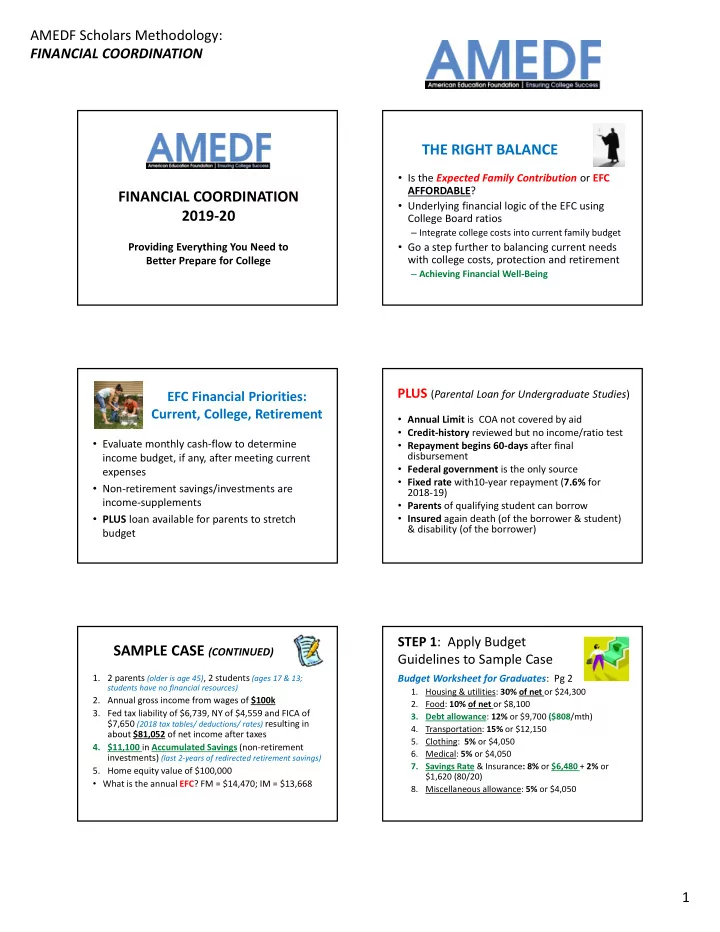
THE RIGHT BALANCE

  • Is the Expected Family Contribution or EFC

AFFORDABLE?

  • Underlying financial logic of the EFC using

College Board ratios

– Integrate college costs into current family budget

  • Go a step further to balancing current needs

with college costs, protection and retirement

– Achieving Financial Well‐Being

EFC Financial Priorities: Current, College, Retirement

  • Evaluate monthly cash‐flow to determine

income budget, if any, after meeting current expenses

  • Non‐retirement savings/investments are

income‐supplements

  • PLUS loan available for parents to stretch

budget

PLUS (Parental Loan for Undergraduate Studies)

  • Annual Limit is COA not covered by aid
  • Credit‐history reviewed but no income/ratio test
  • Repayment begins 60‐days after final

disbursement

  • Federal government is the only source
  • Fixed rate with10‐year repayment (7.6% for

2018‐19)

  • Parents of qualifying student can borrow
  • Insured again death (of the borrower & student)

& disability (of the borrower)

SAMPLE CASE (CONTINUED)

  • 1. 2 parents (older is age 45), 2 students (ages 17 & 13;

students have no financial resources)

  • 2. Annual gross income from wages of $100k
  • 3. Fed tax liability of $6,739, NY of $4,559 and FICA of

$7,650 (2018 tax tables/ deductions/ rates) resulting in about $81,052 of net income after taxes

  • 4. $11,100 in Accumulated Savings (non‐retirement

investments) (last 2‐years of redirected retirement savings)

  • 5. Home equity value of $100,000
  • What is the annual EFC? FM = $14,470; IM = $13,668

STEP 1: Apply Budget Guidelines to Sample Case

Budget Worksheet for Graduates: Pg 2

  • 1. Housing & utilities: 30% of net or $24,300
  • 2. Food: 10% of net or $8,100
  • 3. Debt allowance: 12% or $9,700 ($808/mth)
  • 4. Transportation: 15% or $12,150
  • 5. Clothing: 5% or $4,050
  • 6. Medical: 5% or $4,050
  • 7. Savings Rate & Insurance: 8% or $6,480 + 2% or

$1,620 (80/20)

  • 8. Miscellaneous allowance: 5% or $4,050
slide-2
SLIDE 2

AMEDF Scholars Methodology: FINANCIAL COORDINATION 2

STEP 2: Apply Results to Determine Income Budget for College Costs

  • Total Tax (#3 from slide 5) = $18,948 Total

Expenses (#1 ‐ #8 from slide 6) = $74,500

  • Resulting Income Budget:

$100k ‐ $18,948 ‐ $74,500 = $6,552

(or 8% of net income; the “Student Loan” budget item from Budget Worksheet for Graduates)

STEP 3: Determine EFC Affordability

  • 1. Income Budget: $6,552
  • 2. Redirect Savings Rate: $6,480
  • 3. EFC Shortfall: $14,470 ‐ $6,552 ‐ $6,480 =

$1,438

  • 4. From Accumulated Savings Each Year: $1,438
  • n $11,100 of non‐retirement savings (covers

more than 7 years of EFC shortfall)

  • 5. Can afford EFC of $14,470 without PLUS

OTHER OPTIONS/SCENARIOS

Carrying credit card or other high‐interest debt?

  • Consider using a “Debt Swap” to reduce interest

rate and monthly payments even if PLUS not needed

– Sample case: monthly debt allowance (#3 on Cash‐ Flow Worksheet) of $808/mth or $9,700/yr used to pay credit card payments (at 17.24% interest  $34,000 in credit card debt using 2% minimum payment and 14‐year payoff) – $808/mth is the payment for $66,000 in PLUS at 8% interest

OTHER OPTIONS/SCENARIOS

What if there is no income budget or accumulated savings?

  • Possible Solution:

– Redirect Savings Rate (8% of net income) as budget: Sample Case = $6,480 or $540/mth – Leverage budget with PLUS: $540/mth at 8% interest (2018‐19 rate for PLUS is 7.6%) = $44,507 total PLUS loan – $44,507  $11,000/year college cost budget

KEYS TO AFFORDING EFC

  • 1. Already saving a portion of income: Savings

Rate, (also for retirement) and/or

  • 2. Have an Income Budget after subtracting

taxes and expenses, and/or

  • 3. Have Accumulated Savings as income

supplement for college expenses

  • 4. With PLUS to stretch budget

FINANCIAL WELL‐BEING: Retirement

  • Retirement projection using EFC logic:

– Savings rate: 8% of net income in sample case – Equivalent starting salaries with 3% COLA each year starting at age 22 – Retire at age 67 and death at age 87 (20‐years in retirement) – 6% preretirement return/4% after retirement return – Does not take into account interruption during college years  33% of pre‐retirement income/year from savings

SOURCE: Clear Focus Financial “How Much will Your Retirement Cost” calculator

slide-3
SLIDE 3

AMEDF Scholars Methodology: FINANCIAL COORDINATION 3

FINANCIAL WELL‐BEING: Protection

  • Protect income with Insurance

– Review life and disability insurance coverage – PLUS is insured against death and disability of borrower and death of the student – Student Loan is insured against death and disability of borrower

LAST DITCH OPTIONS?

ALL students can attend public college with a little help from parents! ECC $6,800, SUNY Bflo State $12k and SUNY UB $14k as a commuter

  • ALL INCOMES: Student loan, work full time during

summers and part‐time during school year= $5,500 + $1,200 + $2,560 = $9,260

  • Under $125k: Excelsior, student loan, and/or work

= $6,870 (UB) + $5,500 = $12,370 + work

NY EXCELSIOR SCHOLARSHIP

  • Tuition‐free for NY public 2& 4‐yr colleges
  • 2019‐20 and beyond up to $125k in 2017 AGI using

prior prior year

  • Integrates with TAP and Pell
  • 30 credits/yr; passing GPA; on‐time completion and

residency/work post‐graduation in NY required

  • HESC.NY.Gov

COLLEEGE BOARD TOOLS

  • “Cash‐Flow Worksheet for Parent Borrowers”

to categorize expenses, determine college budget and estimating PLUS payments

  • “Budget Worksheet for Graduates” for

financial ratios (pg. 2)

  • “Debt Planning Worksheet” to determine debt
  • ptions other than PLUS
  • “Financial Planning Tips” on savings and

budgeting

WRAP UP

  • Perform financial exercises

1. EFC Formula results 2. Cash‐Flow Worksheet for Parent Borrowers 3. Step by Step to establish college budget 4. Estimate retirement and protection needs

  • Schedule counseling session to review progress and/or

preliminary results

– Professional help available: Use AMEDF subsidized counseling certificates! – 70% ‐ 100% subsidized – Received at Session 2 conference – Up to 8 in 24‐month period – Use evaluation to request certificates

Help Us Help You

  • Evaluation‐ Please turn in!
  • Get the word out (www.AMEDF.org)
  • Register and designate AMEDF to benefit from

use of Goodsearch.com and Goodshop.com

  • Participate in additional counseling and at‐home

exercises (CB Big Future, CB worksheets)

  • Make a donation
  • Take action!