The Mythology of Big Data OReilly Strata Conference February 2, - - PowerPoint PPT Presentation

the mythology of big data
SMART_READER_LITE
LIVE PREVIEW

The Mythology of Big Data OReilly Strata Conference February 2, - - PowerPoint PPT Presentation

The Mythology of Big Data OReilly Strata Conference February 2, 2011 Mark R. Madsen http://ThirdNature.net @markmadsen Everytechnologycarries withinitselftheseeds ofitsowndestruc5on.


slide-1
SLIDE 1

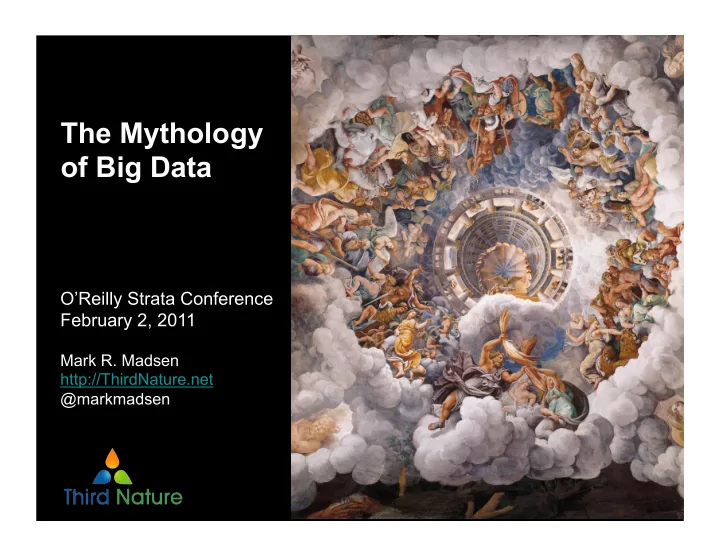
The Mythology

  • f Big Data

O’Reilly Strata Conference February 2, 2011

Mark R. Madsen http://ThirdNature.net @markmadsen
slide-2
SLIDE 2

Every
technology
carries 
 within
itself
the
seeds


  • f
its
own
destruc5on.

slide-3
SLIDE 3

Code
is
a
commodity


http://www.flickr.com/photos/ecstaticist/1120119742/

slide-4
SLIDE 4

What’s
the
central
myth
underlying
big
data? 


slide-5
SLIDE 5

The
myth
that
drove
the
gold
rush 


All we need is a fat pipe and pans working in parallel…

You change an org by ac.ng with, through others, not alone.

slide-6
SLIDE 6

Evolu5on
of
data 


50s‐60s:
data
as
product
 70s‐80s:
data
as
byproduct
 90s‐00s:
data
as
asset
 2010s
+:
data
as
substrate


The real data revolu.on is in business structure and processes and how they use informa.on.

slide-7
SLIDE 7

Everything
is
so
different
now… 


Your grandmother, the data scientist.

slide-8
SLIDE 8

Many
current
approaches
miss
the
point 


Using
Big
Data 


slide-9
SLIDE 9

It’s
not
about
“big” 


Using
Big
Data 


And “big” is often not as big as you think it is.

slide-10
SLIDE 10

It’s
not
really
about
data,
either 


Using
Big
Data 


If there’s no process for applying information in a specific context then you are producing expensive trivia.

slide-11
SLIDE 11

Where
does
the
value
in
data
come
from? 


For
most
of
us
in
non‐data
 businesses,
this
translates
 to
“How can we use informa.on to improve the decisions made in our

  • rganiza.on?”

We
need
to
focus
on
that
 singularly
bad
decision
 making
enDty,
the
group.
 OrganizaDons
seem
to
 amplify
innate
decision
 making
flaws.


slide-12
SLIDE 12

Decision‐making
reali5es


The
operaDng
model
in
senior
 management
is
primarily
intuiDon
and
 paKern‐based.
 The
mode
for
middle
management
is
 poliDcal,
bureaucraDc.
 New
data
is
destabilizing,
which
is
why
 you
may
hit
a
wall
trying
to
push
your
 data‐driven
agenda.
 Data
is
contextual,
so
we
need
stories
 to
explain
how
we
think
the
world
 works,
why
my
data
is
beKer
than
 yours,
and
why
your
theory
sucks.
 CogniDve
bias
creates
a
morass
for
 interpretaDon.


slide-13
SLIDE 13

A
very
abstract
business
intelligence
model 


Who
are
the
people
making
decisions?


Strategic
 TacDcal
 OperaDonal


slide-14
SLIDE 14

What
is
the
nature
of
their
decisions? 


Scope,
Dme
frame
of
decision,
Dme
scale
of
data,
data
 volume,
breadth
of
data,
frequency,
paKern
vs
fact‐based 


Strategic
 TacDcal
 OperaDonal


Months
 Days‐ Weeks
 Mins‐ Days


  • PaMern‐based

  • Broad
scope

  • Fact‐based

  • Moderate


scope


  • Rule‐based

  • Narrow
scope


Analytic complexity

slide-15
SLIDE 15

The
process
aspect
of
decisions
5es
to
people 


Scope
of
control
for
people
in
most
organizaDons
aligns:
 in
process,
on
process,
over
process


Strategic
 TacDcal
 OperaDonal


The exceptions not handled at one level due to rule / procedure / policy deficiency are escalated to the next.

slide-16
SLIDE 16

What
kind
of
support
do
they
have
today? 


Strategic
 TacDcal
 OperaDonal


Other people Email, meetings Reports, dashboards Realm of traditional BI Reality of most reports and dashboards is that they provide basic monitoring at best.

slide-17
SLIDE 17

Strategic
 TacDcal
 OperaDonal


How
and
where
can
you
apply
data
solu5ons? 


High
single
value,
less
 frequent,
so
improve
the
 effecDveness
of
individual
 decisions.
 Fuzzy middle ground Low
single
value,
frequent,
 can
improve
the
efficiency


  • r
the
effecDveness
for
large


aggregate
improvement.


Analytic complexity

slide-18
SLIDE 18

What
do
people
do
with
data? 


  • 1. Describe:
use
data
to
characterize
a
current
or
prior
state
of
the


 system,
for
example
monitoring
and
idenDfying
excepDons


  • 2. Inves5gate:
explore
data
to
discover
the
boundaries
and


characterisDcs
of
a
system,
frame
a
problem
or
find
 supporDng
/
discrediDng
evidence.


  • 3. Explain:
use
data
and
analyDc
methods
to
determine
causes


and
effects,
build
models
and
construct
stories.


  • 4. Predict:
apply
analyDc
models
to
determine
possible
/
probable


future
states
of
the
system


  • 5. Prescribe:
use
data
in
models
to
define
policy,
procedure,
and


rules
for
taking
acDon,
and
possibly
automate
them
 Data infrastructure and tool support for these ac.vi.es in most

  • rganiza.ons is uneven at best, decreasing as you move down.
slide-19
SLIDE 19

Figure: Pirolli and Card, 2005

Effort
 Structure
 If you want to be a data scien1st, or build so5ware to support them, read this paper

slide-20
SLIDE 20

“A
toolmaker
succeeds
as,
and
only
as,
the
users of
his
 tools
succeed
with
his
aid.
However
shining
the
blade,
 however
jeweled
the
hilt,
however
perfect
the
he_,
a
 sword
is
tested
only
by
cu`ng.
That
swordsmith
is
 successful
whose
clients
die
of
old
age.”


Frederick Brooks

slide-21
SLIDE 21

About the Presenter

Mark Madsen is president of Third Nature, a technology research and consulting firm focused on business intelligence, analytics and performance management. Mark is an award-winning author, architect and former CTO whose work has been featured in numerous industry

  • publications. During his career Mark

received awards from the American Productivity & Quality Center, TDWI, Computerworld and the Smithsonian

  • Institute. He is an international

speaker, contributing editor at Intelligent Enterprise, and manages the open source channel at the Business Intelligence Network. For more information or to contact Mark, visit http://ThirdNature.net.

slide-22
SLIDE 22

About Third Nature

Third Nature is a research and consulting firm focused on new and emerging technology and practices in business intelligence, data integration and information management. If your question is related to BI,

  • pen source, web 2.0 or data integration then you‘re at the right place.

Our goal is to help companies take advantage of information-driven management practices and applications. We offer education, consulting and research services to support business and IT organizations as well as technology vendors. We fill the gap between what the industry analyst firms cover and what IT

  • needs. We specialize in product and technology analysis, so we look at

emerging technologies and markets, evaluating the products rather than vendor market positions.