The marauders map or the use of non-intrusive range laser scanners - - PowerPoint PPT Presentation

the marauder s map or the use of non intrusive range
SMART_READER_LITE
LIVE PREVIEW

The marauders map or the use of non-intrusive range laser scanners - - PowerPoint PPT Presentation

The marauders map or the use of non-intrusive range laser scanners in the context of smart rooms S ebastien Pi erard Computer science department, Faculty of science, University of Sherbrooke, Canada INTELSIG Laboratory, Montefiore


slide-1
SLIDE 1

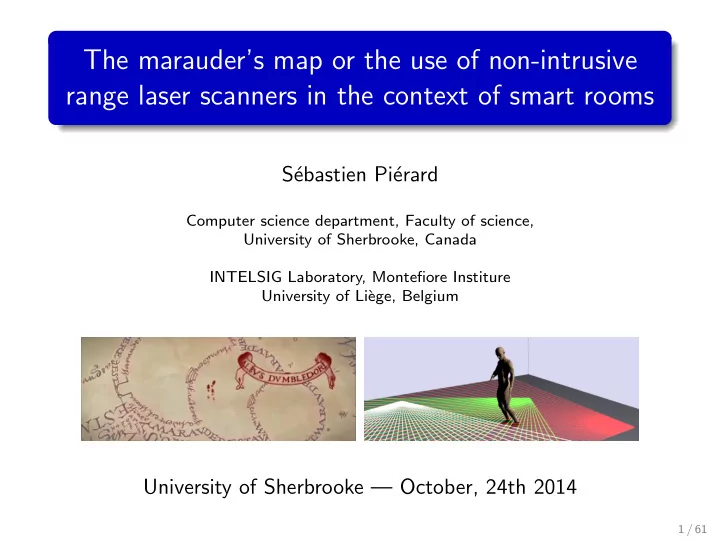
The marauder’s map or the use of non-intrusive range laser scanners in the context of smart rooms

S´ ebastien Pi´ erard

Computer science department, Faculty of science, University of Sherbrooke, Canada INTELSIG Laboratory, Montefiore Institure University of Li` ege, Belgium

University of Sherbrooke — October, 24th 2014

1 / 61

slide-2
SLIDE 2

Outline

1

Introduction: from the marauder’s map to GAIMS

2

The project GAIMS: the system and the database

3

Using GAIMS in smart environments

4

Using GAIMS for medical applications

5

Other things we can do with range laser scanners

6

Conclusion

This presentation is for the general public and doesn’t aim to go into scientific details.

2 / 61

slide-3
SLIDE 3

Outline

1

Introduction: from the marauder’s map to GAIMS

2

The project GAIMS: the system and the database

3

Using GAIMS in smart environments

4

Using GAIMS for medical applications

5

Other things we can do with range laser scanners

6

Conclusion

3 / 61

slide-4
SLIDE 4

The marauder’s map in Harry Potter: a dream?

https://www.youtube.com/watch?v=o3-KM- fni0

ACKNOWLEDGMENT: I thank Sophie Lejeune for this very nice idea of comparing the capabilities of GAIMS with the marauder’s map in Harry Potter.

4 / 61

slide-5
SLIDE 5

The marauder’s map in Harry Potter: a dream?

https://www.youtube.com/watch?v=o3-KM- fni0 5 / 61

slide-6
SLIDE 6

The marauder’s map in Harry Potter: a dream?

https://www.youtube.com/watch?v=o3-KM- fni0 6 / 61

slide-7
SLIDE 7

The features of the marauder’s map

◮ a precise map of the environment ◮ showing in realtime the footsteps ◮ accurately identifying each person ◮ unfoolable by artifices ◮ without placing any sensor on the persons

In the project GAIMS:

◮ we use range laser scanners (⇒ non-intrusive) ◮ we estimate the feet trajectories (⇒ we show footsteps)

and derive gait descriptors

◮ we use machine learning techniques to infer some information

about the observed person (gender, height, weight, identity, and we can detect and characterize alcohol intake as well as some neurological diseases)

7 / 61

slide-8
SLIDE 8

Why are we interested by non-intrusive measurements?

Mainly for medical application, but a lot of other applications can benefit from it.

http://www.er.uqam.ca/nobel/r33400/kelvin.gif 8 / 61

slide-9
SLIDE 9

Outline

1

Introduction: from the marauder’s map to GAIMS

2

The project GAIMS: the system and the database

3

Using GAIMS in smart environments

4

Using GAIMS for medical applications

5

Other things we can do with range laser scanners

6

Conclusion

9 / 61

slide-10
SLIDE 10

GAIMS (GAIt Measuring System)

◮ We track the feet with a high accuracy and precision, without

equipping the person with markers or sensors.

◮ A set of unsynchronized range laser scanners are scanning a

common horizontal plane (15 cm above the floor).

◮ Insensitive to lighting conditions and to the colors of clothes. ◮ We use sensors working at 15Hz, taking 274 distance

measures in a plane and in a field of view of about 96°.

10 / 61

slide-11
SLIDE 11

The signal processing pipeline

feet localizer two feet positions feet identification (left/right) two labelled points two feet trajectories point cloud of one person person extraction (ROI/tracking) background subtraction moving elements polar to cartesian registration & merging ns sensors 274ns distance measures ns point clouds global point cloud interpolation and filtering

REFERENCE: S. Pi´ erard, S. Azrour, and M. Van Droogenbroeck. Design of a reliable processing pipeline for the non-intrusive measurement of feet trajectories with lasers. In IEEE International Conference on Acoustics, Speech and Signal Processing (ICASSP), pages 4432-4436, Florence, Italy, May 2014.

11 / 61

slide-12
SLIDE 12

Realtime visualization of the measured trajectories

This is“easy”to do by using GAIMS and I-see-3D together.

REFERENCE: S. Pi´ erard, V. Pierlot, A. Lejeune, and M. Van Droogenbroeck. I-see-3D! An interactive and immersive system that dynamically adapts 2D projections to the location of a user’s eyes. In International Conference on 3D Imaging (IC3D), Li` ege, Belgium, December 2012.

12 / 61

slide-13
SLIDE 13

The gait descriptors provided by GAIMS

GAIMS derives many gait characteristics (currently 26) from the feet trajectories. They are related to:

◮ the speed; ◮ the inter-feet distance; ◮ the deviation from the followed path; ◮ the cadence; ◮ the stride length; ◮ the gait asymmetry; ◮ the temporal variability; ◮ the proportion of double limb support time; ◮ etc.

13 / 61

slide-14
SLIDE 14

Example of application: gait analysis by neurologists

In our target application, 4 sensors (in red) scan a common horizontal plane at 15 Hz. The patients are asked to walk in 3 different modes (comfortable, as fast as possible, tandem) along a straight path (in green) or a ∞-shaped path (in orange).

  • 4
  • 3
  • 2
  • 1
1 2 3
  • 7
  • 6
  • 5
  • 4
  • 3
  • 2
  • 1
1 2 3 4 5 6 7 y [ m ] x [ m ]

We aim at estimating reliably the feet trajectories in the gray area. The maximal walking speed is 3.6 m/s (≃ 13 km/h).

14 / 61

slide-15
SLIDE 15

Example of input : walk at preferred pace

(click here to play video)

15 / 61

slide-16
SLIDE 16

Example of input : walk in tandem mode

(click here to play video)

16 / 61

slide-17
SLIDE 17

Our database

◮ more than 6500 tests recorded, and still growing! ◮ 129 healthy persons (41 recorded at least 5 times) ◮ 71 patients with multiple sclerosis ◮ 24 volunteers for drinking alcohol

17 / 61

slide-18
SLIDE 18

The acquisition protocol

test 1 2 3 4 5 6 7 8 9 10 11 12 distance 25 ft

  • 20 m
  • 100 m
  • 500 m
  • mode

comfortable

  • fast
  • tandem
  • 18 / 61
slide-19
SLIDE 19

Outline

1

Introduction: from the marauder’s map to GAIMS

2

The project GAIMS: the system and the database

3

Using GAIMS in smart environments

4

Using GAIMS for medical applications

5

Other things we can do with range laser scanners

6

Conclusion

19 / 61

slide-20
SLIDE 20

Preliminary remark

The results presented in this section have been obtained with the database of GAIMS. The acquisition conditions were standardized. We expect a larger variability of the gait in free living conditions. Future work could assess our methods in less constrained environments.

20 / 61

slide-21
SLIDE 21

Estimation of morphological characteristics

Machine learning algorithm: the ExtRaTrees (regression). Input: the gait descriptors provided by GAIMS. height weight

1.5 1.6 1.7 1.8 1.9 2 1.5 1.6 1.7 1.8 1.9 2 predicted value ground truth 40 50 60 70 80 90 100 110 120 40 50 60 70 80 90 100 110 120 predicted value ground truth

correlation coefficient = 0.79 correlation coefficient = 0.67 mean absolute error = 4.0 cm mean absolute error = 8.4 Kg

REFERENCE: S. Lejeune. Reconnaissance de personnes sur base des caract´ eristiques de la marche observ´ ees avec des capteurs laser. Master’s thesis, University of Li` ege, Belgium, 2014.

21 / 61

slide-22
SLIDE 22

Estimation of morphological characteristics

Machine learning algorithm: the ExtRaTrees (classification). Input: the gait descriptors provided by GAIMS. gender

20 40 60 80 100 20 40 60 80 100 True Female Rate (%) True Male Rate (%)

REFERENCE: S. Lejeune. Reconnaissance de personnes sur base des caract´ eristiques de la marche observ´ ees avec des capteurs laser. Master’s thesis, University of Li` ege, Belgium, 2014.

22 / 61

slide-23
SLIDE 23

Biometric identification with GAIMS

◮ This is the first work, to our knowledge, about gait

recognition based on range laser scanners.

◮ The database gathers the gait characteristics of 114 people,

acquired with GAIMS.

◮ Among these, 41 people were recorded at least five times to

take the intra-subject variability into account.

◮ “Gait also has the advantage of being difficult to hide, steal,

  • r fake.”

REFERENCE: N. Boulgouris, D. Hatzinakos, and K. Plataniotis. Gait recognition: a challenging signal processing technology for biometric identification. IEEE Signal Processing Magazine, 22(6):78-90, November 2005.

23 / 61

slide-24
SLIDE 24

Biometric identification with GAIMS

A first system:

REFERENCE: S. Lejeune. Reconnaissance de personnes sur base des caract´ eristiques de la marche observ´ ees avec des capteurs laser. Master’s thesis, University of Li` ege, Belgium, 2014.

24 / 61

slide-25
SLIDE 25

Biometric identification with GAIMS

Let’s improve it by taking into the biases of the estimators

REFERENCE: S. Lejeune. Reconnaissance de personnes sur base des caract´ eristiques de la marche observ´ ees avec des capteurs laser. Master’s thesis, University of Li` ege, Belgium, 2014.

25 / 61

slide-26
SLIDE 26

Biometric identification with GAIMS

REFERENCE: S. Lejeune. Reconnaissance de personnes sur base des caract´ eristiques de la marche observ´ ees avec des capteurs laser. Master’s thesis, University of Li` ege, Belgium, 2014.

26 / 61

slide-27
SLIDE 27

Biometric identification with GAIMS

A second system:

REFERENCE: S. Lejeune. Reconnaissance de personnes sur base des caract´ eristiques de la marche observ´ ees avec des capteurs laser. Master’s thesis, University of Li` ege, Belgium, 2014.

27 / 61

slide-28
SLIDE 28

Biometric identification with GAIMS

REFERENCE: S. Lejeune. Reconnaissance de personnes sur base des caract´ eristiques de la marche observ´ ees avec des capteurs laser. Master’s thesis, University of Li` ege, Belgium, 2014.

28 / 61

slide-29
SLIDE 29

Biometric identification with GAIMS

We can still improve the previous results by introducing the concept of“client” .

◮ A gait recognition system can be replicated in many different

places: the“clients” .

◮ Each client has a different set of users, so there are two cases:

1

The client must only establish his database and uses a generic gait recognition model.

2

The client has to execute a machine learning algorithm to create a model optimized for him, in addition to the creation

  • f his database.

By particularizing the similarity model for the client, our results suggest that it is possible to achieve a correct recognition rate of 100%, for clients needing to recognize 1 person among 41.

REFERENCE: S. Lejeune. Reconnaissance de personnes sur base des caract´ eristiques de la marche observ´ ees avec des capteurs laser. Master’s thesis, University of Li` ege, Belgium, 2014.

29 / 61

slide-30
SLIDE 30

Is (s)he drunk?

As everybody walk in a different way, it is difficult to tell whether a person has taken alcohol or not, based on the observation of the feet trajectories. However, if you know the person, then you can guess his state from the gait descriptors provided by GAIMS.

◮ we assume we have two recordings of the same person ◮ we assume that the person is clean in at least one recording ◮ we want to know if the person consumed alcohol in the first,

in the second, or in none of the recordings

30 / 61

slide-31
SLIDE 31

Is (s)he drunk?

Our study:

◮ 24 healthy volunteers, aged between 22 and 57 years. ◮ Approved by the ethics committee (because of the medical

reason for this study, as it will be explained in a few slides).

◮ We measured the BAC: µ = 67mg/l, σ = 22mg/l. ◮ The most important modifications are behavioral, and the gait

disorder specialists had difficulties to see any difference on feet movements induced by ethanol.

◮ We use the ExtRaTrees (classification) for each pair of tests.

The attributes are

ω (Ta) , π (Ta) ,

  • fi (Ta) + fi (Tb)

2 , fi (Tb) − fi (Ta) , fi (Tb) − fi (Ta) fi (Ta) + fi (Tb)

26

i=1 31 / 61

slide-32
SLIDE 32

Is (s)he drunk?

Results obtained with all gait descriptors provided by GAIMS:

20 40 60 80 100 7 11 8 21 23 20 4 5 10 15 16 17 13 14 2 19 3 6 9 12 18 22 24 1 correct classification rate (%) healthy volunteer ID

REFERENCE: S. Pi´ erard, R. Phan-Ba, and M. Van Droogenbroeck. Machine learning techniques to assess the performance of a gait analysis system. In European Symposium on Artificial Neural Networks, Computational Intelligence and Machine Learning (ESANN), pages 419-424, Bruges, Belgium, April 2014.

32 / 61

slide-33
SLIDE 33

Is (s)he drunk?

Results obtained with the gait descriptors related to a stopwatch:

20 40 60 80 100 20 21 2 8 11 7 10 12 15 18 13 5 22 1 16 19 23 24 17 14 9 3 4 6 correct classification rate (%) healthy volunteer ID

REFERENCE: S. Pi´ erard, R. Phan-Ba, and M. Van Droogenbroeck. Machine learning techniques to assess the performance of a gait analysis system. In European Symposium on Artificial Neural Networks, Computational Intelligence and Machine Learning (ESANN), pages 419-424, Bruges, Belgium, April 2014.

33 / 61

slide-34
SLIDE 34

Is (s)he drunk?

Can a human expert do better ? No ! We have shown 228 randomly ordered pairs of video sequences (recorded during the acquisitions) to 14 other gait disorder specialists (neurologists of the university hospital of Li` ege). Their correct decision rate (62.28%, with a high inter-expert variability) is clearly lower than the one of our automatic classification system based on GAIMS (70.9%).

REFERENCE: S. Pi´ erard, R. Phan-Ba, and M. Van Droogenbroeck. Machine learning techniques to assess the performance of a gait analysis system. In European Symposium on Artificial Neural Networks, Computational Intelligence and Machine Learning (ESANN), pages 419-424, Bruges, Belgium, April 2014.

34 / 61

slide-35
SLIDE 35

Is (s)he drunk?

◮ We asked 27 other healthy persons to perform twice the tests

(during two consecutive visits), without any alcohol intake.

◮ These are the results we obtain when a third class is added for

the pairs of visits (without alcohol, without alcohol):

10 20 30 40 50 60 70 80 90 100 10 20 30 40 50 60 70 80 90 100 estimated probability of gait modification [ % ] estimated probability of gait improvement assuming a modification [ % ] results obtained with the ’mean’ rule 10 20 30 40 50 60 70 80 90 100 10 20 30 40 50 60 70 80 90 100 estimated probability of gait modification [ % ] estimated probability of gait improvement assuming a modification [ % ] results obtained with the ’probabilistic product’ rule

REFERENCE: S. Pi´ erard, S. Azrour, R. Phan-Ba, and M. Van Droogenbroeck. Detection and characterization of gait modifications, for the longitudinal follow-up of patients with neurological diseases, based on the gait analyzing system GAIMS. In BIOMEDICA (the European Life Sciences Summit), Maastricht, The Netherlands, June 2014.

35 / 61

slide-36
SLIDE 36

Outline

1

Introduction: from the marauder’s map to GAIMS

2

The project GAIMS: the system and the database

3

Using GAIMS in smart environments

4

Using GAIMS for medical applications

5

Other things we can do with range laser scanners

6

Conclusion

36 / 61

slide-37
SLIDE 37

The prevalence of multiple sclerosis in the world

USA: 400,000 Canada: 65,000 France: 57,000 Belgium: 12,000 World: 2,500,000 persons have MS

World Health Organization and Multiple Sclerosis International Federation, Atlas Multiple Sclerosis Resources in the World. WHO, 2008. 37 / 61

slide-38
SLIDE 38

The Expanded Disability Status Scale (EDSS)

◮ The EDSS score quantifies the disability in multiple sclerosis. ◮ The EDSS is based on 8 functional systems, and is only partly

based on the gait disability.

◮ The EDSS is correlated with the motor impairments.

http://www.mobilitymattersinms. com/uk/assessment-tests.aspx 38 / 61

slide-39
SLIDE 39

Why analyzing the gait of MS patients ?

◮ Most of the patients with MS have walking difficulties and

they often perceive these difficulties as the most important source of disability.

REFERENCE: C. Heesen, J. B¨

  • hm, C. Reich, J. Kasper, M. Goebel, and S. Gold.

Patient perception of bodily functions in multiple sclerosis: gait and visual function are the most valuable. Multiple Sclerosis, 14:988–991, 2008. ◮ Ambulation impairments appear during the early stages of the

disease and the magnitude of the gait modification is a good indicator of the disease activity.

REFERENCE: R. Phan-Ba, P. Calay, P. Grodent, G. Delrue, E. Lommers, V. Delvaux,

  • G. Moonen, and S. Belachew. Motor fatigue measurement by distance-induced slow

down of walking speed in multiple sclerosis. PLoS ONE, 7(4):8 pages, April 2012. ◮ The clinical evaluation of the gait could help in proposing

appropriate drugs and physical therapy to counter the effects

  • f the disease.

39 / 61

slide-40
SLIDE 40

Ataxia (MS ≃ alcohol)

The ambulation impairments have often a component related to

  • ataxia. Alcohol induces ataxia. So, alcohol intake is a good proxy

to learn and test models for MS. ֒ → The results presented in the previous section hold also for MS. ֒ → GAIMS can be useful to the contrary of a stopwatch. ֒ → It is possible to discriminate between“gait deterioration” ,“no modification” , and“gait improvement” .

20 40 60 80 100 7 11 8 21 23 20 4 5 10 15 16 17 13 14 2 19 3 6 9 12 18 22 24 1 correct classification rate (%) healthy volunteer ID 20 40 60 80 100 20 21 2 8 11 7 10 12 15 18 13 5 22 1 16 19 23 24 17 14 9 3 4 6 correct classification rate (%) healthy volunteer ID 10 20 30 40 50 60 70 80 90 100 10 20 30 40 50 60 70 80 90 100 estimated probability of gait modification [ % ] estimated probability of gait improvement assuming a modification [ % ] results obtained with the ’mean’ rule 10 20 30 40 50 60 70 80 90 100 10 20 30 40 50 60 70 80 90 100 estimated probability of gait modification [ % ] estimated probability of gait improvement assuming a modification [ % ] results obtained with the ’probabilistic product’ rule

40 / 61

slide-41
SLIDE 41

Estimating the EDSS

◮ The gait descriptors are normalized with respect to the

morphological characteristics.

◮ One prediction per test, averaged for each visit. REFERENCE: S. Azrour, S. Pi´ erard, P. Geurts, and M. Van Droogenbroeck. Data normalization and supervised learning to assess the condition of patients with multiple sclerosis based on gait analysis. In European Symposium on Artificial Neural Networks, Computational Intelligence and Machine Learning (ESANN), pages 649-654, Bruges, Belgium, April 2014.

41 / 61

slide-42
SLIDE 42

Diagnosing multiple sclerosis

◮ The gait descriptors are normalized with respect to the

morphological characteristics.

◮ One prediction per test, averaged for each visit. REFERENCE: S. Azrour, S. Pi´ erard, and M. Van Droogenbroeck. Using gait measuring system (GAIMS) to discriminate patients with multiple sclerosis from healthy persons. In BEMEKO Workshop on measurement: Challenges and Opportunities, Li` ege, Belgium, November 2013.

42 / 61

slide-43
SLIDE 43

The motor fatigue plays an important role

In this study:

◮ The ExtRaTrees are used to predict if the observed person is

healthy (HP) or has multiple sclerosis (MSP) based on a the temporal evolution of the gait descriptors provided by GAIMS.

◮ 115 HP and 59 MSP (median EDSS 3.26) walked a 500 m

distance (25 laps of an 8-shaped path) as fast as possible, and their gait was recorded with GAIMS.

◮ The measures taken over the total path, and 50 consecutive

windows of 10 m, have been analyzed. This led to 26 GDs for the total path, and for each window.

REFERENCE: S. Pi´ erard, S. Azrour, R. Phan-Ba, V. Delvaux, P. Maquet, and M. Van

  • Droogenbroeck. Diagnosing multiple sclerosis with a gait measuring system, an

analysis of the motor fatigue, and machine learning. Multiple Sclerosis Journal, 20(S1):171, September 2014. Proceedings of ACTRIMS/ECTRIMS 2014 (Boston, USA), P232. REFERENCE: R. Phan-Ba, P. Calay, P. Grodent, G. Delrue, E. Lommers, V. Delvaux,

  • G. Moonen, and S. Belachew. Motor fatigue measurement by distance-induced slow

down of walking speed in multiple sclerosis. PLoS ONE, 7(4):8 pages, April 2012.

43 / 61
slide-44
SLIDE 44

The motor fatigue plays an important role

1 1.2 1.4 1.6 1.8 2 2.2 100 200 300 400 500 useful velocity [m/s] traveled distance [m] µ for healthy persons µ for MS patients µ ± σ for healthy persons µ ± σ for MS patients 0.09 0.1 0.11 0.12 0.13 0.14 0.15 0.16 0.17 0.18 100 200 300 400 500 lateral inter-feet distance [m] traveled distance [m] µ for healthy persons µ for MS patients µ ± σ for healthy persons µ ± σ for MS patients

REFERENCE: S. Pi´ erard, S. Azrour, R. Phan-Ba, V. Delvaux, P. Maquet, and M. Van

  • Droogenbroeck. Diagnosing multiple sclerosis with a gait measuring system, an

analysis of the motor fatigue, and machine learning. Multiple Sclerosis Journal, 20(S1):171, September 2014. Proceedings of ACTRIMS/ECTRIMS 2014 (Boston, USA), P232.

44 / 61

slide-45
SLIDE 45

The motor fatigue plays an important role

20 40 60 80 100 20 40 60 80 100 True Positive Rate (%) True Negative Rate (%) ROC plot

REFERENCE: S. Pi´ erard, S. Azrour, R. Phan-Ba, V. Delvaux, P. Maquet, and M. Van

  • Droogenbroeck. Diagnosing multiple sclerosis with a gait measuring system, an

analysis of the motor fatigue, and machine learning. Multiple Sclerosis Journal, 20(S1):171, September 2014. Proceedings of ACTRIMS/ECTRIMS 2014 (Boston, USA), P232.

45 / 61

slide-46
SLIDE 46

The motor fatigue plays an important role

  • 0.3
  • 0.25
  • 0.2
  • 0.15
  • 0.1
  • 0.05
0.05 100 200 300 400 500 useful velocity - useful velocity at the begining [m/s] traveled distance [m] µ for healthy persons µ for MS patients µ ± σ for healthy persons µ ± σ for MS patients
  • 0.02
  • 0.01
0.01 0.02 0.03 100 200 300 400 500 lateral inter-feet distance - lateral inter-feet distance at the begining [m] traveled distance [m] µ for healthy persons µ for MS patients µ ± σ for healthy persons µ ± σ for MS patients

REFERENCE: S. Pi´ erard, S. Azrour, R. Phan-Ba, V. Delvaux, P. Maquet, and M. Van

  • Droogenbroeck. Diagnosing multiple sclerosis with a gait measuring system, an

analysis of the motor fatigue, and machine learning. Multiple Sclerosis Journal, 20(S1):171, September 2014. Proceedings of ACTRIMS/ECTRIMS 2014 (Boston, USA), P232.

46 / 61

slide-47
SLIDE 47

The motor fatigue plays an important role

20 40 60 80 100 20 40 60 80 100 True Positive Rate (%) True Negative Rate (%) ROC plot

REFERENCE: S. Pi´ erard, S. Azrour, R. Phan-Ba, V. Delvaux, P. Maquet, and M. Van

  • Droogenbroeck. Diagnosing multiple sclerosis with a gait measuring system, an

analysis of the motor fatigue, and machine learning. Multiple Sclerosis Journal, 20(S1):171, September 2014. Proceedings of ACTRIMS/ECTRIMS 2014 (Boston, USA), P232.

47 / 61

slide-48
SLIDE 48

Quantity and quality of the physical therapy

◮ There exist correlations between some gait characteristics

measured with GAIMS and the quantity and quality of the physical therapy and physical activity followed by MSP: the speed, the double support time, the deviation from the followed path (during tandem walk), and the lateral distance between feet, as well as the speed decrease during a long walk.

◮ The positive correlation between the lateral inter-feet distance

and the quantity of physical therapy and physical activity was unexpected and is still unexplained.

◮ Remarkably, correlations between some gait characteristics

provided by GAIMS and the emotional state of the patients have also been observed: the more the PMS feel coached by their physical therapist, the more the double support time is reduced when walking a small distance as fast as possible.

REFERENCE: A. Giet. Cr´ eation et validation multimodale d’une ´ echelle mesurant la qualit´ e de la kin´ esith´ erapie et de l’activit´ e physique chez les personnes souffrant de scl´ erose en plaques. Master’s thesis, University of Li` ege, Belgium, 2013.

48 / 61

slide-49
SLIDE 49

Outline

1

Introduction: from the marauder’s map to GAIMS

2

The project GAIMS: the system and the database

3

Using GAIMS in smart environments

4

Using GAIMS for medical applications

5

Other things we can do with range laser scanners

6

Conclusion

49 / 61

slide-50
SLIDE 50

Mobility assessment tests in domestic environments

  • REFERENCE: T. Frenken, M. Lipprandt, M. Brell, M. G¨
  • vercin, S. Wegel, E.

Steinhagen-Thiessen, and A. Hein. Novel approach to unsupervised mobility assessment tests: Field trial for aTUG. In 6th International Conference on Pervasive Computing Technologies for Healthcare (PervasiveHealth), pages 131 –138, San Diego, USA, May 2012.

50 / 61

slide-51
SLIDE 51

Tracking people

!" #" $" %" &" '" " & !" !& #" #& $" $& " !" #" $" %" &" '" " & !" !& #" #& $" $&

!"#$%&'())

REFERENCE: X. Song, X. Shao, H. Zhao, J. Cui, R. Shibasaki, and H. Zha. An

  • nline approach: Learning- semantic-scene-by-tracking and

tracking-by-learning-semantic-scene. In IEEE International Conference on Computer Vision and Pattern Recognition (CVPR), pages 739–746, San Francisco, USA, June 2010.

51 / 61

slide-52
SLIDE 52

Working with silhouettes instead of point clouds

52 / 61

slide-53
SLIDE 53

Working with silhouettes instead of point clouds

53 / 61

slide-54
SLIDE 54

Working with silhouettes instead of point clouds

REFERENCE: O. Barnich, S. Pi´ erard, and M. Van Droogenbroeck. A virtual curtain for the detection of humans and access control. In Advanced Concepts for Intelligent Vision Systems (ACIVS), Part II, pages 98–109, Sydney, Australia, December 2010.

54 / 61

slide-55
SLIDE 55

Working with silhouettes instead of point clouds

If we add a third dimension corresponding to the time, we obtain volumes describing the movements and the interactions: This can be used to detect piggybacking and tailgating . . .

REFERENCE: O. Barnich, S. Pi´ erard, and M. Van Droogenbroeck. A virtual curtain for the detection of humans and access control. In Advanced Concepts for Intelligent Vision Systems (ACIVS), Part II, pages 98–109, Sydney, Australia, December 2010.

55 / 61

slide-56
SLIDE 56

Where is it preferable to place the sensors?

@ CREI, we try to answer this question, by simulation.

REFERENCE: http://www.makehuman.org

56 / 61

slide-57
SLIDE 57

Outline

1

Introduction: from the marauder’s map to GAIMS

2

The project GAIMS: the system and the database

3

Using GAIMS in smart environments

4

Using GAIMS for medical applications

5

Other things we can do with range laser scanners

6

Conclusion

57 / 61

slide-58
SLIDE 58

Conclusion

◮ GAIMS is a non-intrusive and reliable system measuring

reliable feet trajectories.

◮ The observed person does not need to be equipped with any

active or passive marker, sensor, etc.

◮ It has proven to be useful for medical applications and could

also be used for other applications.

58 / 61

slide-59
SLIDE 59

For more information

http://www.montefiore.ulg.ac.be/gaims

59 / 61

slide-60
SLIDE 60

For more information

http://www.montefiore.ulg.ac.be/gaims/publications.php

60 / 61

slide-61
SLIDE 61

Thank you! Do you have questions?

Now, do you think the marauder’s map will stay forever in the imaginary world, or is it already possible to do better with range laser scanners, signal processing, and machine learning?

https://www.youtube.com/watch?v=o3-KM- fni0

Mischief managed !

61 / 61