The leaders guide to decision-making when building research and - - PowerPoint PPT Presentation

the leader s guide to decision making when building
SMART_READER_LITE
LIVE PREVIEW

The leaders guide to decision-making when building research and - - PowerPoint PPT Presentation

The leaders guide to decision-making when building research and scholarship capacity A BRC preconference workshop at ADFM 2020 Association of Departments of Family Medicine New Orleans; February 12, 2020 C.J. Peek PhD, Bernard Ewigman MD


slide-1
SLIDE 1

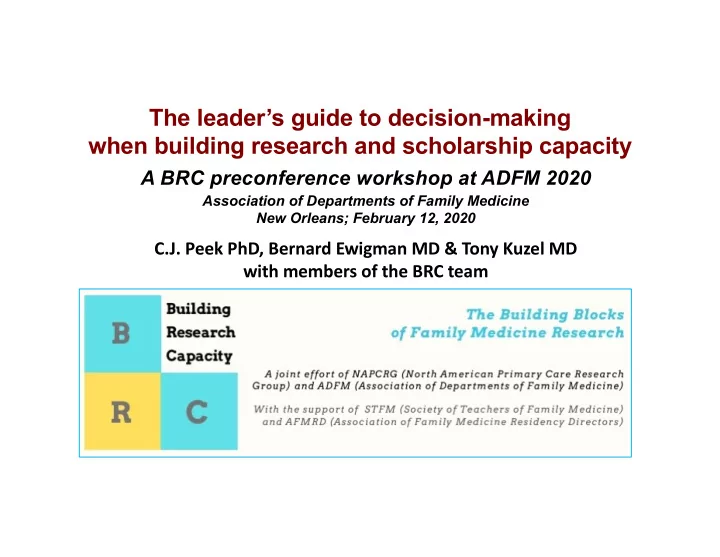
The leader’s guide to decision-making when building research and scholarship capacity

A BRC preconference workshop at ADFM 2020

Association of Departments of Family Medicine New Orleans; February 12, 2020

C.J. Peek PhD, Bernard Ewigman MD & Tony Kuzel MD with members of the BRC team

slide-2
SLIDE 2

2

About BRC (Building Research Capacity)

Sponsored by NAPCRG and ADFM, with the support of STFM and AFMRD

To help family medicine departments and programs build and sustain research & scholarship capacity appropriate to their own goals and situation

BRC offers:

  • Learning workshops at family medicine meetings including NAPCRG, ADFM, STFM, AFMRD
  • A consultation service for departments or programs—exploratory conversations that could be

followed by on-site and/or phone-based consultation

  • A Fellowship to equip individuals with knowledge, skills, mentorship and peer support to develop

& implement a strategic plan for research capacity in own institution

Volunteer leaders (among many other faculty volunteers and staff) Workshops / Curriculum: Dave Schneider & Dean Seehusen Consultation: Tony Kuzel & CJ Peek Fellowship: Irf Asif & Stephen Stacey Evaluation: Lynn Meadows and Peter Seidenberg Steering Committee: Bernard Ewigman

All supported administratively by Leyla Haddad

slide-3
SLIDE 3

The product: A decision-making plan to take home and carry forward Flow: In four parts—decisions on…

  • 1. Goals and scope of R&S—based on knowing what matters to people
  • 2. What you will ask for, partners you seek, and how you will show up and

influence

Quick sharing across tables so far—and break

  • 3. Shaping department culture and operations to support your R&S goals
  • 4. Where the time & money will come from—financial goals & expectations

Closing reflections

Brief presentation alternates with table conversation to as you fill out your worksheet

3

slide-4
SLIDE 4

Part I: Decisions about goals and scope of R&S

  • 0. How you will find out…

What already matters around you—stakeholder analysis

4

Worksheet p. 2 Stakeholder What already matters most How research can appeal to that Areas of concern and how I address Institutional leaders Leaders / approvers in your own area Those doing or might do research Others whose work is affected

Fill in these cells with accurate information. Don’t make things up or fill in what matters to you or should matter to them.

slide-5
SLIDE 5

Appeal to what already matters around you? An opportunity to consider:

5

“What already matters”: What burning questions? What “must do” changes? What critical decisions are people facing that could use some evidence?

Give research a “tailwind” by aligning with clinical, quality, educational, and operational priorities? Seek to harmonize care, education, and research? Each strengthening the other, not just competing.

slide-6
SLIDE 6

6

Worksheet: p. 3

Decisions about goals and scope of R&S (cont’d)

  • 1. How wide do you want your lens for R&S—scope?

How wide to serve your goals and appeal to what matters?

For example:

  • Just federally funded clinical and other trials or RCT’s?
  • All types of scholarship: discovery, practice, integration, teaching?
  • Evaluation, not only research?
  • QI research, not only QI?
  • Implementation study, not only outcome study
  • A generalized culture of curiosity & inquiry: everyone’s work can be

scholarly if done that way?

slide-7
SLIDE 7

Part II:

Decisions about claiming an identity with R&S, partners, and agency—a fancy way of asking:

  • 2. What to ask for by way of R&S support when being recruited or

transitioning to chair / interim or other leader role

  • 3. Who to collaborate or partner with—going concerns you want to

join to amplify your available energy and “capital”

  • 4. How you will show up and influence things

7

Worksheet p. 3-4

slide-8
SLIDE 8

Quick sharing across tables (10 min)

A) Share any themes or highlights from your conversations so far? B) Any areas you’d like a consult from a different table? (You can talk during the break)

8

slide-9
SLIDE 9

Part III:

Decisions about aligning dept. goals, culture, and systems with R&S

  • 5. Dept goals & culture; a real, visible, and lived part of dept identity

and faculty roles

  • 6. Dept systems / operations—beyond values statements--what’s

built in to visibly acknowledge and support R&S (examples on worksheet)

9

Worksheet p. 5

slide-10
SLIDE 10

Part IV:

Decisions on where the time and money will come from

  • 7. Financial expectations for sustainable R&S in your dept., e.g.

Self-sustaining? All the time? Sustained partly by overall budgeting for entire dept. mission?

  • 8. External financial support you seek for R&S and collaborations

you are trying to bring to life, e.g.

Federal grants? Internal institutional funds? Philanthropy? State funds?

(examples on worksheet)

10

Worksheet p. 6

slide-11
SLIDE 11

11

Reflections on the session, e.g. What was especially valuable, surprising, challenging? Or especially fuzzy and flat? What difference has this made to your view of decision-making? What follow-up help or “sounding board” could you use back home?

Please fill out feedback / evaluation form

Thank you!