The Jules Horowitz Research Reactor Experimental devices and first - - PowerPoint PPT Presentation

the jules horowitz research reactor
SMART_READER_LITE
LIVE PREVIEW

The Jules Horowitz Research Reactor Experimental devices and first - - PowerPoint PPT Presentation

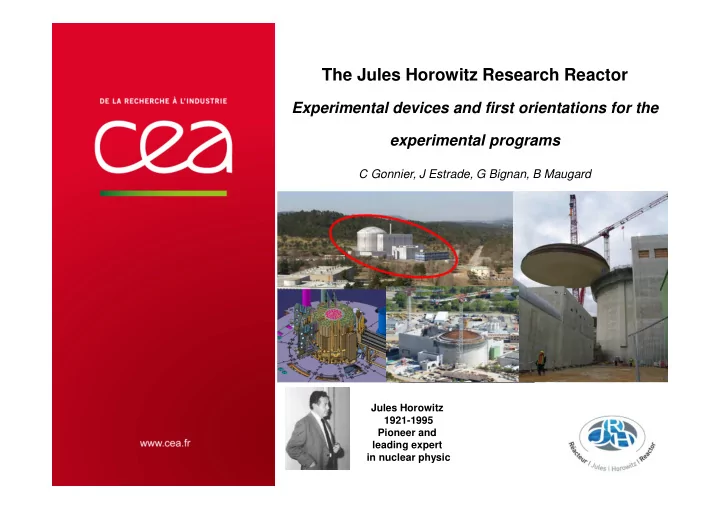
The Jules Horowitz Research Reactor Experimental devices and first orientations for the experimental programs C Gonnier, J Estrade, G Bignan, B Maugard Jules Horowitz 1921-1995 Pioneer and leading expert in nuclear physic | PAGE 1 Jules

slide-1
SLIDE 1

| PAGE 1

The Jules Horowitz Research Reactor

Experimental devices and first orientations for the experimental programs

C Gonnier, J Estrade, G Bignan, B Maugard

Jules Horowitz 1921-1995 Pioneer and leading expert in nuclear physic

slide-2
SLIDE 2

Jules Horwitz Reactor: The CONTEXT

9 NOVEMBRE 2017Q& | PAGE 2

* * * *

'

* *

HBWR OSIRIS BR 2

under construction

HFR LVR 15 RJH

* *

OSIRIS

GW

Generation 3 Existing fleet 40-year plant life

1980 1990 2000 2010 2020 2030 2040 2050 2060

Generation 3

Plant life extension beyond 40 years

1980 1990 2000 2010 2020 2030 2040 2050 2060

Generation 4

Safety and Plant life time management (ageing & new plants) Fuel behaviour validation in incidental and accidental situation Assess innovations and related safety for future NPP: Gen 3 and Gen 4 Training of new generations

Existing technologies PWR, BWR, …

Illustration

  • f nuclear

power evolution in France

The needs of a new brand MTR for R&D in support to industry and regulators linked to the evolution of nuclear energy: Plant life time extension of GII reactors Surge of GIII reactors Preparation of GIV technology The need of a new MTR because of an ageing fleet of MTR in Europe (with

  • ld safety standards)

The complementary needs: Medical applications (99Mo-99Tc / scintigraphy) Context (needs and safety standards) => specific technical choices for the JHR

See the presentation dedicated to the Moly production in JHR

slide-3
SLIDE 3

JHR general design : a 100MWth pool type light water MTR optimized for fuel and material testing

| PAGE 3

60 cm

Hot cells (non destructive examinations) Reactor pool with examination benches Core (Φ Φ Φ Φ 70cm / h 60 cm) and Be reflector Storage pools Reactor block JHR fuel element

Water channels in Be reflector

Experimental cubicles and analysis laboratories

BR : Φ 37m H 45m BAN : 51x47m H 35m Pool : Φ 7m H 12m

Core Designed for UMo-Al fuel Start-up with U3Si2-Al fuel 70 MWth / 100 MWth 25 to 30 days cycle length 6-7 days shutdown Rooms dedicated to reactor operation

(heat exchangers, primary pumps, safety systems,…)

Rooms dedicated to reactor operation

(control room, hot workshop, labs,…)

About 200 aseismic pads

slide-4
SLIDE 4

JHR experimental capacity general characteristics of the core

| PAGE 4

Thermal neutron flux Fast neutron flux

The core is under moderated => high fast neutron flux in the core and high thermal neutron flux in the reflector

  • Located in the water channels (reflector)
  • Flexible power variations with an accurate control
  • Steady state conditions (long term irrad.)
  • Power cycling (load follow)
  • Power ramps (up to 700W/cm/s)
  • Experiment decoupled from the core
slide-5
SLIDE 5

JHR facility & experimental capacity: the Non Destructive Examination Benches

| PAGE 5

Gamma and X-Ray tomography systems Multipurpose test benches

LINAC (X) γ γ γ γ-detector Shielding XR-detector Tunable γ

γ γ γ front collimator

Device

Side cutaway

Pool bank fixing Penetration X-table Y-table Bench Z-table XR-collimator

View from the core

Coupled Gamma &X-ray bench

Coupled X-ray & γ bench in storage pool Neutron imaging system in reactor pool Coupled X-ray & γ bench in reactor pool

Test device examination in pools Sample examination in hot cells

Initial checks of the experimental loading Adjustment of the experimental protocol On-site NDE tests after the irradiation phase

Neutron Imaging System VTT In-Kind

slide-6
SLIDE 6

Hosting experimental systems (dedicated to LWR fuel testing)

9 NOVEMBRE 2017 | PAGE 6

MADISON For fuel testing under nominal conditions (short / long term irradiations) ADELINE For fuel testing under

  • ff-normal conditions

reference possible evolution

Power transient (up to 620W/cm), post clad failure fuel behavior, Lift-off experiment…

LORELEI fuel testing under accidental conditions (LOCA)

  • Source Term

(FP releases)

  • Rod thermal-

mechanical behaviour

Ballooning and clad burst (fuel relocation) Corrosion at high temperature Quenching and post- quench behaviour

Fuel µstructure Clad corrosion

slide-7
SLIDE 7

9 NOVEMBRE 2017 | PAGE 7

  • Irradiated material behaviour

tensile tests, resilience test (Charpy), crack propagation tests …..

  • Behaviour of Thermal

affected zones CLOE Corrosion loop for “Zr alloy Corrosion” and “Irradiation Assisted Stress Corrosion Cracking”

(Water loop, 190 bar, 360°C, radiolysis, representative chemical conditions, samples under stress …) .

CALIPSO, MICA

For material testing under high dpa (up to 16dpa/y) and accurate temperature control (+ mechanical loading)

specimen for µ structure evolution, tensile test ; for 1 or 2 D creep tests ; for bending tests (stress releiving experiments) ;…

Hosting experimental systems (dedicated to LWR material testing)

OCCITANE For pressure Vessel steel testing

Equivalent carrying volume 30x62.5x500mm3 Helium 230 – 300°C 100 mdpa/year

slide-8
SLIDE 8

An example of sample holder designed for MICA test device Melodie sample holder

MELODIE (MEchanical LOading Device for Irradiation Experiments) experiment performed in OSIRIS – 2015 a challenging experiment … to prepare MICA instrumented rigs

Technical goals

  • Study of LWR cladding 2D irradiation creep
  • 2D : anisotropic material, multiaxial stresses because of gas pressure and PCMI

OSIRIS environment

  • Sample holder in a CHOUCA capsule similar to MICA
  • 350 °C, static NaK coolant

Biaxial stress controlled in real time

  • Specimen pressurization Max pressure 160 bar
  • Push-pull axial loading unit (biaxiality ratio : 0 to 1)
  • Hoop Stress limit: σӨ = 120 MPa, Axial stress limit: σz = 180 MPa

Online biaxial measurement of creep strain

  • Continuous measurement of axial strain with a 5-wire LVDT
  • Periodical measurement of hoop strain with a diameter gauge (DG)

Partnerships

  • Design and manufacturing of MELODIE : VTT
  • Self-compensated LVDT (axial + DG) : IFE

Creep test with a bi-axial loading experimental device (controlled bi-axial load) and an on-line bi-axial deformation measurement device (sample diameter and length)

| PAGE 8

slide-9
SLIDE 9

Towards GEN IV and the “FUSION technologies” (test devices under conceptual design)

Fusion technologies : Inquiry about the needs => three conceptual designs (FUSERO test devices):

Thermo-Mechanical Fatigue testing: study of components submitted to both mechanical strain and

thermal strain (from the breeding blanket to divertor tiles).

Ceramic testing (for diagnostic windows); samples bi-axially loaded, analysis of optical properties and

sub-critical crack growth.

Cryogenic testing for the study of electrical and structural properties of superconducting magnet

materials.

Thermo- mechanical fatigue Ceramic testing Cryogenic testing

GEN IV (mainly SFR): adaptation of the Calipso test device

Material irradiation : adaptation for high temperature, up to 650°C Fuel irradiation : In-core : long term irradiations (NaK- neutron filters)

In-reflector : off-normal situations, power and flowrate transients (Na)

slide-10
SLIDE 10

Test Devices for « Start Up Tests »

General objectives

  • Verification of the performances of

the facility

  • Verification of the safety parameters
  • Accurate determination of the

experimental parameters (a challenge: to be as accurate as the present MTRs which started to

  • perate at least 40 years ago…)

Optimization of the strategy for the start-up tests (timing of the tests, accuracy, power level, reactor configuration,….) Analysis of the needs in terms of instrumentation

  • Neutron flux and gamma heating mapping, neutron spectra
  • fissile power, reactivity measurement, in core void effect evaluation
  • THy (flowrate in experimental cavities, in core, in reflector ; core

under free convection, ...)

  • Devices dedicated to the thermal mapping of the reactor structural

materials

| PAGE 10

slide-11
SLIDE 11

Examples of instrumentation developments

Measurement of Fission Gas Release By using an acoustic sensor Measurement technics using optical fibers On-line Measurement of Fast neutron flux in MTRs Sub-miniature fission chambers

slide-12
SLIDE 12

July 2007 September 2009 December 2010

Some milestones of the project – civil work

July 2011 containment wall first pouring November 2012 December 2013 January 2015

2015

19/03/2007 Signature of the JHR consortium Mid 2017

slide-13
SLIDE 13

Examples of some components manufacturing and testing

Polar crane testing nov 2014 Emergency diesel generator (tested on a shacking table)

Primary pump testing

Mock up of displacement system Currently under testing Manufacturing of core components Heat exchangers (primary/secondary system)

slide-14
SLIDE 14

Exemples of some experimental component manufacturing and testing

Double envelop tight connector (patented) “Two-way Filter” (patented), dedicated to trap Na-K

  • xides and hydrides

Test device heads Cables and pipes connection Heaters qualification Qualification of sensors under irradiation Sample holder handling in hot cells CLOE : feedthroughs, flow amplifier, chemistry control ; sample holder, loading system, DCPD,… Lorelei 900°C Mica

Occitane

slide-15
SLIDE 15

Qualification of CALIPSO prototype + NaK process (in SOPRANO facility)

Fluid control panel Handling cask Operating plateform Good behavior of the components (electromagnetic pump, heat exchanger, heater)

| PAGE 15

Temperature distribution in the test section

slide-16
SLIDE 16

JHR CONSORTIUM & GOVERNING BOARD

JHR Consortium current partnership: Research centers & Industrial companies

IAEC

Associated Partnership: NNL is the UK representative to JHR UK/CEA agreement – March 2013 19/03/2007 Signature of the JHR consortium

In some cases, the organization (member of the JHR consortium) is itself the representative of a national consortium which gathers organizations among industry, R&D organizations, TSO, or safety authority

JHR consortium gathers organizations which take part financially in the construction of JHR (1 representative / organization)

slide-17
SLIDE 17

9 NOVEMBRE 2017 | PAGE 17

PREPARATION of EXPERIMENTAL PROGRAMS

The preparation of the future JHR program:

  • The identification of open issues in the field of nuclear fuel and nuclear materials

development and qualification,

  • The definition of criteria to elaborate “ranking grids” about fuels / materials types,

reactor systems In order to define the experimental objectives and main irradiation conditions, taking into account the availability and constraints of JHR experimental devices.

  • And finally the set up of a priority list

The initiation of a first R&D program in a short term future (before the start of JHR) that will be performed in operating MTRs and/or in hot cell laboratories (to gather the International scientific community and set-up a group which will be

  • perational at the JHR start-up). This first R&D program will have a

continuation in the JHR

Governing Board decision (2012) : creation of 3 Working Groups on fuel, material and technology issues

  • To provide recommendations and guidance regarding the reactor experimental capacity

including hints on the facilities to be developed versus potential R&D needs and taking into account cost/benefit analysis

  • To gather an international scientific Community for exchange of information and knowledge

including scientific and technical seminars to identify and prioritize the topics of interest,

See the presentation dedicated to the FIJHOP R&D program proposal

slide-18
SLIDE 18

9 NOVEMBRE 2017 | PAGE 18

Essential / Strong interest on:

LWR fuel material basis properties (thermal-mechanical, FP effects. Less interest for new fuel concepts) Fuel element performance : power up-rates LWR fuel in incidental situations : power ramps, failed fuel behavior (also in normal

  • peration)

LWR accidental situations : LOCA (less interest for other off-normal situations) Gen IV : Integral fuel performance : SFR type-concept

Lower interest on:

Selection/Characterization of Th-based LWR fuels High conversion LWRs Minor actinides transmutation Particle fuel concept (e.g. HTR) Driver fuels for research reactors

FUEL RANKING GRID ASSESSMENT : FIRST RESULTS and HIGHLIGHTS

slide-19
SLIDE 19

9 NOVEMBRE 2017 | PAGE 19

Cladding

Cladding behavior : creep test (2D), effect of environment, effect of irradiation on µstructure (embrittlement, creep, hardening (GII&III), swelling (GIV)) High demanding conditions (both material and fuel issues)

Reactor pressure vessel

effect of irradiation on µstructure and mechanical properties

Internals

effect of irradiation and environment (LWR)

Absobers (both material and fuel issues)

effect of irradiation and overall behavior (degradation, swelling,…)

MATERIAL RANKING GRID ASSESSMENT : FIRST RESULTS - HIGHLIGHTS

slide-20
SLIDE 20

9 NOVEMBRE 2017 | PAGE 20

Fuel program Identification and quantification of the phenomena involved in power transient and having an impact on the clad loading. Quantification of fission gas release effect and impact on pellet-clad interaction during a power transient (successive power steps) First experiment : in ~ 2019 in an existing European MTR ; similar experiment will be carried out

  • n a similar fuel rod in the ADELINE LWR irradiation loop in JHR (>2020)

Material program Neutron spectrum effect on Stainless Steel behavior Dose-damage relationship quantified by tensile testing and microstructure characterizations. Effect of ratio “epithermal + fast” neutron flux / “fast” neutron flux (Rs 2 - 5)

  • n mechanical properties and on µstructure of SS

Irradiation test in MTR in mid 2019-2020 - PIE analysis in 2020-2022 (benchmark of PIE technics in various hot labs) - Additional / complementary tests will be performed later-on in JHR (> 2020)

gathering an international scientific community by initiating of a new R&D program (proposal)

See the presentation dedicated to the FIJHOP R&D program proposal

slide-21
SLIDE 21

THANKS FOR YOUR THANKS FOR YOUR THANKS FOR YOUR THANKS FOR YOUR ATTENTION ATTENTION ATTENTION ATTENTION

Any Questions?

9 NOVEMBRE 2017 | PAGE 21 CEA | 10 AVRIL 2012

Participants at the annual experimental seminar