The Impact of COVID-19 in Africa & Latin America: Challenges - - PowerPoint PPT Presentation

the impact of covid 19 in africa latin america challenges
SMART_READER_LITE
LIVE PREVIEW

The Impact of COVID-19 in Africa & Latin America: Challenges - - PowerPoint PPT Presentation

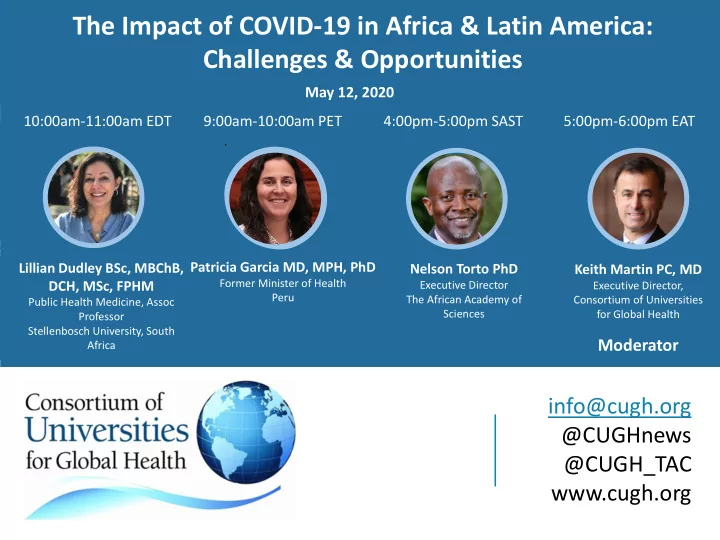
The Impact of COVID-19 in Africa & Latin America: Challenges & Opportunities May 12, 2020 10:00am-11:00am EDT 9:00am-10:00am PET 4:00pm-5:00pm SAST 5:00pm-6:00pm EAT Patricia Garcia MD, MPH, PhD Lillian Dudley BSc, MBChB, Nelson


slide-1
SLIDE 1

The Impact of COVID-19 in Africa & Latin America: Challenges & Opportunities

Lillian Dudley BSc, MBChB, DCH, MSc, FPHM

Public Health Medicine, Assoc Professor Stellenbosch University, South Africa

Patricia Garcia MD, MPH, PhD

Former Minister of Health Peru

Nelson Torto PhD

Executive Director The African Academy of Sciences

Keith Martin PC, MD

Executive Director, Consortium of Universities for Global Health

Moderator

info@cugh.org @CUGHnews @CUGH_TAC www.cugh.org

10:00am-11:00am EDT 9:00am-10:00am PET 4:00pm-5:00pm SAST 5:00pm-6:00pm EAT May 12, 2020

slide-2
SLIDE 2

Prof Nelson Torto, the African Academy of Sciences, Executive Director

The Global COVID-19 pandemic and the need for an African response

slide-3
SLIDE 3
  • A non-aligned, non-political,

not-for-profit pan-African organisation

  • The only continental Academy in Africa

enjoying the support and recognition of the AU, (and with joint programmes with AUDA-NEPAD), several governments and major international partner

  • Tripartite mandate:
  • recognise excellence,
  • advisory and think tank functions and
  • implementing key science, technology

and innovation programmes

The African Academy of Sciences (AAS)

Environment & Climate change Health & wellbeing Social sciences & Humanities Policy & governance Natural sciences The AAS Strategic Plan 2018-2022, priority areas

slide-4
SLIDE 4

The EVOLVING situation in Africa – Africa CDC Dashboard, 23 April 2020

Epidemic preparedness/Global Health Security – COVID-19

Data updated: 23 April 2020 | Source: Africa CDC

slide-5
SLIDE 5

The EVOLVING situation in Africa – Africa CDC Dashboard, 11 May 2020

Epidemic preparedness/Global Health Security – COVID-19

Data updated: 11 May 2020 | Source: Africa CDC

slide-6
SLIDE 6

Contextual issues for Africa for COVID-19

Food Insecurity 124M experience high level of food insecurity Climate Change

Africa’s 6M tons carbon emissions vs. China’s >9B yet will suffer worst devastation

Poverty

390M living in extreme poverty

High disease burden & epidemiological transition >20% disease burden, health system challenges High youthful Demographic Dividend

Kenya’s 3.1% vs. Italy’s 22.8% population >65 years

Rural-urban ratio (~3:2)

Variety of low density rural areas and high density urban areas

slide-7
SLIDE 7
  • Supporting the research base
  • Identifying African research priorities
  • Identifying relevant African research expertise
  • Identifying ongoing and planned COVID-19 research activities across Africa
  • Acting as a trusted resource for policy, public and community engagement

Epidemic preparedness/Global Health Security – COVID-19

The AAS’ role in the fight against COVID-19

The AAS is convening African and Global scientists, policymakers and funders to discuss the COVID-19 pandemic in Africa and what this means for the rest of the world. Specifically the AAS is:

slide-8
SLIDE 8
  • 4—8 April African scientists invited to

participate in an open survey to develop a priority list for R&D to supplement the WHO coordinated Global research Roadmap 844 completed responses

  • 17 new priorities specific for Africa identified

and listed against global priorities

  • Report available: COVID-19 R&D goals for

Africa CLICK ON LINK 26 March the AAS hosted a webinar to kick start common thinking towards defining a research agenda for the COVID-19 pandemic in Africa. 275 scientists attended Developing a list of COVID-19 experts and researchers working on COVID-19 related research on the continent through the AAS Clinical Trials Community (CTC) programme

Survey collating Africa’s R&D priorities COVID-19 experts in Africa AAS COVID-19 all hands Webinar

Epidemic preparedness/Global Health Security – COVID-19

The AAS mobilized partners to provide funding for identified research priorities, A COVID-19 call shared 1 May 2020

Funding for COVID-19 R&D priorities

What the AAS has done so far:

slide-9
SLIDE 9

Research & Development goals for the COVID-19 outbreak in Africa:

Epidemic preparedness/Global Health Security – COVID-19

Animal & environmental research on the virus origin, and management measures at the human-animal interface; Infection prevention and control, including health care workers’ protection; Integrating social sciences in the outbreak response Ethical considerations for research; Virus natural history, transmission, and diagnostics Clinical characterization and management; Epidemiological studies; Candidate therapeutics R&D; Candidate vaccines R&D; 42 priorities from WHO ROAD MAP plus 17 additional potential priorities from the consultation process

slide-10
SLIDE 10
  • Support work to examine alternative approaches to delivering testing

(e.g. centralised versus devolved)

  • Have a special focus on potentially at-risk groups e.g. malnourished

individuals, HIV, TB and Sickle Cell

  • Develop protocols for management of severe disease in the absence of

intensive care facilities

  • Develop new PPE approaches using local materials and

manufacturing processes

  • Establish processes for speeding up ethical review of Covid-19 related

research proposals

  • Examine optimal ways of communicating about potential

interventions in high density, low socioeconomic status urban settings

  • Investigate innovate approaches to short term economic support of

vulnerable populations such as cash transfer by mobile money mechanisms

Epidemic preparedness/Global Health Security – COVID-19

Examples of additional African priorities developed for the survey

slide-11
SLIDE 11

Epidemic preparedness/Global Health Security – COVID-19

Supporting grant-makers and organizations to quickly respond to the COVID-19 pandemic

  • The AAS announced a fixed cost of $100 to allow organizations
  • f any size to assess their compliance against the requirements
  • f the global standard for Good Financial Grant Practice (GFGP)
  • This allows organizations of any size to rate their capability to

receive and manage grants

  • The offer is restricted to grant makers and grant receivers who

can demonstrate the funds will be used to combat the COVID 19 pandemic. Benefits for Grant Makers and Grant Receivers.

  • Grantmakers can disburse funds quicker through searching the

GGC organizational directory to seek out new partners who have completed an assessment to GFGP and who are “ready to be funded”

  • Grant recipients can achieve greater credibility and attract more

funding for their COVID-19 related activities through completing pre-certification assessments on the GGC portal. Subject to permissions, the responses to the assessments can be viewed

  • n-line by potential funders who can quickly evaluate whether

they are financially capable to safely administer their funds.

slide-12
SLIDE 12

Epidemic preparedness/Global Health Security – COVID-19

Way forward

  • Rolling call – Have a perpetually open call with peer review on received

applications dependent on fund availability

  • Policy, public, community and engagement – priority list publication and

communication to partners

  • Clinical Trials Community (CTC) programme – development of COVID-19

database of experts, capacity to deliver work and COVID-19 ongoing and planned research

  • Convenings on research priority areas – formation of research expert groups
  • Engagement of Country Emergency Response groups – Research groups

with expert teams e.g. bioethics, vaccine development, candidate therapeutics, PPE evaluation

  • Develop multidisciplinary work packages – that release advisories for

countries e.g. inclusion of social science, humanities and economics

slide-13
SLIDE 13

Contact The AAS for more information or to join mailing list

Email: communication@aasciences.africa

www.aasciences.africa

The AAS COVID-19 team is led by Dr Moses Alobo and Prof Kevin Marsh covid19team@aasciences.africa To view more on the COVID-19 response visit https://www.aasciences.africa/COVID-19-updates

slide-14
SLIDE 14

COVID-19 AND INEQUITY– A PERSPECTIVE FROM SOUTH AFRICA

CUGH Webinar 12 May 2020 Assoc Prof Lilian Dudley Department of Global Health Stellenbosch University, South Africa

slide-15
SLIDE 15

Epidemic curves of outbreaks in selected African countries,25 Feb – 5 May

WHO Afro SitRep 6 May

slide-16
SLIDE 16

South Africa

  • First confirmed COVID-19 case 5 March

2020

  • Projected to peak between June and

September with approx. 50 000 deaths Context

  • Population 60 million, 9% > 60 years
  • 55.5 % live in poverty
  • 10% in informal settlements
  • HIV prevalence 20%; 62% on Rx
  • TB incidence 700/100 000
slide-17
SLIDE 17

Travellers Contacts Community transmission

slide-18
SLIDE 18
slide-19
SLIDE 19
slide-20
SLIDE 20
slide-21
SLIDE 21

Deaths from COVID-19

(n = 64, W.Cape, 06/05/2020) Co-morbidities in COVID-19 deaths (n = 64)

No co-morbidity 41% > 1 comorbidity 32% Of those with co-morbidities:- Diabetes 34% Hypertension 31% HIV 13% Cardiac 8% Obesity 6% COPD 4% Chronic kidney disease 3% Previous TB 1%

slide-22
SLIDE 22

What worked?

  • Stage 1: Handwashing campaigns on

media, preparing laboratories

  • Stage 2: Closing schools, borders to

international travel

  • Stage 3: Lockdown in high and middle

income suburbs. Multi-sectoral planning; civil society mobilisation.

What did not?

  • Stage 1: Limited culturally appropriate

community education; difficulties in physical distancing and hand hygiene; mixed messages about face masks.

  • Stage 2: Large gatherings – panic shopping;
  • Stage 3: Poor adherence to lockdown in low

income areas, particularly informal settlements. Queues for food parcels and social grants. Funerals. Excess police and military force. Increased domestic violence.

slide-23
SLIDE 23

What worked?

  • Stage 4: Testing available; > 28 000

CHW’s mobilised for community screening and testing

  • Stage 5: some Provinces active

surveillance, case and contact tracing, outbreak investigation

  • Stage 6: Enough time to prepare

medical facilities, temporary hospitals and procure supplies

What did not?

  • Stage 4: testing case definition very

narrow; CHW screening not targeted.

  • Stage 5: lab testing backlogs, data

and ‘implausible’ trends

  • Stage 6: Limited bed, clinical and ICU

capacity, competition for PPE and

  • ther supplies – no flights
slide-24
SLIDE 24

Challenges: Inequity

Socio- economic

  • Food insecurity - >30% hungry
  • Living conditions
  • Livelihoods – unemployment increased to

> 40%

  • Slow social relief response from

government

  • Engagement of communities, fake news
  • Excess use of force

Health System

  • Outbreak preparedness – IHR JEE

scores

  • Dual health system – 80% dependent
  • n poorly resourced public health

system

  • Quality of care – IPC scores poor
  • Laboratory system – accredited but

under pressure, long ToT

  • Inpatient beds & ICU capacity

Talisuna A et al. JEE of the IHR (2005) capacities: current status and lessons learnt in the WHO African region BMJ Global Health 2019;4:e00131

slide-25
SLIDE 25

Opportunities: Address inequity and strengthen public health – tailor response to context

Socio- economic

  • Safe housing, access to water &

sanitation

  • Address food insecurity
  • Create employment opportunities
  • Improve management of social

security system

  • Engagement and empowerment of

communities

  • Change approach of security forces

to population

Health System

  • Strengthen and tailor public health

and outbreak preparedness – IHR (2005)

  • Universal health coverage & national

health system for SA

  • Improve quality of care & IPC
  • Strengthen laboratory system,

medical care capacity

  • Local production of medical products

and supplies - ? intnl patents

Mehtar S et al. Limiting the spread of COVID-19 in Africa: one size mitigation strategies do not fit all

  • countries. Lancet Global Health, April 28 2020.
slide-26
SLIDE 26