The General Plan Update County of Kauai Planning Department SSFM - - PDF document

the general plan update
SMART_READER_LITE
LIVE PREVIEW

The General Plan Update County of Kauai Planning Department SSFM - - PDF document

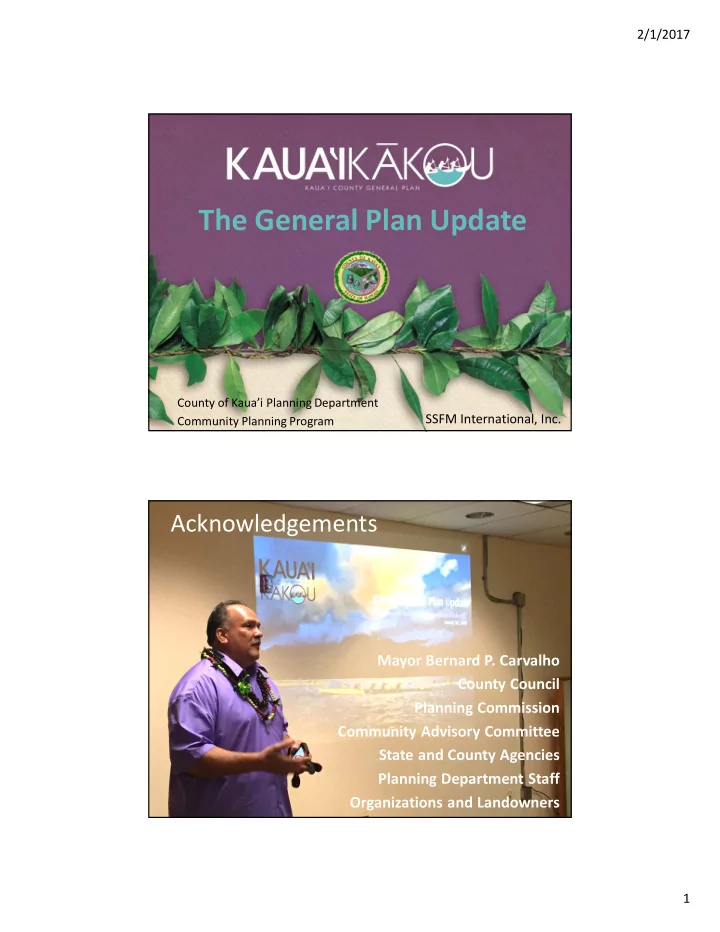
2/1/2017 The General Plan Update County of Kauai Planning Department SSFM International, Inc. Community Planning Program Acknowledgements Mayor Bernard P. Carvalho County Council Planning Commission Community Advisory Committee State


slide-1
SLIDE 1

2/1/2017 1

The General Plan Update

County of Kaua’i Planning Department Community Planning Program

SSFM International, Inc.

Mayor Bernard P. Carvalho County Council Planning Commission Community Advisory Committee State and County Agencies Planning Department Staff Organizations and Landowners

Acknowledgements

slide-2
SLIDE 2

2/1/2017 2 1. Introduction 2. “Kaua’i Kakou” Project Development 3. Public Process and Youth Outreach 5. 4 Goals and Vision Statements 6. 20 Policies 7. 10 Sectors 8. Future Land Use Map 9. Implementation

  • 10. Closing

Overview

slide-3
SLIDE 3

2/1/2017 3

Michael Dahilig Kaaina Hull Marie Williams Leanora Kaiaokamalie Marisa Valenciano Lee Steinmetz Ruby Pap Cheryl Soon, FAICP Melissa White, AICP

PROJECT TEAM

Opticos Design, Inc. Charlier & Associates SMS Research PBR-Hawai’i UH Sea Grant

Planning Department Consultant Subconsultants

CAC

Bill Arakaki Kurt Bosshard Bev Brody Helen Cox Luke Evslin Ross Farias Randall Francisco Laurie Ho Brenda Jose Sue Kanoho Cammie Matsumoto Mark Oyama Gary Pacheco Barbara Robeson Tom Shigemoto Stacy Sproat-Beck Susan Tai Keneko

slide-4
SLIDE 4

2/1/2017 4

What is the General Plan?

Mandate

  • State Law

HRS § 226-58 (2013)

  • County Charter

Section 14.06

  • Kaua’i County Code

Chapter 7

Opportunity

Capture the hopes and concerns

  • f the community

Confront emerging issues and trends Educate about the importance of planning Get buy-in from agencies and partners

General Plan

slide-5
SLIDE 5

2/1/2017 5

General Plan

Phase 1: 2012-2015

Multimodal Transportation Plan Community Plan Updates

PURPOSE: To establish baseline data and inform how we plan

Socioeconomic Projections Land Use Buildout Analysis Infrastructure Assessment Climate Change & Coastal Hazards Community Health IAL

Key Growth Trends

slide-6
SLIDE 6

2/1/2017 6

Phase 2: 2015-2017 Timeline

  • Work Plan
  • Public

Engagement Strategy

  • Technical Paper

Review

Nov 2014- Mar 2015

  • Existing

Conditions, Issues & Opportunities

  • CAC Kickoff
  • Media Campaign
  • Website

April 2015

  • Community

Meetings

  • Policy

Development Strategy

May 2015

  • Vision, Goals, Policy

Development

  • Ongoing CAC,

Agency Briefing

  • Public Engagement

June 2015-June 2016

  • Administrative Draft

Plan

  • Discussion Draft
  • Community Open

Houses

August- December 2016

  • Departmental Draft
  • Planning

Commission Review

  • Council Review
  • Adoption of Final GP

Early 2017

WE ARE HERE

12

slide-7
SLIDE 7

2/1/2017 7

White Papers and Studies

Updating the Vision for Kaua‘i (July 2015) Entitled Lands Analysis (August 2015) Issues and Opportunities Paper (September 2015) Economic Snapshot of Kaua‘i (November 2015) Community Place Types and Degree-of-Change Visioning Workshops (November 2015 and April 2016) Adequacy of Future Infrastructure Assessment (August 2016) Integrating State and County Transportation Policy (September 2016)

13

The Public Process

Marisa Valenciano, COK Planning Department

14

slide-8
SLIDE 8

2/1/2017 8

General Plan

Community & Special Area Plans

Functional Plans Regulatory

Capital Improvements Program

Actions

Community = Foundation of the Plan

slide-9
SLIDE 9

2/1/2017 9 Visioning Outreach

Policy and Land Use Outreach Discussion Draft Outreach

Spring 2015

  • Nov. 2015- Oct. 2016

Winter 2016

Face-to-Face Engagement

CAC Meetings Agency Meetings Landowner Meetings Community Meetings/ Open House Small Group Meetings Neighborhood Association Meetings

slide-10
SLIDE 10

2/1/2017 10

Digital Engagement

Instagram #plankauai Website Facebook Video Online Surveys E-Mail Blasts

Youth Engagement

Elementary School Middle School High School Colle ge

slide-11
SLIDE 11

2/1/2017 11

Innovative Ideas for Outreach

Pop-Up Events Coffee Hour Talk Place-Type Workshops

Vision, Goals and Policies

Leanora Kaiaokamalie, COK Planning Department

22

slide-12
SLIDE 12

2/1/2017 12

Vi Visio sion & & Goals als Polici cies es Actions

Organization of General Plan 2035 Vision and Goals Twenty Cross-Sector Policies

Organization of General Plan 2035

VISION AND GOALS

CROSS-SECTOR POLICIES ACTIONS

By way of…  Permitting actions and code changes  Plans and studies  Partnership needs  Projects and programs

Policy Maps  Land Use Designations  Heritage Resources  Hazards  Infrastructure  Public Facilities  Transportation

High Level Specific

10 Sectors  The Watershed  Housing  Transportation  Economy  Heritage Resources  Energy Sustainability  Public Safety & Hazards Resiliency  Opportunity & Health for All

slide-13
SLIDE 13

2/1/2017 13

Organization of General Plan 2035

Policy Maps – Section 5.0

Land Use Designations Maps  Document the desired land patterns for the six Planning Districts  Distinguish areas appropriate for future development  Identify areas to be preserved  New designations – Natural (versus open) – Neighborhood Center – Neighborhood General – Urban Growth Boundary (Līhu‘e) – Plantation Camps (Makaweli) – Homesteads – Large Towns – Small Towns – University (Puhi) – [Provisional] – pending Community Plan process

Organization of General Plan 2035

Policy Maps, cont…

Other Maps  Heritage Resources  Hazards  Infrastructure  Public facilities  Transportation – Transit – Roadways and Paths These maps, in conjunction with the Land Use maps are intended to:  Guide review of projects, including subdivision development  Be used in preparation of community and functional plans  Be used in preparation of amendments to the CZO, zoning maps, SMA, and other

  • rdinances
slide-14
SLIDE 14

2/1/2017 14

A sustainable island A unique and beautiful place A healthy and resilient people An equitable place, with opportunities for all

Vision and Goals

Growing responsibly to meet the needs of current and future generations without depleting resources. Stewardship and protection of the natural, cultural, social, and built environment assets that are of value to the community. Increasing health, vitality and resilience of communities through improving the natural, built and social environment and responding to impacts from climate change. Fostering diverse and equitable communities with vibrant economies, access to jobs and housing, and a high quality of life.

To Guide Growth and Meet Vision and Goals

POLICIES

Cross-Sector

The General Plan is a Policy Document The Policies hone-in and describe the key cross- sector issues expressed by community during the public process The Policies articulate the path forward to meeting the community’s vision and goals of sustainability, unique character, resilience, and equity

slide-15
SLIDE 15

2/1/2017 15

POLICIES

Cross-Sector

Act with the understanding that forests, biodiversity, and water resources are fragile and

  • interconnected. Restore and

protect our watershed from mauka to makai. Protect the island’s natural beauty by preserving the open space and views between towns. Perpetuate traditional Native Hawaiian rights and protect public trust resources and cultural sites in all land use development and activities. Protect access to and customary use of shoreline areas, trails, and places for religious and cultural

  • bservances, fishing, gathering,

hunting and recreational activities, such as hiking and surfing. Mitigate Climate Change and reduce system-wide carbon emissions by at least 80% by 2050 through deep reductions in energy use and by transforming electricity, transportation, and infrastructure systems toward the use of clean energy. Prepare for impacts to the island economy, food systems, and infrastructure that will be caused by Climate Change.

See handout

POLICIES

Cross-Sector

Create and foster thriving commercial areas in Town Centers through improved Infrastructure, civic space, streetscapes, updated zoning standards, and streamlined approval processes. Support economic Diversification and access to locally produced food by increasing the productivity and profitability of all forms of

  • agriculture. Nurture small-scale

farms, promote crop diversity, and form stronger public/private partnerships with farmers Protect the identity of Kaua‘i’s visitor industry by focusing on revitalization and limiting new resort growth only to existing Visitor Destination Areas. Reduce visitors’ impacts on infrastructure and communities. Reduce the combined cost of housing and transportation, which consume more than 30% of the average household income. Do this by connecting jobs and providing a diversity of housing types and affordable transportation options. Increase the amount of housing available for local households by focusing infrastructure improvements in growth areas. Eliminate onerous regulatory barriers and form active public-private partnerships.

slide-16
SLIDE 16

2/1/2017 16

POLICIES

Cross-Sector

Kaua‘i’s towns and planning districts are distinct, each with its own character, opportunities, and needs. This uniqueness must be celebrated, protected in Community Plans, and reinforced in development standards. Preserve Kaua‘i’s rural character by limiting the supply of developable land to an amount adequate for future needs. Prohibit development not adjacent to towns. Ensure new development occurs inside growth boundaries and is compact and walkable. Ensure new and existing neighborhoods have safe roads and functional parks, as well as access to jobs, commerce, transit, and public services. New government investment should support growth areas and include priority projects as identified in Community Plans. Manage future congestion conditions in the major growth areas

  • f Līhu‘e and South Kaua‘i through

strategic infrastructure improvements and increased multimodal transportation options. Improve traffic conditions along Wailua-Kapa‘a corridor by implementing capacity and congestion management projects, including network and intersection improvements, and through careful management of residential growth of the Wailua Bridge.

POLICIES

Cross-Sector

Prepare for the aging of Kaua‘i’s population through housing, services, and facility improvements that meet the needs of elderly households. Value youth as Kaua‘i’s most treasured resource. Provide them with safe communities, great schools and facilities, and financially sustainable jobs, housing, and transportation

  • pportunities so they are able to

seek livelihoods on Kaua‘i.

Kaua‘i’s residents care about planning and decision-making. Government must share information, encourage input, improve public processes, and be responsive.

slide-17
SLIDE 17

2/1/2017 17

Overview of General Plan Sectors

Cheryl Soon, SSFM International

33

What are Sector Actions and how do they fit into the Kaua‘i Planning System?

34

slide-18
SLIDE 18

2/1/2017 18

Chapter 2: Eleven Sectors

  • I. Watersheds
  • II. Housing
  • III. Land Transportation
  • IV. Critical Infrastructure
  • V. Shared Spaces
  • VI. Economy
  • VII. Heritage Resources
  • VIII. Energy Sustainability
  • IX. Public Safety and Hazards Resiliency
  • X. Opportunity and Health for All

[ XI. Land Use is Chapter 4]

35

Four Tools for Action

Permitting Actions and Code Changes Plans and Studies Partnership Needs Projects and Programs

36

slide-19
SLIDE 19

2/1/2017 19

Watershed

  • Upper/Mauka
  • Aquifers, Streams,

Water Bodies, Drainage

  • Māka‘i/Lower
  • Invasive Species

Key Actions: Forests and Mauka Areas

  • Establish a County Watershed Task Force or liaison to

facilitate communication and coordination between agencies and organizations that work in the watershed

  • Educate residents and visitors about native species

stewardship

  • Work with the State, private landowners, and other

partners to improve management and protection of forest resources and upper watershed areas in Conservation Districts Key Actions: Aquifers, Streams, Water Bodies

  • Incorporate green infrastructure into County drainage

regulations and manuals and the CZO

  • In Community Plans, include protective actions for streams

and inland water bodies

  • Support the efforts of volunteer environmental groups and

encourage efforts to manage and protect watersheds

37

Watershed (2)

  • Upper
  • Aquifers, Streams, Water

Bodies, Drainage

  • Māka‘i/Lower
  • Invasive Species

Key Actions: Shorelines and Coastal Waters

  • Protect the quality of coral reefs through standards that

address, prevent and minimize impacts from development

  • Fund and utilize the Public Access, Open Space, and

Natural Resources Fund to actively acquire shoreline lands and access ways for public use

  • Support the creation and implementation of community-

based subsistence management activities Key Actions: Threatened and Endangered Species

  • Address development impact on threatened and

endangered flora and fauna prior to construction and

  • perations
  • Support efforts to complete and implement native

species Habitat Conservation Plans

  • Support predator control programs and efforts
  • Develop educational programs about endangered and

threatened species

38

slide-20
SLIDE 20

2/1/2017 20

Housing

  • Affordable Housing
  • Infill Housing
  • New Communities
  • Housing for Agriculture Workers
  • Hawaiian Homesteads
  • Elderly and Assisted Living
  • Houseless
  • Impact of Resort Uses

Key Actions

  • Promote and support appropriately scaled infill

development in all towns, with the exception of areas affected by existing and future hazards

  • Remove impediments to the development of

affordable housing

  • Increase opportunities for moderate and low income

households to become homeowners by providing a range of housing types

  • Build housing in proximity to jobs, parks, community

resources and services

  • Increase supply of residential housing that is

affordable, accessible to services, and promotes aging-in-place

  • Prevent and reduce time spent houseless by

providing a continuum of safe and affordable housing opportunities and supportive programs

  • Identify partnership opportunities with landowners

and community organizations to accommodate sheltering and transitional housing needs for the houseless population and people with disabilities

39

Land Transportation

  • Balanced System
  • County Roads
  • Transit
  • Pedestrian
  • Bicycle
  • Parking Management

Key Actions: Balanced System

  • Coordinate transportation planning with land

use to minimize congestion, improve walkability in town centers, revitalize commercial areas, and enhance mobility in places where people live, work, learn and play

  • In all Community Plans, incorporate planning of

transportation needs to support economic revitalization

  • Improve the process of collaboration with

Hawai‘i Department of Transportation in planning, scoping, design, and funding of transportation plans and projects

40

slide-21
SLIDE 21

2/1/2017 21

Land Transportation (2)

  • Balanced System
  • County Roads
  • Transit
  • Pedestrian
  • Bicycle
  • Parking Management

Key Actions: Roads

  • Complete street design standards to address all

users

  • Support completion of the priority projects in the

Kapa‘a Transportation Solutions Report

  • Complete priority roadway projects identified in

the Roadway Capacity, Network, and Shared Use Path Map Key Actions: Transit

  • Complete Short Range Transit Plan and set

priorities for expanding service and increasing the bus frequency. Complete priority projects identified in the Transit Map

  • Improve bus routes and schedule information,

amenities, shelters and maintenance.

41

Land Transportation (3)

  • Balanced System
  • County Roads
  • Transit
  • Pedestrian
  • Bicycle
  • Parking Management

Key Actions: Pedestrian

  • Continue a robust Safe Routes to School Program
  • Complete priority pedestrian projects as identified in

Community Plans and other studies

  • Develop a Safe Routes to Parks program

Key Actions: Bicycle Program

  • Establish an island-wide bikeways plan with

priorities for implementation

  • Prepare and implement a bike share feasibility study
  • Complete shared use paths on the East Side, West

Side, and South Side

42

slide-22
SLIDE 22

2/1/2017 22

Critical Infrastructure

  • Domestic Water
  • Wastewater, Septic,

Cesspools

  • Solid Waste and Recycling
  • Airports & Harbors

Key Actions

  • Give priority to water supply improvements in

infill development areas with compact development

  • Encourage alternative individual water systems,

such as rainwater catchment and greywater recycling

  • Expand wastewater systems to existing

communities and provide new regional wastewater treatment solutions for South Kaua‘i and Kīlauea

  • Reduce solid waste volume through recycling and

source-reduction programs

43

Shared Spaces

  • Town Centers
  • Parks
  • Linear Parks,Trails, and Passive

Parks

  • State Parks
  • Privately Owned Recreation

Spaces

Key Actions

  • Prioritize the building and maintaining of

parks, playgrounds and green spaces in low-income neighborhoods with concentration of youth

  • Provide more opportunities for disabled

and elderly to use parks through enhanced accessibility features

  • Ensure that large residential development

projects a range of civic space and parks

44

slide-23
SLIDE 23

2/1/2017 23

Economy

  • Tourism
  • Agriculture
  • Small Business and

Economic Clusters

Key Actions: Tourism

  • Revitalize, rather than expand existing resort areas.
  • Do not expand Visitor Destination Areas or provide

for new resort areas

  • Develop alternative transportation options for

visitors

  • Promote sustainable tourism and cultural exchange

Key Actions: Agriculture

  • Protect agricultural lands from conversion to other

uses through regulations and code changes and designation of IAL

  • Protect and restore irrigation systems
  • Incentivize and provide assistance to farmers to

promote diversified agriculture and locally grown food products

45

Economy (2)

  • Tourism
  • Agriculture
  • Small Business

and Economic Clusters

Key Actions: Small Business

  • Lessen restrictions for home based

businesses in rural areas and revitalize rural town centers

  • Invest in incubators and shared

facilities to promote creative industries, technology, and manufacturing

  • Leverage the tourism industry to

market and promote Kaua‘i Made products.

46

slide-24
SLIDE 24

2/1/2017 24

Heritage Resources

  • Historic Buildings

and Structures

  • Cultural Sites and

Resources

  • Landmarks and

Scenic Resources

Key Actions: Heritage Resources

  • Preserve and Restore important archaeological

and cultural sites

  • Maintain customary access to these sites
  • Create natural, landscaped buffers between

sites and adjacent uses

  • Acknowledge sites and wahi pana in

Community Plans

  • Promote partnerships to preserve and raise

awareness

  • Prepare amendments to provide criteria

47

Opportunity and Health for All

  • Social Equity
  • Access to

Education and Training

  • Community Health

Key Actions: Social Equity

  • Establish health and opportunity criteria for prioritizing

County programs and policies

  • Complete a study to establish ratios for different

categories of housing for workforce, elderly, disabled

  • Deepen partnerships with Kaua‘i Community College to

workforce development and training programs and apprenticeships Key Actions: Health Services

  • Conduct health impact assessments to analyze policy

proposals for their impacts on health equity

  • Change the land use code to support healthy community

design

  • Increase access to healthy foods and work with fast-food

restaurants to offer healthy options and improve labeling.

48

slide-25
SLIDE 25

2/1/2017 25

Energy Sustainability

  • Energy

Sustainability

  • Reduction of

Greenhouse Gases

Key Actions: Energy Sustainability

  • Support the Kaua‘i Island Utility Cooperative (KIUC)

and private enterprise initiatives for solar, biomass, hydro, and other clean energy production types to reach 50% renewable energy production by 2023

  • Reduce Kaua‘i’s greenhouse gas emissions 80% by

2050 by renewable technologies, conservation, and efficiency

  • Promote higher density residential development

near job centers and amenities, while strongly discouraging development that will require residents to commute by car

  • Accelerate the transition to alternative fuels in the

transportation sector

49

Public Safety and Hazard Resiliency

  • Police, Fire, and

Emergency Services

  • Hazard Resiliency
  • Global Warming

and Climate Change Adaptation

Key Actions

  • Develop community-based resilience plans,

and incorporate disaster management into future Community Plans

  • Develop a post-disaster recovery plan that

incorporates disaster mitigation into development and land use plans

  • Designate evacuation routes, critical facility

access routes, and public shelters in cooperation with local communities

  • Educate residents, businesses, and visitors

about disaster preparedness and response

50

slide-26
SLIDE 26

2/1/2017 26

Summary Matrix of Sector Actions See also, Appendix H

Sectors SUSTAINABILITY Growing Responsibly STEWARDSHIP Protecting Kaua‘i’s Unique Beauty HEALTH & RESILIENCE Strengthening Communities OPPORTUNITY Promoting Diversity & Equity The Watershed

Ensure use and enjoyment of resources without depletion. Protect natural, historic, and cultural resources in perpetuity. Protect resources and traditions that promote self-sufficiency. Promote equal access to natural areas and recreation. Public Safety & Hazards Resiliency Protect or relocate assets, develop outside hazard areas, and reduce greenhouse gas emissions. Identify and protect those resources vulnerable to climate change. Strengthen preparedness, response, and recovery to hazards and climate change. Increase and diversify food grown and consumed on island. Opportunity & Health for All Foster shared responsibility for sustainable choices. Protect residents’ access to shoreline and recreational areas Improve health aspects of natural and built landscapes. Ensure widespread access to health care, education, and services. Economy Promote economic diversification and cross- sector convergences Protect high-quality agricultural lands from development. Partner to enhance education and employment opportunities Provide infrastructure to strengthen and grow small business Housing Provide housing to accommodate growth within and near town centers. Prevent housing sprawl into Open and Agricultural lands. Provide housing for multi- generational families and aging in place. Ensure affordable housing is provided in proximity to job centers. Infrastructure & Services Provide adequate infrastructure to accommodate growth. Preserve natural areas by concentrating growth and services in existing developed areas. Provide equitable access to safe and sanitary services and facilities. Ensure low income communities have adequate facilities and services. Energy Sustainability Reduce fossil fuels and transition to renewables. Encourage use of alternative fuel sources. Promote clean energy from non-harmful sources. Explore solutions to reduce energy costs to residents. Shared Spaces Provide adequate park facilities for resident and visitor enjoyment. Protect popular destinations from deterioration and overuse. Provide a diversity of facilities that support active lifestyles Increase access to parks and recreation in all neighborhoods Transportation Promote multimodal shifts to reduce costs. Decrease vehicle miles traveled to reduce carbon emissions. Provide connectivity and safe routes to walk or bike to parks and schools. Promote equal access to transportation. Land Use Concentrate growth within and adjacent to existing centers. Protect open spaces between communities and scenic view planes. Provide community gathering places and walkable neighborhoods. Promote mixed-income and diverse communities with a range of housing. Planning District Policies Ensure that each district completes a Community Plan. Identify elements of character and features to be preserved. Celebrate community identity and provide gathering places. Promote rural revitalization and provision of basic services.

51

Future Land Use

SSFM International

52

slide-27
SLIDE 27

2/1/2017 27

Directed Growth Policy

  • The GP land use map and policies direct

growth to existing communities through mixed use development and infill.

  • This approach is directly supportive of the

following General Plan Policies:

53

Directed Growth by District (2010-2035)

54 1990 2000 2010 2020 2030 2035 County of Kaua‘i 51,67 6 58,46 3 67,09 1 74,69 3 83,32 8 88,013 Līhu‘e 11,16 9 12,50 7 14,68 3 18,01 7 21,59 5 23,456 South Kaua‘i 9,600 10,54 5 11,69 6 13,62 3 15,73 7 16,855 Hanapēpē - ‘Ele‘ele 3,873 4,362 6,157 6,463 6,860 7,094 Waimea-Kekaha 4,698 5,660 5,561 5,901 6,323 6,566 North Shore 5,913 6,605 8,002 8,286 8,686 8,933 East Kaua‘i 16,19 2 18,78 4 20,99 2 22,40 3 24,12 8 25,110

Kaua‘i County Population, Island wide and By District (1990-2035)
slide-28
SLIDE 28

2/1/2017 28

Approach to Updating Land Use Maps

55

Action Resources Consulted Consulted population allocations and buildout projections contained in the General Plan technical studies Land Use Buildout Analysis (PBR Hawai‘i, 2015) Socioeconomic Analysis & Forecasts (SMS Research, 2016) Confirmed or updated information on entitled lands and landowner plans County permit records Landowner interviews Incorporated information from South Kaua‘i and Līhu‘e Community Plans regarding areas of change and land use designations Līhu‘e Community Plan (2015) South Kaua‘i Community Plan (2015) Applied place types and right-sized Neighborhood Centers in Waimea-Kekaha, Hanapēpē-‘Ele‘ele, East Kaua‘i, and North Shore General Plan Community Visioning Workshops (November 2015 and April 2016) Applied/overlaid information on hazard areas and infrastructure to existing developed areas and future growth areas General Plan Infrastructure Study (RM Towill, 2015) Infrastructure Assessment for the General Plan Update (SSFM International, 2016) Kaua‘i Climate Change and Coastal Hazards Assessment (2014) NOAA Sea Level Rise (SLR) Viewer State and County GIS Hazard Layers Applied Neighborhood Center and Neighborhood General designations to areas identified for growth Līhu‘e Community Plan (2015) South Kaua‘i Community Plan (2015) General Plan Community Visioning Workshops (November 2015 and April 2016) Updated and applied General Plan land use designations for areas outside Neighborhood Center and General areas Kaua‘i General Plan (Kaua‘i County, 2000)

Līhu‘e and South Kaua‘i CP examples

Walkable Place Types

56

slide-29
SLIDE 29

2/1/2017 29

Kaua‘i’s Walkable Place Types

Place Type Characteristics Example Crossroads Small amount of locally serving retail and other services in a rural context. Transitions into rural or natural areas. Scale: < 1 Neighborhood Village Compact, standalone places featuring a small main street surrounding

  • residential. Transitions into agricultural

uses or natural areas. Scale: ≤ 1 Neighborhood Small Town Made up of clusters of neighborhoods in urbanized areas that can support a larger mixed-use environment. Scale: 2-3 Neighborhoods Large Town Urbanized areas with multiple neighborhoods supporting a mixed use environment. Scale: 4+ Neighborhoods

57

La Land Us nd Use Ma Map: p: Isl Island V View

58

Twelve Land Use Designations:

  • Natural
  • Agriculture
  • Homesteads
  • Neighborhood Center
  • Neighborhood General
  • Residential Community
  • Urban Center
  • Industrial and Transportation
  • Military
  • University
  • Parks and Recreation
  • Golf Courses
slide-30
SLIDE 30

2/1/2017 30

Updated Land Use Designations

59 Designation Differencefrom 2000 General Plan AGRICULTURE GP Update distinguishes between IAL and non-IAL lands. NATURAL Applies only to undeveloped areas (replaces Open designation from 2000 GP). Areas designated as Natural have either limited development capacity or are not suitable for development due to topography, hazards vulnerability, sensitive resources, and other constraints. URBAN CENTER Limited to Līhu‘e District (within Urban Growth Boundary). Applies to urbanized areas that accommodate intensive urban uses and zoning such as general commercial and general industrial. UNIVERSITY New designation applied to Kaua‘i Community College (Līhu‘e District). NEIGHBORHOOD CENTER, GENERAL Neighborhood Center is a new designation focused on historic town cores. It corresponds to existing or future areas appropriate for accommodating infill development and growth. Neighborhood General applies to areas within a quarter mile, or five-minute walk, from Neighborhood Centers. RESORT Resort Designation was removed or reduced in unentitled areas (without County Resort Zoning or Visitor Destination Area) and where there was little community support for resort expansion such as Nukoli‘i. Further restrictions are required on remaining areas without entitlements in the actions for the Economy sector. HOMESTEAD New designation created to acknowledge existing rural residential areas in Kalāheo, Wailua, and Kapa‘a. RESIDENTIAL COMMUNITY Only applies to existing residential communities more than 0.25 mile from existing centers, as well as planned and entitled developments. Not applied to future growth areas. PARKS AND GOLF COURSES Definition of Parks is unchanged. Golf Courses shown separately from Parks. MILITARY, INDUSTRIAL, TRANSPORTATION Definition unchanged.

Actions Needed for Land Use Map Implementation

PERMITTING ACTIONS AND CODE CHANGES

  • Implement a zoning program to comprehensively redistrict and

rezone lands consistent with the Future Land Use Map and updated Community Plan and map designations.

  • Build upon place types in future Community Plans and update

zoning and development standards to be place-based.

  • Support State Land Use Boundary Amendment Petitions for new

Urban District consistent with the Future Land Use Map. PLANS AND STUDIES

  • Use the community planning process to update and refine the

Future Land Use Maps as needed.

60

slide-31
SLIDE 31

2/1/2017 31

How to Use the Land Use Maps

To identify existing developed areas and lands appropriate for future development. To identify areas that should be retained in a natural or undeveloped state due to special qualities or vulnerabilities to erosion and other hazards. To guide preparation of Community Plans. To prepare or revise land use ordinances and rules, including but not limited to the following: revisions to the Comprehensive Zoning Ordinance or the Zoning Maps; zone change ordinances; revisions to the Special Management Area (SMA) rules or boundaries; revisions to the Subdivision Ordinance; and the preparation of new ordinances or rules. To be consulted when projects are undertaken with State or County lands or funds. To serve as a guide in the review of subdivision and land use permit

  • applications. General Plan Land Use Maps alone may not be used to

prohibit a land use that is allowed by the Comprehensive Zoning Ordinance or by permit.

61

Approach to Updating Planning District Visions and Land Use Maps

62 Community Vision Statements Policy Opportunities and Priorities Land Use Map Changes

Town Centers and Walksheds Place Types Degrees of Change

Community Input GP Vision, Policies & Actions Baseline Information & References 2000 General Plan, Community Plans, GP Technical Studies, Landowner Interviews

District Vision Community Plans Functional Plans Regulatory Changes

slide-32
SLIDE 32

2/1/2017 32

Community Visioning Workshops

(East Kaua‘i, North Shore, Hanapēpē- ‘Ele‘ele, Waimea-Kekaha)

  • Identified

centers, place types, desired degree of change, preliminary vision statements, and other priorities for four planning districts.

63

Information collected during the workshops told us…

  • How the community defines its character, scale,

and form, now and in the future (Place Type)

  • How much each community wants to grow and

evolve (Degree of Change)

  • The core areas that constitute community identity

and take priority for revitalization and investment (Town Centers and Walksheds)

This information was documented in presentations and maps that were vetted by community members in a closing presentation. The findings formed the basis of a Place Typing and Community Vision memo and maps to inform General Plan land use designations.

64

slide-33
SLIDE 33

2/1/2017 33

Wa Waimea- Ke Keka kaha

65

  • Two areas west of Waimea

changed from Residential Community to Agriculture.

  • 60 acres of Resort

changed to “Conditional” Resort to allow for a community planning process to determine the appropriateness, scale and extent for resort development in Waimea. Major Land Use Map Changes

Han Hanapēpē

  • ‘El
  • ‘Ele‘ele

66

  • Neighborhood Center, Edge

and General Designation added to both Port Allen and Hanapēpē Town to be consistent with DHHL plans and to connect Lima Ola to Port Allen.

  • 75 acres for planned Lima Ola

affordable housing development changed from Agriculture to Residential Community.

  • New Neighborhood Center and

Neighborhood General added to Port Allen.

  • Approximately 19 acres in

Makaweli on existing mill site from agriculture to industrial.

Major Land Use Map Changes

slide-34
SLIDE 34

2/1/2017 34

Sou South Ka Kaua‘i

67

Major Land Use Map Changes

  • Neighborhood Center, Edge

and General Designation applied to Kōloa, Kalāheo and Po'ipū Roundabout Area.

  • New Neighborhood Center at

Po’ipū Mixed Use Gateway.

  • Residential Community

removed from 60 acres above Weliweli Tract.

Līhu‘ hu‘e e

68

  • Neighborhood Center

applied to Līhu‘e Town Core, Puhi Mauka, Isenberg Mauka, Hanamā‘ulu Town, and area in Hanamā‘ulu fronting Highway adjacent to Triangle (west of bluff) formerly owned by EWM.

  • Urban Center applied

surrounding Neighborhood Centers and within Urban Growth Boundary.

  • Residential Community

removed from areas along Kīpū Road. Major Land Use Map Changes

slide-35
SLIDE 35

2/1/2017 35

Ea East Ka Kaua‘i

69

Major Land Use Map Changes

  • Urban Center designation

around Kapa‘a Middle School changed to Agriculture (site of proposed Hokua Place development).

  • Urban Center in Kapa‘a

removed and Neighborhood Center/General/Edge applied.

  • Portion of area behind Coco

Palms in the Flood Zone changed from Resort to Natural.

  • New Neighborhood Center at
  • Kapahi. Anahola Post Office,

and Anahola Town Center (to match DHHL’s Anahola Town Center Plan).

No North rth Sh Shor

  • re

70

Major Land Use Map Changes

  • Neighborhood Center and

General Designation applied to Hanalei and Kīlauea.

  • Kīlauea town center

expanded to accommodate growth.

  • Residential Community at

Princeville Airport changed to Transportation.

  • Residential Community

mauka of Princeville Airport removed and changed to Agriculture.

  • Resort designation makai of

highway limited by policy in Actions by Sector VI Economy Section 1 Permitting Actions.

slide-36
SLIDE 36

2/1/2017 36

Implementation

Marie Williams, COK Planning Department

71

Implementation

  • Chapter 3, Implementation & Monitoring
  • Appendix H, General Plan Action Matrix
slide-37
SLIDE 37

2/1/2017 37

Reporting & Monitoring

73

  • Performance Measures
  • Process Measures - how well is the plan being

implemented

  • Outcome Measures - address the question of

whether the right changes are occurring

  • Online Dashboard – real-time and accessible
  • Kakou Committee – biannual review

A Living Document

  • Sec. 7-3.1, KCC

Amendment of the General Plan The General Plan Ordinance or the General Plan of the County of Kaua‘i may be amended by ordinance, in accordance with the Charter. An amendment may change provisions of this ordinance; text provisions or map designations of the General Plan document; or any of these in combination.

slide-38
SLIDE 38

2/1/2017 38

Wrap-up

75

Marie Williams, COK Planning Department

MAHALO!

76