SLIDE 1 The Evolutionary Origins of Genetic Information
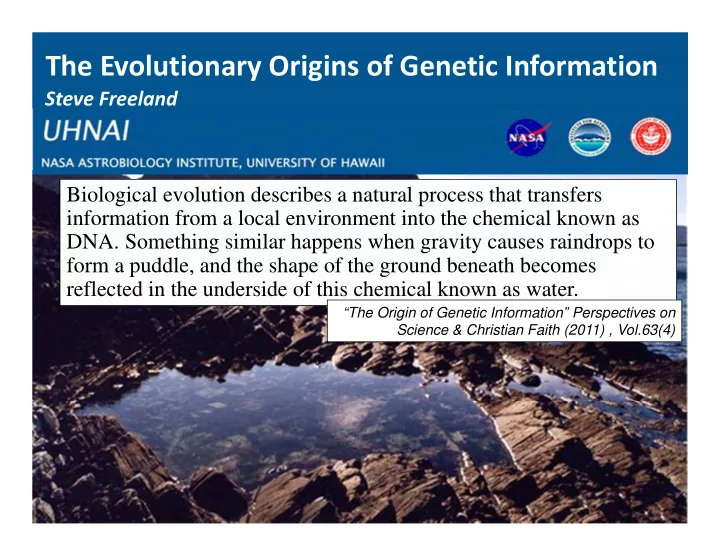
Biological evolution describes a natural process that transfers information from a local environment into the chemical known as
- DNA. Something similar happens when gravity causes raindrops to
form a puddle, and the shape of the ground beneath becomes reflected in the underside of this chemical known as water. Biological evolution describes a natural process that transfers information from a local environment into the chemical known as
- DNA. Something similar happens when gravity causes raindrops to
form a puddle, and the shape of the ground beneath becomes reflected in the underside of this chemical known as water.
“The Origin of Genetic Information” Perspectives on Science & Christian Faith (2011) , Vol.63(4)
Steve Freeland
SLIDE 2
Clearly, biological organisms carry a lot of non‐random information … Can natural processes account for the emergence of new genetic information?
SLIDE 3
Natural processes can clearly increase genetic information by making new copies… From us reproducing, to individual cells dividing to the molecular processes by which DNA makes copies of itself… no disagreement here!
The double helix of DNA
SLIDE 4 A adenine C cytosine G guanine
T thymine
The double helix of DNA
Abundantly documented/studied mutations (often errors made during the copying process) can substitute any one nucleotide for any other, or add or delete nucleotides: Again, no disagreement here! …I n fact, well-understood molecular processes can transform any genetic sequence into any other
SLIDE 5
Q# 2: Which of these texts contains the most information? Q# 1: Which of these pictures contains the most information?
But what exactly is (genetic) information?
SLIDE 6 http://earth.geol.ksu.edu/sgao/g100/plots/
6
Does evolution increase genetic information?
SLIDE 7 https://eapbiofield.wikispaces.com/PR+9,+Classification,+WD
A classical view of life’s diversity
SLIDE 8
A modern, objective view of life’s diversity
SLIDE 9 9
http://genomicron.blogspot.com/2007/09/whats-wrong-with-this-figure.html
Humans show no clear signs of genetic “superiority”
Qty of genetic information (log10 Mb of “single copy” DNA)
http://www.genomesize.com/statistics.php Humans
SLIDE 10 Darwin used the word evolution exactly
- nce in the whole of the Origin of Species:
“Thus, from the war of nature, from famine and death, the most exalted object which we are capable of conceiving...directly follows. There is grandeur in this view of life… that … from so simple a beginning endless forms most beautiful and most wonderful have been, and are being, evolved.”
- Literally the final word of the final paragraph of the
final chapter…
SLIDE 11
Who likened progressive development of zygote into adult with progressive development of simple species into more complex species This word entered the English language via pre‐Darwinian developmental biologists From Latin evolvere “to unroll”
“Evolution”
The word “evolution” is pre-Darwinian!
SLIDE 12
... implies that each living species is somewhere, higher or lower, on an measurable scale...
(lower) (higher)
The “ladder of evolutionary progress”
SLIDE 13
The “Scala Naturae” (the Great Chain of Being)
Higher Lower God Non being Rocks
Plants Animals Humans
This idea has deep, deep roots within our culture
SLIDE 14
And enormous penetration that is hard to dispel…
SLIDE 15
“Where there is a struggle for existence within a population of organisms, inherited variations that improve reproductive success will increase over time”
More individuals are born than can survive These individuals vary from one another These variations are inherited from parents to offspring
What Darwin actually said…
SLIDE 16
“Where there is a struggle for existence within a population of organisms, inherited variations that improve reproductive success will increase over time”
What Darwin actually said…
TIME
(nothing here says that “red” is more complex or sophisticated)
SLIDE 17
Progress: from fish to reptiles to mammals? Progress: from fish to reptiles to mammals? Progress: from fish to reptiles to mammals? Progress: from fish to reptiles to mammals?
Example: progress from water to land?
SLIDE 18
Progress: from fish to reptiles to mammals? Progress: from fish to reptiles to mammals? Evolutionary theory has discovered no metric of “progress” that applies within biology…
Progress from water to land? (not necessarily!)
SLIDE 19
Evolutionary theory has discovered no metric of “progress” that applies within biology… Natural selection has no intrinsic tendency to increase complexity
cave-fish: Astyanax mexicanus
SLIDE 20
cave-fish: Astyanax mexicanus
But genetic information can evolve new semantic content If life on Earth evolved from chemistry (and/or physics), then it appears that life has generated (semantic) genetic information
SLIDE 21
P1: All dogs have 4 legs, teeth, fur and a tail P2: The animal I am looking at has 4 legs, teeth, fur and a tail => The animal I am looking at is a dog
A syllogism
P1: All books contain non‐random information created by an intelligent designer (author) P2: The phenomenon I am looking at contains information like a book => The phenomenon I am looking at was created by an intelligent designer
SLIDE 22 “The ancestors of this fish that looked more like seaweed (survived and) reproduced more than their relatives who looked less like seaweed” “The leafy sea-dragon is a fish that has evolved to look like sea-weed in
- rder to avoid being eaten by predators”
So where does new genetic information come from?
SLIDE 23 “The ancestors of this fish that looked more like seaweed (survived and) reproduced more than their relatives who looked less like seaweed” “The leafy sea-dragon is a fish that has evolved to look like sea-weed in
- rder to avoid being eaten by predators”
So where does new genetic information come from?
SLIDE 24 The “fittest” organism is the one that best “fits” (reflects/ matches) its environment
Temperature
pH
Availability of food and shelter Water availability
The source of new “semantic” genetic information is the environment
‘good’ and ‘bad’ genetic variations exist only relative to a context: the environment in which the
resources to reproduce…
SLIDE 25
Temperature
pH
Availability of food and shelter Water availability
The environment is highly complex and always changing
SLIDE 26 Much of an organism’s environment is defined by
Predators, prey, mates, competitors, symbionts, parasites, infections – all these other changing, evolving entities create reflections of reflections of reflections of the environment…
SLIDE 27
Biological evolution describes a natural process that transfers information from a local environment into DNA. Something similar happens when gravity causes raindrops to form a puddle, and the shape of the ground beneath becomes reflected in the underside of the water.
SLIDE 28
Evolution does not create information – it produces “images” of the semantic information of the universe – images that are beautiful, complex and different from one another …
Now what, in the name of radical, transforming grace, are we doing here?