
SLIDE 1
Diagnosis and Treatment
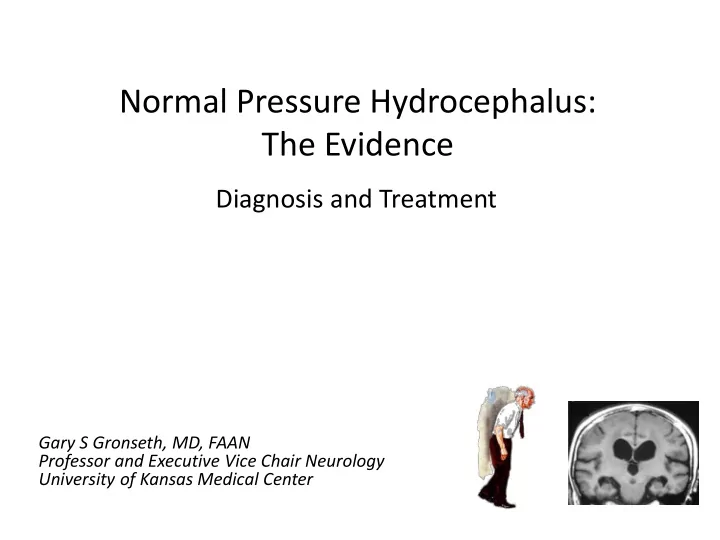
Normal Pressure Hydrocephalus: The Evidence
Gary S Gronseth, MD, FAAN Professor and Executive Vice Chair Neurology University of Kansas Medical Center
The Evidence Diagnosis and Treatment Gary S Gronseth, MD, FAAN - - PowerPoint PPT Presentation
Normal Pressure Hydrocephalus: The Evidence Diagnosis and Treatment Gary S Gronseth, MD, FAAN Professor and Executive Vice Chair Neurology University of Kansas Medical Center Disclosures Chief Evidence-based Medicine Methodologist
Diagnosis and Treatment
Gary S Gronseth, MD, FAAN Professor and Executive Vice Chair Neurology University of Kansas Medical Center
American Academy of Neurology
Neurology
Understand the evidence relevant to the diagnosis and treatment of NPH and apply it to your practice. Become more comfortable with interpreting effect sizes using a 2 x 2 table.
Neurology 2015; 85:2063-2071 Clifford B. Saper, MD, PhD Annals of Neurology 2016; 79:165-166
My conclusions may be different from that of the AAN Guideline
Adams
ventricles
cause of dementia
J Neurol Sci 1965;2:307–327.
Unknown cause
Complication of subarachnoid hemorrhage or infectious meningitis
Estimated prevalence of 5.5/100,000
Acta Neurol Scand 2008;118:48–53.
Non-communicating Communicating
“Increased flow resistance in arachnoid villi or increased dural sinus pressure”
Pv Psas Pv >>>> Psas Pv >>> Psas Pv >> Psas Pv > Psas
Lesser degrees of impedance to flow: less elevation in pressure
Gait apraxia Incontinence Memory problems
Inclusion criteria:
Exclusion criteria:
analyses, review articles, duplicative reports
iNPH/suspected iNPH
to therapy for <3 months
440 abstracts 36 articles
Searched: Medline, EMBASE, LILACS, and Cochrane databases from 19802012; updated search of Medline and Cochrane 2012 to November 2013
Class I Class II Class III Class IV
Effect Size
No Effect
Better Not Better Pos Neg Recruit Pts w/ suspected NPH Test Shunt Evaluate Response
“In all studies, the authors considered patients candidates for inclusion if they had all or part of the clinical triad, brain imaging studies demonstrating ventriculomegaly, and no history of factors that could cause secondary hydrocephalus.”
J Neurol Neurosurg Psychiatry 2013;84:562–568.
Neurosurgery 2005;57(Suppl 3):S4–16.
10 meter walk test
Ordinal scale I to VI
Acta Neurol Scand 2012;126:229–37.
Total Score
2xGait + Neuropsych + Balance + Continence 5
repeated
and psychometric tests compared with baseline
(Codman & Shurtleff)
patency of the shunts:
scores on the iNPH Scale and mRS.
Parameter label Result Sensitivity 52% Specificity 59% Positive PV 88% Negative PV 18% “[The] CSF TT can be used for selecting patients for shunt surgery but not for excluding patients from treatment.”
excluded (not offered surgery)
do not not offer surgery.
Better Not Better Pos Neg Recruit Pts w/ suspected NPH Tap Test Shunt Evaluate Response
142 115
Shunt Response Tap Test Yes No All Positive 51 7 58 Negative 47 10 57 Total 98 17 115
Shunt Response Tap Test Yes No Positive 51 7 50% Negative 47 10 50% Total 98 17 100%
Shunt Response Tap Test Yes No Positive 51 7 58 Negative 47 10 57 Total 85% 15% 100%
Shunt Response Tap Test Yes No All Positive 88% 12% 100% Negative 82% 18% 100% Total 85% 15% 100%
PPV NPV Risk Difference: 6% more of the patients with a positive TT improved with shunting (95% CI -8% to 19%)
0% 20% 40% 60% 80% 100%
Pos Tap Test Neg Tap Test Improved Not Improved Positive PV 88% Negative PV 18%
Risk Difference
Shunt Response Tap Test Yes No All Positive 52% 41% 50% Negative 48% 59% 50% Total 100% 100% 100%
Sensitivity Specificity Youden’s Index: 11% more of the patients who improved with shunting had a positive TT (95% CI -14% to 33%)
0% 10% 20% 30% 40% 50% 60% 70% 80% 90% 100%
Improved Not Improved Neg Tap Test Pos Tap Test Sensitivity 52% Specificity 59%
Youden’s Index
0% 20% 40% 60% 80% 100% 0% 20% 40% 60% 80% 100%
Sensitivity Specificity
Tap test Indifference
Change in iNPH scale score after 12 months Change in iNPH scale score after tap test
Improvement on the CSF TT is probably NOT useful for identifying patients who are more likely to respond to shunting
Risk Difference: 6% more of the patients with a positive TT improved with shunting (95% CI -8% to 19%) Improvement: Positive TT: 88% Negative TT: 82%
The probability of responding to the shunt is essentially the same whether or not the Tap Test is positive
Risk Difference with 95% Confidence intervals
Patients with Pos TT do better Patients with Neg TT do better
Risk Difference with 95% Confidence intervals
Patients with Pos TT do better Patients with Neg TT do better
In patients with suspected iNPH, the TT probably does not identify patients who are more likely to respond to shunting.
Different from AAN conclusion
Better Not Better Pos Neg Recruit Pts w/ suspected NPH ELD Shunt Evaluate Response
27 22 Panagiotopoulos et al. Acta Neurochir 2005;147:953–958
Parameter label Result Sensitivity 94% Specificity 40% Positive PV 84% Negative PV 67% Risk difference 51% (0.1% to 80%) Youden’s Index 34% (-1% to 71%)
0% 20% 40% 60% 80% 100%
Pos ELD Test Neg ELD Test Improved Not Improved Positive PV 84% Negative PV 67%
Risk Difference
0% 20% 40% 60% 80% 100% 0% 20% 40% 60% 80% 100%
Sensitivity Specificity
Tap test ELD Indifference
(Single Class III study, large magnitude of effect) In patients with suspected iNPH, improvement after ELD might identify patients more likely to respond to shunting.
Different from AAN
Poor Specificity: Bergstrand et al. Radionuclide cisternography and computed tomography in 30 healthy volunteers. Neuroradiology. 1986;28(2):154-60. 40% of Healthy Controls had abnormal studies
There is insufficient evidence to determine whether patients with suspected iNPH and persistent ventricular stasis on radioisotope cisternography would respond to shunting.
B Waves
Class I study: Foss et al. Dement Geriatr Cogn Disord 2007;23:47–54.
Change in CSF pressure with heart beat
0% 20% 40% 60% 80% 100% 0% 20% 40% 60% 80% 100%
Sensitivity Specificity
Tap test ELD CSF puls hyper Pooled Ro Pooled MRI aq Indifference
for patients with typical and “questionable” iNPH.
typical and “questionable” groups.
Mandatory criteria
at onset or after gait disturbance
enlargement
J Neurol Neurosurg Psychiatry 2013;84:562–568.
Kiefer M, Eymann R, Steudel WI. Outcome predictors for normal- pressure hydrocephalus. Acta Neurochir Suppl 2006;96:364367
1 point 2 points 3 points Vascular risk factors Hypertension Diabetes mellitus Peripheral vascular occlusion Aortofemoral bypass; stent; internal carotid artery stenosis Peripheral vascular
Cerebrovascular disease Posterior circulation insufficiency Vascular encephalopathy; TIA; RIND Cerebral infarct Heart Arrhythmia; valvular disease; heart failure (coronal); stent; aortocoronary bypass; infarction
Overall, 66% of patients with iNPH had a good response, but 83% of those with low comorbidity index score had a good response
For patients with iNPH does shunting compared to no shunting improve outcomes
Gait Continence Cognition
Allocate Recruit Follow Rx No Rx
Worse Better
Control Blind Retain Randomize Primary Outcome
Natural History Regression to the mean Selection bias Placebo effect Performance bias Measurement bias Reporting Bias Attrition bias
Assess 40% 60% 10% 90%
Study Allocation Masking Follow-up (months) Outcome Kahlon 2007 Non- random Open Label 6 Improved Gait % Razay 2009 Non- random Open Label 3-4 No walking Aid % Kazui 2015 Random Open Label 3 Improved mRankin %
Three Class III Studies
Improved Shunt Yes No All Yes 65% 35% 100% No 5% 95% 100%
PPV NPV Risk Difference: 60% more of the patients with a shunt improved. (95% CI 43% to 73%)
0% 20% 40% 60% 80% 100%
Shunt No Shunt Improved Not Improved Positive PV 65% Negative PV 95%
Risk Difference
Comparative studies of shunting in iNPH Risk Difference of Improvement
Favors Shunting Favors No Shunting
Evidence Synthesis
Model: Random Effects Scale: Linear E Population patients with iNPH, 2 Intervention shunting
Comparator no shunting 1 Outcome improving function Important effect size 0.100 Unimportant effect size 0.010 Include Study (Author Year) Class Indirectness Effect LCL UCL 1 Kahlon 2007 III Minor 0.595 0.351 0.748 1 Razay 2009 III Minor 0.274
0.537 1 SINPHONI 2015 III Minor 0.608 0.432 0.730 Summary (Rand. Effects) 3; III Minor 0.532 0.364 0.700 Conclusion (moderate confidence) For patients with iNPH, shunting is probably more effective than no shunting in improving function
Bayesian Synthesis of comparative studies of shunting in iNPH Risk Difference of Improvement
0.5 1
Kahlon 2007 Razay 2009 SINPHONI 2015 Summary
Favors Shunting Favors No Shunting
iNPH symptoms after 18 months
Benefits Risks
Unknown Magnitude and duration of benefit Complications: Subdural
both clinical and radiographic features consistent with NPH
more likely to respond to shunting
probably beneficial—the magnitude and duration of the benefit is unknown
Diagnosis and Treatment
Gary S Gronseth, MD, FAAN Professor and Executive Vice Chair Neurology University of Kansas