The DLP Problem Consider G, having order n. < >={ i :0 i - - PDF document

the dlp problem
SMART_READER_LITE
LIVE PREVIEW

The DLP Problem Consider G, having order n. < >={ i :0 i - - PDF document

The Discrete Logarithm Problem Debdeep Mukhopadhyay IIT Kharagpur The DLP Problem Consider G, having order n. < >={ i :0 i n-1} is a cyclic sub-group of G having order n. 1 Cryptographic Utility of DLP For


slide-1
SLIDE 1

1

The Discrete Logarithm Problem

Debdeep Mukhopadhyay IIT Kharagpur

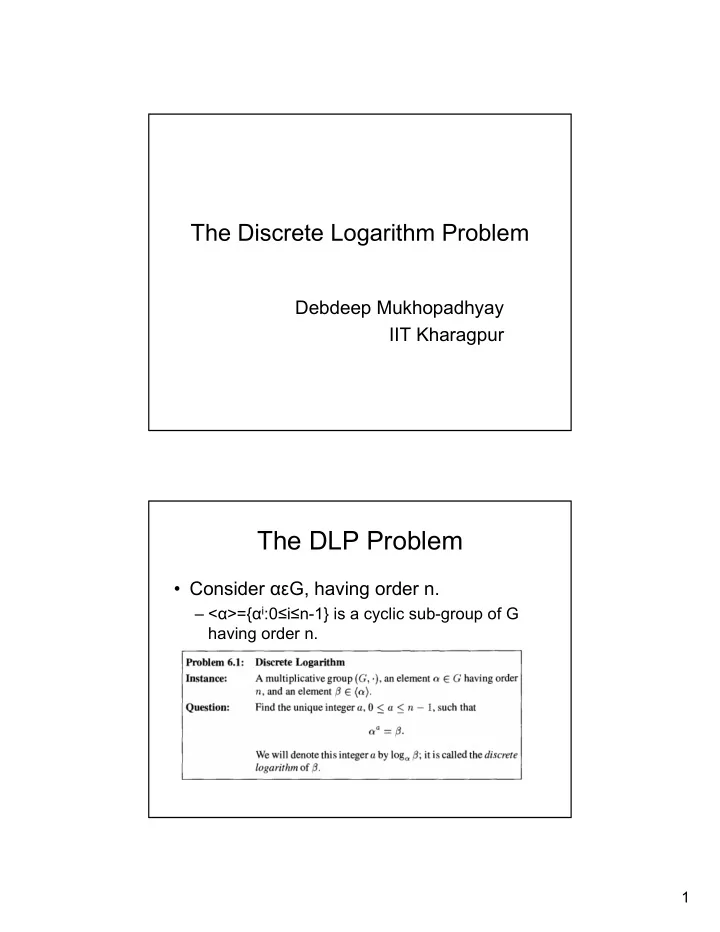
The DLP Problem

  • Consider αεG, having order n.

– <α>={αi:0≤i≤n-1} is a cyclic sub-group of G having order n.

slide-2
SLIDE 2

2

Cryptographic Utility of DLP

  • For suitable choices of the parameters,

finding Discrete Logarithm seems to be difficult.

  • However, the inverse operation of

exponentiation is efficiently computable by the square and multiply algorithm.

– Exponentiation is a candidate one-way function.

The ElGamal Cryptosystem

slide-3
SLIDE 3

3

Working of the algorithm

  • Plaintext x is masked by multiplying it by

βk, yielding y2.

  • The value αk is also transmitted as a part
  • f the ciphertext.
  • Bob who has the secret ‘a’ can compute βk

by raising αk to ‘a’.

  • Then he obtains x by dividing y2 with βk
  • Note that for each plaintext, there are p-1

possible ciphertexts.

Example

  • p=2579, α=2 (primitive element of Zp*)
  • a=765 (secret value)
  • β=2765 mod 2579=949.
  • Suppose, Alice wishes to send x=1299 to Bob.

She randomly chooses k=853.

– y1=2853 mod 2579 = 435 – y2=1299(949853)mod 2579=2396

  • Alice sends y=(435,2396)
  • Bob computes x=2396(435765)-1 mod

2579=1299.

slide-4
SLIDE 4

4

Algorithms for the DLP Problem

  • If αi was monotonically non decreasing

with i, we could have done a binary search to find i.

– but the problem with modular exponentiation is that there is no ordering of the powers. – Thus one have to do an exhaustive search in the worst case.

  • Thus it can be solved in O(n) time and O(1) space.

– However pre-computation helps.

Time Memory Trade Off

  • Suppose we store all possible values of

αi (mod p) as ordered pairs (i,αi mod p) and sort the elements wrt the second parameter. Now search for the given challenge by employing binary search.

  • Complexity: Pre-computation O(n), Memory

O(n), Time to sort: O(nlog n) [using a good sorting algorithm], Time to search O(log n)

  • Often we neglect the log n terms in these

algorithms, as n is much larger than log n

– thus Time to search O(1) and Pre-computation or Memory both are O(n)

slide-5
SLIDE 5

5

Non-trivial Algorithms

  • Shank’s Algorithm
  • Pollard Rho Discrete Log Algorithm
  • Index Calculus Method

Shanks Algorithm

slide-6
SLIDE 6

6

Explanation

  • αmj=y=βα-i=> αmj+i=β.
  • If βε<α>, logαβ=(mj+i) mod n, where both

0≤i,j≤m-1.

– The search is successful as we can ensure that logαβ≤m(m-1)+(m-1)=n-1, as desired. – Complexity: O(m)

Example

  • Compute, log3525 in Z809

*. Note 809 is

prime and 3 is a primitive element of Z809

*.

  • Order=n=808, β=525, m=√808=29
  • α29 mod 809=99
slide-7
SLIDE 7

7

Tables

  • Match:

(10,644) and (19,644) log3525=(29x10 +19)mod 808=309.

L1: L2:

The Diffie Hellman Problem

  • DDH <<P CDH <<P DLP
  • Thus DDH hardness is the strongest assumption.
slide-8
SLIDE 8

8

Application: The DH Key Agreement Scheme

  • Public: g and p
  • Secret: Alice’s exponent a, Bob’s exponent b

Alice, a Bob, b ga mod p gb mod p

  • Alice computes (gb)a = gba = gab mod p
  • Bob computes (ga)b = gab mod p
  • Could use K = gab mod p as symmetric key

Application: The DH Key Agreement Scheme

  • Subject to man-in-the-middle (MiM) attack

Alice, a Bob, b ga mod p gb mod p Trudy, t gt mod p gt mod p

  • Trudy shares secret gat mod p with Alice
  • Trudy shares secret gbt mod p with Bob
  • Alice and Bob don’t know Trudy exists!
slide-9
SLIDE 9

9

Designing Cryptographic Protocols

  • The Man in the Middle Attack on the DH

key agreement scheme shows that although the primitives are strong, the protocol can be weak.

  • Thus, the next question is how to design

strong protocols from strong primitives.

  • We will not discuss in depth, but have a

brief overview as our last topic this semester…

Possible Preventions

  • How to prevent MiM attack?

– Encrypt DH exchange with symmetric key – Encrypt DH exchange with public key – Sign DH values with private key – May be other methods also exist