
SLIDE 1
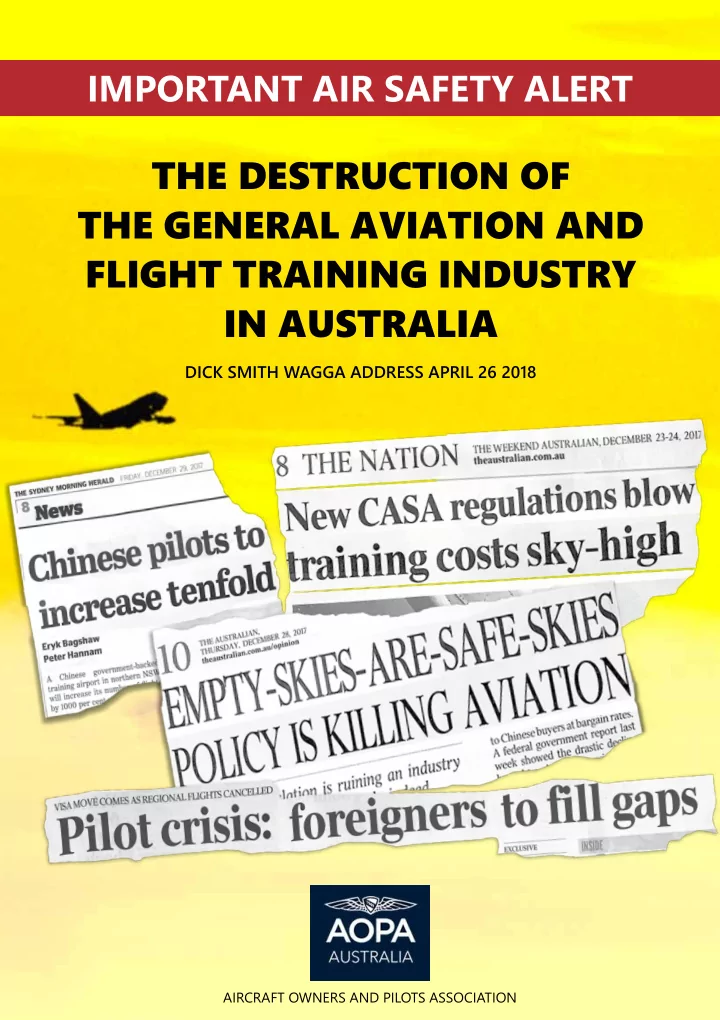
IMPORTANT AIR SAFETY ALERT
THE DESTRUCTION OF THE GENERAL AVIATION AND FLIGHT TRAINING INDUSTRY IN AUSTRALIA
DICK SMITH WAGGA ADDRESS APRIL 26 2018
AIRCRAFT OWNERS AND PILOTS ASSOCIATION
THE DESTRUCTION OF THE GENERAL AVIATION AND FLIGHT TRAINING - - PDF document
IMPORTANT AIR SAFETY ALERT THE DESTRUCTION OF THE GENERAL AVIATION AND FLIGHT TRAINING INDUSTRY IN AUSTRALIA DICK SMITH WAGGA ADDRESS APRIL 26 2018 AIRCRAFT OWNERS AND PILOTS ASSOCIATION 2 This publication covers the address given by former
DICK SMITH WAGGA ADDRESS APRIL 26 2018
AIRCRAFT OWNERS AND PILOTS ASSOCIATION
2 This publication covers the address given by former CAA and CASA Chairman Dick Smith in Wagga, 26 April 2018.
3
Dick Smith 26 April 2018
Introduction
Historically, there has never been such disillusion with our democratic process. There is low trust in
I come from a business background, however, over the last 30 years or so I have had experience with the Canberra ‘machine’. This gives me an insight into how that system works, or perhaps more accurately, often doesn’t work. I was appointed to the Civil Aviation Authority (CAA) Board in 1988. My focus today is on the efgect the Canberra ‘machine’ has had on the general aviation industry in Australia By general aviation, I mean aviation other than the major airlines and defence. That is: charter, training, private and business, maintenance, aerial agriculture, aerial ambulance, and rescue operations. Parts of the general aviation industry are close to collapse, (see the charts on pages 12 and 13), and it has got this way due to some really poor decisions by those in charge.
4 We all laughed while watching ‘Yes, Minister’, that wonderful, insightful BBC series about politics and the Westminster System, however there is a telling message here on why our democratic system appears to be failing. Remember the hospital without any patients segment, with the famous exchange between the Minister and Mrs Rogers, the hospital superintendent? Minister “But isn’t it appalling that it is not being used?” Mrs Rogers “Oh no, it’s a very good thing in some ways. It prolongs its life
Might that be general aviation in Australia today? Could the bureaucrats be saying, “Minister, small planes crash. If we don’t have small planes it will be safer. ” On 3 November 1989 (nearly 30 years ago) at an Australian Made Campaign function, the then Prime Minister Bob Hawke said to me, “Dick, I have decided to appoint you Chairman of the Civil Aviation Authority. ” I replied, “No way, Prime
” He responded, “What are you talking about?” I explained that with the introduction of ‘user pays’, the sell-ofg of airports and the increased regulatory costs to the industry, there were serious problems. I explained, “The airlines will be okay. With tens of millions of passengers they can add extra costs to the air ticket and it is hardly noticeable, but general aviation, especially in the bush, will be destroyed. ”
With the Prime Minister and Kay Cottee at the Australian Made Campaign, November 1989 - where the Prime Minister asked if I would be Chairman of the CAA.
5 The Prime Minister asked, “What can we do?” I replied, “We have to make it clear that the money spent on aviation safety is always limited by what our society can
a safe industry. Otherwise, how could it afgord the cost of implementing the best safety measures?” The Prime Minister then said, “You take on the job and I will support you, ” and he
We now know that our Prime Minister was in a relationship with a journalist, which was kept secret by the press. Imagine if the newspapers at the time had put his private life on the front page day after day, after day. The do-gooders would have had Bob Hawke sacked. We would have lost one of our best Prime Ministers and our country would be worse ofg. There is a lesson here. I fjnished my term as CAA Chairman in February 1992, having started the reform
strong support from industry icons such as Don Kendell AM and Max Hazelton OBE. The front page of The Australian on 18 February, 1992 stated: “Good, cheap safety touches down as Dick Smith takes ofg. ”
6 The copy read:
“Afgordable safety may have been a controversial concept but by admitting that safety is limited by what those who pay for it can afgord, the CAA and the industry has been forced to examine every regulation to see which gives the best safety and cost benefjt.” “If we could save a dollar and still maintain the level of safety, we changed to it.” “Among the changes were more individual responsibility for pilots and
The Australian newspaper, Tuesday 18 February, 1992
I didn’t realise at the time that the Canberra bureaucracy did not grasp the truism
with costs not in their realm of thinking. After I retired as Chairman, the Civil Aviation Act was changed, introducing the new cargo cult* regulation:
“ …CASA must regard the safety of air navigation as the most important consideration… ”
Civil Aviation Act (1995 amendment)
Now that sounds like a great motherhood statement. In fact, it is more a dishonest marketing slogan that would suit a fmy-by-night shonky airline – or one of our major banks! It is a lie because there are many times where the most important consideration is cost. This is simple common sense. For example, airline aircraft could be fjtted with ejection capsules for each seat, that are activated in the event of a hijack. Safety would be improved but the cost
four engines for over-ocean travel. Once again, safety would be improved in a small way, but ticket prices would be unafgordable for many.
*cargo cult - a belief of primitive people that if they build an aerodrome and worship correctly, “cargo” will be delivered from the skies at no cost.
7 Closer to home, the higher CASA regulatory costs have resulted in small towns like Gunnedah no longer having an air service. This forces Australian travellers on to far less safe roads, particularly in regional and remote areas. To this day the bureaucrats have fought to ensure that this wording remains, and this has been the driving force behind the destruction of our once viable general aviation and fmying training industry.
The front page of The Australian, 18 February, 1992: “Good, cheap safety touches down as Dick Smith takes ofg.”
8 In May 1997, having been away from the regulator for fjve years, I was appointed to the CASA Board by National Party Minister John Sharp, to revitalise the cost reducing reforms. A safety brochure was published showing the existing difgerent regulated levels of safety due to afgordability. This made it clear that there were many times when CASA did not put safety as the most important consideration. It made clear ‘the lie in the wording’ of the Act. Soon after my appointment, a real aviation disaster
for Transport. He is the nicest bloke you could ever
at a price. He became our longest serving Transport Minister – six years and nine months. He not only stopped any move to reduce costs – he supported the opposite. Let me quote what he said on 5 October 2000:
“I don’t think that you should ever regard aviation safety as what is afgordable.” “Safety is something which has the highest priority – it is not a question of cost.”
Deputy Prime Minister, John Anderson, Namoi Valley Independent 5 October 2000
9 Amazingly, the Canberra Press Gallery made no comment. If a Deputy Prime Minister of this country made claims that the earth was fmat or that the CIA
statements, which were just as loopy, were met with silence. These cargo cult statements were like manna from heaven for the Canberra
and made the place a wreck, with rule after rule, cost increase after increase, they strangled the industry’s neck. ” The message to the bureaucrats was clear. Ignore cost, ignore afgordability - very quickly, the safety brochure was shredded. Over the last 18 years CASA has spent more than $150 million in writing the most expensive, gold-plated, and they would say ‘safest’ regulations in the world. Let me give you just one example of the hundreds of cost increases. In the USA, retired airline pilots can set themselves up as fmight instructors. 70% of American pilots are taught by independent instructors. However, in Australia, this is not permitted – CASA forced on the industry the most extraordinary additional costs, paperwork and bureaucracy. A recent email I received from a member of the Royal Federation of Aero Clubs said that fmight training accreditation could cost a whopping $200,000. Flying schools started closing down. Yes, we were heading towards the hospital without any patients.
10
Now why would Mr Anderson deny that safety has to always be afgordable and why would he say that safety is not a question of cost? The statements are clearly not truthful. Why would an honourable man be sprouting such nonsense? There is an explanation. These days, our parliamentarians are forced to be ‘actors’ – following a ritual that has gradually evolved. We don’t say that Nicole Kidman is a liar when she plays a weather girl that murders people, we just call her a damn good actor. There is another famous ‘Yes, Minister’ episode, where Bernard, the Secretary, alluded to the truth.
Bernard “...but isn’t it a bad idea to be associated with actors? I mean their job is pretending to be what they are not and if you’re seen with them, well people might realise....”
Yes, our politicians have been forced to become actors following a dishonest
dropped dramatically – how sad. When Mr Anderson retired after his record term, he was praised in Parliament and by the media for having done a great job. If you look at his Wikipedia entry there is no mention of one achievement or change that benefjted the then struggling aviation industry. This is a message to our parliamentarians – do little and you are less likely to be attacked. I said Mr Anderson made no changes – however as a good actor he did make announcements about changes that were always about to happen. In true ‘Yes, Minister’ fashion he would send out media releases. Here is one dated 4 November 1999:
11 John Anderson press release – November 1999
“The new regulatory framework will make it possible for new
services in competition with Airservices Australia.” “We will phase in competition for these services... ”
These changes would have allowed the control tower at Wagga airport to be manned again, but at an afgordable cost by locally employed controllers, without the staggering overheads of the Canberra bureaucracy. That was 19 years ago, but it never happened. Possibly the head of the department said, “Minister, that would be a courageous decision. ” That would have stopped it in its tracks – and it did.
Above: This is the famous Navair Flying School hangar at Bankstown Airport. Once a hive of activity, full of aircraft and having trained thousands of pilots over many decades. The doors on the far end have been closed ofg from the airport access and the hangar has been leased by the airport authority to a machinery company. What a disaster!
12 Let’s look at the destruction of our industry. First of all, private and business
a drop of 42% in 25 years while our population has increased by six million. Let’s look at general aviation pilot numbers. They have dropped from 26,000 in 2001 to 18,000 in 2015 – a staggering 34% decline.
DECLINE
SINCE 2000 1990 1991 1992 1993 1994 1995 1996 1997 1998 1999 2000 2001 2002 2003 2004 2005 2006 2007 2008 2009 2010 2011 2012 2013 2014 2015
PRIVATE AND BUSINESS FLYING HOURS 1990-2015
Source: Dept Infrastructure, Regional Development & Cities, Australian Aircraft Activity. 5 year rolling average.
HOURS FLOWN (1000s)
580 565 550 535 520 505 490 475 460 445 430 415 400 385 370 355 340 325
DECLINE
SINCE 1990
13
Most importantly, the Regional Aviation Association says that fmying training is down 30% in the last fjve years, when it should be up dramatically because of the shortage of pilots. After all, Australian trained pilots are the backbone of our very safe air transport industry. Many fmying schools have gone broke because of the increased costs imposed by CASA. Now wealthy Chinese companies have been purchasing the schools and are primarily training Chinese nationals – not Aussie
parents, has become unafgordable. Every graph does not go down, however. The CASA budget between 2001 and 2016 has increased by 90% from $97.3 million to $184.4 million. Wow! More money to provide more stafg to write more complex and expensive regulations. Just part of that cost would be the estimated salary of $600,000 paid to the Director
the last decade a number of industry professionals, with vision on how to solve the CASA problems, have applied for the director’s position but have not got past the fjrst interview.
2001 2002 2003 2004 2005 2006 2007 2008 2009 2010 2011 2012 2013 2014 2015 2016
CASA INCOME - 2001 -2016
$190 $180 $170 $160 $150 $140 $130 $120 $110 $100 $90 MILLIONS
90%
INCREASE
SINCE 2001 Source: CASA Annual Reports 2001-2016
14
In December 2017 there was some good news. Barnaby Joyce – clearly a Bob Hawke in many ways – was appointed the Minister. What a difgerence. I had a breakfast meeting with Mr Joyce and pointed out that the Civil Aviation Act didn’t mention that cost had to be considered. He instantly said, “That is ridiculous, you always have to look at cost. ” It was a fantastic breakthrough. He asked me, “Dick, if you were a dictator what would you do to get the industry going again – especially aviation in the bush. ” I replied, “The fjrst thing I would do is fjx the Act so costs are considered, and I believe we can get the Shadow Minister, Anthony Albanese, to agree with this. ” Mr Joyce told me to go ahead and have a go, so I asked an industry expert to come up with the new, efgective wording, which says:
“CASA must seek to achieve the highest level of safety in air navigation that is consistent with: (a) Maintaining an effjcient and sustainable Australian aviation industry, including a viable general aviation and training sector (b) The need for more people to benefjt from civil aviation.”
It was just common sense. Who could possibly be against such wording? Legislation that allows cost to be considered is not a unique idea. Let’s look at the equivalent wording in the British Civil Aviation Act:
“...provide air transport services which satisfy... public demand at the lowest charges consistent with a high standard of safety... and an economic return to effjcient operators... ” British CAA Act (2012)
Yes, totally difgerent to our existing ‘safety as the most important consideration’
with the Shadow Minister. Within days, Mr Albanese suggested a couple of adjustments and supported the change – fantastic. That was all to change. Within two weeks, Barnaby Joyce had resigned, clearly because he did not live in Bob Hawke times!
Shadow Minister Anthony Albanese Former Deputy Prime Minister Barnaby Joyce
15
Now let’s move to the present time. I was fortunate to be able to arrange a meeting with the new Deputy Prime Minister, and now Transport and Infrastructure Minister, The Hon Michael McCormack. When I asked if he would support the change of the Act, he was undecided and said:
“I would like more information. I think there should be more discussion and more consultation.”
Now why wouldn’t he have said:
“Dick, this is just common sense - of course I will support the change - cost always has to be considered and I have read so much about the destruction of general aviation, particularly in the bush.”
It is very likely that Mr McCormack would have liked to have said that, but with his six years as a politician, I think his ‘actor’ training came in. He knew that any changes to the Act that even hinted that costs should be looked at would be considered by some as reducing safety – and be beaten up accordingly in the media. However, I really hope he will support the change in the future.
Deputy Prime Minister Michael McCormack
16 We laughed at the ‘Yes, Minister’ segments, however, let’s think about it. The ‘Yes, Minister’ show is an example of how our politicians have become actors not doers. I was shocked each time I was Chair of the safety regulator in Canberra to see how people – once the emotive word ‘safety’ came up – were not game to apply the common sense that I had experienced in private enterprise for over 30 years. You can’t blame individual politicians for this. The vast majority are as honest as any Australians. It is the system we have evolved into and we have to fjx it. Even though I have concentrated on a story about aviation, this is also the explanation of why so many are disillusioned with our democratic systems. No wonder Mr Trump was elected, with his call to drain the dishonest swamp.
So how can we revitalise general aviation so we become world leaders, especially in fmying training?
the lie – change the Act – let aviation thrive!’ This should be our motto.
every unnecessary cost.
allow a successful, safe, general aviation industry.
to the Minister and appointed to the CASA Board. For the last 15 years, no one advising the Minister on aviation has had the relevant skills or experience, or ever stated any vision on how to grow aviation.
not the point-scoring that clearly damages our country.
17 The major parties agree on our alliance with the USA. Why? Because it is of such national interest. What could be of more ‘national interest’ than having a safe and viable aviation industry? We need the major parties to join in supporting aviation
can be achieved.
Tens of millions of dollars of additional export income In closing - the Deputy Prime Minister, Mr Michael McCormack, has a huge
in the bush, thriving again. We could become world leaders in fmight training and recreational aviation – tens
massive investment in both infrastructure and services in our country towns and regional centres. The problems I have mentioned do not afgect me personally, I’m fortunate. I can afgord the high costs. It’s others and my country I am concerned about. Call to action This is my call to action. I ask you to contact the Minister, your Local Member, the media – everyone – and ask for the Dick Smith Wagga Proposals to go ahead. They are on my website. Sir Henry Parkes gave the Tenterfjeld Oration in 1889, which was a trigger for our
the revitalisation of general aviation in Australia. Aviation call for action www.dicksmithfairgo.com.au
18
On the morning I gave the Wagga presentation, Mr McCormack was quoted in the Wagga Daily Advertiser:
“I’ve had a number of discussions with Dick Smith, and I appreciate that the industry wants to see changes made as soon as possible, but what I won’t do for anyone is rush policy change, especially when there might be safety implications,” Mr McCormack said. He continued, “It’s all well and good to bind me to the Barnaby Joyce agreement, but the fact is Barnaby is not Transport Minister anymore and, while I appreciate that he had discussions with Anthony Albanese, I was not in
19
Aircraft Owners and Pilots Association of Australia Australian Business Aviation Association Australian Parachute Federation Australian Warbirds Association Aviation Maintenance Repair and Overhaul Business Association Hang Gliding Federation of Australia Recreational Aviation Australia Regional Aviation Association of Australia Sport Aircraft Association of Australia The Gliding Federation of Australia
www.aopa.com.au www.dicksmithfairgo.com.au
V10-7 MAY 2018
www.aopa.com.au www.dicksmithfairgo.com.au