G¨ unter Rote, Freie Universit¨ at Berlin The Computational Geometry of Congruence Testing Workshop on Geometric Computation and Applications, Trinity College, Dublin, June 17–21, 2018
The Computational Geometry of Congruence Testing, Part II G unter - - PowerPoint PPT Presentation
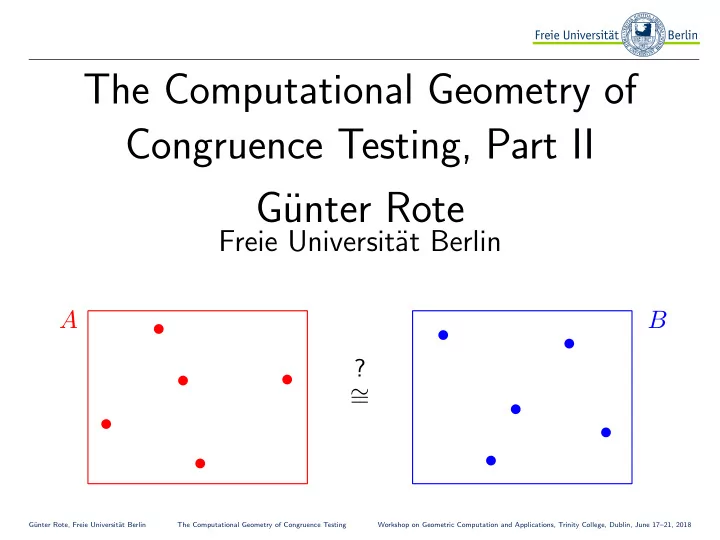
The Computational Geometry of Congruence Testing, Part II G unter Rote Freie Universit at Berlin A B ? = G unter Rote, Freie Universit at Berlin The Computational Geometry of Congruence Testing Workshop on Geometric
G¨ unter Rote, Freie Universit¨ at Berlin The Computational Geometry of Congruence Testing Workshop on Geometric Computation and Applications, Trinity College, Dublin, June 17–21, 2018
∼ = ? A B
The Computational Geometry of Congruence Testing, Part II G¨ unter Rote
Freie Universit¨ at Berlin
A
G¨ unter Rote, Freie Universit¨ at Berlin The Computational Geometry of Congruence Testing Workshop on Geometric Computation and Applications, Trinity College, Dublin, June 17–21, 2018
Overview
- 1 dimension
- 2 dimensions
- 3 dimensions
- 4 dimensions
- d dimensions
O(n log n) time O(n⌈d/3⌉ log n) time [Brass and Knauer 2002] today (joint work with Heuna Kim) O(n⌊(d+2)/2⌋/2 log n) Monte Carlo [Akutsu 1998/Matouˇ sek] ↓ O(n⌊(d+1)/2⌋/2 log n) time
G¨ unter Rote, Freie Universit¨ at Berlin The Computational Geometry of Congruence Testing Workshop on Geometric Computation and Applications, Trinity College, Dublin, June 17–21, 2018
Overview
- 1 dimension
- 2 dimensions
- 3 dimensions
- 4 dimensions
- d dimensions
O(n log n) time O(n⌈d/3⌉ log n) time [Brass and Knauer 2002]
- Rotations in 4-space
- Pl¨
ucker coordinates for 2-planes in 4-space
- The Hopf fibration of S3
- Closest pair graph
- 2+2 dimension reduction
- Coxeter classification of reflection groups
today (joint work with Heuna Kim) O(n⌊(d+2)/2⌋/2 log n) Monte Carlo [Akutsu 1998/Matouˇ sek] ↓ O(n⌊(d+1)/2⌋/2 log n) time
G¨ unter Rote, Freie Universit¨ at Berlin The Computational Geometry of Congruence Testing Workshop on Geometric Computation and Applications, Trinity College, Dublin, June 17–21, 2018
4 Dimensions: Algorithm Overview
Iterative Pruning Generating Orbit Cycles Mirror Case
planes mirror symmetry n = |A| is bounded
2+2 Dimension Reduction 1+3 Dimension Reduction
edge- transitive ≤ 100|P| markers lower-dimensional components
Marking and Condensing Great Circles
|P| ≤ n/200 ≤ n
2
≤ n
2
joint work with Heuna Kim
G¨ unter Rote, Freie Universit¨ at Berlin The Computational Geometry of Congruence Testing Workshop on Geometric Computation and Applications, Trinity College, Dublin, June 17–21, 2018
4 Dimensions: Algorithm Overview
Iterative Pruning Generating Orbit Cycles Mirror Case
planes mirror symmetry n = |A| is bounded
2+2 Dimension Reduction 1+3 Dimension Reduction
edge- transitive ≤ 100|P| markers lower-dimensional components
Marking and Condensing Great Circles
|P| ≤ n/200 ≤ n
2
≤ n
2
joint work with Heuna Kim
G¨ unter Rote, Freie Universit¨ at Berlin The Computational Geometry of Congruence Testing Workshop on Geometric Computation and Applications, Trinity College, Dublin, June 17–21, 2018
Initialization: Closest-Pair Graph
2) Compute the closest pair graph G(A) = (A, { uv : u − v = δ }) where δ := the distance of the closest pair, in O(n log n) time. 1) PRUNE by distance from the origin.
- =
⇒ we can assume that A lies on the 3-sphere S3.
- We can assume that δ is SMALL: δ ≤ δ0 := 0.0005.
(Otherwise, |A| ≤ n0, by a packing argument.)
[ Bentley and Shamos, STOC 1976 ]
G¨ unter Rote, Freie Universit¨ at Berlin The Computational Geometry of Congruence Testing Workshop on Geometric Computation and Applications, Trinity College, Dublin, June 17–21, 2018
Everything looks the same!
By the PRUNING principle, we can assume that all points look locally the same:
- All points have congruent neighborhoods in G(A).
(The neighbors of u lie on a 2-sphere in S3; There are at most K3 = 12 neighbors.) u δ
1 2 3 4 6 5 7 8
G¨ unter Rote, Freie Universit¨ at Berlin The Computational Geometry of Congruence Testing Workshop on Geometric Computation and Applications, Trinity College, Dublin, June 17–21, 2018
Everything looks the same!
By the PRUNING principle, we can assume that all points look locally the same:
- All points have congruent neighborhoods in G(A).
(The neighbors of u lie on a 2-sphere in S3; There are at most K3 = 12 neighbors.) u δ
1 2 3 4 6 5 7 8
u v
- Make a directed graph D from G(A)
and PRUNE its arcs uv by the joint neighborhood of u and v.
G¨ unter Rote, Freie Universit¨ at Berlin The Computational Geometry of Congruence Testing Workshop on Geometric Computation and Applications, Trinity College, Dublin, June 17–21, 2018
Everything looks the same!
By the PRUNING principle, we can assume that all points look locally the same:
- All points have congruent neighborhoods in G(A).
(The neighbors of u lie on a 2-sphere in S3; There are at most K3 = 12 neighbors.) u δ
1 2 3 4 6 5 7 8
u v
- Make a directed graph D from G(A)
and PRUNE its arcs uv by the joint neighborhood of u and v.
G¨ unter Rote, Freie Universit¨ at Berlin The Computational Geometry of Congruence Testing Workshop on Geometric Computation and Applications, Trinity College, Dublin, June 17–21, 2018
Everything looks the same!
By the PRUNING principle, we can assume that all points look locally the same:
- All points have congruent neighborhoods in G(A).
(The neighbors of u lie on a 2-sphere in S3; There are at most K3 = 12 neighbors.) u δ
1 2 3 4 6 5 7 8
u v
- Make a directed graph D from G(A)
and PRUNE its arcs uv by the joint neighborhood of u and v.
G¨ unter Rote, Freie Universit¨ at Berlin The Computational Geometry of Congruence Testing Workshop on Geometric Computation and Applications, Trinity College, Dublin, June 17–21, 2018
Everything looks the same!
By the PRUNING principle, we can assume that all points look locally the same:
- All points have congruent neighborhoods in G(A).
(The neighbors of u lie on a 2-sphere in S3; There are at most K3 = 12 neighbors.) u δ
1 2 3 4 6 5 7 8
u v
- . . . until all arcs uv
look the same.
- Make a directed graph D from G(A)
and PRUNE its arcs uv by the joint neighborhood of u and v.
G¨ unter Rote, Freie Universit¨ at Berlin The Computational Geometry of Congruence Testing Workshop on Geometric Computation and Applications, Trinity College, Dublin, June 17–21, 2018
Algorithm Overview
Iterative Pruning Generating Orbit Cycles Mirror Case
planes mirror symmetry n = |A| is bounded
2+2 Dimension Reduction 1+3 Dimension Reduction
edge- transitive ≤ 100|P| markers lower-dimensional components
Marking and Condensing Great Circles
|P| ≤ n/200 ≤ n
2
≤ n
2
G¨ unter Rote, Freie Universit¨ at Berlin The Computational Geometry of Congruence Testing Workshop on Geometric Computation and Applications, Trinity College, Dublin, June 17–21, 2018
Algorithm Overview
Iterative Pruning Generating Orbit Cycles Mirror Case
planes mirror symmetry n = |A| is bounded
2+2 Dimension Reduction 1+3 Dimension Reduction
edge- transitive ≤ 100|P| markers lower-dimensional components
Marking and Condensing Great Circles
|P| ≤ n/200 ≤ n
2
≤ n
2
G¨ unter Rote, Freie Universit¨ at Berlin The Computational Geometry of Congruence Testing Workshop on Geometric Computation and Applications, Trinity College, Dublin, June 17–21, 2018
Algorithm Overview
Iterative Pruning Generating Orbit Cycles Mirror Case
planes mirror symmetry n = |A| is bounded
2+2 Dimension Reduction 1+3 Dimension Reduction
edge- transitive ≤ 100|P| markers lower-dimensional components
Marking and Condensing Great Circles
|P| ≤ n/200 ≤ n
2
≤ n
2
G¨ unter Rote, Freie Universit¨ at Berlin The Computational Geometry of Congruence Testing Workshop on Geometric Computation and Applications, Trinity College, Dublin, June 17–21, 2018
Predecessor-Successor Figure
α u v t w s(uv) p(uv) Pick some α. s(uv) := {vw : vw ∈ E, ∠uvw = α}
G¨ unter Rote, Freie Universit¨ at Berlin The Computational Geometry of Congruence Testing Workshop on Geometric Computation and Applications, Trinity College, Dublin, June 17–21, 2018
Predecessor-Successor Figure
α u v t w t′ w′ s(uv) p(uv) Pick some α. s(uv) := {vw : vw ∈ E, ∠uvw = α} τ w′ t′ torsion angle τ
G¨ unter Rote, Freie Universit¨ at Berlin The Computational Geometry of Congruence Testing Workshop on Geometric Computation and Applications, Trinity College, Dublin, June 17–21, 2018
Predecessor-Successor Figure
α u v t w t′ w′ s(uv) p(uv) Pick some α. s(uv) := {vw : vw ∈ E, ∠uvw = α} τ w′ t′ torsion angle τ
G¨ unter Rote, Freie Universit¨ at Berlin The Computational Geometry of Congruence Testing Workshop on Geometric Computation and Applications, Trinity College, Dublin, June 17–21, 2018
Predecessor-Successor Figure
α u v t w t′ w′ s(uv) p(uv) Pick some α. s(uv) := {vw : vw ∈ E, ∠uvw = α} τ w′ t′ torsion angle τ can PRUNE arcs from s(u, v) canonical directions
G¨ unter Rote, Freie Universit¨ at Berlin The Computational Geometry of Congruence Testing Workshop on Geometric Computation and Applications, Trinity College, Dublin, June 17–21, 2018
Predecessor-Successor Figure
α u v t w t′ w′ s(uv) p(uv) Pick some α. s(uv) := {vw : vw ∈ E, ∠uvw = α} τ w′ t′ torsion angle τ can PRUNE arcs from s(u, v) τ0 For every path tuv with ∠tuv = α, ∃ vw with ∠uvw = α and torsion angle τ0. canonical directions
G¨ unter Rote, Freie Universit¨ at Berlin The Computational Geometry of Congruence Testing Workshop on Geometric Computation and Applications, Trinity College, Dublin, June 17–21, 2018
Orbit cycles
p1 p0 p2 For every path pipi+1pi+2 with ∠pipi+1pi+2 = α, ∃ pi+3 with ∠pi+1pi+2pi+3 = α and torsion τ0.
!
G¨ unter Rote, Freie Universit¨ at Berlin The Computational Geometry of Congruence Testing Workshop on Geometric Computation and Applications, Trinity College, Dublin, June 17–21, 2018
Orbit cycles
p1 p0 p2 p3 For every path pipi+1pi+2 with ∠pipi+1pi+2 = α, ∃ pi+3 with ∠pi+1pi+2pi+3 = α and torsion τ0.
!
G¨ unter Rote, Freie Universit¨ at Berlin The Computational Geometry of Congruence Testing Workshop on Geometric Computation and Applications, Trinity College, Dublin, June 17–21, 2018
Orbit cycles
p1 p0 p2 p3 For every path pipi+1pi+2 with ∠pipi+1pi+2 = α, ∃ pi+3 with ∠pi+1pi+2pi+3 = α and torsion τ0. R(p0, p1, p2) = (p1, p2, p3) R
!
G¨ unter Rote, Freie Universit¨ at Berlin The Computational Geometry of Congruence Testing Workshop on Geometric Computation and Applications, Trinity College, Dublin, June 17–21, 2018
Orbit cycles
p1 p0 p2 p3 For every path pipi+1pi+2 with ∠pipi+1pi+2 = α, ∃ pi+3 with ∠pi+1pi+2pi+3 = α and torsion τ0. p4 R(p0, p1, p2) = (p1, p2, p3) R(p0, p1, p2, p3) = (p1, p2, p3, p4) R
!
G¨ unter Rote, Freie Universit¨ at Berlin The Computational Geometry of Congruence Testing Workshop on Geometric Computation and Applications, Trinity College, Dublin, June 17–21, 2018
Orbit cycles
p1 p0 p2 p3 For every path pipi+1pi+2 with ∠pipi+1pi+2 = α, ∃ pi+3 with ∠pi+1pi+2pi+3 = α and torsion τ0. p4 R(p0, p1, p2) = (p1, p2, p3) R(p0, p1, p2, p3) = (p1, p2, p3, p4) R(p1, p2, p3, p4) = (p2, p3, p4, p5) · · · Rpi = pi+1: The orbit of p0 under R, a helix R
!
G¨ unter Rote, Freie Universit¨ at Berlin The Computational Geometry of Congruence Testing Workshop on Geometric Computation and Applications, Trinity College, Dublin, June 17–21, 2018
Rotations in 4 dimensions
R = cos ϕ − sin ϕ sin ϕ cos ϕ cos ψ − sin ψ sin ψ cos ψ = Rϕ Rψ
- in some appropriate coordinate system.
ϕ = ±ψ: → unique decomposition R4 = P ⊕ Q into two completely orthogonal 2-dimensional axis planes P and Q ϕ = ±ψ: isoclinic rotations circle with radius r The orbit of a point p0 = (x1, y1, x2, y2) lies on a helix
- n a flat torus Cr × Cs, with r =
- x2
1 + y2 1, s =
- x2
2 + y2 2
G¨ unter Rote, Freie Universit¨ at Berlin The Computational Geometry of Congruence Testing Workshop on Geometric Computation and Applications, Trinity College, Dublin, June 17–21, 2018
Rotations in 4 dimensions
R = cos ϕ − sin ϕ sin ϕ cos ϕ cos ψ − sin ψ sin ψ cos ψ = Rϕ Rψ
- The orbit of a point p0 = (x1, y1, x2, y2) lies on a helix
- n a flat torus Cr × Cs, with r =
- x2
1 + y2 1, s =
- x2
2 + y2 2
s p0 p1 p2 p5 p6 p7 ϕ ψ Cr
G¨ unter Rote, Freie Universit¨ at Berlin The Computational Geometry of Congruence Testing Workshop on Geometric Computation and Applications, Trinity College, Dublin, June 17–21, 2018
Planes in 4 dimensions
- Every point lies on ≤ 60 orbit cycles.
- Every orbit cycle contains ≥ 12000 points,
because δ is small.
- Every orbit cycle generates 1 plane
(corresponding to the smaller of ϕ and ψ.) = ⇒ a collection of ≤ n/200 planes (or: great circles)
G¨ unter Rote, Freie Universit¨ at Berlin The Computational Geometry of Congruence Testing Workshop on Geometric Computation and Applications, Trinity College, Dublin, June 17–21, 2018
Algorithm Overview
Iterative Pruning Generating Orbit Cycles Mirror Case
planes mirror symmetry n = |A| is bounded
2+2 Dimension Reduction 1+3 Dimension Reduction
edge- transitive ≤ 100|P| markers lower-dimensional components
Marking and Condensing Great Circles
|P| ≤ n/200 ≤ n
2
≤ n
2
G¨ unter Rote, Freie Universit¨ at Berlin The Computational Geometry of Congruence Testing Workshop on Geometric Computation and Applications, Trinity College, Dublin, June 17–21, 2018
Algorithm Overview
Iterative Pruning Generating Orbit Cycles Mirror Case
planes mirror symmetry n = |A| is bounded
2+2 Dimension Reduction 1+3 Dimension Reduction
edge- transitive ≤ 100|P| markers lower-dimensional components
Marking and Condensing Great Circles
|P| ≤ n/200 ≤ n
2
≤ n
2
G¨ unter Rote, Freie Universit¨ at Berlin The Computational Geometry of Congruence Testing Workshop on Geometric Computation and Applications, Trinity College, Dublin, June 17–21, 2018
Marking Points on Great Circles
projection of another unit circle Q unit circle P
G¨ unter Rote, Freie Universit¨ at Berlin The Computational Geometry of Congruence Testing Workshop on Geometric Computation and Applications, Trinity College, Dublin, June 17–21, 2018
Marking Points on Great Circles
projection of another unit circle Q unit circle P IDEA: mark those two points in P
G¨ unter Rote, Freie Universit¨ at Berlin The Computational Geometry of Congruence Testing Workshop on Geometric Computation and Applications, Trinity College, Dublin, June 17–21, 2018
Marking Points on Great Circles
projection of another unit circle Q unit circle P IDEA: mark those two points in P a neighbor of P IDEA 2: Construct the closest-pair graph in the space of great circles, in O(n log n) time.
G¨ unter Rote, Freie Universit¨ at Berlin The Computational Geometry of Congruence Testing Workshop on Geometric Computation and Applications, Trinity College, Dublin, June 17–21, 2018
Pl¨ ucker coordinates
planes in 4-space ⇔ great circles on S3 ⇔ a.k.a. lines in RP 3 plane through (x1, y1, x2, y2) and (x′
1, y′ 1, x′ 2, y′ 2) :
(v1, . . . , v6) =
- x1 y1
x′
1 y′ 1
- ,
- x1 x2
x′
1 x′ 2
- ,
- x1 y2
x′
1 y′ 2
- ,
- y1 x2
y′
1 x′ 2
- ,
- y1 y2
y′
1 y′ 2
- ,
- x2 y2
x′
2 y′ 2
- (v1, . . . , v6) ∈ RP 5. [Pl¨
ucker relations v1v6 − v2v5 + v3v4 = 0] Normalize: → A great circle is represented by two antipodal points on S5. This representation is geometrically meaningful: Distances on S5 are preserved under rotations of R4 / S3. (Packings of 2-planes in 4-space were considered by [Conway, Hardin and Sloane 1996], with different distances.)
G¨ unter Rote, Freie Universit¨ at Berlin The Computational Geometry of Congruence Testing Workshop on Geometric Computation and Applications, Trinity College, Dublin, June 17–21, 2018
Marking Points on Great Circles
projection of another unit circle Q unit circle P IDEA: mark those two points in P a neighbor of P IDEA 2: Construct the closest-pair graph in the space of great circles, in O(n log n) time. Every plane has at most K5 ≤ 44 neighbors.
G¨ unter Rote, Freie Universit¨ at Berlin The Computational Geometry of Congruence Testing Workshop on Geometric Computation and Applications, Trinity College, Dublin, June 17–21, 2018
Marking Points on Great Circles
m ≤
n 200 great circles in R4
− → m point pairs on S5 projection of another unit circle Q unit circle P IDEA: mark those two points in P At most 88 (≤ 100) points are marked on every great circle. These points replace A. → successful CONDENSATION a neighbor of P IDEA 2: Construct the closest-pair graph in the space of great circles, in O(n log n) time. Every plane has at most K5 ≤ 44 neighbors.
G¨ unter Rote, Freie Universit¨ at Berlin The Computational Geometry of Congruence Testing Workshop on Geometric Computation and Applications, Trinity College, Dublin, June 17–21, 2018
Algorithm Overview
Iterative Pruning Generating Orbit Cycles Mirror Case
planes mirror symmetry n = |A| is bounded
2+2 Dimension Reduction 1+3 Dimension Reduction
edge- transitive ≤ 100|P| markers lower-dimensional components
Marking and Condensing Great Circles
|P| ≤ n/200 ≤ n
2
≤ n
2
G¨ unter Rote, Freie Universit¨ at Berlin The Computational Geometry of Congruence Testing Workshop on Geometric Computation and Applications, Trinity College, Dublin, June 17–21, 2018
Algorithm Overview
Iterative Pruning Generating Orbit Cycles Mirror Case
planes mirror symmetry n = |A| is bounded
2+2 Dimension Reduction 1+3 Dimension Reduction
edge- transitive ≤ 100|P| markers lower-dimensional components
Marking and Condensing Great Circles
|P| ≤ n/200 ≤ n
2
≤ n
2
G¨ unter Rote, Freie Universit¨ at Berlin The Computational Geometry of Congruence Testing Workshop on Geometric Computation and Applications, Trinity College, Dublin, June 17–21, 2018
Isoclinic planes
Where to mark?? projection of a neighbor Q of P unit circle P
G¨ unter Rote, Freie Universit¨ at Berlin The Computational Geometry of Congruence Testing Workshop on Geometric Computation and Applications, Trinity College, Dublin, June 17–21, 2018
Isoclinic planes
Where to mark?? projection of a neighbor Q of P Problem if all closest pairs are isoclinic. unit circle P
G¨ unter Rote, Freie Universit¨ at Berlin The Computational Geometry of Congruence Testing Workshop on Geometric Computation and Applications, Trinity College, Dublin, June 17–21, 2018
Isoclinic planes
Where to mark?? projection of a neighbor Q of P Problem if all closest pairs are isoclinic. unit circle P Constant distances from one circle to the other. “Clifford-parallel” ≡ isoclinic
G¨ unter Rote, Freie Universit¨ at Berlin The Computational Geometry of Congruence Testing Workshop on Geometric Computation and Applications, Trinity College, Dublin, June 17–21, 2018
Clifford-parallel circles
s P : x1 y1 x2 y2 = cos t sin t , Q: r cos t r sin t s cos(α + t) s sin(α + t) P Q r2 + s2 = 1
G¨ unter Rote, Freie Universit¨ at Berlin The Computational Geometry of Congruence Testing Workshop on Geometric Computation and Applications, Trinity College, Dublin, June 17–21, 2018
Clifford-parallel circles
s P : x1 y1 x2 y2 = cos t sin t , Q: r cos t r sin t s cos(α + t) s sin(α + t) P Q r2 + s2 = 1 h(x1, y1, x2, y2) = the right Hopf map h: S3 → S2
- 2(x1y2 − y1x2), 2(x1x2 + y1y2), 1 − 2(x2
2 + y2 2)
- [ Hopf 1931 ]
G¨ unter Rote, Freie Universit¨ at Berlin The Computational Geometry of Congruence Testing Workshop on Geometric Computation and Applications, Trinity College, Dublin, June 17–21, 2018
Clifford-parallel circles
s P : x1 y1 x2 y2 = cos t sin t , Q: r cos t r sin t s cos(α + t) s sin(α + t) P Q Q′ : r cos t r sin t s cos(α − t) s sin(α − t) Q′ r2 + s2 = 1 h(x1, y1, x2, y2) = the right Hopf map h: S3 → S2
- 2(x1y2 − y1x2), 2(x1x2 + y1y2), 1 − 2(x2
2 + y2 2)
- [ Hopf 1931 ]
G¨ unter Rote, Freie Universit¨ at Berlin The Computational Geometry of Congruence Testing Workshop on Geometric Computation and Applications, Trinity College, Dublin, June 17–21, 2018
The Hopf fibration
The fibers h−1(p) for p ∈ S2 are great circles: a Hopf bundle
http://www.geom.uiuc.edu/~banchoff/script/b3d/hypertorus.html
Every great circle belongs to a unique right Hopf bundle. Right Hopf map h: S3 → S2 Isoclinic ≡ belong to the same Hopf bundle This is a transitive relation. stereographic projection S3 → R3 (Villarceau circles)
G¨ unter Rote, Freie Universit¨ at Berlin The Computational Geometry of Congruence Testing Workshop on Geometric Computation and Applications, Trinity College, Dublin, June 17–21, 2018
The Hopf fibration
The fibers h−1(p) for p ∈ S2 are great circles: a Hopf bundle
http://www.geom.uiuc.edu/~banchoff/script/b3d/hypertorus.html
Every great circle belongs to a unique right Hopf bundle. Right Hopf map h: S3 → S2 Isoclinic ≡ belong to the same Hopf bundle This is a transitive relation. If all closest pairs are isoclinic → all great circles in a connected component of the closest-pair graph belong to the same bundle. → h maps them to points on S2. We know how to deal with S2!
G¨ unter Rote, Freie Universit¨ at Berlin The Computational Geometry of Congruence Testing Workshop on Geometric Computation and Applications, Trinity College, Dublin, June 17–21, 2018
Condensing on the 2-Sphere
Equivariant condensation on the 2-sphere: Input: A ⊆ S2. Output: A′ ⊆ S2, |A′| ≤ min{|A|, 12}.
- A′ = vertices of a regular icosahedron
- A′ = vertices of a regular octahedron
- A′ = vertices of a regular tetrahedron
- A′ = two antipodal points, or
- A′ = a single point.
G¨ unter Rote, Freie Universit¨ at Berlin The Computational Geometry of Congruence Testing Workshop on Geometric Computation and Applications, Trinity College, Dublin, June 17–21, 2018
Condensing on the 2-Sphere
Equivariant condensation on the 2-sphere: Input: A ⊆ S2. Output: A′ ⊆ S2, |A′| ≤ min{|A|, 12}.
- A′ = vertices of a regular icosahedron
- A′ = vertices of a regular octahedron
- A′ = vertices of a regular tetrahedron
- A′ = two antipodal points, or
- A′ = a single point.
Condense each connected component of the closest-pair graph to ≤ 12 great circles. Compute closest-pair graph (on S5) from scratch. If no progress, distance between closest pairs is ≥ Dicosa → ≤ 829 great circles → 2+2 DIMENSION REDUCTION
G¨ unter Rote, Freie Universit¨ at Berlin The Computational Geometry of Congruence Testing Workshop on Geometric Computation and Applications, Trinity College, Dublin, June 17–21, 2018
Algorithm Overview
Iterative Pruning Generating Orbit Cycles Mirror Case
planes mirror symmetry n = |A| is bounded
2+2 Dimension Reduction 1+3 Dimension Reduction
edge- transitive ≤ 100|P| markers lower-dimensional components
Marking and Condensing Great Circles
|P| ≤ n/200 ≤ n
2
≤ n
2
G¨ unter Rote, Freie Universit¨ at Berlin The Computational Geometry of Congruence Testing Workshop on Geometric Computation and Applications, Trinity College, Dublin, June 17–21, 2018
Algorithm Overview
Iterative Pruning Generating Orbit Cycles Mirror Case
planes mirror symmetry n = |A| is bounded
2+2 Dimension Reduction 1+3 Dimension Reduction
edge- transitive ≤ 100|P| markers lower-dimensional components
Marking and Condensing Great Circles
|P| ≤ n/200 ≤ n
2
≤ n
2
G¨ unter Rote, Freie Universit¨ at Berlin The Computational Geometry of Congruence Testing Workshop on Geometric Computation and Applications, Trinity College, Dublin, June 17–21, 2018
2+2 Dimension Reduction
We have a plane P and we know its image in B. x1 y1 x2 y2 (x1, y1, x2, y2) r2 ϕ2 ϕ1 r1 (0, 0, 0, 0) P P ⊥ “Double-polar” coordinates (r1, ϕ1, r2, ϕ2) We can change ϕ1 and ϕ2. r1 and r2 are fixed.
G¨ unter Rote, Freie Universit¨ at Berlin The Computational Geometry of Congruence Testing Workshop on Geometric Computation and Applications, Trinity College, Dublin, June 17–21, 2018
2+2 Dimension Reduction
attach (r1, r2) as a label (color) ϕ2 ϕ1
G¨ unter Rote, Freie Universit¨ at Berlin The Computational Geometry of Congruence Testing Workshop on Geometric Computation and Applications, Trinity College, Dublin, June 17–21, 2018
2+2 Dimension Reduction
attach (r1, r2) as a label (color) ϕ2 ϕ1
G¨ unter Rote, Freie Universit¨ at Berlin The Computational Geometry of Congruence Testing Workshop on Geometric Computation and Applications, Trinity College, Dublin, June 17–21, 2018
2+2 Dimension Reduction
attach (r1, r2) as a label (color) ϕ2 ϕ1 the picture for set B Are they the same up to translation on the ϕ1, ϕ2-torus?
G¨ unter Rote, Freie Universit¨ at Berlin The Computational Geometry of Congruence Testing Workshop on Geometric Computation and Applications, Trinity College, Dublin, June 17–21, 2018
2+2 Dimension Reduction
ϕ2 ϕ1 Prune without losing information: (CANONICAL SET)
G¨ unter Rote, Freie Universit¨ at Berlin The Computational Geometry of Congruence Testing Workshop on Geometric Computation and Applications, Trinity College, Dublin, June 17–21, 2018
2+2 Dimension Reduction
ϕ2 ϕ1 Prune without losing information: (CANONICAL SET) Pick a color class
G¨ unter Rote, Freie Universit¨ at Berlin The Computational Geometry of Congruence Testing Workshop on Geometric Computation and Applications, Trinity College, Dublin, June 17–21, 2018
2+2 Dimension Reduction
Prune without losing information: (CANONICAL SET) Pick a color class
G¨ unter Rote, Freie Universit¨ at Berlin The Computational Geometry of Congruence Testing Workshop on Geometric Computation and Applications, Trinity College, Dublin, June 17–21, 2018
2+2 Dimension Reduction
Prune without losing information: (CANONICAL SET) Pick a color class Compute the Voronoi diagram
G¨ unter Rote, Freie Universit¨ at Berlin The Computational Geometry of Congruence Testing Workshop on Geometric Computation and Applications, Trinity College, Dublin, June 17–21, 2018
2+2 Dimension Reduction
Prune without losing information: (CANONICAL SET) Pick a color class Compute the Voronoi diagram Assign other points to cells. Refine the coloring, based on color and relative position of assigned points, shape of Voronoi cell. Repeat. After recoloring, the reduced set has THE SAME translational symmetries as the old set.
G¨ unter Rote, Freie Universit¨ at Berlin The Computational Geometry of Congruence Testing Workshop on Geometric Computation and Applications, Trinity College, Dublin, June 17–21, 2018
2+2 Dimension Reduction
Termination: All points have the same color and the same cell shape (a modular lattice) ANY point is as good a representative as any other. CANONICAL SET c(A): move (any) representative point to (ϕ1, ϕ2) = (0, 0), or to (x1, 0, x3, 0). ∃T with TP = P and TA = B ⇐ ⇒ c(A) = c(B)
G¨ unter Rote, Freie Universit¨ at Berlin The Computational Geometry of Congruence Testing Workshop on Geometric Computation and Applications, Trinity College, Dublin, June 17–21, 2018
Algorithm Overview
Iterative Pruning Generating Orbit Cycles Mirror Case
planes mirror symmetry n = |A| is bounded
2+2 Dimension Reduction 1+3 Dimension Reduction
edge- transitive ≤ 100|P| markers lower-dimensional components
Marking and Condensing Great Circles
|P| ≤ n/200 ≤ n
2
≤ n
2
G¨ unter Rote, Freie Universit¨ at Berlin The Computational Geometry of Congruence Testing Workshop on Geometric Computation and Applications, Trinity College, Dublin, June 17–21, 2018
Algorithm Overview
Iterative Pruning Generating Orbit Cycles Mirror Case
planes mirror symmetry n = |A| is bounded
2+2 Dimension Reduction 1+3 Dimension Reduction
edge- transitive ≤ 100|P| markers lower-dimensional components
Marking and Condensing Great Circles
|P| ≤ n/200 ≤ n
2
≤ n
2
G¨ unter Rote, Freie Universit¨ at Berlin The Computational Geometry of Congruence Testing Workshop on Geometric Computation and Applications, Trinity College, Dublin, June 17–21, 2018
The Mirror Case
α u v t w t′ w′ s(uv) p(uv) Pick some α. s(uv) := {vw : vw ∈ E, ∠uvw = α} τ w′ t′ torsion angle τ can PRUNE arcs from s(u, v) τ0
G¨ unter Rote, Freie Universit¨ at Berlin The Computational Geometry of Congruence Testing Workshop on Geometric Computation and Applications, Trinity College, Dublin, June 17–21, 2018
The Mirror Case
Every edge acts like a perfect mirror of the neighborhood. → Every connnected component is the orbit of a point under a group generated by reflections. These groups have been classified. (Coxeter groups)
- “small” components
→ condensing
- Cartesian product of 2-dimensional groups (infinite family)
→ 2+2 dimension reduction
- “large” components (finite family)
→ |A| ≤ n0
G¨ unter Rote, Freie Universit¨ at Berlin The Computational Geometry of Congruence Testing Workshop on Geometric Computation and Applications, Trinity College, Dublin, June 17–21, 2018
Algorithm Overview
Iterative Pruning Generating Orbit Cycles Mirror Case
planes mirror symmetry n = |A| is bounded
2+2 Dimension Reduction 1+3 Dimension Reduction
edge- transitive ≤ 100|P| markers lower-dimensional components
Marking and Condensing Great Circles
|P| ≤ n/200 ≤ n
2
≤ n
2
G¨ unter Rote, Freie Universit¨ at Berlin The Computational Geometry of Congruence Testing Workshop on Geometric Computation and Applications, Trinity College, Dublin, June 17–21, 2018
Algorithm Overview
Iterative Pruning Generating Orbit Cycles Mirror Case
planes mirror symmetry n = |A| is bounded
2+2 Dimension Reduction 1+3 Dimension Reduction
edge- transitive ≤ 100|P| markers lower-dimensional components
Marking and Condensing Great Circles
|P| ≤ n/200 ≤ n
2
≤ n
2
G¨ unter Rote, Freie Universit¨ at Berlin The Computational Geometry of Congruence Testing Workshop on Geometric Computation and Applications, Trinity College, Dublin, June 17–21, 2018
Afterthoughts
- 5 dimensions and higher
- terrible constants
- chimeras
- tolerances, ≤ ε versus ≥ 10ε
- depth of construction (→ degree of predicates)
- Pl¨
ucker space
- point groups in 4 dimensions
G¨ unter Rote, Freie Universit¨ at Berlin The Computational Geometry of Congruence Testing Workshop on Geometric Computation and Applications, Trinity College, Dublin, June 17–21, 2018
Symmetry groups
- COROLLARY. The symmetry group of a finite full-dimensional
point set in 3-space (= a discrete subgroup of O(3)) is
- the symmetry group of a Platonic solid,
- the symmetry group of a regular prism,
- or a subgroup of such a group.
The point groups (discrete subgroups of O(3)) are classified (Hessel’s Theorem).
[ F. Hessel 1830, M. L. Frankenheim 1826 ]
G¨ unter Rote, Freie Universit¨ at Berlin The Computational Geometry of Congruence Testing Workshop on Geometric Computation and Applications, Trinity College, Dublin, June 17–21, 2018
Point groups in higher dimensions
¿The symmetry group of a finite full-dimensional point set in d-space (= a discrete subgroup of O(d)) is
- the symmetry group of a regular d-dimensional polytope:
– a regular simplex – ∗ a hypercube (or its dual, the crosspolytope) – a regular n-gon in two dimensions – a dodecahedron (or its dual, the icosahedron) in 3 d. – a 24-cell, or a 120-cell (or its dual, the 600-cell) in 4 d.
- the symmetry group of the Cartesian product of
lower-dimensional regular polytopes,
- or a subgroup of such a group?
? Bold and naive CONJECTURE:
G¨ unter Rote, Freie Universit¨ at Berlin The Computational Geometry of Congruence Testing Workshop on Geometric Computation and Applications, Trinity College, Dublin, June 17–21, 2018
Point groups in higher dimensions
¿The symmetry group of a finite full-dimensional point set in d-space (= a discrete subgroup of O(d)) is
- the symmetry group of a regular d-dimensional polytope:
– a regular simplex – ∗ a hypercube (or its dual, the crosspolytope) – a regular n-gon in two dimensions – a dodecahedron (or its dual, the icosahedron) in 3 d. – a 24-cell, or a 120-cell (or its dual, the 600-cell) in 4 d.
- the symmetry group of the Cartesian product of
lower-dimensional regular polytopes,
- or a subgroup of such a group?
? Bold and naive CONJECTURE: Counterexample (Paco Santos, by divisibility). The symmetry groups of the root systems E6, E7, E8 in 6, 7, 8 dimensions.
G¨ unter Rote, Freie Universit¨ at Berlin The Computational Geometry of Congruence Testing Workshop on Geometric Computation and Applications, Trinity College, Dublin, June 17–21, 2018
The four-dimensional point groups
- [ W. Threlfall and H. Seifert, Math. Annalen, 1931, 1933 ]
enumerated discrete subgroups of SO(4) (determinant +1)
- [ J. Conway and D. Smith 2003 ]
complete enumeration of point groups 4d-rotation T ↔ pair (R, S) of 3d-rotations. (for example, via quaternions)
- The groups generated by reflections (Coxeter groups) have
been enumerated up to 8 dimensions.
[ Norman Johnson, unpublished book manuscript ]
Goursat’s Lemma: [ ´
- E. Goursat 1890 ]
Pairs of 3d point groups + additional information → 4d point groups
G¨ unter Rote, Freie Universit¨ at Berlin The Computational Geometry of Congruence Testing Workshop on Geometric Computation and Applications, Trinity College, Dublin, June 17–21, 2018
The four-dimensional point groups
Table 4.1. The chiral groups (groups of
- rientation-preserving
- rthogonal transformations)
both m and n must be odd.
[ Conway and Smith 2003 ]
G¨ unter Rote, Freie Universit¨ at Berlin The Computational Geometry of Congruence Testing Workshop on Geometric Computation and Applications, Trinity College, Dublin, June 17–21, 2018
The four-dimensional point groups
Table 4.2. The chiral groups (continued)
G¨ unter Rote, Freie Universit¨ at Berlin The Computational Geometry of Congruence Testing Workshop on Geometric Computation and Applications, Trinity College, Dublin, June 17–21, 2018
The four-dimensional point groups
Table 4.3. The achiral groups
G¨ unter Rote, Freie Universit¨ at Berlin The Computational Geometry of Congruence Testing Workshop on Geometric Computation and Applications, Trinity College, Dublin, June 17–21, 2018
The four-dimensional point groups
Table 4.3. The achiral groups
- Project: Visualize
these groups: Schlegel diagram of a 4-polytope which has these symmetries.
G¨ unter Rote, Freie Universit¨ at Berlin The Computational Geometry of Congruence Testing Workshop on Geometric Computation and Applications, Trinity College, Dublin, June 17–21, 2018
Point groups in four dimensions
¿The symmetry group of a finite full-dimensional point set in 4-space (= a discrete subgroup of O(4)) is
- the symmetry group of a regular d-dimensional polytope:
– a regular simplex – a regular n-gon in two dimensions – a dodecahedron (or its dual, the icosahedron) in 3 d. – a 24-cell, or a 120-cell (or its dual, the 600-cell) in 4 d.
- the symmetry group of the Cartesian product of
lower-dimensional regular polytopes,
- or a subgroup of such a group?
? Bold and naive CONJECTURE:
G¨ unter Rote, Freie Universit¨ at Berlin The Computational Geometry of Congruence Testing Workshop on Geometric Computation and Applications, Trinity College, Dublin, June 17–21, 2018
Point groups in four dimensions
¿The symmetry group of a finite full-dimensional point set in 4-space (= a discrete subgroup of O(4)) is
- the symmetry group of a regular d-dimensional polytope:
– a regular simplex – a regular n-gon in two dimensions – a dodecahedron (or its dual, the icosahedron) in 3 d. – a 24-cell, or a 120-cell (or its dual, the 600-cell) in 4 d.
- the symmetry group of the Cartesian product of
lower-dimensional regular polytopes,
- or a subgroup of such a group?
? Bold and naive CONJECTURE: Counterexample: I × Cn (group-theoretic product, but not geometric Cartesian product) Icosahedron on S2 ⇒ 12 great circles with regular n-gons in S3
G¨ unter Rote, Freie Universit¨ at Berlin The Computational Geometry of Congruence Testing Workshop on Geometric Computation and Applications, Trinity College, Dublin, June 17–21, 2018
Point groups in four dimensions
Counterexample: I × Cn (group-theoretic product, but not geometric Cartesian product) Icosahedron on S2 ⇒ 12 great circles with regular n-gons in S3
http://www.geom.uiuc.edu/~banchoff/script/b3d/hypertorus.html
G¨ unter Rote, Freie Universit¨ at Berlin The Computational Geometry of Congruence Testing Workshop on Geometric Computation and Applications, Trinity College, Dublin, June 17–21, 2018
Point groups in four dimensions
Counterexample: I × Cn (group-theoretic product, but not geometric Cartesian product) Icosahedron on S2 ⇒ 12 great circles with regular n-gons in S3
http://www.geom.uiuc.edu/~banchoff/script/b3d/hypertorus.html