SLIDE 1
The complexity of deriving multi-trees from sets of bipartitions
Vincent Moulton, School of Computing Sciences
SLIDE 2 Joint work with
- Dr. Katharina Huber, Martin Lott, Dr. Andreas Spillner
School of Computing Sciences,University of East Anglia
- Prof. Bengt Oxelman, Anna Petri
Department of Plant and Environmental Sciences, University of Gothenburg
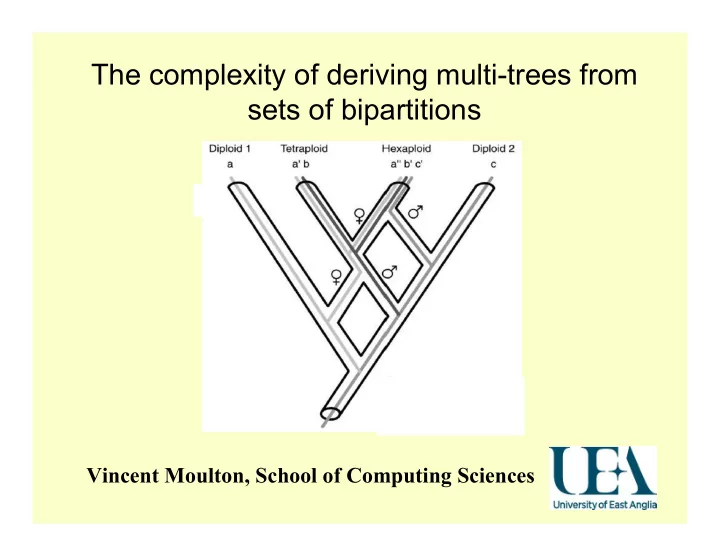
SLIDE 3 Modelling polyploidy
(multi-trees from networks)
A B C A B B C
SLIDE 4 Networks from multi-trees?
Smedmark et al., Systematic Biology, 2003
SLIDE 5
Multiple possibilties
a b c b c b d
c
a b c d a b c d
SLIDE 6 Aim
A B B C B C D
A B C D
Given a multi-labeled tree T …. …. construct a “most parsimonious” reticulate network displaying T
SLIDE 7
Merging leaves
a b b c b b c c d a b b b b c d a b c d
SLIDE 8
Inextendible subtrees
a a b b c c b c maximal inextendible inextendible
SLIDE 9
Construction
a b b b c c d a b c c d a b c d D(T) a b b c b b c c d T Theorem [Huber,Moulton, 2006] D(T) is “minimal” network displaying T.
SLIDE 10
Question: How do we get the multi-tree?
SLIDE 11
Consensus trees
A B C D E A B D A D C C E B E AB | CDE , ABC | DE AC |BDE, ABC | DE AB|DCE, ABD | CE A B C D E
SLIDE 12 Problem!
Theorem Given a set S of splits of a multi-set M, it is NP-hard to decide if S can be displayed by a multi-tree (even if the multiplicity of all elements in M is bounded by 3). Idea for why this is the case: M = {n x} S = { n1 x | (n-n1)x , … , nm x | (n-nm) x} Deciding if we can display this set by a multi-tree is essentially equivalent to deciding if there is a subset of {n1,.., nm} that adds up to n/2.
x x x x x x x
“x-tree”
SLIDE 13
Useful result and conjecture
Theorem [Lott, Huber, Moulton, Spillner, in press] If every submultiset of size at most m := max{2Δ, Δ+2} of a multiset of splits of M can be displayed by a multi-tree, then so can the whole collection. Conjecture m = Δ+2 Given multiset M = {m(x) x}x in X , let Δ(M) = Σ x in X (m(x) - 1).
SLIDE 14
Work in progress…
SLIDE 15
PADRE
http://www.cmp.uea.ac.uk/~vlm/padre/ Martin Lott