
SLIDE 1
The question The theory The data and model Results
The Book
Andrew Gelman and Jeff Cai Should the Democrats Move Left?
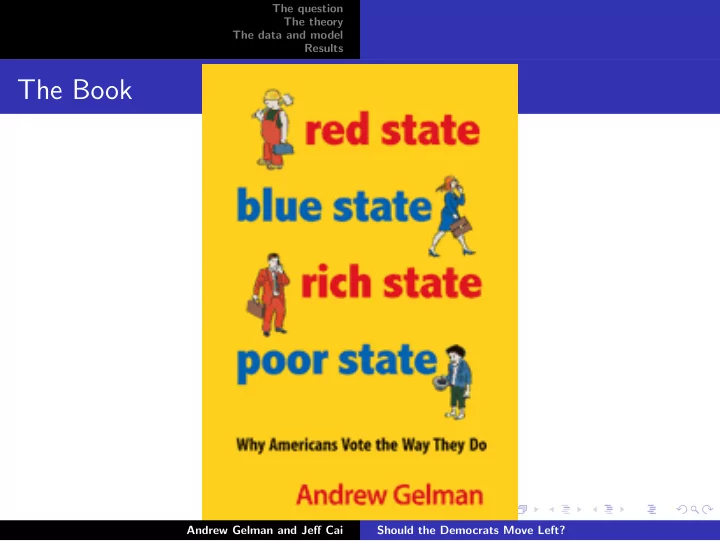
The Book Andrew Gelman and Jeff Cai Should the Democrats Move Left? - - PowerPoint PPT Presentation
The question The theory The data and model Results The Book Andrew Gelman and Jeff Cai Should the Democrats Move Left? The question The theory The data and model Results Should the Democrats move left on economic policy? Andrew Gelman
The question The theory The data and model Results
Andrew Gelman and Jeff Cai Should the Democrats Move Left?
The question The theory The data and model Results
Andrew Gelman and Jeff Cai Should the Democrats Move Left?
The question The theory The data and model Results
Andrew Gelman and Jeff Cai Should the Democrats Move Left?
The question The theory The data and model Results
Andrew Gelman and Jeff Cai Should the Democrats Move Left?
The question The theory The data and model Results
Andrew Gelman and Jeff Cai Should the Democrats Move Left?
The question The theory The data and model Results
Andrew Gelman and Jeff Cai Should the Democrats Move Left?
The question The theory The data and model Results
Andrew Gelman and Jeff Cai Should the Democrats Move Left?
The question The theory The data and model Results
Andrew Gelman and Jeff Cai Should the Democrats Move Left?
The question The theory The data and model Results Median voter theorem Multiple dimensions Measurement error
Andrew Gelman and Jeff Cai Should the Democrats Move Left?
The question The theory The data and model Results Median voter theorem Multiple dimensions Measurement error
Andrew Gelman and Jeff Cai Should the Democrats Move Left?
The question The theory The data and model Results Median voter theorem Multiple dimensions Measurement error
Andrew Gelman and Jeff Cai Should the Democrats Move Left?
The question The theory The data and model Results Median voter theorem Multiple dimensions Measurement error
Andrew Gelman and Jeff Cai Should the Democrats Move Left?
The question The theory The data and model Results Median voter theorem Multiple dimensions Measurement error
conservative
liberal on economy conservative
liberal on
conservative
liberal on economy conservative
liberal on
Andrew Gelman and Jeff Cai Should the Democrats Move Left?
The question The theory The data and model Results Median voter theorem Multiple dimensions Measurement error
Andrew Gelman and Jeff Cai Should the Democrats Move Left?
The question The theory The data and model Results Median voter theorem Multiple dimensions Measurement error
Andrew Gelman and Jeff Cai Should the Democrats Move Left?
The question The theory The data and model Results Median voter theorem Multiple dimensions Measurement error
Andrew Gelman and Jeff Cai Should the Democrats Move Left?
The question The theory The data and model Results Median voter theorem Multiple dimensions Measurement error
Andrew Gelman and Jeff Cai Should the Democrats Move Left?
The question The theory The data and model Results Median voter theorem Multiple dimensions Measurement error
Andrew Gelman and Jeff Cai Should the Democrats Move Left?
The question The theory The data and model Results Data Model
◮ Perception of George W. Bush ◮ Perception of John Kerry ◮ Perception of self Andrew Gelman and Jeff Cai Should the Democrats Move Left?
The question The theory The data and model Results Data Model
◮ Perception of George W. Bush ◮ Perception of John Kerry ◮ Perception of self Andrew Gelman and Jeff Cai Should the Democrats Move Left?
The question The theory The data and model Results Data Model
◮ Perception of George W. Bush ◮ Perception of John Kerry ◮ Perception of self Andrew Gelman and Jeff Cai Should the Democrats Move Left?
The question The theory The data and model Results Data Model
◮ Perception of George W. Bush ◮ Perception of John Kerry ◮ Perception of self Andrew Gelman and Jeff Cai Should the Democrats Move Left?
The question The theory The data and model Results Data Model
◮ Perception of George W. Bush ◮ Perception of John Kerry ◮ Perception of self Andrew Gelman and Jeff Cai Should the Democrats Move Left?
The question The theory The data and model Results Data Model
−8 −4 4 8 −8 −4 4 8
−8 −4 4 8 −8 −4 4 8
−8 −4 4 8 −8 −4 4 8
Andrew Gelman and Jeff Cai Should the Democrats Move Left?
The question The theory The data and model Results Data Model
◮ Extreme partisans view Kerry as more liberal and view Bush as
◮ Moderates tend to view both candidates as moderates Andrew Gelman and Jeff Cai Should the Democrats Move Left?
The question The theory The data and model Results Data Model
◮ Extreme partisans view Kerry as more liberal and view Bush as
◮ Moderates tend to view both candidates as moderates Andrew Gelman and Jeff Cai Should the Democrats Move Left?
The question The theory The data and model Results Data Model
◮ Extreme partisans view Kerry as more liberal and view Bush as
◮ Moderates tend to view both candidates as moderates Andrew Gelman and Jeff Cai Should the Democrats Move Left?
The question The theory The data and model Results Data Model
◮ Extreme partisans view Kerry as more liberal and view Bush as
◮ Moderates tend to view both candidates as moderates Andrew Gelman and Jeff Cai Should the Democrats Move Left?
The question The theory The data and model Results Data Model
◮ (dist.E)i = (econBush
i
i
i
i
◮ (dist.S)i = (socBush
i
i
i
i
◮ Separate logistic regressions for self-declared Democrats,
◮ Economic issues matter more than social issues (especially
Andrew Gelman and Jeff Cai Should the Democrats Move Left?
The question The theory The data and model Results Data Model
◮ (dist.E)i = (econBush
i
i
i
i
◮ (dist.S)i = (socBush
i
i
i
i
◮ Separate logistic regressions for self-declared Democrats,
◮ Economic issues matter more than social issues (especially
Andrew Gelman and Jeff Cai Should the Democrats Move Left?
The question The theory The data and model Results Data Model
◮ (dist.E)i = (econBush
i
i
i
i
◮ (dist.S)i = (socBush
i
i
i
i
◮ Separate logistic regressions for self-declared Democrats,
◮ Economic issues matter more than social issues (especially
Andrew Gelman and Jeff Cai Should the Democrats Move Left?
The question The theory The data and model Results Data Model
◮ (dist.E)i = (econBush
i
i
i
i
◮ (dist.S)i = (socBush
i
i
i
i
◮ Separate logistic regressions for self-declared Democrats,
◮ Economic issues matter more than social issues (especially
Andrew Gelman and Jeff Cai Should the Democrats Move Left?
The question The theory The data and model Results Data Model
◮ (dist.E)i = (econBush
i
i
i
i
◮ (dist.S)i = (socBush
i
i
i
i
◮ Separate logistic regressions for self-declared Democrats,
◮ Economic issues matter more than social issues (especially
Andrew Gelman and Jeff Cai Should the Democrats Move Left?
The question The theory The data and model Results Data Model
◮ (dist.E)i = (econBush
i
i
i
i
◮ (dist.S)i = (socBush
i
i
i
i
◮ Separate logistic regressions for self-declared Democrats,
◮ Economic issues matter more than social issues (especially
Andrew Gelman and Jeff Cai Should the Democrats Move Left?
The question The theory The data and model Results Data Model
◮ (dist.E)i = (econBush
i
i
i
i
◮ (dist.S)i = (socBush
i
i
i
i
◮ Separate logistic regressions for self-declared Democrats,
◮ Economic issues matter more than social issues (especially
Andrew Gelman and Jeff Cai Should the Democrats Move Left?
The question The theory The data and model Results Data Model
◮ Bush could move on economics or on social policy ◮ Kerry could move on economics or on social policy
◮ Shift the model of the perceived positions of candidates ◮ Run the model of votes given distances ◮ Sum over all the survey respondents ◮ Compare to unadjusted survey data Andrew Gelman and Jeff Cai Should the Democrats Move Left?
The question The theory The data and model Results Data Model
◮ Bush could move on economics or on social policy ◮ Kerry could move on economics or on social policy
◮ Shift the model of the perceived positions of candidates ◮ Run the model of votes given distances ◮ Sum over all the survey respondents ◮ Compare to unadjusted survey data Andrew Gelman and Jeff Cai Should the Democrats Move Left?
The question The theory The data and model Results Data Model
◮ Bush could move on economics or on social policy ◮ Kerry could move on economics or on social policy
◮ Shift the model of the perceived positions of candidates ◮ Run the model of votes given distances ◮ Sum over all the survey respondents ◮ Compare to unadjusted survey data Andrew Gelman and Jeff Cai Should the Democrats Move Left?
The question The theory The data and model Results Data Model
◮ Bush could move on economics or on social policy ◮ Kerry could move on economics or on social policy
◮ Shift the model of the perceived positions of candidates ◮ Run the model of votes given distances ◮ Sum over all the survey respondents ◮ Compare to unadjusted survey data Andrew Gelman and Jeff Cai Should the Democrats Move Left?
The question The theory The data and model Results Data Model
◮ Bush could move on economics or on social policy ◮ Kerry could move on economics or on social policy
◮ Shift the model of the perceived positions of candidates ◮ Run the model of votes given distances ◮ Sum over all the survey respondents ◮ Compare to unadjusted survey data Andrew Gelman and Jeff Cai Should the Democrats Move Left?
The question The theory The data and model Results Data Model
◮ Bush could move on economics or on social policy ◮ Kerry could move on economics or on social policy
◮ Shift the model of the perceived positions of candidates ◮ Run the model of votes given distances ◮ Sum over all the survey respondents ◮ Compare to unadjusted survey data Andrew Gelman and Jeff Cai Should the Democrats Move Left?
The question The theory The data and model Results Data Model
◮ Bush could move on economics or on social policy ◮ Kerry could move on economics or on social policy
◮ Shift the model of the perceived positions of candidates ◮ Run the model of votes given distances ◮ Sum over all the survey respondents ◮ Compare to unadjusted survey data Andrew Gelman and Jeff Cai Should the Democrats Move Left?
The question The theory The data and model Results Data Model
◮ Bush could move on economics or on social policy ◮ Kerry could move on economics or on social policy
◮ Shift the model of the perceived positions of candidates ◮ Run the model of votes given distances ◮ Sum over all the survey respondents ◮ Compare to unadjusted survey data Andrew Gelman and Jeff Cai Should the Democrats Move Left?
The question The theory The data and model Results Data Model
◮ Bush could move on economics or on social policy ◮ Kerry could move on economics or on social policy
◮ Shift the model of the perceived positions of candidates ◮ Run the model of votes given distances ◮ Sum over all the survey respondents ◮ Compare to unadjusted survey data Andrew Gelman and Jeff Cai Should the Democrats Move Left?
The question The theory The data and model Results Results Conclusions Conclusions Extra material
Change in Bush vote −2 + 2 −4% +4% Kerry shift on social issues Shift in Kerry’s position on social issues −2 + 2 Bush shift on econ issues Change in Bush vote −2 + 2 −4% +4% Bush shift on social issues Shift in Bush’s position on social issues −2 + 2 Kerry shift on econ issues Shift in Kerry’s position on economy Shift in Bush’s position on economy
Andrew Gelman and Jeff Cai Should the Democrats Move Left?
The question The theory The data and model Results Results Conclusions Conclusions Extra material
◮ Data limitations ◮ Extrapolation
◮ No, Kerry wouldn’t have gained by moving left ◮ But Bush would’ve gained by moving left
Andrew Gelman and Jeff Cai Should the Democrats Move Left?
The question The theory The data and model Results Results Conclusions Conclusions Extra material
◮ Data limitations ◮ Extrapolation
◮ No, Kerry wouldn’t have gained by moving left ◮ But Bush would’ve gained by moving left
Andrew Gelman and Jeff Cai Should the Democrats Move Left?
The question The theory The data and model Results Results Conclusions Conclusions Extra material
◮ Data limitations ◮ Extrapolation
◮ No, Kerry wouldn’t have gained by moving left ◮ But Bush would’ve gained by moving left
Andrew Gelman and Jeff Cai Should the Democrats Move Left?
The question The theory The data and model Results Results Conclusions Conclusions Extra material
◮ Data limitations ◮ Extrapolation
◮ No, Kerry wouldn’t have gained by moving left ◮ But Bush would’ve gained by moving left
Andrew Gelman and Jeff Cai Should the Democrats Move Left?
The question The theory The data and model Results Results Conclusions Conclusions Extra material
◮ Data limitations ◮ Extrapolation
◮ No, Kerry wouldn’t have gained by moving left ◮ But Bush would’ve gained by moving left
Andrew Gelman and Jeff Cai Should the Democrats Move Left?
The question The theory The data and model Results Results Conclusions Conclusions Extra material
◮ Data limitations ◮ Extrapolation
◮ No, Kerry wouldn’t have gained by moving left ◮ But Bush would’ve gained by moving left
Andrew Gelman and Jeff Cai Should the Democrats Move Left?
The question The theory The data and model Results Results Conclusions Conclusions Extra material
◮ Data limitations ◮ Extrapolation
◮ No, Kerry wouldn’t have gained by moving left ◮ But Bush would’ve gained by moving left
Andrew Gelman and Jeff Cai Should the Democrats Move Left?
The question The theory The data and model Results Results Conclusions Conclusions Extra material
◮ Data limitations ◮ Extrapolation
◮ No, Kerry wouldn’t have gained by moving left ◮ But Bush would’ve gained by moving left
Andrew Gelman and Jeff Cai Should the Democrats Move Left?
The question The theory The data and model Results Results Conclusions Conclusions Extra material
◮ Data limitations ◮ Extrapolation
◮ No, Kerry wouldn’t have gained by moving left ◮ But Bush would’ve gained by moving left
Andrew Gelman and Jeff Cai Should the Democrats Move Left?
The question The theory The data and model Results Results Conclusions Conclusions Extra material
Andrew Gelman and Jeff Cai Should the Democrats Move Left?
The question The theory The data and model Results Results Conclusions Conclusions Extra material
◮ Government spending ◮ Government provide economic environment for job security ◮ Defense spending
◮ Role of women ◮ Gun-control policy ◮ Government aid to African Americans Andrew Gelman and Jeff Cai Should the Democrats Move Left?
The question The theory The data and model Results Results Conclusions Conclusions Extra material
◮ Government spending ◮ Government provide economic environment for job security ◮ Defense spending
◮ Role of women ◮ Gun-control policy ◮ Government aid to African Americans Andrew Gelman and Jeff Cai Should the Democrats Move Left?
The question The theory The data and model Results Results Conclusions Conclusions Extra material
◮ Government spending ◮ Government provide economic environment for job security ◮ Defense spending
◮ Role of women ◮ Gun-control policy ◮ Government aid to African Americans Andrew Gelman and Jeff Cai Should the Democrats Move Left?
The question The theory The data and model Results Results Conclusions Conclusions Extra material
◮ Government spending ◮ Government provide economic environment for job security ◮ Defense spending
◮ Role of women ◮ Gun-control policy ◮ Government aid to African Americans Andrew Gelman and Jeff Cai Should the Democrats Move Left?
The question The theory The data and model Results Results Conclusions Conclusions Extra material
◮ Government spending ◮ Government provide economic environment for job security ◮ Defense spending
◮ Role of women ◮ Gun-control policy ◮ Government aid to African Americans Andrew Gelman and Jeff Cai Should the Democrats Move Left?
The question The theory The data and model Results Results Conclusions Conclusions Extra material
◮ Government spending ◮ Government provide economic environment for job security ◮ Defense spending
◮ Role of women ◮ Gun-control policy ◮ Government aid to African Americans Andrew Gelman and Jeff Cai Should the Democrats Move Left?
The question The theory The data and model Results Results Conclusions Conclusions Extra material
◮ Government spending ◮ Government provide economic environment for job security ◮ Defense spending
◮ Role of women ◮ Gun-control policy ◮ Government aid to African Americans Andrew Gelman and Jeff Cai Should the Democrats Move Left?
The question The theory The data and model Results Results Conclusions Conclusions Extra material
◮ Government spending ◮ Government provide economic environment for job security ◮ Defense spending
◮ Role of women ◮ Gun-control policy ◮ Government aid to African Americans Andrew Gelman and Jeff Cai Should the Democrats Move Left?
The question The theory The data and model Results Results Conclusions Conclusions Extra material
◮ Government spending ◮ Government provide economic environment for job security ◮ Defense spending
◮ Role of women ◮ Gun-control policy ◮ Government aid to African Americans Andrew Gelman and Jeff Cai Should the Democrats Move Left?
The question The theory The data and model Results Results Conclusions Conclusions Extra material
Andrew Gelman and Jeff Cai Should the Democrats Move Left?
The question The theory The data and model Results Results Conclusions Conclusions Extra material
Average ideologies of different groups of voters Average score on economic issues Average score on social issues
liberal moderate conservative liberal moderate conservative Poor Middle Rich
Democratic States
Poor Middle Rich
Battleground States
Poor Middle Rich
Republican States Andrew Gelman and Jeff Cai Should the Democrats Move Left?
The question The theory The data and model Results Results Conclusions Conclusions Extra material
Andrew Gelman and Jeff Cai Should the Democrats Move Left?