The birth of a near Universe UHECR Astronomy? (Uhe neutrino should - - PowerPoint PPT Presentation

the birth of a near universe
SMART_READER_LITE
LIVE PREVIEW

The birth of a near Universe UHECR Astronomy? (Uhe neutrino should - - PowerPoint PPT Presentation

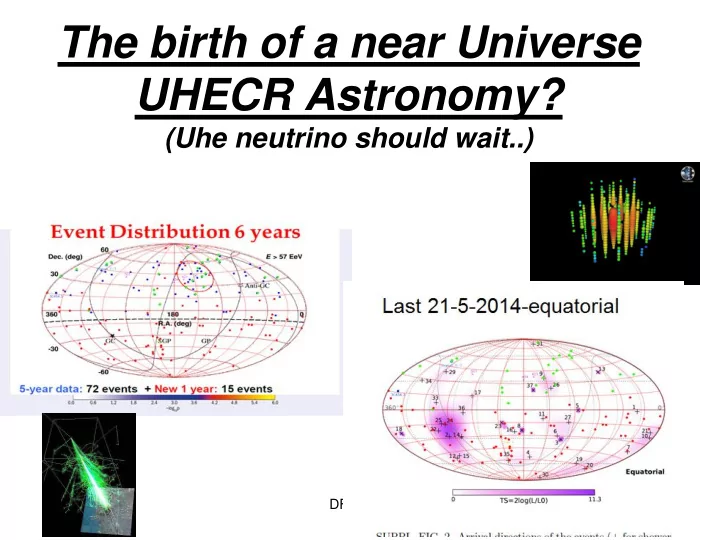
The birth of a near Universe UHECR Astronomy? (Uhe neutrino should wait..) DF/8/7/14 1 1 Astronomy need to recognize the sources name: UHECR attractive sample today News; TA=87; AUGER=69: a rich UHECR map sky Most UHECR modelling are


slide-1
SLIDE 1

1

The birth of a near Universe UHECR Astronomy?

(Uhe neutrino should wait..)

1 DF/8/7/14
slide-2
SLIDE 2

2

Astronomy need to recognize the sources name: UHECR attractive sample today News; TA=87; AUGER=69: a rich UHECR map sky

  • Most UHECR modelling are dealing just with spectra,

composition, Galactic or Extragalactic Nature, possible source engine

  • GRBs,AGN, Starburst Galaxy,BL Lac..
  • did not fit the expectations
  • Few are advocating UHECR relics decay (to day above

PeV masses) to feed neutrinos at PeVs

  • No one (longer) try to pont to any real location and

correlation with known source for UHECR

  • Where are the source candidate ( even bent ones)?
  • I will try to show map with bending reading key

finding a few candidate sources for most UHECR

slide-3
SLIDE 3

3

An apparent Super Galactic Plane connection

slide-4
SLIDE 4

4

2011 AUGER in Galactic coordinates: no longer SGP, but just Cen A cluster

slide-5
SLIDE 5

5

Photon and Charged nuclei or nucleon on Earth: Airshowers

5 DF/8/7/14

slide-6
SLIDE 6

6

Cosmic ray Composition and Showers: Define both Universe size and deflection angle

6 DF/8/7/14

slide-7
SLIDE 7

7

UHECR hopes for near-by bounded almost undeflected Astronomy

  • Because at highest energy UHECR are almost

unbent they may trace their origin

  • However their composition may diffuse their

arrival angle and define their arrival distances: the GZK cut off due to nucleon or nuclei

  • pacity on relic photons
  • Clustering angle:

size related to UHECR nuclei Composition

slide-8
SLIDE 8

8

The GZK cut off and the cosmogenic neutrinos

8 DF/8/7/14

slide-9
SLIDE 9

9

Lightest He UHECR in a very very Small sized Universe, few Mpc: easy to disentangle sources

Proton: 2% of Universe Fe: 2% but randomly smeared He: 0.2 % of the Universe;

Virgo may be obscored

Harari June 2014:A

9 DF/8/7/14

slide-10
SLIDE 10

10

The case of Virgo

  • The name of a GW experiment
  • The name of nearest and brightest

(IR) cluster of Galaxies (thousands)

  • The largest mass within the GZK cut
  • ff inside the Super Galactic Plane
  • This wide sky region is nearly

absent in UHECR: both in AUGER and TA !

slide-11
SLIDE 11

11

UHECR contradiction: The composition…and the

absence of Virgo and the apparent SGP ..2007..2009..2011.

:…..the Super Galactic Plane on 2011.. fade away

11 DF/8/7/14

slide-12
SLIDE 12

12 12 DF/8/7/14

No any clear UHECR (69 events) correlation at 40 Mpc Universe volumes Few clustering along Cen A, maybe Vela

slide-13
SLIDE 13

13

A possible solution to Virgo absence by GZK light nuclei dissociation cut off

  • Physica Scripta Volume 78 Number 4
  • D Fargion 2008 Phys. Scr. 78 045901 :
  • Light nuclei solving the AUGER

puzzles: the Cen-A imprint

  • Virgo absent because He

UHECR are absorbed

slide-14
SLIDE 14

14

Lightest Nuclei for Cen A-Virgo GZK cut off may solve the Virgo absence

14 DF/8/7/14

slide-15
SLIDE 15

15

Composition updated Hires 2010 and TA 2011, 2014 Light Nuclei fit both AUGER and TA

15 DF/8/7/14

slide-16
SLIDE 16

16

Alternate spiral magnetic fields in our galaxy making CenA events by He nuclei UHECR spread up-down in an oval shape

slide-17
SLIDE 17

17

Random Bending along Galactic plane and spliral arm fields: the He UHECR bending

The He fragments of the UHECR at 20 EeV energy will be one third lower energy and half charged: three half the previous value

slide-18
SLIDE 18

18

Foreseen He fragments since 2009: Observed by AUGER

  • n 2011

18 DF/8/7/14 2008 DF arXiv:0908.2650 , NIMA51778 PII: S0168-9002(10)01230-1, 2010

AUGER Coll., (TAUP 2011) , IOP Publishing Journal of Physics: Conference Series 375,(2012) 052002

slide-19
SLIDE 19

19

Additional hints:TeVs Gamma may tag UHECR? EQUATORIAL MAPS

slide-20
SLIDE 20

20

Also a Coherent Bending for heavy He,Fe while crossing vertically in our galaxy

slide-21
SLIDE 21

21

Overlap of UHECR TA, Hires,AUGER in celestial coordinate 2014

slide-22
SLIDE 22

22

slide-23
SLIDE 23

23

Virgo absence in AUGER and TA

slide-24
SLIDE 24

24

Who is feeding by bending UHECR the TA Hot Spot?

slide-25
SLIDE 25

25

He UHECR solving the TA Hot Spot puzzle?

  • The UHECR TA events are not spread

events of any spread cluster but they are probably the spread random walk of one main source: It suffer few Coherent bending while crossing at vertical galactic B fields

  • He photo-nuclear fragility avoid UHECR to

arrive from Virgo (as well from URSA Majoris, 60 My), but UHECR He,(Be,B) may still arrive scrambled and deflected from near M82 at 11 My a few degree (p,D) or at larger ones (He,Be,B) as they are observed in the TA Hot

spot

slide-26
SLIDE 26

26

Most recent Proposal (in press Nucl.Phys.B) arXiv:1408.0227 DF

M82: protons

M82: Deflected He B,C,O From M82

Cygnus X3 SS433 Or Aq X1 Cen A Vela Multiplet

slide-27
SLIDE 27

27

M82: Nearest brightest nearest Starburst Galaxy (distance of 12 million light years )

slide-28
SLIDE 28

28

Last Nature letter 2 days ago

  • There’s a bit of a mystery buried in the heart
  • f the Cigar Galaxy, known more formally as

M82 or Messier 82. Shining brightly in X-rays is a black hole (called M82 X-1) that straddles an unusual line between small and huge black holes, new research has revealed.

  • The new study reveals for the first time just how

big this black hole is — about 400 times the mass of the sun — after about a decade of struggling to figure this out.

slide-29
SLIDE 29

29

Virgo

slide-30
SLIDE 30

30

Conclusion 1

  • UHECR astronomy is possibly born: lightest nuclei are their main courier:

Mostly He, D, p and maybe B,C,O too. Galactic Ni,Fe may also rise but rarely and near. Just a few sources in action within narrow He GZK

  • They are few known sources, somehow off-axis:
  • Cena A (nearest AGN)
  • Vela ?(nearest, brightest gamma pulsar)
  • Aq-X1 or SS433,nearest and powerfull jets
  • Cygnus X3 , brightest binary in TeV milagro, ARGO map
  • M 82 (nearest star burst galaxy)
  • INTERMEDIATE MASS BH Jet may play a role

Most UHECR spread clustering are just spectroscopically , coherently spread events correlated with narrow cluster as for M 82. Thank you for the kind attention

slide-31
SLIDE 31

31

Conclusion 2 on UHE neutrino

  • UHE neutrino are only partially galactic and

possibly rarely correlated to UHECR as Vela (event 3,6), Cen A, Galactic center, Aq-X1 or SS433..UHE neutrinos are mostly cosmic, often uncorrelated or difficult to pick up in time (GRB, BL Lac flare) but within precursor events.

  • UHE crossing muons at horizons (several dozens) may soon

help to disentangle their maps (foreseen and observed)

  • Present ICECUBE test at TeV-PeV mostly crossing muons are

polluted by atmospheric events: useless

  • Precessing jets for GRB and SGR are long life: they

may be still consistent with UHE neutrino and AGN flare at few- ten percent.

  • Neutrino may shed in future light on Cosmic

Rays but already UHECR light nuclei may shed light to UHE light neutrino

  • Thank you for the kind attention
slide-32
SLIDE 32

32

Nature ,17 August 2014

  • M82 X-1, the brightest X-ray source in the galaxy M82, has been thought to be

an intermediate-mass black hole (100 to 10,000 solar masses) because of its extremely

high luminosity and variability characteristics1, 2, 3, 4, 5, 6, although some models suggest that its mass may be only about 20 solar masses3, 7. The previous mass estimates were based on scaling relations that use low-frequency characteristic timescales which have large intrinsic uncertainties8, 9. For stellar-mass black holes, we know that the high-frequency quasi-periodic

  • scillations (100–450 hertz) in the X-ray emission that occur in a 3:2 frequency ratio are stable

and scale in frequency inversely with black hole mass with a reasonably small dispersion10, 11, 12, 13, 14, 15. The discovery of such stable oscillations thus potentially offers an alternative and less ambiguous means of mass determination for intermediate-mass black holes, but has hitherto not been realized. Here we report stable, twin-peak (3:2 frequency ratio) X-ray quasi-periodic

  • scillations from M82 X-1 at frequencies of 3.32 ± 0.06 hertz and 5.07 ± 0.06 hertz. Assuming

that we can extrapolate the inverse-mass scaling that holds for stellar-mass black holes, we estimate the black hole mass of M82 X-1 to be 428 ± 105 solar masses. In addition, we can estimate the mass using the relativistic precession model, from which we get a value of

415 ± 63 solar masses.

  • Intermediate BH at thousand solar Mass may be the UHECR

sources

slide-33
SLIDE 33

33

Cygnus X 3

  • Bynary system jet
slide-34
SLIDE 34

34

SS433 as Aq X1: bynary precessing jet

index.jpg

slide-35
SLIDE 35

35

Cena A: Our nearest AGN

35 DF/8/7/14

slide-36
SLIDE 36

36

M82: nearest star burst, inner core

slide-37
SLIDE 37

37

Additional slides

slide-38
SLIDE 38

38

Ursa cluster versus M82

  • The Ursa Major Cluster (Ursa Major I Cluster, UMa I

ClG) is a spiral-rich galaxy cluster of the Virgo Supercluster.

  • Some of its largest members are NGC 3631, NGC 3953,

M109 on North (M109 Group) and NGC 3726, NGC 3938 NGC 4051 on South.

  • The Ursa Major cluster is located at a distance of 18.6

megaparsecs (60 million light years) and contains about 30% of the light but only 5% of the mass of the nearby Virgo cluster.:

  • THEREFORE: WHY NOT VIRGO?
slide-39
SLIDE 39

39

Historical puzzle of Fly’s Eye: Correlation with AGN above GZK? The Fly’s Eye 1995 discover

  • THE ASTROPHYSICAL JOURNAL, 517:1999:

Received 1997 October 9; accepted 1999 January 4, DF,B.Mele,A.Salis

  • UltraHigh-Energy Neutrino Scattering
  • nto Relic Light Neutrinos in the

Galactic Halo as a Possible Source of the Highest Energy Extragalactic Cosmic Rays—(so called Z burst model)

  • D. F, B. MELE, AND A. SALIS;
  • Weiler Thomas J. Cosmic Ray Neutrino Annihilation on Relic Neutrinos

Revisited: A Mechanism for Generating Air Showers above the Greisen- Zatsepin-Kuzmin Cut-off (figures) Astropart.Phys. 11 (1999) 303-316 (22 Oct 1997-July 1999)

39 DF/8/7/14

slide-40
SLIDE 40

40 40 DF/8/7/14

slide-41
SLIDE 41

41 41 DF/8/7/14

slide-42
SLIDE 42

42 42 DF/8/7/14

slide-43
SLIDE 43

43

Any correlation of UHE neutrinos with UHECR?

43 DF/8/7/14

slide-44
SLIDE 44

44

Conclusion 3

  • Tau neutrino cannot be born in Earth

mixing because Earth size and tau mass threshold: Tau astronomy is free of noise.

  • PeVs events exist (not yet Glashow ones);
  • Tau airshower at PeVs difficult to be seen by

fluorescence (AUGER,TA) but detectable by beamed Cherenkov flash.

  • Tau airshowers at ASHRA (now) and HAWC ,

HESS, MAGIC may be soon seen. The most clean neutrino astronomy of this decade.

44 DF/8/7/14

slide-45
SLIDE 45

45

Possible MeV- (COMPTON Obs) –AUGER and TA UHECR connection

45 DF/8/7/14

slide-46
SLIDE 46

46

Very recent UHE neutrino anisotropy seem to avoid any correlation: Nevertheless. Energy polluted by atmospheric.1 TeV noise dominance..

slide-47
SLIDE 47

47 DF/8/7/14 47

Muons Neutrino tracks and other Neutrino showers in ICECUBE

slide-48
SLIDE 48

48 48 DF/8/7/14

slide-49
SLIDE 49

49

The Tau neutrino role

  • Because no atmospheric noise
  • Because no possible to feed it by
  • scillation  No tau neutrino noise above

TeV energy

  • Above PeVs up to EeV energy their tract

directions

  • (50 m—10 Km) in matter make them an ideal

probe to interact in mountains or Earth , escape and decay in flight; the Tau Airshower neutrino astronomy

49 DF/8/7/14

slide-50
SLIDE 50

50

The lepton Muon, Tau Distances in matter with energy

50 DF/8/7/14

slide-51
SLIDE 51

51

The flavor Mixing occurs along large galactic distances

  • Even at ZeV energy oscillation makes all

flavor at same flux.

51 DF/8/7/14

slide-52
SLIDE 52

52

D.Fargion The Astrophysical Journal,570,p.909. 2002

ICRC 1999-Salth Lake_US

52 DF/8/7/14