The algebraic surgery exact sequence ANDREW RANICKI (Edinburgh) - - PDF document

the algebraic surgery exact sequence
SMART_READER_LITE
LIVE PREVIEW

The algebraic surgery exact sequence ANDREW RANICKI (Edinburgh) - - PDF document

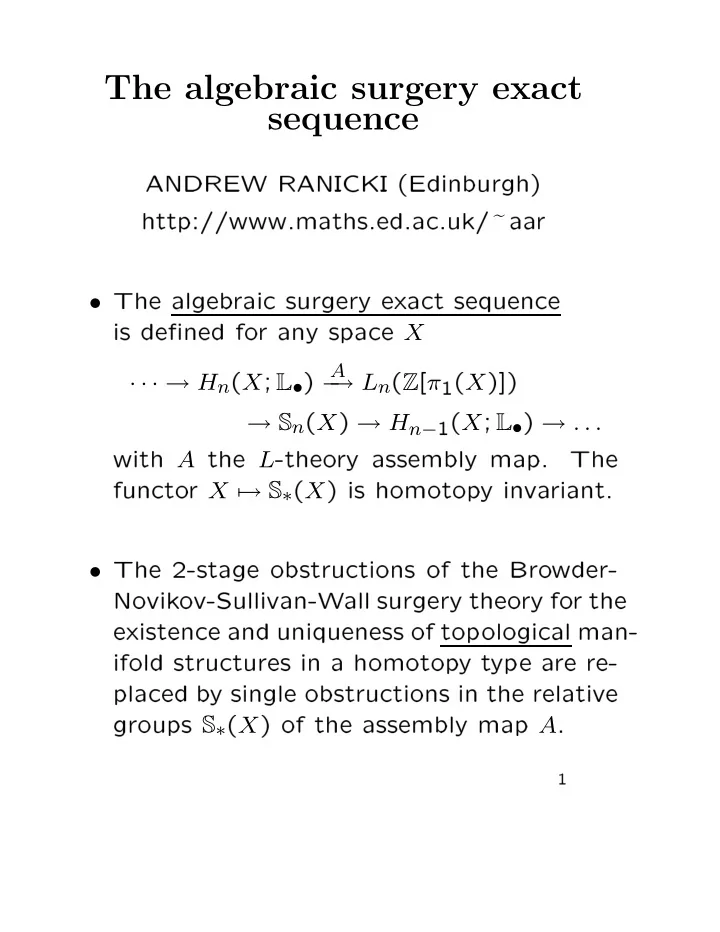
The algebraic surgery exact sequence ANDREW RANICKI (Edinburgh) http://www.maths.ed.ac.uk/ aa r The algeb raic surgery exact sequence is dened fo r any space X ) A H n ( X ; L L n ( Z [ ( X


slide-1
SLIDE 1

The algebraic surgery exact sequence

ANDREW RANICKI (Edinburgh) http://www.maths.ed.ac.uk/ aa r
  • The
algeb raic surgery exact sequence is dened fo r any space X

· · · → Hn

(X ; L• ) A

− → Ln

(Z [π 1 (X )])

→ Sn

(X ) → Hn− 1 (X ; L• ) → . . . with A the L
  • theo
ry assembly map. The functo r X → S∗ (X ) is homotop y inva riant.
  • The
2-stage
  • bstructions
  • f
the Bro wder- Novik
  • v-Sullivan-W
all surgery theo ry fo r the existence and uniqueness
  • f
top
  • logical
man- ifold structures in a homotop y t yp e a re re- placed b y single
  • bstructions
in the relative groups S∗ (X )
  • f
the assembly map A. 1
slide-2
SLIDE 2 Lo cal and global mo dules
  • The
assembly map A : H∗ (X ; L• ) → L∗ (Z [π 1 (X )]) is induced b y a fo rgetful functo r

A

: {(Z, X )-mo dules} → {Z [π 1 (X )]-mo dules} where the domain dep ends
  • n
the lo cal top
  • logy
  • f X
and the ta rget dep ends
  • nly
  • n
the fundamental group π 1 (X )
  • f X
, which is global.
  • In
terms
  • f
sheaf theo ry A = q !p ! with

p

:

X → X

the universal covering p rojection and q :

X → {

pt.}.
  • The
geometric mo del fo r the L
  • theo
ry as- sembly A is the fo rgetful functo r

{geometric

P
  • inca
r
  • e
complexes}

→ {

top
  • logical
manifolds.} In fact, in dimensions n ≥ 5 this functo r has the same b re as A. 2
slide-3
SLIDE 3 Lo cal and global quadratic P
  • inca
r
  • e
complexes
  • (Global)
The L
  • group Ln
(Z [π 1 (X )]) is the cob
  • rdism
group
  • f n-dimensional
quadratic P
  • inca
r
  • e
complexes (C, ψ )
  • ver Z
[π 1 (X )].
  • (Lo
cal) The generalized homology group

Hn

(X ; L• ) is the cob
  • rdism
group
  • f n-
dimensional quadratic P
  • inca
r
  • e
complexes (C, ψ )
  • ver
(Z, X ). As in sheaf theo ry C has stalks , which a re Z
  • mo
dule chain com- plexes C (x ) (x ∈ X ).
  • (Lo
cal-Global) Sn (X ) is the cob
  • rdism
group
  • f
(n − 1)-dimensional quadratic P
  • inca
r
  • e
complexes (C, ψ )
  • ver
(Z, X ) such that the

Z

[π 1 (X )]-mo dule chain complex assembly

A(C

) is acyclic. 3
slide-4
SLIDE 4 The total surgery
  • bstruction
  • The
total surgery
  • bstruction
  • f
an

n-dimensional

geometric P
  • inca
r
  • e
complex

X

is the cob
  • rdism
class

s

(X ) = (C, ψ ) ∈ Sn (X )
  • f
a Z [π 1 (X )]-acyclic (n − 1)-dimensional quadratic P
  • inca
r
  • e
complex (C, ψ )
  • ver
(Z, X ). The stalks C (x ) (x ∈ X ) measure the fail- ure
  • f X
to have lo cal P
  • inca
r
  • e
dualit y

· · · → Hr

(C (x )) → Hn−r ({x}) → Hr (X, X\{x})

→ Hr−

1 (C (x )) → Hn−r +1 ({x}) → . . .

X

is an n-dimensional homology manifold if and
  • nly
if H∗ (C (x )) = 0. In pa rticula r, this is the case if X is a top
  • logical
manifold.
  • T
  • tal
Surgery Obstruction Theo rem

s

(X ) = 0 ∈ Sn (X ) if (and fo r n ≥ 5
  • nly
if )

X

is homotop y equivalent to an n-dimensional top
  • logical
manifold. 4
slide-5
SLIDE 5 The p ro
  • f
  • f
the T
  • tal
Surgery Obstruction Theo rem The p ro
  • f
is a translation into algeb ra
  • f
the t w
  • -stage
Bro wder-Novik
  • v-Sullivan-W
all
  • b-
struction fo r the existence
  • f
a top
  • logical
man- ifold in the homotop y t yp e
  • f
a P
  • inca
r
  • e
com- plex X :
  • The
image t (X ) ∈ Hn− 1 (X ; L• )
  • f s
(X ) is such that t (X ) = if and
  • nly
if the Spi- vak no rmal b ration νX : X → BG has a top
  • logical
reduction

νX

: X → BTOP .
  • If t
(X ) = then s (X ) ∈ Sn (X ) is the im- age
  • f
the surgery
  • bstruction σ∗
(f, b ) ∈

Ln

(Z [π 1 (X )])
  • f
the no rmal map (f : M →

X, b

: νM →

νX

) determined b y a choice
  • f
lift

νX

: X → BTOP .
  • s
(X ) = if and
  • nly
if there exists a reduc- tion

νX

: X → BTOP fo r which σ∗ (f, b ) = 0. 5
slide-6
SLIDE 6 The structure inva riant
  • The
structure inva riant
  • f
a homotop y equiv- alence h : N → M
  • f n-dimensional
top
  • logical
manifolds is the cob
  • rdism
class

s

(h ) = (C, ψ ) ∈ Sn +1 (M )
  • f
a globally acyclic n-dimensional quadratic P
  • inca
r
  • e
complex (C, ψ ). The stalks C (x ) (x ∈ M ) measure the failure
  • f h
to have acyclic p
  • int
inverses, with

H∗

(C (x )) = H∗ (h− 1 (x ) → {x}) =
  • H∗
+1 (h− 1 (x )) (x ∈ M ) .
  • h
has acyclic p
  • int
inverses if and
  • nly
if

H∗

(C (x )) = 0. In pa rticula r, this is the case if h is a homeomo rphism.
  • Structure
Inva riant Theo rem

s

(h ) = 0 ∈ Sn +1 (M ) if (and fo r n ≥ 5
  • nly
if ) h is homotopic to a homeomo rphism. 6
slide-7
SLIDE 7 The p ro
  • f
  • f
the Structure Inva riant Theo rem (I) The p ro
  • f
is a translation into algeb ra
  • f
the t w
  • -stage
Bro wder-Novik
  • v-Sullivan-W
all
  • b-
struction fo r the uniqueness
  • f
top
  • logical
man- ifold structures in a homotop y t yp e :
  • the
image t (h ) ∈ Hn (M ; L• )
  • f s
(h ) is such that t (h ) = if and
  • nly
if the no rmal in- va riant can b e trvialized (h− 1 )∗νN−νM ≃ {∗} : M → L 0 ≃ G/TOP if and
  • nly
if 1∪h : M ∪N → M ∪M extends to a no rmal b
  • rdism
(f, b ) : (W ; M, N ) → M × ([0, 1]; {0}, {1})
  • if t
(h ) = then s (h ) ∈ Sn +1 (M ) is the image
  • f
the surgery
  • bstruction

σ∗

(f, b ) ∈ Ln +1 (Z [π 1 (M )]) . 7
slide-8
SLIDE 8 The p ro
  • f
  • f
the Structure Inva riant Theo rem (I I)
  • s
(h ) = if and
  • nly
if there exists a no rmal b
  • rdism
(f, b ) which is a simple homotop y equivalence.
  • Have
to w
  • rk
with simple L
  • groups
here, to tak e advantage
  • f
the s
  • cob
  • rdism
the-
  • rem.
  • Alternative
p ro
  • f.
The mapping cylinder
  • f h
: N → M

P

= M ∪h N × [0, 1] denes an (n + 1)-dimensional geometric P
  • inca
r
  • e
pair (P, M∪N ) with manifold b
  • und-
a ry , such that P is homotop y equivalent to

M

. The structure inva riant is the rel ∂ to- tal surgery
  • bstruction

s

(h ) = s∂ (P ) ∈ Sn +1 (P ) = Sn +1 (M ) . 8
slide-9
SLIDE 9 The simply-connected case
  • F
  • r π
1 (X ) = {1} the algeb raic surgery ex- act sequence b reaks up 0 → Sn (X ) → Hn− 1 (X ; L• ) → Ln− 1 (Z ) →
  • The
total surgery
  • bstruction s
(X ) ∈ Sn (X ) maps injectively to the TOP reducibilit y
  • b-
struction t (X ) ∈ Hn− 1 (X ; L• )
  • f
the Spi- vak no rmal b ration νX . Thus fo r n ≥ 5 a simply-connected n-dimensional geometric P
  • inca
r
  • e
complex X is homotop y equiva- lent to an n-dimensional top
  • logical
man- ifold if and
  • nly
if νX : X → BG admits a

TOP

reduction

νX

: X → BTOP .
  • The
structure inva riant s (h ) ∈ Sn +1 (M ) maps injectively to the no rmal inva riant

t

(h ) ∈ Hn (M ; L• ) = [M, G/TOP ]. Thus fo r

n ≥

5 h is homotopic to a homeomo rphism if and
  • nly
if t (h ) ≃ {∗} : M → G/TOP . 9
slide-10
SLIDE 10 The geometric surgery exact sequence
  • The
structure set STOP (M )
  • f
a top
  • log-
ical manifold M is the set
  • f
equivalence classes
  • f
homotop y equivalences h : N →

M

from top
  • logical
manifolds N , with

h ∼ h′

if there exist a homeomo rphism g :

N′ → N

and a homotop y hg ≃ h′ : N′ → M .
  • Theo
rem (Quinn, R.) The geometric surgery exact sequence fo r n = dim (M ) ≥ 5

· · · → Ln

+1 (Z [π 1 (M )]) → STOP (M )

[M, G/TOP ] → Ln (Z [π 1 (M )]) is isomo rphic to the relevant p
  • rtion
  • f
the algeb raic surgery exact sequence

· · · → Ln

+1 (Z [π 1 (M )]) → Sn +1 (M )

→ Hn

(M ; L• ) A

− → Ln

(Z [π 1 (M )]) with STOP

(M×Dk, M×Sk− 1 ) = Sn +k +1 (M ). Example STOP (Sn ) = Sn +1 (Sn ) = 0. 10
slide-11
SLIDE 11 The image
  • f
the assembly map
  • Theo
rem F
  • r
any nitely p resented group

π

the image
  • f
the assembly map

A

: Hn (K (π, 1); L• ) → Ln (Z [π ]) is the subgroup
  • f Ln
(Z [π ]) consisting
  • f
the surgery
  • bstructions σ∗
(f, b )
  • f
no rmal maps (f, b ) : N → M
  • f
closed n-dimensional manifolds with π 1 (M ) = π .
  • There
a re many calculations
  • f
the image
  • f A
fo r nite π , notably the Oozing Con- jecture p roved b y Hambleton-Milgram-T a ylo r- Williams. 11
slide-12
SLIDE 12 Statement
  • f
the Novik
  • v
conjecture
  • The L
  • genus
  • f
an n-dimensional manifold

M

is a collection
  • f
cohomology classes

L

(M ) ∈ H 4∗ (M ; Q ) which a re determined b y the P
  • ntrjagin
classes
  • f νM
: M →

BTOP

. In general, L (M ) is not a homo- top y inva riant.
  • The
Hirzeb ruch signature theo rem fo r a 4k
  • dimensional
manifold M signature (H 2k (M ), ∪ ) = L (M ), [M ] ∈ Z sho ws that pa rt
  • f
the L
  • genus
is homotop y inva riant.
  • The
Novik
  • v
conjecture fo r a discrete group

π

is that the higher signatures fo r any man- ifold M with π 1 (M ) = π

σx

(M ) = x∪L (M ), [M ] ∈ Q (x ∈ H∗ (K (π, 1); Q )) a re homotop y inva riant. 12
slide-13
SLIDE 13 Algeb raic fo rmulation
  • f
the Novik
  • v
conjecture
  • Theo
rem The Novik
  • v
conjecture holds fo r a group π if and
  • nly
if the rational assem- bly maps

A

: Hn (K (π, 1); L• ) ⊗ Q = Hn− 4∗ (K (π, 1); Q )

→ Ln

(Z [π 1 (M )]) ⊗ Q a re injective.
  • T
rivially true fo r nite π .
  • V
eried fo r many innite groups π using al- geb ra, geometric group theo ry , C∗
  • algeb
ras, etc. See Pro ceedings
  • f
1993 Ob erw
  • lfach
conference (LMS Lecture Notes 226,227) fo r state
  • f
the a rt in 1995, not substan- tially
  • ut
  • f
date. 13
slide-14
SLIDE 14 Statement
  • f
the Bo rel conjecture
  • An n-dimensional
P
  • inca
r
  • e
dualit y group π is a discrete group such that the classifying space K (π, 1) is an n-dimensional P
  • inca
r
  • e
complex.
  • π
must b e innite and to rsion-free.
  • The
Bo rel conjecture is that fo r every n- dimensional P
  • inca
r
  • e
dualit y group π there exists an aspherical n-dimensional manifold

M ≃ K

(π, 1) with

STOP

(M ) = 0 . This is top
  • logical
rigidit y: every homo- top y equivalence h : N → M is (conjec- tured) to b e homotopic to a homeomo r- phism. The conjecture also p redicts higher rigidit y

STOP

(M × Dk, M × Sk− 1 ) = (k ≥ 0) . 14
slide-15
SLIDE 15 Algeb raic fo rmulation
  • f
the Bo rel conjecture
  • Theo
rem F
  • r n ≥
5 the Bo rel conjecture holds fo r an n-dimensional P
  • inca
r
  • e
group

π

if and
  • nly
if s (K (π, 1)) = 0 ∈ Sn (K (π, 1)) and the assembly map

A

: Hn +k (K (π, 1); L• ) → Ln +k (Z [π 1 (M )]) is injective fo r k = and an isomo rphism fo r k ≥ 1.
  • V
eried fo r many P
  • inca
r
  • e
dualit y groups

π

, with Sn (K (π, 1)) = L (Z ) = Z .
  • T
rue in the classical case π = Zn , K (π, 1) =

T n

, which w as crucial in the extension due to Kirb y-Sieb enmann (ca. 1970)
  • f
the 1960's Bro wder-Novik
  • v-Sullivan-W
all surgery theo ry from the dierentiable and PL cat- ego ries to the top
  • logical
catego ry . 15
slide-16
SLIDE 16 The 4-p erio dic algeb raic surgery exact sequence
  • The
4-p erio dic algeb raic surgery exact sequence is dened fo r any space X

· · · → Hn

(X ; L• ) A

− → Ln

(Z [π 1 (X )])

→ Sn

(X ) → Hn− 1 (X ; L• ) → . . . with L = L (Z ) × G/TOP and A the L
  • theo
ry assembly map.
  • Exact
sequence

· · · → Hn

(X ; L (Z )) → Sn (X ) → Sn (X ) → . . .
  • The
4-p erio dic total surgery
  • bstruction s
(X ) ∈

Sn

(X )
  • f
an n-dimensional geometric P
  • inca
r
  • e
complex X is the image
  • f s
(X ) ∈ Sn (X ). 16
slide-17
SLIDE 17 Homology manifolds (I)
  • Every n-dimensional
compact ANR homol-
  • gy
manifold M is homotop y equivalent to a nite n-dimensional geometric P
  • inca
r
  • e
complex (W est)
  • The
total surgery
  • bstruction s
(M ) ∈ Sn (M )
  • f
an n-dimensional compact ANR homol-
  • gy
manifold M is the image
  • f
the Quinn resolution
  • bstruction i(M
) ∈ Hn (M ; L (Z )). The 4-p erio dic total surgery
  • bstruction
is

s

(M ) = 0 ∈ Sn (M ).
  • The
homology manifold structure set SH (M )
  • f
a compact ANR homology manifold M is the set
  • f
equivalence classes
  • f
simple homotop y equivalences h : N → M from top
  • logical
manifolds N , with h ∼ h′ if there exist an s
  • cob
  • rdism
(W ; N, N′ ) and an extension
  • f h∪h′
to a simple homotop y equivalence (W ; N, N′ ) → N×([0, 1]; {0}, {1}). 17
slide-18
SLIDE 18 Homology manifolds (I I)
  • Theo
rem (Bry ant-F erry-Mio-W einb erger) (i) The 4-p erio dic total surgery
  • bstruction
  • f
an n-dimensional geometric P
  • inca
r
  • e
com- plex X is s (X ) = 0 ∈ Sn (X ) if (and fo r

n ≥

6
  • nly
if ) X is homotop y equivalent to a compact ANR homology manifold. (ii) F
  • r
an n-dimensional compact ANR homology manifold M with n ≥ 6 the 4- p erio dic rel ∂ total surgery
  • bstruction
de- nes a bijection

SH

(M ) → Sn +1 (M ) ; (h : N → M ) → s (h )
  • Sn
+1 (Sn ) = SH (Sn ) = L (Z ), i.e. there exists a non-resolvable compact ANR ho- mology manifold n homotop y equivalent to Sn , with a rbitra ry resolution
  • bstruction

i(n

) ∈ L (Z ). 18
slide-19
SLIDE 19 The simply-connected surgery sp ectrum

L•

  • What
is L• ? Required p rop erties

πn

(L• ) = Ln (Z ) , L 0 ≃ G/TOP .
  • What
a re the generalized homology groups

H∗

(X ; L• )? Will construct them as cob
  • r-
dism groups
  • f
combinato rial sheaves
  • ver

X

  • f
quadratic P
  • inca
r
  • e
complexes
  • ver Z
.
  • Confession:
so fa r, have
  • nly
w
  • rk
ed
  • ut
everything fo r a (lo cally nite) simplicial complex X , using simplicial homology . In p rinciple, could use singula r homology fo r any space X , but this w
  • uld
b e even ha rder. In any case, could use nerves
  • f
covers to get
  • Cech
theo ry . 19
slide-20
SLIDE 20 The (Z, X )-mo dule catego ry
  • X
= simplicial complex.
  • A
(Z, X )-mo dule is a based f.g. free Z
  • mo
dule B with direct sum decomp
  • sition

B

=
  • σ∈X

B

(σ ) .
  • A
(Z, X )-mo dule mo rphism f : B → C is a

Z

  • mo
dule mo rphism such that

f

(B (σ )) ⊆
  • τ≥σ

C

(τ ) .
  • Prop
  • sition
(Ranicki-W eiss) A (Z, X )-mo dule chain map f : D → E is a chain equivalence if and
  • nly
if the Z
  • mo
dule chain maps

f

(σ, σ ) : D (σ ) → E (σ ) (σ ∈ X ) a re chain equivalences. (This illustrates the X
  • lo
cal nature
  • f
the (Z, X )-catego ry). 20
slide-21
SLIDE 21 Assembly fo r (Z, X )-mo dules
  • Use
the universal covering p :

X → X

to dene the assembly functo r

A

: {(Z, X )-mo dules} → {Z [π 1 (X )]-mo dules} ;

B → B

(

X

) =
  • σ∈

X

B

(p (

σ

)) .
  • In
  • rder
to extend A to L
  • theo
ry need in- volution
  • n
the (Z, X )-catego ry . Unfo rtu- nately , it do es not have
  • ne!
The naive dual
  • f
a (Z, X )-mo dule mo rphism f : B →

C

is not a (Z, X )-mo dule mo rphism f∗ :

C∗ → B∗

.
  • Instead,
have to w
  • rk
with a chain dualit y , in which the dual
  • f
a (Z, X )-mo dule B is a (Z, X )-mo dule chain complex T (B ). Ana- logue
  • f
V erdier dualit y in sheaf theo ry . 21
slide-22
SLIDE 22 Dual cells
  • The
ba rycentric sub division X′
  • f X
is the simplicial complex with
  • ne n-simplex

σ σ

1 . . .

σn

fo r each sequence
  • f
simplexes in X

σ

0 < σ 1 < · · · < σn .
  • The
dual cell
  • f
a simplex σ ∈ X is the contractible sub complex

D

(σ, X ) = {

σ σ

1 . . .

σn | σ ≤ σ

0} ⊆ X′ , with b
  • unda
ry

∂D

(σ, X ) = {

σ σ

1 . . .

σn | σ < σ

0} ⊆ D (σ, X ) .
  • Intro
duced b y P
  • inca
r
  • e
to p rove dualit y .
  • A
simplicial map f : M → X′ has acyclic p
  • int
inverses if and
  • nly
if (f|)∗ : H∗ (f− 1D (σ, X )) ∼ = H∗ (D (σ, X )) (σ ∈ X ) . 22
slide-23
SLIDE 23 Where do (Z, X )-mo dule chain complexes come from?
  • F
  • r
any simplicial map f : M → X′ the simplicial chain complex (M ) is a (Z, X )- mo dule chain complex: (M )(σ ) = (f− 1D (σ, X ), f− 1∂D (σ, X ))
  • The
simplicial co chain complex (X )−∗ is a (Z, X )-mo dule chain complex with: (X )−∗ (σ )r =

  

Z

if r = −|σ|
  • therwise.
23
slide-24
SLIDE 24 The (Z, X )-mo dule chain dualit y
  • The
additive catego ry A (Z, X )
  • f
(Z, X )- mo dules has a chain dualit y with dualizing complex (X )−∗

T

(B ) = HomZ (Hom (Z,X ) ((X )−∗, B ), Z )
  • T
(B )r (σ ) =

    

  • τ≥σ
HomZ (B (τ ), Z ) if r = −|σ| if r = −|σ|
  • the
dual
  • f
a (Z, X )-mo dule chain complex

C

is a (Z, X )-mo dule chain complex T (C ) with

T

(C ) ≃Z Hom (Z,X ) (C, (X′ ))−∗ ≃Z HomZ (C, Z )−∗
  • T
((X′ )) ≃ (Z,X ) (X )−∗ . 24
slide-25
SLIDE 25 The construction
  • f
the algeb raic surgery exact sequence
  • The
generalized L•
  • homology
groups a re the cob
  • rdism
groups
  • f
adjusted n-dimensional quadratic P
  • inca
r
  • e
complexes
  • ver
(Z, X )

Hn

(X ; L• ) = Ln (Z, X ) . Require adjustments to get L 0 ≃ G/TOP . Unadjusted L
  • theo
ry is the 4-p erio dic Hn (X ; L• ) with L 0 ≃ L (Z )×G/TOP . Adjust to kill L (Z ).
  • The
assembly map A from (Z, X )-mo dules to Z [π 1 (X )]-mo dules induces

A

: Ln (Z, X ) → Ln (Z [π 1 (X )])
  • The
relative groups Sn (X ) = πn (A) a re the cob
  • rdism
groups
  • f
(n − 1)-dimensional quadratic P
  • inca
r
  • e
complexes (C, ψ )
  • ver
(Z, X ) with assembly C (

X

) an acyclic Z [π 1 (X )]- mo dule chain complex. 25
slide-26
SLIDE 26 Reference
  • Algeb
raic L
  • theo
ry and top
  • logical
manifolds Mathematical T racts 102, Camb ridge (1992) 26