THE ADVICE TAKER REVISITED John McCarthy Stanford University - - PDF document

the advice taker revisited john mccarthy stanford
SMART_READER_LITE
LIVE PREVIEW

THE ADVICE TAKER REVISITED John McCarthy Stanford University - - PDF document

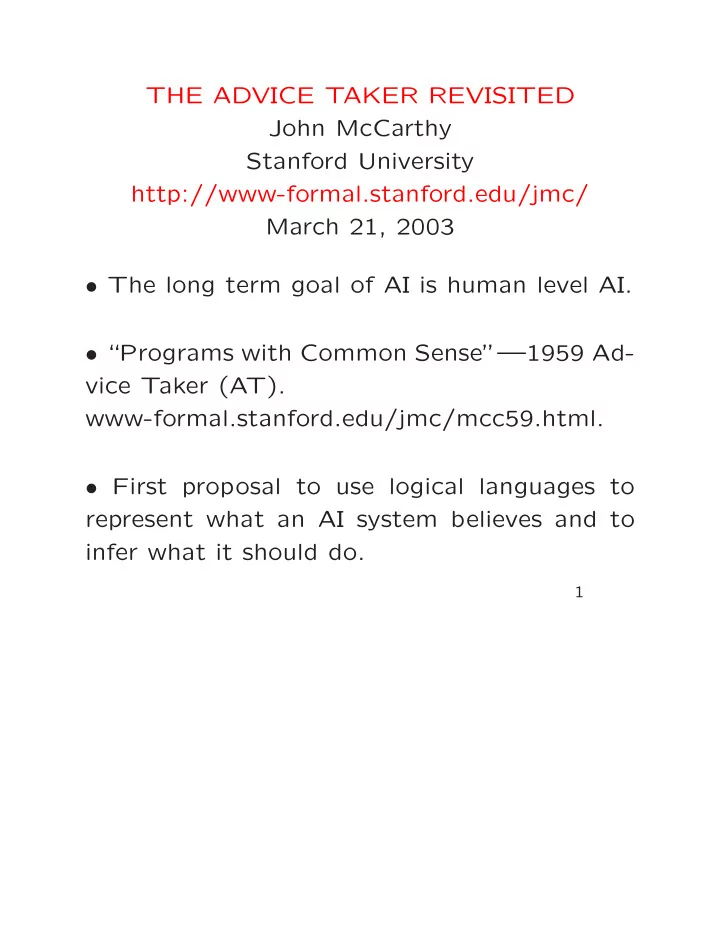
THE ADVICE TAKER REVISITED John McCarthy Stanford University http://www-formal.stanford.edu/jmc/ March 21, 2003 The long term goal of AI is human level AI. Programs with Common Sense1959 Ad- vice Taker (AT).


slide-1
SLIDE 1

THE ADVICE TAKER REVISITED John McCarthy Stanford University http://www-formal.stanford.edu/jmc/ March 21, 2003

  • The long term goal of AI is human level AI.
  • “Programs with Common Sense”—1959 Ad-

vice Taker (AT). www-formal.stanford.edu/jmc/mcc59.html.

  • First proposal to use logical languages to

represent what an AI system believes and to infer what it should do.

1

slide-2
SLIDE 2
  • Representation of facts independent of pur-

pose. When objects collide there’s a noise. make noise, avoid noise, explain no noise, de- sign quiet car.

slide-3
SLIDE 3

PROPOSALS FROM AT THAT ARE USED

  • Use logic to represent information declara-

tively.

  • [Common Sense Informatic Situation] In gen-

eral a thinking human is in what we call the common sense informatic situation, as distinct from the bounded informatic situation. The known facts are necessarily incomplete. We live in a world of middle-sized object which can

  • nly be partly observed and in which the con-

sequences of our actions can only partly be determined.

  • Represent effects of actions.

2

slide-4
SLIDE 4
  • Prove logically that a sequence a of actions

achieves goal g.

  • System does action a when should(a) is in-

ferred.

slide-5
SLIDE 5

IDEAS FROM AT THAT ARE NOT MUCH USED

  • Complex expresssions as objects—Want(At(I, Airport

Want(At(I, x)).

  • Formal generalization
  • Domain dependent logical inference heuris-

tics.

  • Declarative expression of domain dependent

inference heuristics. J. Sierra does it. S. Makar- ios is doing it.

3

slide-6
SLIDE 6

DEVELOPMENTS IN LOGICAL AI

  • Frame, qualification and ramification prob-

lems.

  • Elaboration tolerance
  • Non-monotonic reasoning, default reasoning
  • Fast propositional satisfiabilty solvers
  • Probability based problem formulations and

solvers.

  • I think the problems encountered and partly

solved in logical AI will appear in any approach aiming at human level.

4

slide-7
SLIDE 7

ADVICE ON ADVISABLE SYSTEMS

  • Use at least full first order logic.
  • Do not only use unary predicates. What’s a

convertible?

  • Advisable behavior requires nonmonotonic rea-

soning.

  • Include heuristic advice.
  • Don’t make an English interface a major part
  • f the project. For every boy there’s a girl who

loves only him.

  • Do not emphasize beginners.

5

slide-8
SLIDE 8

MORE ADVICE ON ADVISABILITY

  • elaboration tolerance—www-formal.stanford.edu/jm

There’s an oar on each bank, but the boat needs two oars to carry two people.

  • Use Drosophilas for research and select them

carefully, so that the experiments will be max- imally informative.

  • Remark: The geneticists have used Drosophi-

las since 1910, but the Drosophilas of today are no better than those of 1910.

6

slide-9
SLIDE 9

A POSSIBLE DROSOPHILA

  • Building and moving towers of different kinds
  • f blocks.
  • Advice: green blocks don’t fit on red blocks,

towers 5 high fall down, decide what blocks are to be in a tower before considering mov- ing any blocks. As long as there are moves to final position, keep doing them. Do not put a block on another unless it is a move to final

  • position. A block is in final position if it is on

the block it is supposed to be in the goal (or

  • n the table if that is its position in the goal),

and the block it is on top of is in final posi-

  • tion. Postpone postponable goals. STRIPS as

7

slide-10
SLIDE 10

advice in situation calculus. Never play cards with a man named Doc; never eat at a place called Mom’s; never marry a woman with more troubles than you.

  • From George Polya’s How to solve it—
  • If you suddenly find yourself in danger, think

what you just did and take it back.

  • Some kinds of advisability depend on self-
  • awareness. Avoid wishful thinking.
slide-11
SLIDE 11

NOW’S THE TIME, BUT IT WON’T BE EASY.

  • Start with an easy problem.
  • 8