Text Analysis and Medical History Ben Schmidt: NLM, April 13, 2016 - - PDF document

text analysis and medical history
SMART_READER_LITE
LIVE PREVIEW

Text Analysis and Medical History Ben Schmidt: NLM, April 13, 2016 - - PDF document

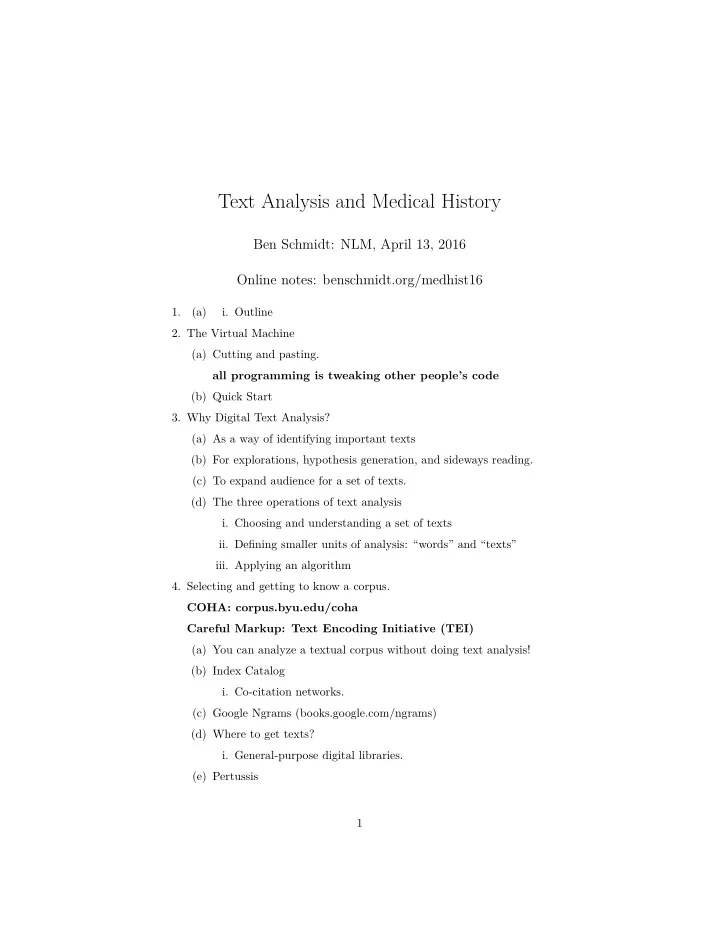
Text Analysis and Medical History Ben Schmidt: NLM, April 13, 2016 Online notes: benschmidt.org/medhist16 1. (a) i. Outline 2. The Virtual Machine (a) Cutting and pasting. all programming is tweaking other peoples code (b) Quick Start


slide-1
SLIDE 1

Text Analysis and Medical History

Ben Schmidt: NLM, April 13, 2016 Online notes: benschmidt.org/medhist16

1. (a)

  • i. Outline
  • 2. The Virtual Machine

(a) Cutting and pasting. all programming is tweaking other people’s code (b) Quick Start

  • 3. Why Digital Text Analysis?

(a) As a way of identifying important texts (b) For explorations, hypothesis generation, and sideways reading. (c) To expand audience for a set of texts. (d) The three operations of text analysis

  • i. Choosing and understanding a set of texts
  • ii. Defining smaller units of analysis: “words” and “texts”
  • iii. Applying an algorithm
  • 4. Selecting and getting to know a corpus.

COHA: corpus.byu.edu/coha Careful Markup: Text Encoding Initiative (TEI) (a) You can analyze a textual corpus without doing text analysis! (b) Index Catalog

  • i. Co-citation networks.

(c) Google Ngrams (books.google.com/ngrams) (d) Where to get texts?

  • i. General-purpose digital libraries.

(e) Pertussis 1

slide-2
SLIDE 2

(f) Pertussis story

  • i. Medicine-Specific sources.
  • 5. Defining Units of Analysis

(a) Optical Character Recognition (b) Word Clouds (c) Algorithms for tokenization

  • i. Named Entity Recognition

Stanford Natural Language Toolkit

  • A. Part of Speech Tagging
  • B. Geo-parsing

geocoding (d) Defining Texts

  • 6. Creating a corpus

(a) Regular expressions

  • 7. Algorithms for insight

(a) For comparison

  • i. Addition, subtraction, division
  • ii. For comparison

Odds ratio TF-IDF Dunning Log-Likelihood (b) For Classification (“Supervised” machine learning)

  • i. Naive Bayes

(c) For Clustering (“Unsupervised” machine learning)

  • i. Principal Components Analysis
  • ii. Topic Modeling
  • 8. Go-to-software packages:

Cut and paste into an online environment: Voyant: voyant- tools.org Topic modeling and machine learning: MALLET: mal- let.cs.umass.edu 2

slide-3
SLIDE 3

Network Analysis: Gephi Tutorials at ProgrammingHistorian.org Cleaning and processing .txt files: Python Statistical analysis: The “R” Language Data visualization: R or D3

  • 9. The Open Questions

3