Testing for C1P using PQ-Trees C1P: order U so that certain sets S - - PowerPoint PPT Presentation

testing for c1p using pq trees
SMART_READER_LITE
LIVE PREVIEW

Testing for C1P using PQ-Trees C1P: order U so that certain sets S - - PowerPoint PPT Presentation

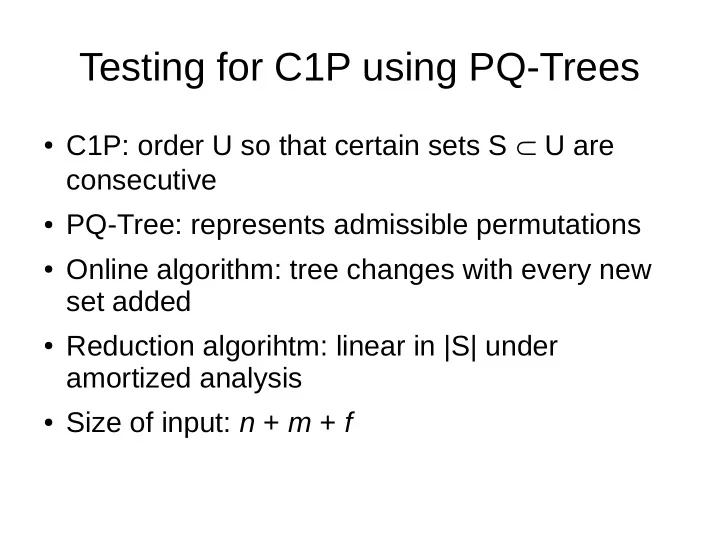
Testing for C1P using PQ-Trees C1P: order U so that certain sets S U are consecutive PQ-Tree: represents admissible permutations Online algorithm: tree changes with every new set added Reduction algorihtm: linear in |S| under


slide-1
SLIDE 1

Testing for C1P using PQ-Trees

  • C1P: order U so that certain sets S ⊂ U are

consecutive

  • PQ-Tree: represents admissible permutations
  • Online algorithm: tree changes with every new

set added

  • Reduction algorihtm: linear in |S| under

amortized analysis

  • Size of input: n + m + f
slide-2
SLIDE 2

PQ-Trees

  • Universal set U
  • Leaves: elements of U
  • Internal nodes:

– P nodes – Q nodes

T1 T2 … Tk T1 T2 … Tk

slide-3
SLIDE 3

Proper PQ-Trees

  • Every element of U appears exactly once as a

leaf

  • Every P node has at least 2 childern
  • Every Q Node has at least 3 children
  • Reading the leaves from left to right

Frontier

slide-4
SLIDE 4

Equivalent trees

  • Notation: T1 = T2
  • T1 and T2 are equivalent when one can be

transformed into the other by zero or more equivalence transformations:

– arbitrarily permute the children of a P node – reverse the children of a Q node

CONSISTENT(T) = {FRONTIER(T') | T' = T}

slide-5
SLIDE 5

Universal tree and null tree

  • Universal tree: |U| = m
  • Null tree = ∅ CONSISTENT(∅) = ∅

a1 a2 … am

slide-6
SLIDE 6

Modern implementation

PQTree<E> universalSet: set of <E> root: PQNode<E>

  • proper(): boolean

frontier(): list of <E> equivalent(PQTree<E>): boolean consistent(): set of <list of <E>> isUniversal(): boolean reduce(set of <E>) PQNode<E> parent: PQNode<E> childList: list of <PQNode> type: Enum(P,Q,L)

slide-7
SLIDE 7

Reducing PQ-trees

  • Input: PQ-tree T, set S ⊆ U
  • Bottom-up: starts at leaves; process each node only

after all its children have been processed

  • Processing each node:

– Find a pattern that applies to it – Replace the pattern by the replacement

  • Stop when:

– No pattern for a node: return null tree – After processing a node that “contains” S

slide-8
SLIDE 8

Modern implementation (2)

PQTree<E> universalSet: set of <E> root: PQNode<E>

  • proper(): boolean

frontier(): list of <E> equivalent(PQTree<E>): boolean consistent(): set of <list of <E>> isUniversal(): boolean reduce(set of <E>) PQNode<E> parent: PQNode<E> childList: list of <PQNode> type: Enum(P,Q,L)

  • fjndPattern(): Pattern

apply(Pattern) contains(set of <E>): boolean

slide-9
SLIDE 9

Processing a node with respect to S

  • Full, empty, partial
  • Pertinent: full or partial
  • Pertinent subtree: contains S
  • ROOT(T,S): lowest node whose frontier

contains S

partial empty full

slide-10
SLIDE 10

Modern implementation (3)

PQTree<E> universalSet: set of <E> root: PQNode<E>

  • proper(): boolean

frontier(): list of <E> equivalent(PQTree<E>): boolean consistent(): set of <list of <E>> isUniversal(): boolean reduce(set of <E>) root(set of <E>): PQNode<E> PQNode<E> parent: PQNode<E> childList: list of <PQNode> type: Enum(P,Q,L)

  • fjndPattern(): Pattern

apply(Pattern) contains(set of <E>): boolean frontier(): list of <E>

slide-11
SLIDE 11

Templates: pattern and replacement

  • Goal: after replacement, the frontier of the

subtree rooted at this node, as well as all equivalent subtrees, have all their pertinent leaves consecutive

  • Affects node and its children only
  • Type of node and label of children (full, empty,

partial) matter

  • Types of children do not matter

any type

slide-12
SLIDE 12

Templates for leaves

  • Just label as empty or full
slide-13
SLIDE 13

Templates for P-nodes ... ... ... ...

Pattern Replacement

slide-14
SLIDE 14

Templates for P-nodes (cont.)

  • Templates when some children are empty and

some full

– Depend on node being ROOT(T,S) or not – If node is not ROOT(T,S), creates a partial P-node

  • Templates when there are partial children

– One or two partial children ok – More than two partial children: no pattern

  • All templates: apply to equivalent nodes as well
slide-15
SLIDE 15

Templates for Q-nodes

  • Templates for all children empty or all children full
  • Templates for some children empty and some full
  • Depend on node being ROOT(T,S) or not
  • Templates for partial children

– One or two partial children ok – More than two partial children: no pattern

  • All templates: apply to equivalent nodes as well
slide-16
SLIDE 16

Efficient implementation

  • Need to avoid empty subtrees to guarantee

amortized |S| time

  • Prunned pertinent subtree
  • Two bottom-up phases

– Bubbling up: identifying prunned pertinent nodes – Reduce: reducing prunned pertinent nodes

  • Problem with parent pointers: blocking
  • NORM(T): potential for amortized analysis