SLIDE 1
1
Testbench Template
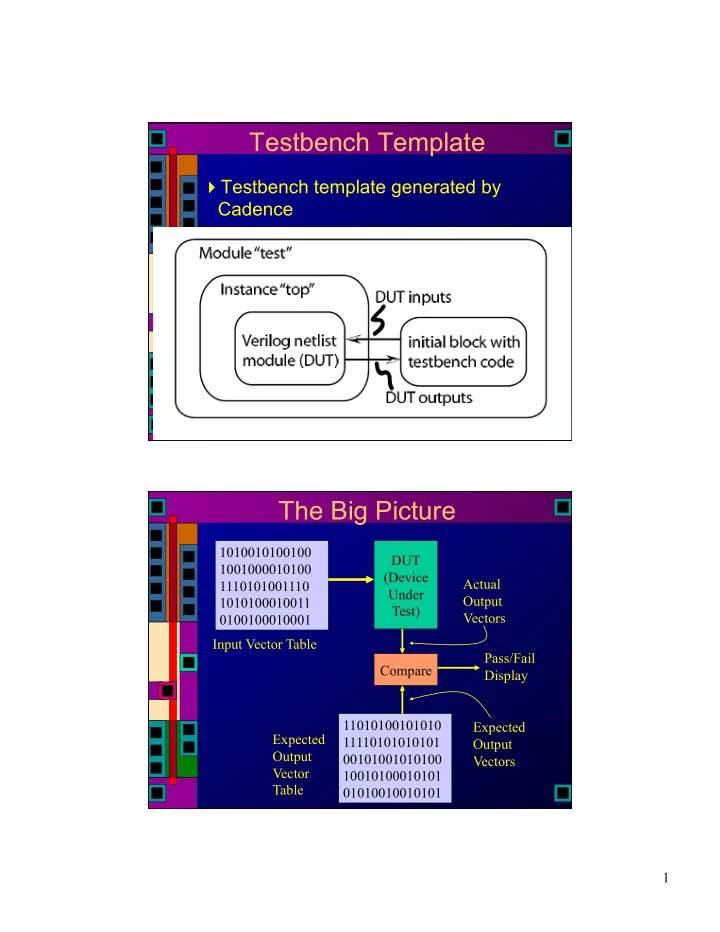
Testbench template generated by Cadence
The Big Picture
1010010100100 1001000010100 1110101001110 1010100010011 0100100010001 DUT (Device Under Test) Compare 11010100101010 11110101010101 00101001010100 10010100010101 01010010010101 Input Vector Table Expected Output Vector Table Actual Output Vectors Pass/Fail Display Expected Output Vectors
SLIDE 2 2
Testing with the LV-500
Tektronix LV-500 Built in 1989-1991
I.e. Ancient technology! eBay is a good source for spare parts these days…
Specifically designed to be a stand-alone tester for ASICs
I.e. More testing features than a basic logic analyzer
What’s an ASIC Tester?
Ours is built on a Tektronix DAS 9200 logic analyzer platform The main differences are in the test head, the pattern/error cards, and the Schmoo
The test head has up to 256 bi-directional pins where each pin has programmable electronics
voltage drive, current drive, voltage sense, etc.
The pattern/error cards store and compare the test vectors at up to 50MHz
fast for 1989!
A Schmoo lets you run repeated tests while the tester alters one or two independent variables like threshold, delay, cycle length, voltage, etc.
SLIDE 3
3
Flavors of LV500s
Common Features
Test speeds up to 50MHz Up to 64,000 unique test vectors Network connection for uploading tests
Thinlan ethernet
8 Meg of RAM 21 or 43 Meg hard drive 5.25 floppy (1.2M floppy)
Flavors of LV500s
LV514
192 test channels (12 sectors)
160 are usable (two sectors may be bad)
Pre-wired test card for class chips (should really be called LV513, but that’s a long story)
LV512
128 test channels (8 sectors)
All channels are usable
Used mostly for tutorial purposes
But, we have a new test card too…
SLIDE 4
4
LV514 LV512
SLIDE 5
5
DUT Card
1 2 3 4 5 6 7 8 9 A B C D E F
DUT Card Sectors & Channels
SLIDE 6
6
Knowing What to Wire
A “Bonding Diagram” is a picture that shows how your chip was bonded to the chip frame It also shows how the chip frame is connected to the chip pins
Bonding/Chip Diagram
SLIDE 7
7
Map Your Pins to Channels
Pick tester sector.channel assignments for each of your pins
Signals that need the same voltage characteristics should be grouped in the same sector
Each sector gets common voltage ranges More on this later…
Signals that need the same timing should be grouped in the same quadrant
Sectors 0-3, 4-7, 8-b, c-f are the four quadrants More on this later…
Wire things up!
Remember to keep a list of what you’ve wired!
Class DUT Card
Pre-wired for class chips
84 pin PGA with specific VDD and GND placements in the pad ring DUTmap.txt on class web page http://www.eng.utah.edu/~cs6712
SLIDE 8 8
DUTmap.txt
PAD-PIN-TESTER CHANNEL MAP FOR CS/EE 5710 DUT CARD Pad locations are taken from MOSIS bonding diagram PGA locations are taken from 84pin PGA bonding diagram Tester channels 6,7,8,9,A are used. The notation is sector.channel Vdd and GND connections are as per 5710 standard pad frame TESTER SIGNAL PAD PGA sec.chn NAME (no spaces)
2 C02 7.7 3 B01 6.B 4 C01 7.6 5 D02 7.D 6 D01 7.C 7 F02 GND GND 8 E02 8.1 9 E01 8.0 10 E03 8.7 12 F01 8.6 13 G01 8.A etc….
Finished DUT Card
Now you have part 1 – a wired DUT card that connects your chip to the tester On to part 2 – configuring the tester…
SLIDE 9
9
LV512 Boot Menu LV500 Main Menu
SLIDE 10
10
LV500 Keyboard Layout Overview
On every tester cycle the LV500:
Applies a set of signals to the DUT
The data to “Force” is defined in the Pattern Which signals are “Forced” on this cycle is defined in the template When the data are applied is defined relative to the “clock phase” template The names of the signals and which tester channels they are on are defined in the DUT wiring menu
At the right time (defined in the template) the tester captures and compares the data from the DUT
Compares against the data in the Pattern
SLIDE 11 11
Procedure
- 1. Get your bonding diagram and map
where your signals are on your chip
- 2. Decide how those pins will map to tester
channels (DUTmap.txt)
- 3. Decide on timing templates for all
signals
- 4. Generate test vectors that include pin
names, templates, and data vectors for every cycle
- 5. Put it all in a .msa file
Procedure 2
- 6. Upload the .msa file to the LV500
- 7. Convert the .msa file to a tester setup
file
- 8. Check all menus to make sure things
are how you want them
- 1. Config
- 2. DUT wiring
- 3. Channel
- 4. Template
- 5. Pattern
SLIDE 12 12
Procedure 3
- 9. Fix or modify test parameters
- 10. Run your test
- 11. Look at the results
- 1. Celebrate!
- 2. Or diagnose and debug…
- 3. Or decide to schmoo to get more info…
Tutorial DUT Card
SLIDE 13
13
Tutorial 1: 74LS547
3 to 8 decoder
74LS547
SLIDE 14
14
547 DUT Wiring 547 Template
SLIDE 15
15
547 Pattern 547 Schmoo
SLIDE 16
16
Tutorial 2: 74LS299
Shift Register, shift L or R, parallel load and output
Bidirectional data bus
74LS299 Timing
Control should be set up ahead of the clock Data should be sampled after the rising edge of the clock Data should be driven after the control is set up
Avoid drive fights on bidirectional path
SLIDE 17
17
74LS299 Timing
Control signals Clock Shift data
Cycle = 200ns Delay = 0ns, Width = 100ns Delay = 40ns, Width = 100ns Delay = 20ns, Width = 80ns
74LS299 Shift/Clear Template
SLIDE 18
18
74LS299 Load Template 74LS299 Pattern