Terminology Selecting an Appropriate Sampling Unit Quadrat = Plot - - PDF document

terminology selecting an appropriate sampling unit
SMART_READER_LITE
LIVE PREVIEW

Terminology Selecting an Appropriate Sampling Unit Quadrat = Plot - - PDF document

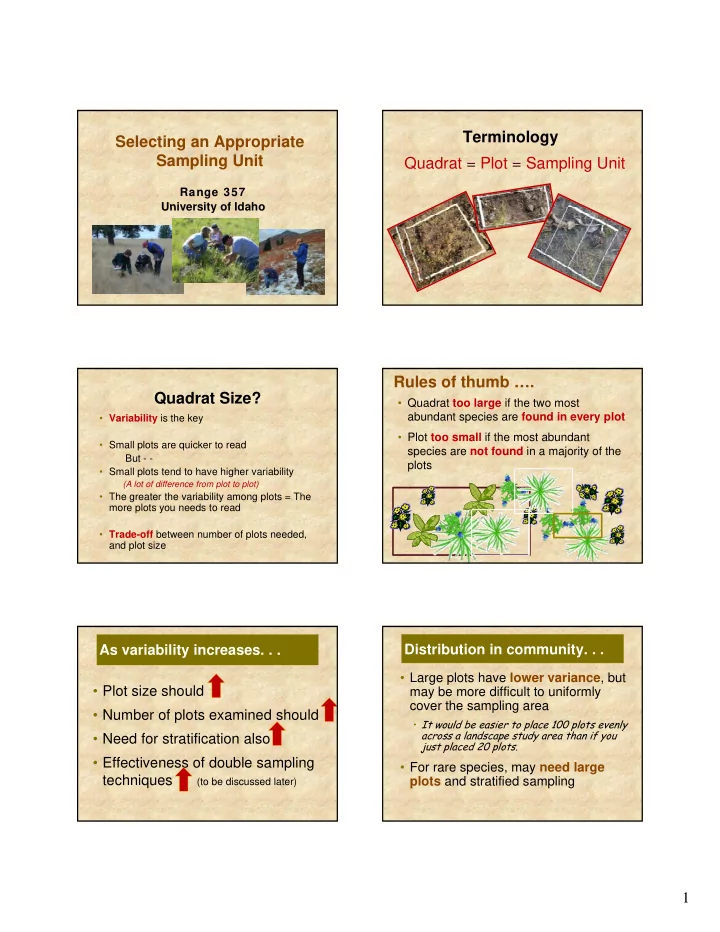
Terminology Selecting an Appropriate Sampling Unit Quadrat = Plot = Sampling Unit Range 357 University of Idaho University of Idaho Rules of thumb . Quadrat Size? Quadrat too large if the two most abundant species are found in every


slide-1
SLIDE 1

1

Selecting an Appropriate Sampling Unit

Range 357 University of Idaho University of Idaho

Terminology Quadrat = Plot = Sampling Unit Quadrat Size?

  • Variability is the key
  • Small plots are quicker to read

But - -

  • Small plots tend to have higher variability

(A lot of difference from plot to plot)

  • The greater the variability among plots = The

more plots you needs to read

  • Trade-off between number of plots needed,

and plot size

Rules of thumb ….

  • Quadrat too large if the two most

abundant species are found in every plot

  • Plot too small if the most abundant

species are not found in a majority of the plots plots

As variability increases. . .

  • Plot size should
  • Number of plots examined should
  • Need for stratification also
  • Effectiveness of double sampling

techniques (to be discussed later) Distribution in community. . .

  • Large plots have lower variance, but

may be more difficult to uniformly cover the sampling area

  • It would be easier to place 100 plots evenly
  • It would be easier to place 100 plots evenly

across a landscape study area than if you just placed 20 plots.

  • For rare species, may need large

plots and stratified sampling

slide-2
SLIDE 2

2

Plant size. . .

  • Larger the average-sized plant the

larger the sampling frame needed

  • Rules of Thumb:
  • Plot should be larger than average-sized plant

Plot should be larger than average sized plant, and larger than average space between plants.

  • Plot is too small if >10% of plot do not contain

the plants of interest

Bottom line

  • Sparse vegetation requires larger

plots or transects than dense vegetation

  • Uniform vegetation requires fewer and

smaller plots than diverse/variable vegetation

Sampling different life forms

  • Difficult to sample different life forms

(moss, grass, forbs, shrubs, trees, etc. One size does not fit all One s ze does not f t all

http://edcintl.cr.usgs.gov/senegal2/gifs/savanna.gif

May require a “stratified” scheme

Several plot sizes in one protocol

Or, select size of plot based

  • n species of greatest interest

Perimeter to Area Concerns

  • Perimeter to area ratio decreases as

plot size increases If borderline decisions (d

idi if l t i

  • If borderline decisions (deciding if plant in or
  • ut) are difficult to make, then select a

plot size that reduces perimeter:area ratio

slide-3
SLIDE 3

3

Shape of Sample Unit

  • Number and size of sample units are

the first and most important considerations

  • However shape of quadrat or frame is
  • However, shape of quadrat or frame is

also important and can reduce variation in the sample

Circle

  • Less perimeter per area than square or

rectangle

  • Perimeter decisions are difficult to make

when clipping vegetation, so circles are

  • ften used
  • ften used
  • Reduced perimeter: area ratio is also

good in communities with large clonal plants

Square

  • Greater perimeter:area ratio than

circles, but less than rectangles.

  • Most frequently used to estimate

frequency because presence/absence is easy to estimate is easy to estimate.

  • Squares are easier to estimate % cover,

than circles but not as easy as rectangles.

Rectangles

  • More likely to cut across plants rather than

be completely occupied by plants

  • Rarely completely occupied by bare spaces
  • Often has lower variance than square or

Often has lower variance than square or circles

  • Can reduce variability in sparsely vegetated

communities

  • Easier to estimate % cover than circles or

squares

Take Home Message

  • Plot Size and Number of Plots

are Most Important

  • Plot Shape is “fine tuning“

http://www.habitats.freeserve.co.uk/images/quadrats.jpg