SLIDE 5 template_le
The template_file data source renders a template from a template string, which is usually loaded from an external le. Note In Terraform 0.12 and later, the templatefile function (/docs/conguration/functions/templatele.html) oers a built-in mechanism for rendering a template from a le. Use that function instead, unless you are using Terraform 0.11 or earlier.
Example Usage
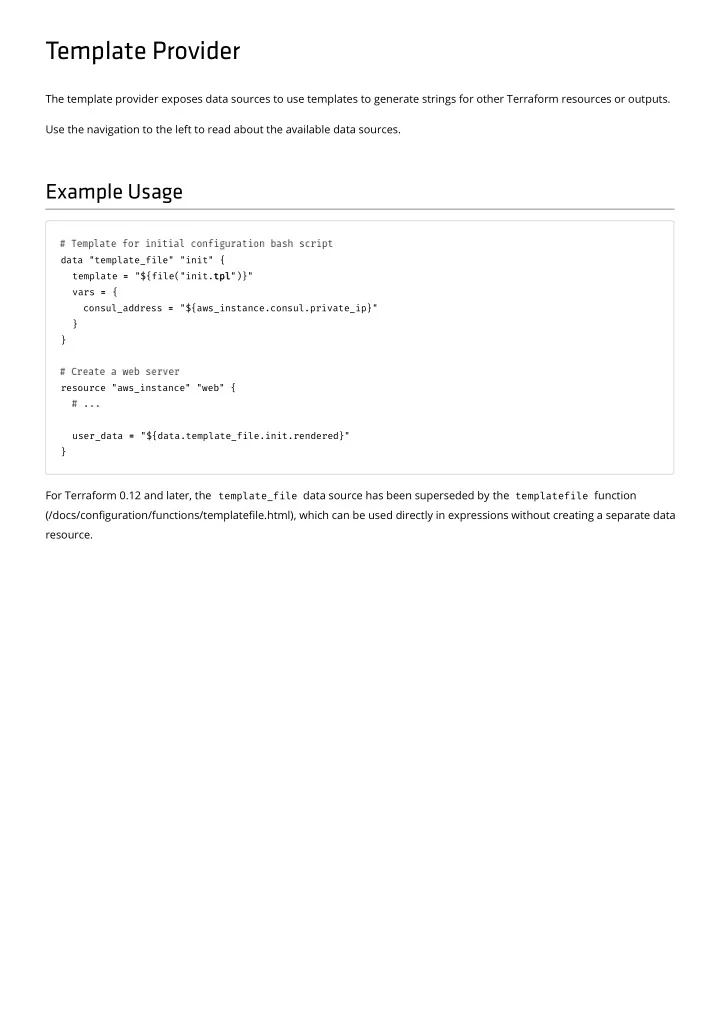
data "template_file" "init" { template = = "${file("${path.module module}/ /init.tpl tpl")}" vars = = { consul_address = = "${aws_instance.consul.private_ip}" } }
Inside init.tpl you can include the value of consul_address . For example:
#!/bin/bash echo "CONSUL_ADDRESS = ${ ${consul_address} }" > > /tmp/iplist
Although in principle template_file can be used with an inline template string, we don't recommend this approach because it requires awkward escaping. Instead, just use template syntax (/docs/conguration/expressions.html#string- templates) directly in the conguration. For example:
user_data = = <<- <<-EOT echo "CONSUL_ADDRESS = ${aws_instance.consul.private_ip}" > /tmp/iplist EOT
Argument Reference
The following arguments are supported:
template - (Required) The contents of the template, as a string using Terraform template syntax
(/docs/conguration/expressions.html#string-templates). Use the file function (/docs/conguration/functions/le.html) to load the template source from a separate le on disk.
vars - (Optional) Variables for interpolation within the template. Note that variables must all be primitives. Direct
references to lists or maps will cause a validation error. Earlier versions of template_file accepted another argument filename as an alternative to template . This has now been removed. Use the template argument with the file function to get the same eect.