Teaching for Form 1 education policy; Purpose the design of - - PowerPoint PPT Presentation

teaching for form 1
SMART_READER_LITE
LIVE PREVIEW

Teaching for Form 1 education policy; Purpose the design of - - PowerPoint PPT Presentation

LSTT Dissemination workshop TIE, 11 April 2016 Language Supportive To share LSTT work and findings; and Textbooks and To debate implications for: Workshop implementation of the new language in Teaching for Form 1 education policy;


slide-1
SLIDE 1

LSTT Dissemination workshop TIE, 11 April 2016 1

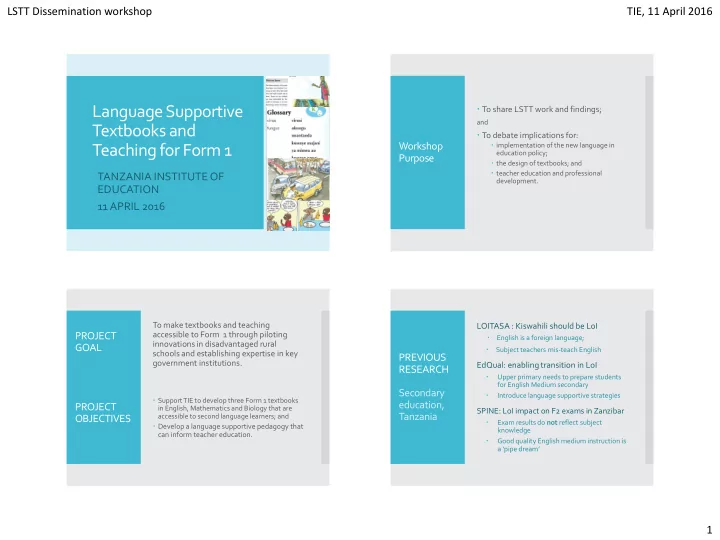
Language Supportive Textbooks and Teaching for Form 1

TANZANIA INSTITUTE OF EDUCATION 11 APRIL 2016

Workshop Purpose

 To share LSTT work and findings;

and

 To debate implications for:

 implementation of the new language in education policy;  the design of textbooks; and  teacher education and professional development.

PROJECT GOAL PROJECT OBJECTIVES

To make textbooks and teaching accessible to Form 1 through piloting innovations in disadvantaged rural schools and establishing expertise in key government institutions.

 Support TIE to develop three Form 1 textbooks in English, Mathematics and Biology that are accessible to second language learners; and  Develop a language supportive pedagogy that can inform teacher education.

PREVIOUS RESEARCH Secondary education, Tanzania

LOITASA : Kiswahili should be LoI

 English is a foreign language;  Subject teachers mis-teach English

EdQual: enabling transition in LoI

 Upper primary needs to prepare students for English Medium secondary  Introduce language supportive strategies

SPINE: LoI impact on F2 exams in Zanzibar

 Exam results do not reflect subject knowledge  Good quality English medium instruction is a ‘pipe dream’

slide-2
SLIDE 2

LSTT Dissemination workshop TIE, 11 April 2016 2

LSTT Baseline (2013)

Survey of 420 students’ reading ability and subject vocabulary Survey of textbook use in 21 schools. Review of 15 English, Mathematics and Biology textbooks.

 Form 1 students are not ready for English medium education  Teachers have textbooks. Distribution to students is uneven.  Biology textbooks to0 hard even for first language learners  Subject textbooks do not support language learning  English textbooks do not target English for Academic Purposes Sociolinguistic theory of learning

(Halliday, 1993)

 Halliday, M. A. K. (1993). "Towards a language-based theory of learning." Linguistics and Education 5(2): 93-116.  Setati, M., et al. (2002). "Incomplete Journeys: Code-switching and Other Language Practices in Mathematics, Science and English Language Classrooms in South Africa." Language and Education 16(2): 128-149

Informal talk dynamic Textbook language synoptic Secondary school talk Students engage in informal talk in main Language Students produce writing and speech in formal English Incomplete Learning Journeys

Incomplete journeys

(Setati et al., 2002)

Teaching and learning materials meet the learner halfway.

Structured support to produce spoken and written outputs in English. student actively negotiates meaning Teacher & teaching Learning Learning materials

Students need time and resources to practice different forms

  • f utterance,

especially through collaborative dialogue.

slide-3
SLIDE 3

LSTT Dissemination workshop TIE, 11 April 2016 3

Providing structure and guidance to move from talk in Kiswahili to writing and presenting in English

Baseline Writing workshop with John Clegg’s & Neil Ingram Pilot Drafts Pilot findings Independent Reviews Evaluation versions

Evaluation research

 Books in schools 3 – 6 weeks  Briefing workshop for teachers  Pre and post written assessments for students  Pre and post verbal assessments for students  Lesson observations and professional ‘interviews’ with teachers

Evaluation sample

Region Biology English Maths Dodoma 6 6 6 Morogoro 8 Lindi 2 2 Total 8 14 8

Participating schools

Sample Biology English Maths written 181 138 185 verbal 64 112 64 LOs 12 28 12

Sample

slide-4
SLIDE 4

LSTT Dissemination workshop TIE, 11 April 2016 4

Written assessment MATHEMATICS Dodoma and Lindi

LSTT EVALUATION FINDINGS

Improvement in Mathematics score in Lindi and Dodoma N Min Max Mean Std. Dev Skewness Stat Stat Stat Stat Stat Stat Std. Error Posttest Lindi 74 8.0 58.0 35.4 12.5 0.02 0.3 Pretest Lindi 74 5.0 55.00 28.1 11.1 0.2 0.3 Posttest Dodoma 111 7.0 67.0 41.5 11.8 -0.1 0.2 Pretest Dodoma 111 10.0 64.0 36.7 10.2 0.2 0.2

SECTION1 (G1): Multiple choice questions that used subject specialist vocabulary An example

What is the largest number you can write with the following digits?

0, 2, 4, 9 ___ 1, 7, 7, 5 ___ 9, 4, 3, 5 ___

1. nine thousand four hundred and thirty-five

  • 2. two thousand and forty-nine
  • 3. seven thousand seven hundred and fifty-one
  • 4. nine thousand four hundred and twenty
  • 5. two hundred and nine
  • 6. nine thousand five hundred and forty-three

SECTION 2 (G2): Problems using mathematical symbols only SECTION3: Word problems 3048 ÷ 12 = ________ Daudi lives 3 km from her school. What is the total distance that he walks to school and back in 14 weeks?

Answer is__________km

slide-5
SLIDE 5

LSTT Dissemination workshop TIE, 11 April 2016 5

All the improvement is in section 1 (10% improvement) (Data for Dodoma only)

PREG1 /42 POSG1 /42 PREG2 /40 POSG2 /40 PREG3 /18 POSG3 /18

N Valid 111 111 111 111 111 111 Mean 16.0 20.2 20.2 20.2 0.5 1.0 Std. Deviation 6.2 7.3 5.2 5.3 1.6 2.9 Skewness 0.5 0.1

  • 0.8
  • 1.3

3.7 3.2 Minimum 4.0 6.0 0.0 0.0 0.0 0.0 Maximu m 34.0 36.0 30.0 25.0 10.0 15.0

Paired Samples Test shows that the improvement is significant

Paired Differences t df Sig. (2- tailed ) Mean Std. Devia tion Std. Error Mean 95% Confidence Interval of the Difference Lowe r Upper Pair 1Posttest Maths Lindi - Pretest Maths Lindi 7.4 14.1 1.6 4.1 10.6 4.5 73 0.000 Pair 2Posttest Maths Dodoma - Pretest Maths Dodoma 4.8 7.5 0.7 3.4 6.2 6.8 110 0.000

Written assessment ENGLISH Dodoma and Morogoro

LSTT EVALUATION FINDINGS

Overall Descriptive Statistics: Dodoma and Morogoro Mean % N Std. Deviation pretest (all) Morogoro 26.9 62 13.0 posttest (all) Mororgoro 32.4 62 14.8 prettest (all) Dodoma 33.9 76 13.5 posttest (all) Dodoma 37.6 76 15.2

slide-6
SLIDE 6

LSTT Dissemination workshop TIE, 11 April 2016 6

Difference is significant for Dodoma and Morogoro Paired Samples Test

Paired Differences t df Sig. (2- tailed ) Mean Std. Deviati

  • n

Std. Error Mean 95% Confidenc e Interval

  • f the

Difference Lowe r Upp er posttest (all) Moro - pretest (all) Moro 5.5 10.6 1.3 8.1 2.8 4.1 61 .000 posttest (all) Dodoma

  • prettest (all) Dodoma

3.7 10.4 1.1 6.1 1.3 3.1 75 .003 Section 1 (voc):General vocabulary through matching definitions with words

Example ____what you get after examinations 1. achievement ____extra classes to improve results 2. results ____what you get when you do well 3. congratulations

  • 4. effort
  • 5. Remedial
  • 6. temperature

Section 2 (comp): comprehension passage accompanied by glossary,  extracting information from the text ;  looking for instances of a grammatical feature (superlatives and prepositions) in text with explanatory instructions An example Here are some superlatives: The elephant is the biggest land animal. The gazelle is the most beautiful animal. Find three superlatives in the ‘The Serengeti’ text above and draw a ring around them.

Section 3 (grm): Structured support for completing or writing a sentence through fill in the blank questions and sentence starters

Examples:

Change the words in bracket and use them to fill in the blanks: Mwalimu Nyerere ………………….. (believe) in equality. I would like to visit the Serengeti because _________________________________________.

Table 2 Descriptive Statistics A case of KIROKA-Moro (Different patterns of improvement for different schools)

N Minimu m Maximu m Mean Std. Deviatio n Skewness Statisti c Statistic Statistic Statisti c Statistic Statisti c Std. Error Voc items: Pretest 10 4.0 24.0 12.4 6.0 0.8 0.7 Voc items: Posttest 10 4.0 26.0 14.8 6.3 0.1 0.7 Comp items: Pretest 10 0.00 16.0 8.6 5.7

  • 0.2

0.7 Comp items: Posttest 10 2.0 22.0 10.2 6.1 0.4 0.7 Grm items: Pretest 10 0.0 7.5 2.9 2.2 0.9 0.7 Grm item: Posttesst 10 1.0 8.5 3.8 3.08 0.6 0.7

slide-7
SLIDE 7

LSTT Dissemination workshop TIE, 11 April 2016 7

Written assessment BIOLOGY Dodoma and Lindi

LSTT EVALUATION FINDINGS

Overall Performance

 Dodoma performance in multiple choice questions (reading and vocabulary)  Better performance in post test than in pre test (mean=4.55)  Girls: 18/63=28.6% score above the mean of 9.6, SD 3.8  Boys: 21/68= 39% scored above the mean

N Mean Std. Deviation

Posttest Lindi

55 14.82 5.59

Pretest Lindi

55 11.73 4.81

Posttest Dodoma

45 11.80 3.64

Pretest Dodoma

126 7.25 3.09

Cross-tabulation with gender shows no significant difference between scores of girls and boys. Difference is 3.09 /24 (13%) for Lindi and 4.55/24 (19%) for Dodoma Analysis is ongoing for Dodoma but there is an improvement and it is significant for both Lindi and Dodoma.

Significant improvement in section1 – reading and vocabulary

Vaccination Antigens Immunity ……… ……… ………

  • A. is an injection of antigens to stimulate immunity.
  • B. is the defense system of the body.
  • C. are chemicals that attack pathogens.
  • D. is the ability of the body to resist diseases.

E. are foreign molecules that attack the body. F. are immunity cells that produce antibodies. glossary inject - dunga sindano stimulate - chochea defend – linda attack – shambulia foreign - kigeni ability - uwezo resist – pinga produce - zalisha

Example of section 1 question

slide-8
SLIDE 8

LSTT Dissemination workshop TIE, 11 April 2016 8

Reading and Biology knowledge

Not correct Correct Pre test /176 22% 78% Post test /131 7% 93% A boy named Maganga sleeps in his room. Since it is very hot he opens all the windows to get fresh air. He forgets to pull down his mosquito net. During the night a small wind blows and it rains. What diseases may Maganga catch? Suggest two. 1…………………………… 2. ……………………………

Significant improvement in writing sentences about pictures

Not correct Correct Pre test 33/176 (19%) 71% Post test 9/131 (7%) 81% Tazama picha namba 3 na 4 zinazoonyesha watu wenye dalili za magonjwa mbalimbali. Andika sentensi moja kwa kutumia lugha ya kiingereza inayoelezea dalili na ugonjwa unaohisi unahusiana na dalili hiyo.

Verbal assessments Main findings

Pre test

 students started discussing in pairs when encouraged by the facilitator  students used Kiswahili in discussions or kept silent.  students did not ask any questions when invited.

Post test

 Kiswahili still used for discussion  written answers produced in English  students attempted to ask questions about the passage when invited using Kiswahili or English.

Conclusions Benefits of putting language supportive materials in students hands

Over short period of the evaluation the books:

 Increased students’ spoken outputs in English and Kiswahili by using Kiswahili as stepping stone to English.  Improved vocabulary, reading and writing in

  • English. Different schools saw

improvements in different areas.  Improved vocabulary and reading in Biology  Improved ability to produce written outputs in Biology  Improved Mathematics subject specialist vocabulary  Had no impact on more complex subject specialist reading skills for Mathematics.

slide-9
SLIDE 9

LSTT Dissemination workshop TIE, 11 April 2016 9

Summary teacher professional development needs

 The affective benefits of using Kiswahli (reducing fear) were larger and had a greater impact on learning than we had anticipated.  For teachers learning to use Kiswahili strategically towards developing ability in English (rather than ensuring understanding) takes time.  Teachers did not realise the potential of textbooks in students’ hands for differentiated learning …  … but some students realised the potential for independent study.  For Maths and Biology teachers planning language learning objectives was new and a challenge …  … but English teachers could help.

Conclusions research and policy

 Put books in students’ hands that they can read and use  More classroom research on language in education in Tanzania, especially by teacher educators  Collaboration between subject and language specialists is vital  Language supportive pedagogy/ bilingual education is a better way to do English medium instruction … but its not easy  We don’t have the capacity to write textbooks

DISCUSSION QUESTIONS MORNING SESSION

 How can the findings of this and similar work inform LOI policy?  What can we learn from LSTT project:

 For classroom practice?  For the design of learning materials?  For a language in education research agenda?

 What practical steps should we take to implement language supportive pedagogy on a large scale?

Teacher Development for Language Supportive Teaching

LSTT dissemination w/shop 11th April 2016

slide-10
SLIDE 10

LSTT Dissemination workshop TIE, 11 April 2016 10

LST and teacher development

 The quality of school learning is determined by, among other things, teacher quality  Teachers are the ones who translate curriculum objectives to classroom learning  Even whern textbooks are good, it is teachers who guide classroom interaction  Thus their knowledge and skills are crucial for students’ learning

Teachers’ professional development

 LST demands teachers’ skills in developing both students’ language and subject content knowledge  For teachers learning to use Kiswahili strategically towards developing ability in English (rather than ensuring understanding) takes time.  For Maths and Biology teachers planning language learning objectives was new and a challenge …  Can this be a teacher training problem?

Learning from Baseline

  • rientation

 The BL course focuses on developing language for learning different subjects  It is an opportunity for subject teachers to develop students’ language and own skills  Research shows that in some shools, subject teachers are not involved (e.g. Murasi 2013)  Only English language teachers run it  This is a missed opportunity by subject teachers

LSTT phase II focuses on teacher professional development

 In phase I, initial efforts focused undergraduates and some masters students  Phase II will work with pre-service science teacher students for secondary schools  Diploma student teachers (UDOM, TCs)  Undergraduate teacher students (St John’s)  Need for scale up and plan for in- service?

slide-11
SLIDE 11

LSTT Dissemination workshop TIE, 11 April 2016 11

Phase 2 proposal

Share learning with other secondary pedagogy interventions and teacher educators Student Maths& Science teachers at UDOM and St. Johns experience and learn about language supportive pedagogy

Teacher Education Sharing Learning

Learning from LSTT I &II

Textbooks

from Phase I used in teacher education and shared with other interventions/teacher educators. Database of prize-winning learning materials generated by student teachers shared with publishers.

M&E Share M&E findings

LSTT II learns from

  • thers

DISCUSSION QUESTIONS

AFTERNOON SESSION  What can be done to make INSET/PRESET more language supportive? [Teacher education (communication skills & other courses) ; In service education and training]  How can our proposed plans for phase two be improved to address language supportive needs of PSE and In Service Education and Training?