Tautologies Definition Formula is a tautology if v | = holds for - - PowerPoint PPT Presentation

tautologies
SMART_READER_LITE
LIVE PREVIEW

Tautologies Definition Formula is a tautology if v | = holds for - - PowerPoint PPT Presentation

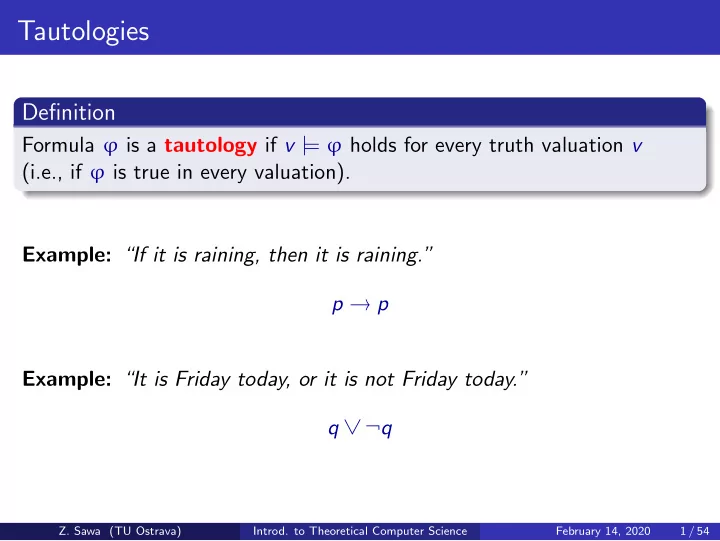
Tautologies Definition Formula is a tautology if v | = holds for every truth valuation v (i.e., if is true in every valuation). Example: If it is raining, then it is raining. p p Example: It is Friday today, or it is not


slide-1
SLIDE 1

Tautologies

Definition

Formula ϕ is a tautology if v | = ϕ holds for every truth valuation v (i.e., if ϕ is true in every valuation). Example: “If it is raining, then it is raining.” p → p Example: “It is Friday today, or it is not Friday today.” q ∨ ¬q

  • Z. Sawa (TU Ostrava)
  • Introd. to Theoretical Computer Science

February 14, 2020 1 / 54

slide-2
SLIDE 2

Tautologies

An example of a more complicated tautology: (p → q) → ((p → ¬q) → ¬p) p q p → q ¬q p → ¬q ¬p (p → ¬q) → ¬p ϕ 1 1 1 1 1 1 1 1 1 1 1 1 1 1 1 1 1 1 1 1 1

  • Z. Sawa (TU Ostrava)
  • Introd. to Theoretical Computer Science

February 14, 2020 2 / 54

slide-3
SLIDE 3

Tautologies

Quite important are tautologies of the form ϕ → ψ or ϕ ↔ ψ — they can be used for logical inference: If ϕ → ψ holds and ϕ holds, then also ψ must hold. In particular, if ϕ → ψ is a tautology and ϕ holds, we can deduce that also ψ holds. Example: (p ∧ q) → p is a tautology. If p ∧ q holds, then also p holds. Example: (p → q) → (¬q → ¬p) is a tautology. If p → q holds and ¬q holds, then ¬p holds.

  • Z. Sawa (TU Ostrava)
  • Introd. to Theoretical Computer Science

February 14, 2020 3 / 54

slide-4
SLIDE 4

Tautologies

If ϕ ↔ ψ holds and ϕ holds, then ψ must hold. Similarly, if ϕ ↔ ψ holds and ψ holds, then ϕ must hold. Example: (¬p → q) ↔ (q ∨ p) is a tautology.

If ¬p → q holds, then also q ∨ p must hold. If q ∨ p holds, then also ¬p → q must hold.

  • Z. Sawa (TU Ostrava)
  • Introd. to Theoretical Computer Science

February 14, 2020 4 / 54

slide-5
SLIDE 5

Tautologies

When we take a tautology ϕ and replace all atomic propositions by arbitrary formulas, we obtain a tautology by this replacement. Example: Formula p → (p ∨ q) is a tautology. This means that ψ → (ψ ∨ χ) is a tautology for arbitrary formulas ψ and χ. Replacement of atomic propositions: p is replaced with q ∨ ¬(r → ¬s) q is replaced with ¬¬(q ↔ p) We obtain tautology (q ∨ ¬(r → ¬s)) → ((q ∨ ¬(r → ¬s)) ∨ ¬¬(q ↔ p))

  • Z. Sawa (TU Ostrava)
  • Introd. to Theoretical Computer Science

February 14, 2020 5 / 54

slide-6
SLIDE 6

Contradictions

Definition

A formula ϕ is a contradiction if v | = ϕ holds for every truth valuation v (i.e., when ϕ is false in every valuation). Example: “It is Wednesday today, and it is not Wednesday today.” p ∧ ¬p ϕ is a tautology iff ¬ϕ is a contradiction ϕ is a contradiction iff ¬ϕ is a tautology

  • Z. Sawa (TU Ostrava)
  • Introd. to Theoretical Computer Science

February 14, 2020 6 / 54

slide-7
SLIDE 7

Satisfiable Formulas

Definition

A formula ϕ is satisfiable if there is at least one truth valuation v such that v | = ϕ. A formula is satisfiable iff it is not a contradiction. Every tautology is satisfiable but not every satisfiable formula is a tautology. Example: A formula, which is satisfiable but not a tautology: (p ∨ q) → p For example in valuation v1, where v1(p) = 1 and v1(q) = 0, the formula is true. In valuation v2, where v2(p) = 0 and v2(q) = 1, it is false.

  • Z. Sawa (TU Ostrava)
  • Introd. to Theoretical Computer Science

February 14, 2020 7 / 54

slide-8
SLIDE 8

Satisfiable Formulas

ϕ is a tautology iff ¬ϕ is not satisfiable ϕ is satisfiable iff ¬ϕ is not a tautology Satisfiable formulas:

To show that a formula is satisfiable, it is sufficient to find a valuation, in which the formula is true. To show that a formula is not satisfiable, it necessary to show that there is no valuation, in which the formula is true.

  • Z. Sawa (TU Ostrava)
  • Introd. to Theoretical Computer Science

February 14, 2020 8 / 54

slide-9
SLIDE 9

Tautologies and Contradictions

Tautologies:

To show that a formula is not a tautology, it is sufficient to find a valuation, in which the formula is false. To show that a formula is a tautology, it necessary to show that there is no valuation, in which the formula is false.

Contradictions:

To show that formula is not a contradiction, it is sufficient to find a valuation, in which the formula is true. To show that a formula is a contradiction, it necessary to show that there is no valuation, in which the formula is true.

  • Z. Sawa (TU Ostrava)
  • Introd. to Theoretical Computer Science

February 14, 2020 9 / 54

slide-10
SLIDE 10

Truth Valuations

For decing whether a formula ϕ is or is not a tautology (resp. a contradiction, satisfiable), the table method can be used: To go through all possible truth valuations systematically. It is usually not necessary to construct the whole table. It is sufficient to concentrate on “interesting” cases. We can draw a graph representing the given formula and try to assign values 0 and 1 to its nodes in such a way that either we find an example of a truth valuation we are looking for (e.g., some valuation where the formula is false), or we find out that such valuation does not exist.

  • Z. Sawa (TU Ostrava)
  • Introd. to Theoretical Computer Science

February 14, 2020 10 / 54

slide-11
SLIDE 11

Truth Valuations

For example, for deciding if a formula is a tautology: We need to find out whether there exists some valuation where the formula is false. In this valuation, the node corresponding to the whole formula should have value 0. So we try to assign value 0 to this node. Then we try to assign values to other nodes in such a way that the assigned values are consistent with values assigned previously. If we succeed in labelling whole graph consistently, we have a valuation, in which the formula is false. In this case, it is clear that the formula is not a tautology.

  • Z. Sawa (TU Ostrava)
  • Introd. to Theoretical Computer Science

February 14, 2020 11 / 54

slide-12
SLIDE 12

Truth Valuations

If some values were already assigned to some nodes, this assignment can impose some constraints on values that can be assigned to other nodes. Examples where some previously assigned values enforce some particular value at some other node (resp. nodes): ϕ ψ ϕ ∧ ψ 1 1 1 1 1 ∧

1 ? ?

  • Z. Sawa (TU Ostrava)
  • Introd. to Theoretical Computer Science

February 14, 2020 12 / 54

slide-13
SLIDE 13

Truth Valuations

If some values were already assigned to some nodes, this assignment can impose some constraints on values that can be assigned to other nodes. Examples where some previously assigned values enforce some particular value at some other node (resp. nodes): ϕ ψ ϕ ∧ ψ 1 1 1 1 1 ∧

1 1 1

  • Z. Sawa (TU Ostrava)
  • Introd. to Theoretical Computer Science

February 14, 2020 12 / 54

slide-14
SLIDE 14

Truth Valuations

If some values were already assigned to some nodes, this assignment can impose some constraints on values that can be assigned to other nodes. Examples where some previously assigned values enforce some particular value at some other node (resp. nodes): ϕ ψ ϕ ∧ ψ 1 1 1 1 1 ∧

?

  • Z. Sawa (TU Ostrava)
  • Introd. to Theoretical Computer Science

February 14, 2020 12 / 54

slide-15
SLIDE 15

Truth Valuations

If some values were already assigned to some nodes, this assignment can impose some constraints on values that can be assigned to other nodes. Examples where some previously assigned values enforce some particular value at some other node (resp. nodes): ϕ ψ ϕ ∧ ψ 1 1 1 1 1 ∧

  • Z. Sawa (TU Ostrava)
  • Introd. to Theoretical Computer Science

February 14, 2020 12 / 54

slide-16
SLIDE 16

Truth Valuations

If some values were already assigned to some nodes, this assignment can impose some constraints on values that can be assigned to other nodes. Examples where some previously assigned values enforce some particular value at some other node (resp. nodes): ϕ ψ ϕ ∧ ψ 1 1 1 1 1 ∧

1 ?

  • Z. Sawa (TU Ostrava)
  • Introd. to Theoretical Computer Science

February 14, 2020 12 / 54

slide-17
SLIDE 17

Truth Valuations

If some values were already assigned to some nodes, this assignment can impose some constraints on values that can be assigned to other nodes. Examples where some previously assigned values enforce some particular value at some other node (resp. nodes): ϕ ψ ϕ ∧ ψ 1 1 1 1 1 ∧

1

  • Z. Sawa (TU Ostrava)
  • Introd. to Theoretical Computer Science

February 14, 2020 12 / 54

slide-18
SLIDE 18

Truth Valuations

If some values were already assigned to some nodes, this assignment can impose some constraints on values that can be assigned to other nodes. Examples where some previously assigned values enforce some particular value at some other node (resp. nodes): ϕ ψ ϕ ∨ ψ 1 1 1 1 1 1 1 ∨

? 1

  • Z. Sawa (TU Ostrava)
  • Introd. to Theoretical Computer Science

February 14, 2020 12 / 54

slide-19
SLIDE 19

Truth Valuations

If some values were already assigned to some nodes, this assignment can impose some constraints on values that can be assigned to other nodes. Examples where some previously assigned values enforce some particular value at some other node (resp. nodes): ϕ ψ ϕ ∨ ψ 1 1 1 1 1 1 1 ∨

1 1

  • Z. Sawa (TU Ostrava)
  • Introd. to Theoretical Computer Science

February 14, 2020 12 / 54

slide-20
SLIDE 20

Truth Valuations

If some values were already assigned to some nodes, this assignment can impose some constraints on values that can be assigned to other nodes. Examples where some previously assigned values enforce some particular value at some other node (resp. nodes): ϕ ψ ϕ ∨ ψ 1 1 1 1 1 1 1 ∨

? ?

  • Z. Sawa (TU Ostrava)
  • Introd. to Theoretical Computer Science

February 14, 2020 12 / 54

slide-21
SLIDE 21

Truth Valuations

If some values were already assigned to some nodes, this assignment can impose some constraints on values that can be assigned to other nodes. Examples where some previously assigned values enforce some particular value at some other node (resp. nodes): ϕ ψ ϕ ∨ ψ 1 1 1 1 1 1 1 ∨

  • Z. Sawa (TU Ostrava)
  • Introd. to Theoretical Computer Science

February 14, 2020 12 / 54

slide-22
SLIDE 22

Truth Valuations

If some values were already assigned to some nodes, this assignment can impose some constraints on values that can be assigned to other nodes. Examples where some previously assigned values enforce some particular value at some other node (resp. nodes): ϕ ψ ϕ ∨ ψ 1 1 1 1 1 1 1 ∨

1 ?

  • Z. Sawa (TU Ostrava)
  • Introd. to Theoretical Computer Science

February 14, 2020 12 / 54

slide-23
SLIDE 23

Truth Valuations

If some values were already assigned to some nodes, this assignment can impose some constraints on values that can be assigned to other nodes. Examples where some previously assigned values enforce some particular value at some other node (resp. nodes): ϕ ψ ϕ ∨ ψ 1 1 1 1 1 1 1 ∨

1 1

  • Z. Sawa (TU Ostrava)
  • Introd. to Theoretical Computer Science

February 14, 2020 12 / 54

slide-24
SLIDE 24

Truth Valuations

If some values were already assigned to some nodes, this assignment can impose some constraints on values that can be assigned to other nodes. Examples where some previously assigned values enforce some particular value at some other node (resp. nodes): ϕ ψ ϕ → ψ 1 1 1 1 1 1 1 →

?

  • Z. Sawa (TU Ostrava)
  • Introd. to Theoretical Computer Science

February 14, 2020 12 / 54

slide-25
SLIDE 25

Truth Valuations

If some values were already assigned to some nodes, this assignment can impose some constraints on values that can be assigned to other nodes. Examples where some previously assigned values enforce some particular value at some other node (resp. nodes): ϕ ψ ϕ → ψ 1 1 1 1 1 1 1 →

1

  • Z. Sawa (TU Ostrava)
  • Introd. to Theoretical Computer Science

February 14, 2020 12 / 54

slide-26
SLIDE 26

Truth Valuations

If some values were already assigned to some nodes, this assignment can impose some constraints on values that can be assigned to other nodes. Examples where some previously assigned values enforce some particular value at some other node (resp. nodes): ϕ ψ ϕ → ψ 1 1 1 1 1 1 1 →

? 1

  • Z. Sawa (TU Ostrava)
  • Introd. to Theoretical Computer Science

February 14, 2020 12 / 54

slide-27
SLIDE 27

Truth Valuations

If some values were already assigned to some nodes, this assignment can impose some constraints on values that can be assigned to other nodes. Examples where some previously assigned values enforce some particular value at some other node (resp. nodes): ϕ ψ ϕ → ψ 1 1 1 1 1 1 1 →

1 1

  • Z. Sawa (TU Ostrava)
  • Introd. to Theoretical Computer Science

February 14, 2020 12 / 54

slide-28
SLIDE 28

Truth Valuations

If some values were already assigned to some nodes, this assignment can impose some constraints on values that can be assigned to other nodes. Examples where some previously assigned values enforce some particular value at some other node (resp. nodes): ϕ ψ ϕ → ψ 1 1 1 1 1 1 1 →

? ?

  • Z. Sawa (TU Ostrava)
  • Introd. to Theoretical Computer Science

February 14, 2020 12 / 54

slide-29
SLIDE 29

Truth Valuations

If some values were already assigned to some nodes, this assignment can impose some constraints on values that can be assigned to other nodes. Examples where some previously assigned values enforce some particular value at some other node (resp. nodes): ϕ ψ ϕ → ψ 1 1 1 1 1 1 1 →

1

  • Z. Sawa (TU Ostrava)
  • Introd. to Theoretical Computer Science

February 14, 2020 12 / 54

slide-30
SLIDE 30

Truth Valuations

If some values were already assigned to some nodes, this assignment can impose some constraints on values that can be assigned to other nodes. Examples where some previously assigned values enforce some particular value at some other node (resp. nodes): ϕ ψ ϕ → ψ 1 1 1 1 1 1 1 →

1 1 ?

  • Z. Sawa (TU Ostrava)
  • Introd. to Theoretical Computer Science

February 14, 2020 12 / 54

slide-31
SLIDE 31

Truth Valuations

If some values were already assigned to some nodes, this assignment can impose some constraints on values that can be assigned to other nodes. Examples where some previously assigned values enforce some particular value at some other node (resp. nodes): ϕ ψ ϕ → ψ 1 1 1 1 1 1 1 →

1 1 1

  • Z. Sawa (TU Ostrava)
  • Introd. to Theoretical Computer Science

February 14, 2020 12 / 54

slide-32
SLIDE 32

Truth Valuations

If some values were already assigned to some nodes, this assignment can impose some constraints on values that can be assigned to other nodes. Examples where some previously assigned values enforce some particular value at some other node (resp. nodes): ϕ ψ ϕ → ψ 1 1 1 1 1 1 1 →

1 ?

  • Z. Sawa (TU Ostrava)
  • Introd. to Theoretical Computer Science

February 14, 2020 12 / 54

slide-33
SLIDE 33

Truth Valuations

If some values were already assigned to some nodes, this assignment can impose some constraints on values that can be assigned to other nodes. Examples where some previously assigned values enforce some particular value at some other node (resp. nodes): ϕ ψ ϕ → ψ 1 1 1 1 1 1 1 →

1

  • Z. Sawa (TU Ostrava)
  • Introd. to Theoretical Computer Science

February 14, 2020 12 / 54

slide-34
SLIDE 34

Truth Valuations

If some values were already assigned to some nodes, this assignment can impose some constraints on values that can be assigned to other nodes. Examples where some previously assigned values enforce some particular value at some other node (resp. nodes): ϕ ψ ϕ ↔ ψ 1 1 1 1 1 1 ↔

1 ?

  • Z. Sawa (TU Ostrava)
  • Introd. to Theoretical Computer Science

February 14, 2020 12 / 54

slide-35
SLIDE 35

Truth Valuations

If some values were already assigned to some nodes, this assignment can impose some constraints on values that can be assigned to other nodes. Examples where some previously assigned values enforce some particular value at some other node (resp. nodes): ϕ ψ ϕ ↔ ψ 1 1 1 1 1 1 ↔

1

  • Z. Sawa (TU Ostrava)
  • Introd. to Theoretical Computer Science

February 14, 2020 12 / 54

slide-36
SLIDE 36

Truth Valuations

If some values were already assigned to some nodes, this assignment can impose some constraints on values that can be assigned to other nodes. Examples where some previously assigned values enforce some particular value at some other node (resp. nodes): ϕ ψ ϕ ↔ ψ 1 1 1 1 1 1 ↔

1 1 ?

  • Z. Sawa (TU Ostrava)
  • Introd. to Theoretical Computer Science

February 14, 2020 12 / 54

slide-37
SLIDE 37

Truth Valuations

If some values were already assigned to some nodes, this assignment can impose some constraints on values that can be assigned to other nodes. Examples where some previously assigned values enforce some particular value at some other node (resp. nodes): ϕ ψ ϕ ↔ ψ 1 1 1 1 1 1 ↔

1 1 1

  • Z. Sawa (TU Ostrava)
  • Introd. to Theoretical Computer Science

February 14, 2020 12 / 54

slide-38
SLIDE 38

Truth Valuations

If some values were already assigned to some nodes, this assignment can impose some constraints on values that can be assigned to other nodes. Examples where some previously assigned values enforce some particular value at some other node (resp. nodes): ϕ ψ ϕ ↔ ψ 1 1 1 1 1 1 ↔

1 ?

  • Z. Sawa (TU Ostrava)
  • Introd. to Theoretical Computer Science

February 14, 2020 12 / 54

slide-39
SLIDE 39

Truth Valuations

If some values were already assigned to some nodes, this assignment can impose some constraints on values that can be assigned to other nodes. Examples where some previously assigned values enforce some particular value at some other node (resp. nodes): ϕ ψ ϕ ↔ ψ 1 1 1 1 1 1 ↔

1

  • Z. Sawa (TU Ostrava)
  • Introd. to Theoretical Computer Science

February 14, 2020 12 / 54

slide-40
SLIDE 40

Truth Valuations

If some values were already assigned to some nodes, this assignment can impose some constraints on values that can be assigned to other nodes. Examples where some previously assigned values enforce some particular value at some other node (resp. nodes): ϕ ψ ϕ ↔ ψ 1 1 1 1 1 1 ↔

1 ?

  • Z. Sawa (TU Ostrava)
  • Introd. to Theoretical Computer Science

February 14, 2020 12 / 54

slide-41
SLIDE 41

Truth Valuations

If some values were already assigned to some nodes, this assignment can impose some constraints on values that can be assigned to other nodes. Examples where some previously assigned values enforce some particular value at some other node (resp. nodes): ϕ ψ ϕ ↔ ψ 1 1 1 1 1 1 ↔

1

  • Z. Sawa (TU Ostrava)
  • Introd. to Theoretical Computer Science

February 14, 2020 12 / 54

slide-42
SLIDE 42

Is a given formula a tautology?

Example: ϕ1 := (p → (q ∨ r)) ∨ (p → r) p p q r r ∨ ∨ → →

  • Z. Sawa (TU Ostrava)
  • Introd. to Theoretical Computer Science

February 14, 2020 13 / 54

slide-43
SLIDE 43

Is a given formula a tautology?

Example: ϕ1 := (p → (q ∨ r)) ∨ (p → r) p q r ∨ ∨ → →

  • Z. Sawa (TU Ostrava)
  • Introd. to Theoretical Computer Science

February 14, 2020 13 / 54

slide-44
SLIDE 44

Is a given formula a tautology?

Example: ϕ1 := (p → (q ∨ r)) ∨ (p → r) p q r ∨ ∨ → →

  • Z. Sawa (TU Ostrava)
  • Introd. to Theoretical Computer Science

February 14, 2020 13 / 54

slide-45
SLIDE 45

Is a given formula a tautology?

Example: ϕ1 := (p → (q ∨ r)) ∨ (p → r) p q r ∨ ∨ → →

  • Z. Sawa (TU Ostrava)
  • Introd. to Theoretical Computer Science

February 14, 2020 13 / 54

slide-46
SLIDE 46

Is a given formula a tautology?

Example: ϕ1 := (p → (q ∨ r)) ∨ (p → r) p q r ∨ ∨ → →

1

  • Z. Sawa (TU Ostrava)
  • Introd. to Theoretical Computer Science

February 14, 2020 13 / 54

slide-47
SLIDE 47

Is a given formula a tautology?

Example: ϕ1 := (p → (q ∨ r)) ∨ (p → r) p q r ∨ ∨ → →

1

  • Z. Sawa (TU Ostrava)
  • Introd. to Theoretical Computer Science

February 14, 2020 13 / 54

slide-48
SLIDE 48

Is a given formula a tautology?

Example: ϕ1 := (p → (q ∨ r)) ∨ (p → r) p q r ∨ ∨ → →

1

Formula ϕ1 is not a tautology — it is false in valuation v where v(p) = 1, v(q) = 0, v(r) = 0.

  • Z. Sawa (TU Ostrava)
  • Introd. to Theoretical Computer Science

February 14, 2020 13 / 54

slide-49
SLIDE 49

Is a given formula a tautology?

Example: ϕ2 := (p ↔ (¬q ∨ r)) → (¬p → q) p q r ¬ ¬ ∨ → → ↔

  • Z. Sawa (TU Ostrava)
  • Introd. to Theoretical Computer Science

February 14, 2020 14 / 54

slide-50
SLIDE 50

Is a given formula a tautology?

Example: ϕ2 := (p ↔ (¬q ∨ r)) → (¬p → q) p q r ¬ ¬ ∨ → → ↔

  • Z. Sawa (TU Ostrava)
  • Introd. to Theoretical Computer Science

February 14, 2020 14 / 54

slide-51
SLIDE 51

Is a given formula a tautology?

Example: ϕ2 := (p ↔ (¬q ∨ r)) → (¬p → q) p q r ¬ ¬ ∨ → → ↔

1

  • Z. Sawa (TU Ostrava)
  • Introd. to Theoretical Computer Science

February 14, 2020 14 / 54

slide-52
SLIDE 52

Is a given formula a tautology?

Example: ϕ2 := (p ↔ (¬q ∨ r)) → (¬p → q) p q r ¬ ¬ ∨ → → ↔

1 1

  • Z. Sawa (TU Ostrava)
  • Introd. to Theoretical Computer Science

February 14, 2020 14 / 54

slide-53
SLIDE 53

Is a given formula a tautology?

Example: ϕ2 := (p ↔ (¬q ∨ r)) → (¬p → q) p q r ¬ ¬ ∨ → → ↔

1 1

  • Z. Sawa (TU Ostrava)
  • Introd. to Theoretical Computer Science

February 14, 2020 14 / 54

slide-54
SLIDE 54

Is a given formula a tautology?

Example: ϕ2 := (p ↔ (¬q ∨ r)) → (¬p → q) p q r ¬ ¬ ∨ → → ↔

1 1 1

  • Z. Sawa (TU Ostrava)
  • Introd. to Theoretical Computer Science

February 14, 2020 14 / 54

slide-55
SLIDE 55

Is a given formula a tautology?

Example: ϕ2 := (p ↔ (¬q ∨ r)) → (¬p → q) p q r ¬ ¬ ∨ → → ↔

1 1 1 1

  • Z. Sawa (TU Ostrava)
  • Introd. to Theoretical Computer Science

February 14, 2020 14 / 54

slide-56
SLIDE 56

Is a given formula a tautology?

Example: ϕ2 := (p ↔ (¬q ∨ r)) → (¬p → q) p q r ¬ ¬ ∨ → → ↔

1 1 1 1,0

  • Z. Sawa (TU Ostrava)
  • Introd. to Theoretical Computer Science

February 14, 2020 14 / 54

slide-57
SLIDE 57

Is a given formula a tautology?

Example: ϕ2 := (p ↔ (¬q ∨ r)) → (¬p → q) p q r ¬ ¬ ∨ → → ↔

1 1 1 1,0 – contradition

  • Z. Sawa (TU Ostrava)
  • Introd. to Theoretical Computer Science

February 14, 2020 14 / 54

slide-58
SLIDE 58

Is a given formula a tautology?

Example: ϕ2 := (p ↔ (¬q ∨ r)) → (¬p → q) p q r ¬ ¬ ∨ → → ↔

1 1 1 1,0 – contradition

Formula ϕ2 is a tautology.

  • Z. Sawa (TU Ostrava)
  • Introd. to Theoretical Computer Science

February 14, 2020 14 / 54

slide-59
SLIDE 59

Semantic Contradiction

Semantic contradition — the case when we find out that in a valuation with the given property we are looking for (e.g., a valuation where a given formula is false), some formula should be true and false at the same time. There could not exist a valuation where some formula would be true and false at the same time. This way we can justify for example that a given formula is a tautology (and so always true), because by finding a semantic contradiction we show there can not exist a valuation where this formula is false.

  • Z. Sawa (TU Ostrava)
  • Introd. to Theoretical Computer Science

February 14, 2020 15 / 54

slide-60
SLIDE 60

Is a given formula a tautology?

The approach from the previous example can described by the following sequnce of arguments:

1. Let us assume that (p ↔ (¬q ∨ r)) → (¬p → q) is false. Then: 2. p ↔ (¬q ∨ r) is true

  • it follows from 1.

3. ¬p → q is false

  • it follows from 1.

4. ¬p is true

  • it follows from 3.

5. q is false

  • it follows from 3.

6. p is false

  • it follows from 4.

7. ¬q is true

  • it follows from 5.

8. ¬q ∨ r is true

  • it follows from 7.

9. ¬q ∨ r is false

  • it follows from 2. a 6.

10. It is not possible that (p ↔ (¬q ∨ r)) → (¬p → q) is false because if it would be so, ¬q ∨ r would have to be true and false at the same time in this case (see 8. a 9.).

Remark: Note that in this justification the graph representing the given formula is not mentioned at all. We talk there only about truth and falsity

  • f subformulas of this formula.
  • Z. Sawa (TU Ostrava)
  • Introd. to Theoretical Computer Science

February 14, 2020 16 / 54

slide-61
SLIDE 61

Is a given formula a tautology?

It is not always the case that values that could be assigned to some nodes are uniquely determined by values previously assigned to some

  • ther nodes.

When we are in a situation where it is not possible to assign a unique value to a node, it is necessary to try several possibilities. We choose some node and a value assigned to it. Then possibly some values that must be assigned to some other nodes are determined. If we do not succeed in finding a valuation we are looking for, we must backtrack, assign a diffent value to the given node, and try this new possibility.

  • Z. Sawa (TU Ostrava)
  • Introd. to Theoretical Computer Science

February 14, 2020 17 / 54

slide-62
SLIDE 62

Is a given formula a tautology?

Example: ϕ3 := ((p ∧ q) ∨ (¬p ∧ ¬q)) ∨ (¬p ∧ q) p q ¬ ¬ ∧ ∧ ∧ ∨ ∨

  • Z. Sawa (TU Ostrava)
  • Introd. to Theoretical Computer Science

February 14, 2020 18 / 54

slide-63
SLIDE 63

Is a given formula a tautology?

Example: ϕ3 := ((p ∧ q) ∨ (¬p ∧ ¬q)) ∨ (¬p ∧ q) p q ¬ ¬ ∧ ∧ ∧ ∨ ∨

  • Z. Sawa (TU Ostrava)
  • Introd. to Theoretical Computer Science

February 14, 2020 18 / 54

slide-64
SLIDE 64

Is a given formula a tautology?

Example: ϕ3 := ((p ∧ q) ∨ (¬p ∧ ¬q)) ∨ (¬p ∧ q) p q ¬ ¬ ∧ ∧ ∧ ∨ ∨

  • Z. Sawa (TU Ostrava)
  • Introd. to Theoretical Computer Science

February 14, 2020 18 / 54

slide-65
SLIDE 65

Is a given formula a tautology?

Example: ϕ3 := ((p ∧ q) ∨ (¬p ∧ ¬q)) ∨ (¬p ∧ q) p q ¬ ¬ ∧ ∧ ∧ ∨ ∨

  • Z. Sawa (TU Ostrava)
  • Introd. to Theoretical Computer Science

February 14, 2020 18 / 54

slide-66
SLIDE 66

Is a given formula a tautology?

Example: ϕ3 := ((p ∧ q) ∨ (¬p ∧ ¬q)) ∨ (¬p ∧ q) p q ¬ ¬ ∧ ∧ ∧ ∨ ∨ We try to assign value zero to node p.

  • Z. Sawa (TU Ostrava)
  • Introd. to Theoretical Computer Science

February 14, 2020 18 / 54

slide-67
SLIDE 67

Is a given formula a tautology?

Example: ϕ3 := ((p ∧ q) ∨ (¬p ∧ ¬q)) ∨ (¬p ∧ q) p q ¬ ¬ ∧ ∧ ∧ ∨ ∨

1

We try to assign value zero to node p.

  • Z. Sawa (TU Ostrava)
  • Introd. to Theoretical Computer Science

February 14, 2020 18 / 54

slide-68
SLIDE 68

Is a given formula a tautology?

Example: ϕ3 := ((p ∧ q) ∨ (¬p ∧ ¬q)) ∨ (¬p ∧ q) p q ¬ ¬ ∧ ∧ ∧ ∨ ∨

1

We try to assign value zero to node p.

  • Z. Sawa (TU Ostrava)
  • Introd. to Theoretical Computer Science

February 14, 2020 18 / 54

slide-69
SLIDE 69

Is a given formula a tautology?

Example: ϕ3 := ((p ∧ q) ∨ (¬p ∧ ¬q)) ∨ (¬p ∧ q) p q ¬ ¬ ∧ ∧ ∧ ∨ ∨

1 1

We try to assign value zero to node p.

  • Z. Sawa (TU Ostrava)
  • Introd. to Theoretical Computer Science

February 14, 2020 18 / 54

slide-70
SLIDE 70

Is a given formula a tautology?

Example: ϕ3 := ((p ∧ q) ∨ (¬p ∧ ¬q)) ∨ (¬p ∧ q) p q ¬ ¬ ∧ ∧ ∧ ∨ ∨

0,1 1 1

We try to assign value zero to node p.

  • Z. Sawa (TU Ostrava)
  • Introd. to Theoretical Computer Science

February 14, 2020 18 / 54

slide-71
SLIDE 71

Is a given formula a tautology?

Example: ϕ3 := ((p ∧ q) ∨ (¬p ∧ ¬q)) ∨ (¬p ∧ q) p q ¬ ¬ ∧ ∧ ∧ ∨ ∨

0,1 – contradiction 1 1

We try to assign value zero to node p.

  • Z. Sawa (TU Ostrava)
  • Introd. to Theoretical Computer Science

February 14, 2020 18 / 54

slide-72
SLIDE 72

Is a given formula a tautology?

Example: ϕ3 := ((p ∧ q) ∨ (¬p ∧ ¬q)) ∨ (¬p ∧ q) p q ¬ ¬ ∧ ∧ ∧ ∨ ∨

1

So node p must have value 1.

  • Z. Sawa (TU Ostrava)
  • Introd. to Theoretical Computer Science

February 14, 2020 18 / 54

slide-73
SLIDE 73

Is a given formula a tautology?

Example: ϕ3 := ((p ∧ q) ∨ (¬p ∧ ¬q)) ∨ (¬p ∧ q) p q ¬ ¬ ∧ ∧ ∧ ∨ ∨

1

  • Z. Sawa (TU Ostrava)
  • Introd. to Theoretical Computer Science

February 14, 2020 18 / 54

slide-74
SLIDE 74

Is a given formula a tautology?

Example: ϕ3 := ((p ∧ q) ∨ (¬p ∧ ¬q)) ∨ (¬p ∧ q) p q ¬ ¬ ∧ ∧ ∧ ∨ ∨

1

  • Z. Sawa (TU Ostrava)
  • Introd. to Theoretical Computer Science

February 14, 2020 18 / 54

slide-75
SLIDE 75

Is a given formula a tautology?

Example: ϕ3 := ((p ∧ q) ∨ (¬p ∧ ¬q)) ∨ (¬p ∧ q) p q ¬ ¬ ∧ ∧ ∧ ∨ ∨

1 1

  • Z. Sawa (TU Ostrava)
  • Introd. to Theoretical Computer Science

February 14, 2020 18 / 54

slide-76
SLIDE 76

Is a given formula a tautology?

Example: ϕ3 := ((p ∧ q) ∨ (¬p ∧ ¬q)) ∨ (¬p ∧ q) p q ¬ ¬ ∧ ∧ ∧ ∨ ∨

1 1

Formula ϕ3 is not a tautology — it is false in valuation v where v(p) = 1, v(q) = 0.

  • Z. Sawa (TU Ostrava)
  • Introd. to Theoretical Computer Science

February 14, 2020 18 / 54

slide-77
SLIDE 77

Equivalence of Formulas

Definition

Formulas ϕ and ψ are logically equivalent if for each truth valuation v it holds that ϕ and ψ have the same truth value in valuation v, i.e., v | = ϕ iff v | = ψ. The fact that formulas ϕ and ψ are logically equivalent is denoted ϕ ⇔ ψ. Formulas ϕ and ψ are logically equivalent iff ϕ ↔ ψ is a tautology.

  • Z. Sawa (TU Ostrava)
  • Introd. to Theoretical Computer Science

February 14, 2020 19 / 54

slide-78
SLIDE 78

Equivalence of Formulas

Example: ¬(p → q) ⇔ p ∧ ¬q p q p → q ¬(p → q) ¬q p ∧ ¬q 1 1 1 1 1 1 1 1 1 1 1

  • Z. Sawa (TU Ostrava)
  • Introd. to Theoretical Computer Science

February 14, 2020 20 / 54

slide-79
SLIDE 79

Equivalence of Formulas

To show that formulas ϕ and ψ are not equivalent, it is sufficient to find a valuation v such that: v | = ϕ and v | = ψ, or v | = ϕ and v | = ψ. Example: p ∨ (q ∧ r) is not equivalent to (p ∨ q) ∧ r Valuation v, where: v(p) = 1 v(q) = 1 v(r) = 0 In this valuation, p ∨ (q ∧ r) holds but (p ∨ q) ∧ r does not hold.

  • Z. Sawa (TU Ostrava)
  • Introd. to Theoretical Computer Science

February 14, 2020 21 / 54

slide-80
SLIDE 80

Some Important Equivalences

– Equivalences for negation: ¬¬p ⇔ p double negation – Equivalences for conjunction: (p ∧ q) ∧ r ⇔ p ∧ (q ∧ r) associativity p ∧ q ⇔ q ∧ p commutativity p ∧ p ⇔ p idempotence – Equivalences for disjunction: (p ∨ q) ∨ r ⇔ p ∨ (q ∨ r) associativity p ∨ q ⇔ q ∨ p commutativity p ∨ p ⇔ p idempotence

  • Z. Sawa (TU Ostrava)
  • Introd. to Theoretical Computer Science

February 14, 2020 22 / 54

slide-81
SLIDE 81

Some Important Equivalences

– Distributivity of ∧ and ∨: p ∧ (q ∨ r) ⇔ (p ∧ q) ∨ (p ∧ r) p ∨ (q ∧ r) ⇔ (p ∨ q) ∧ (p ∨ r) – De Morgan’s laws: ¬(p ∧ q) ⇔ ¬p ∨ ¬q ¬(p ∨ q) ⇔ ¬p ∧ ¬q – Equivalences for implication: p → q ⇔ ¬p ∨ q ¬(p → q) ⇔ p ∧ ¬q

  • Z. Sawa (TU Ostrava)
  • Introd. to Theoretical Computer Science

February 14, 2020 23 / 54

slide-82
SLIDE 82

Some Important Equivalences

– Equivalences for ↔: (p ↔ q) ↔ r ⇔ p ↔ (q ↔ r) associativity p ↔ q ⇔ q ↔ p commutativity p ↔ q ⇔ (p → q) ∧ (q → p) p ↔ q ⇔ (p ∨ ¬q) ∧ (¬p ∨ q) p ↔ q ⇔ (p ∧ q) ∨ (¬p ∧ ¬q)

  • Z. Sawa (TU Ostrava)
  • Introd. to Theoretical Computer Science

February 14, 2020 24 / 54

slide-83
SLIDE 83

Equivalence of Formulas

Let us assume that formulas ϕ and ψ are logically equivalent, i.e., ϕ ⇔ ψ . If we replace atomic propositions in ϕ and ψ by arbitrary formulas, we

  • btain again a pair of equivalent formulas.

Example: ¬(p ∨ q) ⇔ ¬p ∧ ¬q Therefore, for arbitrary formulas χ1 and χ2 is ¬(χ1 ∨ χ2) ⇔ ¬χ1 ∧ ¬χ2

  • Z. Sawa (TU Ostrava)
  • Introd. to Theoretical Computer Science

February 14, 2020 25 / 54

slide-84
SLIDE 84

Equivalence of Formulas

¬(p ∨ q) ⇔ ¬p ∧ ¬q Replacement of atomic propositions: p replaced by q ∨ ¬(r → ¬s) q replaced by ¬(q ↔ p) We obtain ¬((q ∨ ¬(r → ¬s)) ∨ ¬(q ↔ p)) ⇔ ¬(q ∨ ¬(r → ¬s)) ∧ ¬¬(q ↔ p)

  • Z. Sawa (TU Ostrava)
  • Introd. to Theoretical Computer Science

February 14, 2020 26 / 54

slide-85
SLIDE 85

Equivalence of Formulas

Let us assume that ϕ is a formula and ψ its subformula. If we replace some occurrence of subformula ψ in formula ϕ with a formula ψ′ such that ψ ⇔ ψ′, we obtain a formula ϕ′ such that ϕ ⇔ ϕ′ . Example: In formula ¬((p → q) ∨ (¬(p → q) → r)) we replace the second occurrence of subformula p → q with an equivalent formula ¬p ∨ q. We obtain ¬((p → q) ∨ (¬(¬p ∨ q) → r))

  • Z. Sawa (TU Ostrava)
  • Introd. to Theoretical Computer Science

February 14, 2020 27 / 54

slide-86
SLIDE 86

Equivalent Transformations

For arbitrary formulas ϕ, ψ, and χ, it holds: ϕ ⇔ ϕ. If ϕ ⇔ ψ, then ψ ⇔ ϕ. If ϕ ⇔ ψ and ψ ⇔ χ, then ϕ ⇔ χ. When we try to prove equivalence of formulas, we can proceed by smaller steps: For example, if it holds that ϕ1 ⇔ ϕ2, ϕ2 ⇔ ϕ3, ϕ3 ⇔ ϕ4, and ϕ4 ⇔ ϕ5, we can conclude that ϕ1 ⇔ ϕ5 . This can be written as ϕ1 ⇔ ϕ2 ⇔ ϕ3 ⇔ ϕ4 ⇔ ϕ5

  • Z. Sawa (TU Ostrava)
  • Introd. to Theoretical Computer Science

February 14, 2020 28 / 54

slide-87
SLIDE 87

Equivalent Transformations

Example: The proof that (p ∧ q) → r ⇔ p → (q → r) (p ∧ q) → r ⇔ ¬(p ∧ q) ∨ r ⇔ (¬p ∨ ¬q) ∨ r ⇔ ¬p ∨ (¬q ∨ r) ⇔ ¬p ∨ (q → r) ⇔ p → (q → r)

  • Z. Sawa (TU Ostrava)
  • Introd. to Theoretical Computer Science

February 14, 2020 29 / 54

slide-88
SLIDE 88

Equivalent Transformations

Every formula can be transformed to an equivalent formula that uses only “¬”, “∧”, and “∨” as logical connectives. The connective “↔” can be replaced by other connectives using the following equivalences:

p ↔ q ⇔ (p → q) ∧ (q → p) p ↔ q ⇔ (p ∨ ¬q) ∧ (¬p ∨ q) p ↔ q ⇔ (p ∧ q) ∨ (¬p ∧ ¬q)

The connective “→” can be replaced by “¬” and “∨” using the following equivalence:

p → q ⇔ ¬p ∨ q

Example: (¬q → r) ∧ ¬(p ↔ r) ⇔ (¬¬q ∨ r) ∧ ¬(p ↔ r) ⇔ (¬¬q ∨ r) ∧ ¬((p ∧ r) ∨ (¬p ∧ ¬r))

  • Z. Sawa (TU Ostrava)
  • Introd. to Theoretical Computer Science

February 14, 2020 30 / 54

slide-89
SLIDE 89

Equivalent Transformations

Every formula can be transformed to an equivalent formula, which contains only logical connectives “¬”, “∧” and “∨”, and where negations are applied only to atomic propositions. We can assume that formula contains only “¬”, “∧” and “∨”. Negations can be “pushed” to atomic propositions using the following equivalences:

¬¬p ⇔ p ¬(p ∧ q) ⇔ ¬p ∨ ¬q ¬(p ∨ q) ⇔ ¬p ∧ ¬q

  • Z. Sawa (TU Ostrava)
  • Introd. to Theoretical Computer Science

February 14, 2020 31 / 54

slide-90
SLIDE 90

Equivalent Transformations

Example: (¬¬q ∨ r) ∧ ¬((p ∧ r) ∨ (¬p ∧ ¬r)) ⇔ (q ∨ r) ∧ ¬((p ∧ r) ∨ (¬p ∧ ¬r)) ⇔ (q ∨ r) ∧ (¬(p ∧ r) ∧ ¬(¬p ∧ ¬r)) ⇔ (q ∨ r) ∧ ((¬p ∨ ¬r) ∧ ¬(¬p ∧ ¬r)) ⇔ (q ∨ r) ∧ ((¬p ∨ ¬r) ∧ (¬¬p ∨ ¬¬r)) ⇔ (q ∨ r) ∧ ((¬p ∨ ¬r) ∧ (p ∨ ¬¬r)) ⇔ (q ∨ r) ∧ ((¬p ∨ ¬r) ∧ (p ∨ r))

  • Z. Sawa (TU Ostrava)
  • Introd. to Theoretical Computer Science

February 14, 2020 32 / 54

slide-91
SLIDE 91

Logical Constants

For some purposes it can be useful to introduce the following special formulas: ⊤ — a formula, which is always true ⊥ — a formula, which is always false For every truth valuation v it holds: v | = ⊤ (⊤ has always truth value 1) v | = ⊥ (⊥ has always truth value 0)

  • Z. Sawa (TU Ostrava)
  • Introd. to Theoretical Computer Science

February 14, 2020 33 / 54

slide-92
SLIDE 92

Logical Constants

Symbols ⊤ and ⊥ can be viewed as abbreviations: ⊤ stands for an arbitrary tautology (e.g., p → p) ⊥ stands for an arbitrary contradiction (e.g., p ∧ ¬p) Alternatively, we could extend the definition of syntax and semantics of propositional logic. Symbols ⊤ and ⊥ can be viewed as logical connectives with arity 0.

  • Z. Sawa (TU Ostrava)
  • Introd. to Theoretical Computer Science

February 14, 2020 34 / 54

slide-93
SLIDE 93

Logical Constants

Examples of equivalences that hold for ⊤ and ⊥ (and for arbitrary p): ⊤ ⇔ p ∨ ¬p ⊥ ⇔ p ∧ ¬p ¬⊤ ⇔ ⊥ ¬⊥ ⇔ ⊤ p ∧ ⊤ ⇔ p p ∨ ⊥ ⇔ p p ∨ ⊤ ⇔ ⊤ p ∧ ⊥ ⇔ ⊥

  • Z. Sawa (TU Ostrava)
  • Introd. to Theoretical Computer Science

February 14, 2020 35 / 54

slide-94
SLIDE 94

Equivalence of Formulas

It is not necessary for equivalent formulas to contain the same atomic propositions. Example: (q → ¬¬q) ∧ ¬p ⇔ p → (r ∧ ¬r) (q → ¬¬q) ∧ ¬p ⇔ (q → q) ∧ ¬p ⇔ ⊤ ∧ ¬p ⇔ ¬p ⇔ ¬p ∨ ⊥ ⇔ p → ⊥ ⇔ p → (r ∧ ¬r) For example, also all tautologies are logically equivalent.

  • Z. Sawa (TU Ostrava)
  • Introd. to Theoretical Computer Science

February 14, 2020 36 / 54

slide-95
SLIDE 95

Conjunctions and Disjunctions of Several Formulas

Due to associativity of conjunction, it holds for example: p ∧ ((q ∧ r) ∧ (s ∧ t)) ⇔ (p ∧ q) ∧ ((r ∧ s) ∧ t) Both these formulas are also equivalent to formulas p ∧ (q ∧ (r ∧ (s ∧ t))) (((p ∧ q) ∧ r) ∧ s) ∧ t All these formulas are true iff all propositions p, q, r, s, and t are true. Convention: Due to associativity of conjunction, the parentheses can be

  • mitted and we can write

p ∧ q ∧ r ∧ s ∧ t

  • Z. Sawa (TU Ostrava)
  • Introd. to Theoretical Computer Science

February 14, 2020 37 / 54

slide-96
SLIDE 96

Conjunctions and Disjunctions of Several Formulas

Because conjunction is not only associative but also commutative, the

  • rder of members of such more complicated conjunction is not important.

For example: r ∧ t ∧ q ∧ s ∧ p ⇔ p ∧ q ∧ r ∧ s ∧ t Due to idempotence, also the number of occurrences of each member is not important. For example: p ∧ q ∧ p ⇔ q ∧ p ∧ q ∧ q

  • Z. Sawa (TU Ostrava)
  • Introd. to Theoretical Computer Science

February 14, 2020 38 / 54

slide-97
SLIDE 97

Conjunctions and Disjunctions of Several Formulas

The same holds also for disjunction, e.g.: (p ∨ q) ∨ (r ∨ q) ⇔ q ∨ (p ∨ (r ∨ (r ∨ r))) Convention: Instead of (p ∨ q) ∨ (r ∨ (s ∨ t)) we can write p ∨ q ∨ r ∨ s ∨ t All this holds not only for atomic propositions but also for arbitrary formulas, e.g.: Instead of (ϕ1 ∧ ϕ2) ∧ (ϕ3 ∧ (ϕ4 ∧ ϕ5)) we can write ϕ1 ∧ ϕ2 ∧ ϕ3 ∧ ϕ4 ∧ ϕ5

  • Z. Sawa (TU Ostrava)
  • Introd. to Theoretical Computer Science

February 14, 2020 39 / 54

slide-98
SLIDE 98

Conjunctions and Disjunctions of Several Formulas

Conjunction of n formulas ϕ1, ϕ2, . . . , ϕn, where n ≥ 0, is the formula ϕ1 ∧ ϕ2 ∧ · · · ∧ ϕn In particular: For n = 0, the conjunction is the formula ⊤. For n = 1, the conjunction is the formula ϕ1. Disjunction of n formulas ϕ1, ϕ2, . . . , ϕn, where n ≥ 0, is the formula ϕ1 ∨ ϕ2 ∨ · · · ∨ ϕn In particular: For n = 0, the disjunction is the formula ⊥. For n = 1, the disjunction is the formula ϕ1.

  • Z. Sawa (TU Ostrava)
  • Introd. to Theoretical Computer Science

February 14, 2020 40 / 54

slide-99
SLIDE 99

Conjunctions and Disjunctions of Several Formulas

Conjunction ϕ1 ∧ ϕ2 ∧ · · · ∧ ϕn: The whole formula is true iff all formulas ϕ1, ϕ2, . . . , ϕn are true. If some formula ϕi is equivalent to ⊥, then the whole formula is equivalent to ⊥. If some formula ϕi is equivalent to a negation of some formula ϕj (i.e., ϕi ⇔ ¬ϕj), then the whole formula is equivalent to ⊥. If some formula ϕi is equivalent to ⊤, then it is possible to omit the formula ϕi from the whole formula.

  • Z. Sawa (TU Ostrava)
  • Introd. to Theoretical Computer Science

February 14, 2020 41 / 54

slide-100
SLIDE 100

Conjunctions and Disjunctions of Several Formulas

Disjunction ϕ1 ∨ ϕ2 ∨ · · · ∨ ϕn: The whole formula is true iff at least one of formulas ϕ1, ϕ2, . . . , ϕn is true. If some formula ϕi is equivalent to ⊤, then the whole formula is equivalent to ⊤. If some formula ϕi is equivalent to a negation of some formula ϕj (i.e., ϕi ⇔ ¬ϕj), then the whole formula is equivalent to ⊤. If some formula ϕi is equilvalent to ⊥, then it is possible to omit the formula ϕi from the whole formula.

  • Z. Sawa (TU Ostrava)
  • Introd. to Theoretical Computer Science

February 14, 2020 42 / 54

slide-101
SLIDE 101

Normal Forms of Fomulas

Literal — an atomic proposition or its negation, e.g., p ¬q ¬r An elementary conjunction — a conjunction of one or more literals, e.g., (p ∧ ¬q) (r) (q ∧ ¬r ∧ p) An elementary disjunction (clause) — a disjunction of one or more literals, e.g., (p ∨ ¬q) (r) (q ∨ ¬r ∨ p)

  • Z. Sawa (TU Ostrava)
  • Introd. to Theoretical Computer Science

February 14, 2020 43 / 54

slide-102
SLIDE 102

Normal Forms of Fomulas

Example: Elementary conjunction (p ∧ ¬q ∧ r ∧ ¬s ∧ ¬t) is true in exactly those truth valuations v where v(p) = 1 v(q) = 0 v(r) = 1 v(s) = 0 v(t) = 0 Elementary disjunction (p ∨ ¬q ∨ r ∨ ¬s ∨ ¬t) is false in exactly those truth valuations v where v(p) = 0 v(q) = 1 v(r) = 0 v(s) = 1 v(t) = 1

  • Z. Sawa (TU Ostrava)
  • Introd. to Theoretical Computer Science

February 14, 2020 44 / 54

slide-103
SLIDE 103

Normal Forms of Fomulas

Disjunctive normal form (DNF) — a disjunction of zero or more elementary conjunctions, e.g., (p ∧ ¬q) ∨ (¬r) ∨ (¬r ∧ ¬p ∧ ¬q) Conjunctive normal form (CNF) — a conjunction of zero or more elementary disjunctions (clauses), e.g., (p ∨ ¬q) ∧ (¬r) ∧ (¬r ∨ ¬p ∨ ¬q) Remark: So formula ⊥ is a special case of a formula in DNF, and formula ⊤ is a special case of a formula in CNF.

  • Z. Sawa (TU Ostrava)
  • Introd. to Theoretical Computer Science

February 14, 2020 45 / 54

slide-104
SLIDE 104

Normal Forms of Fomulas

A formula in CNF is a tautology iff for each elemetary disjunction there is some atomic proposition p such that literals p and ¬p occur in the elemetary disjunction. Example: (p ∨ q ∨ ¬r ∨ ¬q) ∧ (¬p ∨ ¬s ∨ s) ∧ (t ∨ ¬r ∨ s ∨ ¬t ∨ q) A formula in DNF is a contradiction iff for each elemetary conjunction there is some atomic proposition p such that literals p and ¬p occur in the elemetary conjunction. Example: (p ∧ q ∧ ¬r ∧ ¬q) ∨ (¬p ∧ ¬s ∧ s) ∨ (t ∧ ¬r ∧ s ∧ ¬t ∨ q)

  • Z. Sawa (TU Ostrava)
  • Introd. to Theoretical Computer Science

February 14, 2020 46 / 54

slide-105
SLIDE 105

Normal Forms of Fomulas

Transformation of a formula to DNF and CNF: We can assume that the formula contains only atomic propositions, connectives “¬” applied to atomic propositions, and connectives “∧” and “∨”. The required form of the formula can be obtained by use of the following equivalences:

p ∧ (q ∨ r) ⇔ (p ∧ q) ∨ (p ∧ r) — for transformation to DNF p ∨ (q ∧ r) ⇔ (p ∨ q) ∧ (p ∨ r) — for transformation to CNF

  • Z. Sawa (TU Ostrava)
  • Introd. to Theoretical Computer Science

February 14, 2020 47 / 54

slide-106
SLIDE 106

Normal Forms of Fomulas

Example: Transformation of formula q ∧ ((¬p ∨ ¬r) ∧ (p ∨ r)) to DNF: q ∧ ((¬p ∨ ¬r) ∧ (p ∨ r)) ⇔ (q ∧ (¬p ∨ ¬r)) ∧ (p ∨ r) ⇔ ((q ∧ ¬p) ∨ (q ∧ ¬r)) ∧ (p ∨ r) ⇔ (((q ∧ ¬p) ∨ (q ∧ ¬r)) ∧ p) ∨ (((q ∧ ¬p) ∨ (q ∧ ¬r)) ∧ r) ⇔ (((q ∧ ¬p) ∧ p) ∨ ((q ∧ ¬r) ∧ p)) ∨ (((q ∧ ¬p) ∨ (q ∧ ¬r)) ∧ r) ⇔ (q ∧ ¬p ∧ p) ∨ (q ∧ ¬r ∧ p) ∨ (((q ∧ ¬p) ∨ (q ∧ ¬r)) ∧ r) ⇔ (q ∧ ⊥) ∨ (q ∧ ¬r ∧ p) ∨ (((q ∧ ¬p) ∨ (q ∧ ¬r)) ∧ r) ⇔ ⊥ ∨ (q ∧ ¬r ∧ p) ∨ (((q ∧ ¬p) ∨ (q ∧ ¬r)) ∧ r) ⇔ (q ∧ ¬r ∧ p) ∨ (((q ∧ ¬p) ∨ (q ∧ ¬r)) ∧ r) ⇔ (p ∧ q ∧ ¬r) ∨ (((q ∧ ¬p) ∨ (q ∧ ¬r)) ∧ r) ⇔ . . .

  • Z. Sawa (TU Ostrava)
  • Introd. to Theoretical Computer Science

February 14, 2020 48 / 54

slide-107
SLIDE 107

Normal Forms of Fomulas

. . . ⇔ (p ∧ q ∧ ¬r) ∨ (((q ∧ ¬p) ∨ (q ∧ ¬r)) ∧ r) ⇔ (p ∧ q ∧ ¬r) ∨ (((q ∧ ¬p) ∧ r) ∨ ((q ∧ ¬r) ∧ r)) ⇔ (p ∧ q ∧ ¬r) ∨ (q ∧ ¬p ∧ r) ∨ (q ∧ ¬r ∧ r) ⇔ (p ∧ q ∧ ¬r) ∨ (¬p ∧ q ∧ r) ∨ (q ∧ ¬r ∧ r) ⇔ (p ∧ q ∧ ¬r) ∨ (¬p ∧ q ∧ r) ∨ (q ∧ ⊥) ⇔ (p ∧ q ∧ ¬r) ∨ (¬p ∧ q ∧ r) ∨ ⊥ ⇔ (p ∧ q ∧ ¬r) ∨ (¬p ∧ q ∧ r)

  • Z. Sawa (TU Ostrava)
  • Introd. to Theoretical Computer Science

February 14, 2020 49 / 54

slide-108
SLIDE 108

Normal Forms of Fomulas

It is easy to construct a formula in CNF or DNF for a given truth table:

p q r ϕ 1 1 1 1 1 1 1 1 1 1 1 1 1 1 1

DNF: (¬p ∧ ¬q ∧ r) ∨ (¬p ∧ q ∧ ¬r) ∨ (p ∧ ¬q ∧ r) CNF: (p ∨q ∨r)∧(p ∨¬q ∨¬r)∧(¬p ∨q ∨r)∧(¬p ∨¬q ∨r)∧(¬p ∨¬q ∨¬r)

  • Z. Sawa (TU Ostrava)
  • Introd. to Theoretical Computer Science

February 14, 2020 50 / 54

slide-109
SLIDE 109

Normal Forms of Fomulas

When we consider a fixed finite set of atomic propositions At: Complete disjunctive normal form (CDNF) — a formula in DNF, where every elementary conjunction contains every atomic proposition from At exactly once. Example: (p ∧ ¬q ∧ ¬r) ∨ (p ∧ q ∧ ¬r) ∨ (¬p ∧ q ∧ ¬r) Complete conjunctive normal form (CCNF) — a formula in CNF, where every clause contains every atomic proposition from At exactly

  • nce.

Example: (p ∨ ¬q ∨ ¬r) ∧ (p ∨ q ∨ ¬r) ∧ (¬p ∨ q ∨ ¬r) Remark: In the examples is At = {p, q, r}.

  • Z. Sawa (TU Ostrava)
  • Introd. to Theoretical Computer Science

February 14, 2020 51 / 54

slide-110
SLIDE 110

Minimal Sets of Logical Connectives

We can see from the previous discussion that connectives “¬”, “∧”, and “∨” suffice for contructing a formula for every truth table. In fact, some smaller sets of logical connectives are sufficient for this purpose: “¬”, “∧”: ϕ ∨ ψ can be expressed as ¬(¬ϕ ∧ ¬ψ) “¬”, “∨”: ϕ ∧ ψ can be expressed as ¬(¬ϕ ∨ ¬ψ) “¬”, “→”: ϕ ∨ ψ can be expressed as ¬ϕ → ψ ϕ ∧ ψ can be expressed as ¬(ϕ → ¬ψ)

  • Z. Sawa (TU Ostrava)
  • Introd. to Theoretical Computer Science

February 14, 2020 52 / 54

slide-111
SLIDE 111

Minimal Sets of Logical Connectives

“→”, “⊥”: ¬ϕ can be expressed as ϕ → ⊥ ϕ ∨ ψ can be expressed as (ϕ → ⊥) → ψ ϕ ∧ ψ can be expressed as (ϕ → (ψ → ⊥)) → ⊥ “ | ” — NAND — Sheffer stroke (also denoted by “↑”): ϕ ψ ϕ | ψ 1 1 1 1 1 1 1 ¬ϕ can be expressed as ϕ | ϕ ϕ ∨ ψ can be expressed as (ϕ | ϕ) | (ψ | ψ) ϕ ∧ ψ can be expressed as (ϕ | ψ) | (ϕ | ψ)

  • Z. Sawa (TU Ostrava)
  • Introd. to Theoretical Computer Science

February 14, 2020 53 / 54

slide-112
SLIDE 112

Minimal Sets of Logical Connectives

“↓” — NOR — Peirce’s arrow: ϕ ψ ϕ ↓ ψ 1 1 1 1 1 ¬ϕ can be expressed as ϕ ↓ ϕ ϕ ∨ ψ can be expressed as (ϕ ↓ ψ) ↓ (ϕ ↓ ψ) ϕ ∧ ψ can be expressed as (ϕ ↓ ϕ) ↓ (ψ ↓ ψ)

  • Z. Sawa (TU Ostrava)
  • Introd. to Theoretical Computer Science

February 14, 2020 54 / 54