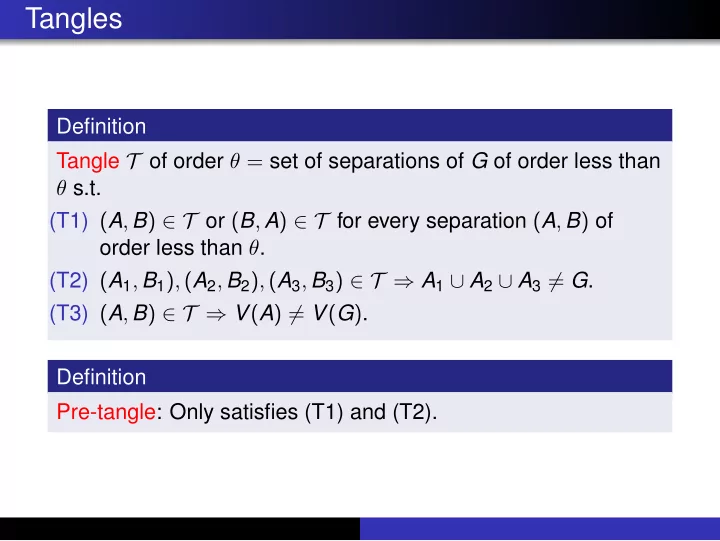
SLIDE 1 Tangles
Definition Tangle T of order θ = set of separations of G of order less than θ s.t. (T1) (A, B) ∈ T or (B, A) ∈ T for every separation (A, B) of
(T2) (A1, B1), (A2, B2), (A3, B3) ∈ T ⇒ A1 ∪ A2 ∪ A3 = G. (T3) (A, B) ∈ T ⇒ V(A) = V(G). Definition Pre-tangle: Only satisfies (T1) and (T2).
SLIDE 2 Lemma T pre-tangle of order θ. Suppose (A1, B1), . . . , (Am, Bm) ∈ T and
i=1 V(Ai ∩ Bi)
m
Ai,
m
Bi
SLIDE 3
Tangle(?) in an embedded graph
SLIDE 4
Drawing is 2-cell if all faces are open disks.
SLIDE 5
Closed curves
Representativity = minimum number of intersections of G with a non-contractible closed curve.
SLIDE 6
A curve is G-normal if it intersects G only in vertices. Radial graph: V(R(G)) = V(G) ∪ F(G), E(R(G)) = incidence between vertices and faces.
SLIDE 7
vertices of G ↔ one part of V(R(G)) faces of G ↔ the other part of V(R(G)) edges of G ↔ the faces of R(G) atoms A(G) of G. R(a) = the corresponding object in R(G).
SLIDE 8
Observation G-normal curves correspond to walks in R(G). Observation R(G) = R(G⋆).
SLIDE 9
Observation G-normal curves correspond to walks in R(G). Observation R(G) = R(G⋆).
SLIDE 10
Slopes
H: 2-cell drawing in Σ. Definition A slope ins of order θ assigns to each cycle C ⊆ H of length less than 2θ a closed disk ins(C) ⊆ Σ bounded by C, s.t. (S1) ℓ(C1), ℓ(C2) < 2θ, C1 ⊆ ins(C2) ⇒ ins(C1) ⊆ ins(C2) (S2) F ⊆ H a theta graph, all cycles in F have length less than 2θ ⇒ for some C ⊆ F, every cycle C′ ⊆ F satisfies ins(C′) ⊆ ins(C).
SLIDE 11
SLIDE 12
Σ not the sphere: Slope exists iff every non-contractible cycle has length at least 2θ; ins unique. Σ is the sphere: “Degenerate” slopes.
SLIDE 13 F ⊆ H is confined if all cycles in F have length less than 2θ. ins(F) = F ∪
ins(C). (S2): F confined ⇒ ins(F) = ins(C) for some cycle C in F.
SLIDE 14
Lemma There exists a cactus F ′ ⊆ F such that ins(F) = ins(F ′), and for any distinct 2-connected blocks B1 and B2 of F ′, ins(B1) and ins(B2) intersect in at most one vertex. For some face f of F, ins(F) = Σ \ f.
SLIDE 15
Lemma There exists a cactus F ′ ⊆ F such that ins(F) = ins(F ′), and for any distinct 2-connected blocks B1 and B2 of F ′, ins(B1) and ins(B2) intersect in at most one vertex. For some face f of F, ins(F) = Σ \ f.
SLIDE 16
Z a set of faces of H. N(Z): Vertices and edges incident with both Z and Z. H bipartite, X one of parts. Definition A set Z of faces is X-small if |V(N(Z)) ∩ X| < θ and Z ⊂ ins(N(Z)).
SLIDE 17 Lemma Z1, Z2, Z3 X-small ⇒ Z1 ∪ Z2 ∪ Z3 = all faces of H. Proof.
F theta-subgraph, Zi faces of H inside one of faces of F. Z1 ∪ Z2 ∪ Z3 = all faces of H. N(Zi) = cycle bounding the i-th face of F. By (S2), one of Z1, Z2, Z3 is not small.
SLIDE 18
G with 2-cell drawing in Σ. For a closed disk ∆ whose boundary is G-normal, (A∆, B∆) = (G ∩ ∆, G ∩ Σ \ ∆). T : a pre-tangle or tangle of order θ in G. Definition T is respectful if every cycle C ⊆ R(G) of length less than 2θ bounds a disk ∆ ⊆ Σ such that (A∆, B∆) ∈ T . We define insT (C) = ∆. Σ = the sphere: Implies representativity ≥ θ, ∆ unique. Σ = the sphere: Always true.
SLIDE 19 Lemma T respectful pre-tangle of order θ in G ⇒ insT is a slope of
Proof.
SLIDE 20 Lemma T respectful pre-tangle of order θ in G ⇒ insT is a slope of
Proof.
SLIDE 21
From a slope to a pre-tangle
For A ⊆ G, let ZA be the faces of R(G) corresponding to the edges of A. ins: a slope of order θ in R(G) Definition Tins = the set of separations (A, B) of order less than θ such that ZA is V(G)-small in R(G). Note: V(N(ZA)) ∩ V(G) = vertices incident with both E(A) and E(B) ⊆ V(A ∩ B).
SLIDE 22
Lemma ins is a slope of order θ in R(G) ⇒ Tins is a respectful pre-tangle of order θ in G. Proof. (T1) ins(N(ZA)) is a complement of a face of N(ZA), N(ZA) = N(ZB) ⇒ ZA or ZB is V(G)-small. (T2) Union of three V(G)-small sets does not contain all faces. Respectfulness: Z1, Z2 partition of F(R(G)) with N(Z1) = C = N(Z2), Z1 or Z2 is small.
SLIDE 23
1 : 1 correspondence
Lemma T respectful pre-tangle of order θ in G: TinsT = T . Lemma ins slope of order θ in R(G): insTins = ins .
SLIDE 24
A slope in R(G) is degenerate if for some face f bounded by a 4-cycle C, ins(C) = the closure of f. Lemma For θ ≥ 3, Tins is a tangle if and only if ins is non-degenerate. Proof. ⇒ f of R(G) corresponds to e ∈ E(G). By (T3) and (T1), (e, G − e) ∈ Tins, so ins(C) = the closure of f.
SLIDE 25 A slope in R(G) is degenerate if for some face f bounded by a 4-cycle C, ins(C) = the closure of f. Lemma For θ ≥ 3, Tins is a tangle if and only if ins is non-degenerate. Proof. ⇐ By the assumption, (e, G − e) ∈ Tins for every e ∈ E(G). If (A, B) ∈ Tins and V(A) = V(G), then (G, V(B)) = A ∪
e, B ∩
G − e ∈ Tins, contradicting (T2).
SLIDE 26
Theorem G 2-cell drawing in Σ = the sphere. G contains a respectful tangle of order θ ≥ 3 iff the representativity is at least θ. This respectful tangle is unique. Proof. The unique slope is non-degenerate.
SLIDE 27
Theorem If G is a plane graph, then G and G⋆ have the same branchwidth, and thus their treewidths differs by a factor of at most 3/2. Proof. Tangles in G and G⋆ correspond to non-degenerate slopes in R(G) = R(G⋆), branchwidth = maximum order of a tangle.
SLIDE 28
For a closed walk W in R(G): G[W] = the subgraph on vertices and edges of W, ins(W) = ins(G[W]). Definition For a, b ∈ A(G), d(a, b) = 0 if a = b, d(a, b) = ℓ/2 if ∃ a closed walk W in R(G), ℓ(W) < 2θ, such that R(a), R(b) insT (W), and ℓ is the length of the shortest such walk, d(a, b) = θ otherwise.
SLIDE 29 Homework assignment: d is a metric It suffices to take into account limited types of walks (ties). For each a ∈ A(G) and k < θ, the set
R(b) is “almost a disk”. For each a ∈ A(G), there exists e ∈ E(G) s.t. d(a, b) = θ.