
SLIDE 1
Tables, Priority Queues, Heaps
Table ADT
purpose, implementations
Priority Queue ADT
variation on Table ADT
Heaps
purpose, implementation heapsort
EECS 268 Programming II 1
Table ADT
A table in generic terms has M columns and N rows
each row contains a separate record each column contains a different component, or field, of the same record
Each table, or set of data, is also generally sorted, or accessed, by a key record component
a single set of data can be organized into several different tables, sorted according to different keys
Another common terms is a dictionary, whose entries are records, inserted and accessed according to a key value
key may be a field in the record or not may also be used as frontends for data base access
EECS 268 Programming II 2
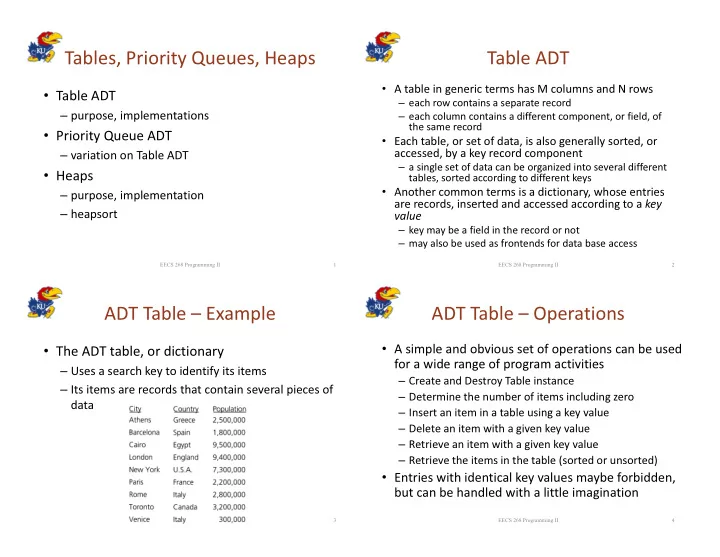
ADT Table Example
The ADT table, or dictionary
Uses a search key to identify its items Its items are records that contain several pieces of data
3
ADT Table Operations
A simple and obvious set of operations can be used for a wide range of program activities
Create and Destroy Table instance Determine the number of items including zero Insert an item in a table using a key value Delete an item with a given key value Retrieve an item with a given key value Retrieve the items in the table (sorted or unsorted)
Entries with identical key values maybe forbidden, but can be handled with a little imagination
EECS 268 Programming II 4