Table 1. Synopsis of research (empirical, conceptual/review*) on - - PowerPoint PPT Presentation

table 1 synopsis of research empirical conceptual review
SMART_READER_LITE
LIVE PREVIEW

Table 1. Synopsis of research (empirical, conceptual/review*) on - - PowerPoint PPT Presentation

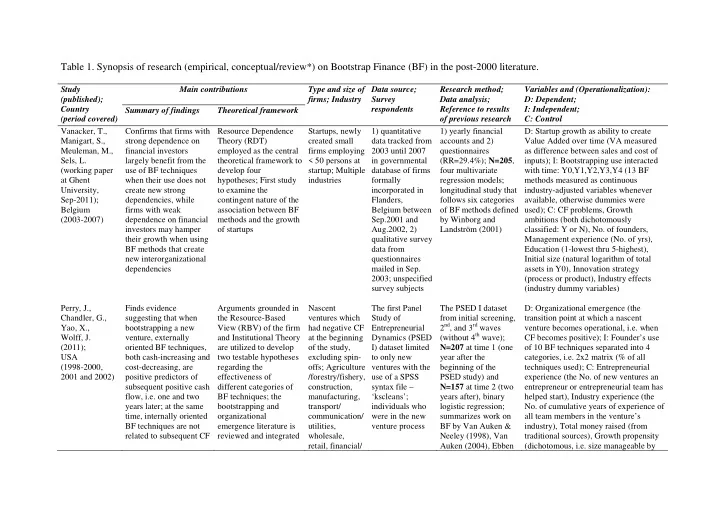
Table 1. Synopsis of research (empirical, conceptual/review*) on Bootstrap Finance (BF) in the post-2000 literature. Study Main contributions Type and size of Data source; Research method; Variables and (Operationalization): (published);


slide-1
SLIDE 1

Table 1. Synopsis of research (empirical, conceptual/review*) on Bootstrap Finance (BF) in the post-2000 literature.

Study (published); Country (period covered) Main contributions Type and size of firms; Industry Data source; Survey respondents Research method; Data analysis; Reference to results

  • f previous research

Variables and (Operationalization): D: Dependent; I: Independent; C: Control Summary of findings Theoretical framework Vanacker, T., Manigart, S., Meuleman, M., Sels, L. (working paper at Ghent University, Sep-2011); Belgium (2003-2007) Confirms that firms with strong dependence on financial investors largely benefit from the use of BF techniques when their use does not create new strong dependencies, while firms with weak dependence on financial investors may hamper their growth when using BF methods that create new interorganizational dependencies Resource Dependence Theory (RDT) employed as the central theoretical framework to develop four hypotheses; First study to examine the contingent nature of the association between BF methods and the growth

  • f startups

Startups, newly created small firms employing < 50 persons at startup; Multiple industries 1) quantitative data tracked from 2003 until 2007 in governmental database of firms formally incorporated in Flanders, Belgium between Sep.2001 and Aug.2002, 2) qualitative survey data from questionnaires mailed in Sep. 2003; unspecified survey subjects 1) yearly financial accounts and 2) questionnaires (RR=29.4%); N=205, four multivariate regression models; longitudinal study that follows six categories

  • f BF methods defined

by Winborg and Landström (2001) D: Startup growth as ability to create Value Added over time (VA measured as difference between sales and cost of inputs); I: Bootstrapping use interacted with time: Y0,Y1,Y2,Y3,Y4 (13 BF methods measured as continuous industry-adjusted variables whenever available, otherwise dummies were used); C: CF problems, Growth ambitions (both dichotomously classified: Y or N), No. of founders, Management experience (No. of yrs), Education (1-lowest thru 5-highest), Initial size (natural logarithm of total assets in Y0), Innovation strategy (process or product), Industry effects (industry dummy variables) Perry, J., Chandler, G., Yao, X., Wolff, J. (2011); USA (1998-2000, 2001 and 2002) Finds evidence suggesting that when bootstrapping a new venture, externally

  • riented BF techniques,

both cash-increasing and cost-decreasing, are positive predictors of subsequent positive cash flow, i.e. one and two years later; at the same time, internally oriented BF techniques are not related to subsequent CF Arguments grounded in the Resource-Based View (RBV) of the firm and Institutional Theory are utilized to develop two testable hypotheses regarding the effectiveness of different categories of BF techniques; the bootstrapping and

  • rganizational

emergence literature is reviewed and integrated Nascent ventures which had negative CF at the beginning

  • f the study,

excluding spin-

  • ffs; Agriculture

/forestry/fishery, construction, manufacturing, transport/ communication/ utilities, wholesale, retail, financial/ The first Panel Study of Entrepreneurial Dynamics (PSED I) dataset limited to only new ventures with the use of a SPSS syntax file – ‘kscleans’; individuals who were in the new venture process The PSED I dataset from initial screening, 2nd, and 3rd waves (without 4th wave); N=207 at time 1 (one year after the beginning of the PSED study) and N=157 at time 2 (two years after), binary logistic regression; summarizes work on BF by Van Auken & Neeley (1998), Van Auken (2004), Ebben D: Organizational emergence (the transition point at which a nascent venture becomes operational, i.e. when CF becomes positive); I: Founder’s use

  • f 10 BF techniques separated into 4

categories, i.e. 2x2 matrix (% of all techniques used); C: Entrepreneurial experience (the No. of new ventures an entrepreneur or entrepreneurial team has helped start), Industry experience (the

  • No. of cumulative years of experience of

all team members in the venture’s industry), Total money raised (from traditional sources), Growth propensity (dichotomous, i.e. size manageable by

slide-2
SLIDE 2

insurance/real estate, public administration & Johnson (2006), Carter & Van Auken (2005) respondent him/herself or with a few key employees or as large as possible), Industry (8 categories) Vanacker, T., Manigart, S., Meuleman, M., Sels, L. (2011); Belgium (2003-2007) Overall, new ventures that use more owner funds, employ more interim personnel, encourage customers to pay more quickly, and apply for more subsidies, all exhibit steeper growth in value added over time Resource-based theories are contrasted with traditional finance theories in the literature review to compare two perspectives, i.e. BF strategies are generally positive for growth and enhance flexibility on the one hand, or BF strategies are only second-best alternatives,

  • n the other hand

Startup ventures with < 50 employees, only newly created companies; Business services, wholesale/retail, restaurants and hotels, construction, and other industries 1) longitudinal data (2003-2007) from BEL-FIRST (Bureau van Dijk) database of firms incorporated in Flanders, Belgium between Sep.2002 and Aug.2003, 2) data from surveys mailed in Sep.2003; entrepreneurs (owners) surveyed 1) yearly financial accounts and 2) questionnaires (RR=29.4%); N=214, Generalized Estimating Equation (GEE) approach, one- period autoregressive correlation structure, five multivariate regression models; compares BF variables and their data source with Winborg and Landström (2001) D: Value Added defined as sales income minus materials and services purchased (Ln); I: 13 BF methods (numeric, Ln, or binomial dummies, mostly industry- adjusted); C: No. of founders, Education (5 levels), [Team] Management experience ([average] No.

  • f yrs), Innovation strategy (product or

process), Growth ambition (dichotomous), CF problems in year 0 (nine different types), Initial size (Ln of assets in year 0), Industry (eight dummy

  • ptions)

*Tomory, E. (working paper at the University

  • f Pécs)

Synthesizes literature on BF of innovation since 1986; concludes that although BF is a widely recognized entrepreneurial activity, the literature is limited, most research focuses on various BF methods, textbooks and courses do not cover BF in depth, and knowledge appears fragmented rather than cumulative; consequently, formal theoretical frameworks need to be generated by scholars N/A N/A Searches in all major article databases for business and management at the University of Toronto Library; double-blind reviewed articles in English N/A Winborg, J., Politis, D. (2009); Sweden (2006) Overall, concludes that the total impact of human capital on bootstrapping orientation is not as strong as predicted; furthermore, concludes that formal education, which represents general Discusses research in entrepreneurship and strategy, i.e. its focus on the potential role of human capital, both general and specific, for firm performance; refers to the substitutability of human and financial New limited businesses registered in 2004, randomly selected; Various industries 1) register supplied by Statistics Sweden, 2) postal survey; Executive manager or CEO

  • f the business

surveyed 1) collection of secondary data available in the register, 2) questionnaires (RR=24%); N=231, four multiple linear regression models (OLS); compares its D: Overall bootstrapping orientation (sum of two five-scaled items, each referring to a separate statement); I: Human capital: General HC (formal education of entrepreneur, coded ‘1’ if university level, and ‘0’ in case of no university education) and specific HC, i.e. Industry-specific (No. of years the business is active in the industry) and

slide-3
SLIDE 3

human capital, actually is more influential than the learning reached from having specific entrepreneurship experience (start-up and managerial) and industry experience capital; bases on the narrower definition of bootstrapping proposed by Winborg (2009); presents two distinct types of new business managers, i.e. those who possess bootstrapping

  • rientation, and those

who do not, based on Winborg (2007) surprising results with findings of, inter alia, Helleboogh and Laveren (2008) entrepreneurship-specific, i.e. Start-up experience (coded ‘1’ for a habitual entrepreneur who has started at least one business before, and ‘0’ otherwise for a novice entrepreneur), and Managerial experience (coded ‘1’ for an expert entrepreneur having at least 10 years of experience as a founder/entrepreneur, and ‘0’ otherwise); C: Industry (service coded ‘1’, and non-service coded ‘0’), Business size (ln of the size of sales) Neeley, L., Van Auken, H. (2009); USA (not explicitly stated) Partially confirms that more highly educated entrepreneurs use BF more than less educated

  • nes, provides limited

support for that older entrepreneurs use BF more than younger ones, and partial support for that female entrepreneurs use BF more than male ones Inconsistency of capital acquisition decisions of small firms with traditional financial theory of capital structure is presented; BF methods discussed at the individual level of analysis Small firms, i.e. employing < 100 persons, prevailingly in their growth and mature stages as

  • nly 2.5%

accounted for startups; Retail, construction, wholesale, manufacturing, service, and

  • ther industries

Harris Illinois Directories of Services and Manufacturers (2003) used for stratified random sample selection; company owner- managers surveyed Questionnaires (RR=16.5%); N=247, factor analysis, t-tests

  • f differences among

factor scores relative to education, age, and gender; study based on the approach of Winborg and Landström (2001) with respect to questionnaire design and factor analysis that identifies six groups of BF methods D: 6 bootstrap factors including 24 BF methods, of which 16 were metric (5- point Likert scaled) and 8 non-metric (dichotomous); I: Owner gender, Owner age (four ranges), Owner education (three levels); C: Industry (six options),

  • No. of employees (four ranges), Stage of

development (four options), Sales in 2001 (five ranges) *Brush, C. (2008) Discusses three pioneering strategies which successful entrepreneurs must master and offers guidance on how to implement them; one of the strategies is to manage cash creatively or learn to bootstrap; provides a definition of bootstrapping; explains four general ways to bootstrap, i.e. 1) product development, 2) business development, 3) conserving cash, 4) meeting cash needs; articulates that companies which effectively bootstrap are more likely to obtain angel investment and equity financing N/A N/A In addition to presenting own definition/explanation

  • f bootstrapping,

refers to the definition by Freear, Sohl and Wetzel (1995); refers to four different ways to bootstrap discussed e.g. in Carter et al. (2006) N/A

slide-4
SLIDE 4

Yilmazer, T., Schrank, H. (2006); USA (1989-2001) Compares determinants

  • f financial

intermingling (FI) in family and non-family businesses and concludes that for both types of firms differences in FI are primarily influenced by business characteristics and household net worth; the predominant intermingling is household-to-business; in general there was a decrease in FI from 1989 to 2001 Indicates that the framework of the Sustainable Family Business Model has been most commonly used to explain the phenomenon of FI; reminds of the study by Van Auken (2003) who points out that the assumptions of the theory of capital structure are irrelevant for most small firms 1099 small family firms (of <=200 employees, household has at least 50%

  • wnership and

in which 2+ family members work), and 3047 small non- family firms (only 1 family member works); Agriculture, construction, manufacturing, retail/wholesale, services and professional practice Survey of Consumer Finances (SCF) large data set collected in 1989, 1992, 1995, 1998, and 2001 SCF data collections, not a longitudinal study; N=4146, multivariate probit analysis to determine which characteristics are significantly associated with FI; the study argues that household-to-business FI is similar to ‘owner resources’ financial bootstrapping identified by Winborg and Landström (2001) but is not the same as it happens ‘in addition’ D: Incidence of financial intermingling (household-to-business and business-to- household as Y or N); I/C: Business characteristics.: No. of employees, Legal

  • rganization (five options), Age of

business (years), Business net worth (in 2001 dollars), Business net profit (in 2001 dollars), Copreneurship (Y or N), Household owns 100% of business (Y or N), Kind of business (six options); Respondent and household cs.: Age (years), Marital status (married or single M or single F); Education (three levels), Race (three options), Risk tolerance (1 if above average and 0 otherwise), Household net worth, No. of other businesses owned and actively managed Ebben, J., Johnson, A. (2006); USA (not explicitly stated) Confirms change in the use of four BF methods

  • ver the time of small

firm development, i.e. the use of owner-related, joint-utilization and delaying-payments techniques decreased

  • ver time, while the use
  • f customer-related

techniques increased

  • ver firm life cycle

Illustrates that the Organizational Theory (OT) can be used to predict bootstrapping behavior in small firms, as BF methods that are used largely coincide with OT predictions (more specifically with resource dependence and organizational learning theories, as Small firms with the mean

  • No. of

employees at 17.80 (between 1 and 85) and the mean age at 13.99 years (between 2 and 37); Retail and service industry University-owned database of firms located in the Midwestern US; firm owners surveyed Questionnaires (RR=28%); N=146, rotated principal components analysis, to verify groupings of BF methods, results in identifying three, not four, BF factors, paired-sample t-tests; the identified factors coincide with the six factors presented by D: Change in the level of use of 20 BF techniques (five-point Likert scaled to identify degree to which each technique was used early in the firm life cycle and the degree to which each technique is currently used); I: Time (dichotomous, i.e. early in the firm life cycle or currently); C: Firm size (No. of employees), Firm Age (years)

slide-5
SLIDE 5

well as theories of entrepreneurial risk- taking and organization- al legitimacy) Winborg and Landström (2001) Ekanem, I. (2005); UK (1998-1999) Indicates that managers

  • f small firms, during

investment decision making process, use mainly bootstrapping techniques, rather than the more formal methods suggested in the financial management literature; more specifically the study provides evidence of: delaying, minimizing investment, owner- financed, and subsidy bootstrappers Study grounded in behavioral/

  • rganizational theories,

rather than neo-classical theory, of the firm; Inductive and balanced empirical description of bootstrapping investment decision- making process is provided and conceptualized within the context of

  • rganizational learning

approach Small limited companies, i.e. manufacturing enterprises employing <=50 persons; Printing and clothing industries Purposive selection of firms from two contrasting sectors because of their distinct technologies and different investment requirements;

  • wner-managers

interviewed and

  • bserved, other

key employees, business advisors and equipment suppliers interviewed Longitudinal case studies using ‘insider accounts’ as an innovative qualitative methodology, i.e. semi-structured, in- depth interviews and direct observation conducted three times

  • ver a period of 18

months; N=8, content analysis, pattern matching, explanation-building technique; relates to the classification of bootstrappers by Winborg and Landström (2001) Bootstrapping techniques adopted in investment decision-making process *Lahm, R. Jr., Little, H. Jr. (2005) Discusses two basic methods which address four types of BF, i.e. bootstrapping product development, bootstrapping business development, minimizing outside capital financing, and minimizing the need for capital; the two methods include: acquisition and control of resources, and efficient utilization of those resources to finance firm growth; article concludes that research on BF is very limited, although in practice it is a widely used strategy to finance startups; textbooks seem to mirror the lack of coverage found in the literature; no theoretical framework presented N/A N/A 1) Proquest databases, 2) Google search and broader Internet search to include business press, practitioner journals, and magazines; study addresses the four types of BF identified by Freear, Sohl, and Wetzel (1995) and Winborg and Landström (2001) N/A

slide-6
SLIDE 6

Van Auken, H. (2005); USA (2002) Comparative study which indicates that

  • wners of technology-

based firms believe that 6 of the 28 BF methods are more important compared to owners of nontechnology-based firms; the former respondents believe that BF methods that improve cash inflows are more important and BF methods that slow disbursements are less important, compared to the latter respondents Argues that traditional finance theory does not recognize the importance of BF, and that it oversimplifies the goals and financing decisions of small firms by presenting them in the context of wealth maximization Small firms, half tech-based and half non tech-based; Retail, service and other types

  • f businesses,

predominantly

  • rganized as S-

/C-Corporations Listing of tenants at two university- based research parks (tech-based firms), listings at chambers of commerce in several cities (non tech-based firms) in a Midwestern state; firm owners surveyed Questionnaire, pre- tested in Fall 2001 and mailed in Spring 2002 (RR=44%); N=88, Wilcoxon two-sample test, Spearman correlation coefficient estimates; the BF methods grouped using factors of Winborg and Landström (2001), the Likert scales adopted thereof Importance of 28 BF methods (six-point Likert scaled) measured for comparative purposes between technology-based versus nontechnology-based firms, also relative to groupings (factors) of BF methods Van Auken, H. (2004); USA (2002) More an exploratory than confirmatory research which indicates that the use of BF is directly related to the risk of the firm, and inversely related to the market size and whether the owner had searched for capital during the past year Explains that traditional financial theory (more specifically capital structure theory and capital market theory) rely on assumptions that are irrelevant for small technology-based firms due to their small size and high risk Small technology- based firms; Retail, service and other businesses legally

  • rganized as S-/

C-Corporations (84%), sole proprietorships, partnerships and LLCs (16%) Two university- based research parks in a Midwestern state; firm owners surveyed Questionnaire, pre- tested and revised in Fall 2001 before mailing in Spring 2002 (RR=51.8%); N=44, Spearman correlation, multinomial logit regression; the BF methods and their measurement with the use of Likert scales adopted from Winborg and Landström (2001) D: Importance of 28 BF methods (six- point Likert scaled); I: Risk proxy (Difficulty of raising capital + Degree of undercapitalization + Firm objectives consistent with “life style” or “high growth” preferences / 3, all three five- point Likert scaled), Market area served (two levels), Owner spent time on capital search during past year (binomial: 1=Y or 0=N); C: Firm age (years), Capital raised since business launch (five ranges) Winborg, J., Landström, H. (2001); Sweden (not explicitly stated) Exploratory research that identifies 32 BF methods through qualitative analysis, which are narrowed down to 25 relevant Questions focus on market solutions to resource needs, i.e. bank financing (debt) and venture capital (equity); financial gap explained Small firms, i.e.< 100 employees, rather mature

  • nes; Various

industries, of Sample selection resulting in over- representation of “larger” firms in relation to the whole population; 1) unstructured explorative interviews

  • n the basis of study

by Freear et al. (1995); 2) questionnaires (RR=30%); N=262, D: 32 BF methods, of which 21 were metric (5-point Likert scaled) and 11 non-metric (dichotomous); I: Firm size in 1995 (No. of employees and turnover), Stage of development (four

  • ptions), Growth (% change in turnover
slide-7
SLIDE 7

methods and grouped into 6 clusters through quantitative empirical testing, i.e. owner financing methods, minimization of account receivable, joint utilization, delaying payments, minimizing investment in stock, and subsidy finance; the study then identifies 6 groups of financial bootstrappers by two-sided information asymmetries, high transaction costs, bonding costs and problems of adverse selection; resource- based view of firm used to define BF which financial, public sector, economic associations and foundations were excluded 1) managers, accountants, consultants, bank

  • fficials,

researchers and Regional Development Fund officials interviewed, 2) business managers (presidents) surveyed explorative factor analysis (varimax rotation, scree-test), and cluster analysis based on the factor scores (ANOVA and chi-square tests) 1994-96), Line of business (eight

  • ptions), Geographical location (three

ranges of No. of inhabitants), Profit margin (dichotomous, i.e. “high” or “low” calculated as Profit 1995 / Turnover 1995), Financial situation, and Long-term bank loans (dichotomous in both cases), Chance of long-term bank finance (five-point scaled)