T / U T proves we utter the phrase Let R be a ring.. A surprising - - PowerPoint PPT Presentation

t u t proves
SMART_READER_LITE
LIVE PREVIEW

T / U T proves we utter the phrase Let R be a ring.. A surprising - - PowerPoint PPT Presentation

The generic model Nongeometric properties A systematic source A topos-theoretic Nullstellensatz This talk in a nutshell: There is a certain ring, the generic ring , which is special in that it is conserva- tive : It has exactly


slide-1
SLIDE 1

The generic model Nongeometric properties A systematic source A topos-theoretic Nullstellensatz

T/UT proves σ σ holds for UT

  • σ holds for M
  • A general Nullstellensatz for generalised spaces

– an invitation – Category Theory 2019 in Edinburgh July 9th, 2019 Ingo Blechschmidt Università di Verona

0 / 10

This talk in a nutshell: There is a certain ring, the generic ring, which is special in that it is conserva- tive: It has exactly those properties which are shared by any ring whatsoever. One could argue that it is this ring which we’re implicitly referring to when we utter the phrase “Let R be a ring.”. A surprising observation is that the generic ring is a field. This is not a contradiction because conservativity only pertains to properties which can be put in a certain syntactic form, dubbed geometric sequents, and the field condition is not of that form. As a consequence, when verifying a geometric sequent for all rings, we may freely assume the field condition: Our proof will apply to the generic ring, because this ring happens to be a field, and its conclusion will spread to any ring whatsoever thanks to its syntactic form. An analogous story can be told for the generic group, the generic vector space and quite generally for the generic model of any geometric theory. It is an interesting task to discover properties of such generic models. This talk presents a source of such properties, the topos-theoretic Nullstellensatz, which is universal in the sense that any such property is a logical consequence of the Nullstellensatz.

slide-2
SLIDE 2

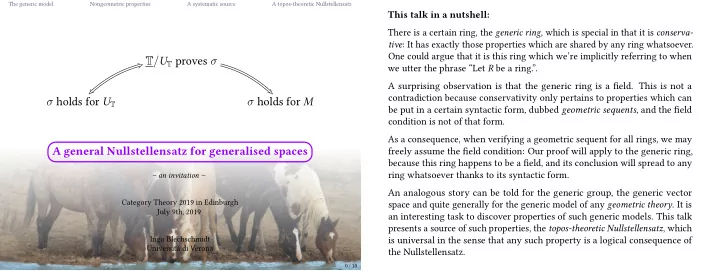
This talk owes a special debt to Alexander Oldenziel, who repeatedly sug- gested that the topic of this talk should be studied. The photos on the slide are of Arthur’s Seat, a beautiful extinct volcano in Edinburgh where parts of these slides have been created. It gives an excellent view of the city and is very much recommended for a hiking tour.

slide-3
SLIDE 3

The generic model Nongeometric properties A systematic source A topos-theoretic Nullstellensatz

The mystery of nongeometric sequents

Let T be a geometric theory

sorts, function symbols, re- lation symbols, geometric sequents as axioms

, for instance the theory of rings

sorts: R

  • fun. symb.: 0, 1, −, +, ·

axioms: (⊤ ⊢x,y:R xy = yx), ...

. Z Z[X, Y, Z]/(X n + Y n − Zn) OX UT

1 / 10

A geometric sequent is a syntactic expression of the form (ϕ ⊢

x1 : X1,...,xn : Xn ψ),

where x1 : X1, . . . , xn : Xn is a list of variable declarations, the Xi ranging over the available sorts, and ϕ and ψ are geometric formulas. Such a sequent is read as “in the context x1 : X1, . . . , xn : Xn, ϕ entails ψ”. Geometric formulas are built from atomic propositions (equality and the available relation symbols) using the connectives ⊤, ⊥, ∧, (set-indexed disjunction) and ∃. Geometric formulas may not contain ¬, ⇒, ∀. There is a notion of a model of a geometric theory in any given topos. For instance, a ring in the usual sense is a model of the theory of rings in the topos Set. The structure sheaf OX of a scheme X is a model in the topos Sh(X)

  • f set-valued sheaves over X.

With topos we mean Grothendieck topos, and as metatheory we use a con- structive but impredicative flavour of English (which could be formalised by what is supported by the internal language of elementary toposes with an NNO). However the Nullstellensatz presented later makes no use of the subobject classifier, hence the results can likely be generalised to hold in a predicative metatheory or to hold for arithmetic universes.

slide-4
SLIDE 4

The generic model Nongeometric properties A systematic source A topos-theoretic Nullstellensatz

The mystery of nongeometric sequents

Let T be a geometric theory

sorts, function symbols, re- lation symbols, geometric sequents as axioms

, for instance the theory of rings

sorts: R

  • fun. symb.: 0, 1, −, +, ·

axioms: (⊤ ⊢x,y:R xy = yx), ...

. Z Z[X, Y, Z]/(X n + Y n − Zn) OX UT

  • Theorem. There is a generic model UT. It is conservative in

that for any geometric sequent σ the following notions coincide:

1 The sequent σ holds for UT. 2 The sequent σ holds for any T-model in any topos . 3 The sequent σ is provable modulo T.

1 / 10

Among all models in any topos, the universal or generic one is special. It enjoys the universal property that any model in any topos can be obtained from it by pullback along an essentially unique geometric morphism. It is intriguing from a logical point of view because it has exactly those properties which are shared by any model in any topos. One could argue, with a certain amount of success, that the generic model

  • f the theory of rings is what a mathematician implicitly refers to when she

utters the phrase “Let R be a ring”. This point of view is fundamental to the slogan continuity is geometricity, as expounded for instance in Continuity and geometric logic by Steve Vickers.

slide-5
SLIDE 5

The generic model Nongeometric properties A systematic source A topos-theoretic Nullstellensatz

The mystery of nongeometric sequents

Let T be a geometric theory

sorts, function symbols, re- lation symbols, geometric sequents as axioms

, for instance the theory of rings

sorts: R

  • fun. symb.: 0, 1, −, +, ·

axioms: (⊤ ⊢x,y:R xy = yx), ...

. Z Z[X, Y, Z]/(X n + Y n − Zn) OX UT

  • Theorem. There is a generic model UT. It is conservative in

that for any geometric sequent σ the following notions coincide:

1 The sequent σ holds for UT. 2 The sequent σ holds for any T-model in any topos . 3 The sequent σ is provable modulo T.

Observation (Kock). The generic local ring is a field: (x = 0 ⇒ ⊥) ⊢x:R (∃y : R. xy = 1)

1 / 10

Among all models in any topos, the universal or generic one is special. It enjoys the universal property that any model in any topos can be obtained from it by pullback along an essentially unique geometric morphism. It is intriguing from a logical point of view because it has exactly those properties which are shared by any model in any topos. One could argue, with a certain amount of success, that the generic model

  • f the theory of rings is what a mathematician implicitly refers to when she

utters the phrase “Let R be a ring”. This point of view is fundamental to the slogan continuity is geometricity, as expounded for instance in Continuity and geometric logic by Steve Vickers. Crucially, the conservativity statement only pertains to properties which can be put as geometric sequents. Generic models may have additional nongeometric properties. Because conservativity does not apply to them, they are not shared by all models in all toposes – but any consequences which can be put as geometric sequents are. For instance, if we want to verify a geometric sequent for all local rings, we may freely use the displayed field axiom. Hence one reason why these nongeometric sequents are interesting is because they provide us with new reduction strategies (proofs by “without loss of generality”).

slide-6
SLIDE 6

The generic model Nongeometric properties A systematic source A topos-theoretic Nullstellensatz

Construction of the generic model

The generic model is not the same as ... the initial model (think Z) or the free model on one generator (think Z[X]). Set-based models are too inflexible.

  • Definition. The syntactic site CT has ...

1 objects: formulas-in-contexts {x1 : X1, . . . , xn : Xn. ϕ} 2 morphisms: eqv. classes of provably functional formulas 3 coverings: provably jointly surjective families

The topos of sheaves over CT is the classifying topos Set[T]. The generic model interprets a sort X by the sheafよ {x : X. ⊤}.

2 / 10

In case the theory T is a Horn theory (for instance if it is an equational theory), the term algebra (the set of terms in the empty context modulo provable equality) is a model of T. While the term algebra does enjoy some nice categorical properties, it is in general not the generic model. For instance, if T is the theory of rings, then the initial model is Z. This model validates some geometric sequents which are not validated by all rings, for instance (x2 = 0 ⊢

x:R x = 0) or (1 = 0 ⊢ ⊥).

In general, the generic model cannot be realised as a set-based model (with a set for each sort, a map for each function symbol and so on). Sets are too constant for this purpose; the flexibility of sheaves (“variable sets”) is required: The generic model lives in the topos of set-valued sheaves over CT, called the classifying topos of T.

slide-7
SLIDE 7

The generic model Nongeometric properties A systematic source A topos-theoretic Nullstellensatz

Construction of the generic model

The generic model is not the same as ... the initial model (think Z) or the free model on one generator (think Z[X]). Set-based models are too inflexible.

  • Definition. The syntactic site CT has ...

1 objects: formulas-in-contexts {x1 : X1, . . . , xn : Xn. ϕ} 2 morphisms: eqv. classes of provably functional formulas 3 coverings: provably jointly surjective families

The topos of sheaves over CT is the classifying topos Set[T]. The generic model interprets a sort X by the sheafよ {x : X. ⊤}.

2 / 10

The notation in the definition of the objects of CT is meant to be suggestive, but should not be taken literally. The objects are syntactic expressions consisting

  • f a context and a geometric formula in that context.

A morphism A = {

  • x. ϕ} → {
  • y. ψ} = B in CT is the equivalence class

(modulo provable equivalence) of a geometric formula θ such that T proves

  • 1. “θ is a relation on A × B”: (θ ⊢
  • x,

y ϕ ∧ ψ)

  • 2. “θ is total”: (ϕ ⊢
  • x ∃
  • y. θ)
  • 3. “θ is single-valued”: (θ ∧ θ[

y′/ y] ⊢

  • x,

y, y′

y = y′) A family ({

  • xi. ϕi}

[θi]

− − → {

  • y. ψ})i is a covering iff T proves (ψ ⊢
  • y
  • i ∃
  • xi. θi).

The slides experiment with using the symbol “ よ ” for the Yoneda embed- ding CT → Set[T], as in Elements of (∞, 1)-category theory by Emily Riehl and Dominic Verity.

slide-8
SLIDE 8

The generic model Nongeometric properties A systematic source A topos-theoretic Nullstellensatz

Construction of the generic model

The generic model is not the same as ... the initial model (think Z) or the free model on one generator (think Z[X]). Set-based models are too inflexible.

  • Definition. The syntactic site CT has ...

1 objects: formulas-in-contexts {x1 : X1, . . . , xn : Xn. ϕ} 2 morphisms: eqv. classes of provably functional formulas 3 coverings: provably jointly surjective families

The topos of sheaves over CT is the classifying topos Set[T]. The generic model interprets a sort X by the sheafよ {x : X. ⊤}.

2 / 10

The special case that the generic model of a theory T can be realised as a model in Set occurs iff T is Morita-equivalent to the empty theory, that is, iff T has exactly one model in any topos. The special case that there exists at least some conservative T-model in Set

  • ccurs iff T has a conservative geometric expansion to a theory which is

Morita-equivalent to the empty theory.

slide-9
SLIDE 9

The generic model Nongeometric properties A systematic source A topos-theoretic Nullstellensatz

Working internally to toposes

Let C be a site. We recursively define U | = ϕ (“ϕ holds on U”) for objects U ∈ C and formulas ϕ. Write “Sh(C) | = ϕ” for U | = ϕ for all U.

U | = ⊤ iff true U | = ⊥ iff false the empty family is a covering of U U | = s = t : F iff s|U = t|U ∈ F(U) U | = ϕ ∧ ψ iff U | = ϕ and U | = ψ U | = ϕ ∨ ψ iff U | = ϕ or U | = ψ there exists a covering (Ui → U)i such that for all i: Ui | = ϕ or Ui | = ψ U | = ϕ ⇒ ψ iff for all V → U: V | = ϕ implies V | = ψ U | = ∀s : F. ϕ(s) iff for all V → U and sections s0 ∈ F(V): V | = ϕ(s0) U | = ∃s : F. ϕ(s) iff there exists s0 ∈ F(U) such that U | = ϕ(s0) there exists a covering (Ui → U)i such that for all i: there exists s0 ∈ F(Ui) such that Ui | = ϕ(s0)

3 / 10

The internal language of a (Grothendieck or elementary) topos E is a device which allows us to speak and reason about the objects and morphisms of E in a naive element-based language close to the usual formal mathematical

  • language. Using this language, objects of E look like plain old sets [or types];

morphisms look like plain old maps between those sets; epimorphisms look like surjections; group objects look like groups; and so on. In particular, we can use the internal language to define what it means for a given T-structure in E to be a model – namely iff it looks like a model from the internal point of view. The internal language can be implemented by the Kripke–Joyal semantics, a translation procedure which converts formulas of the internal language into external statements about the objects and morphisms of E. The slide displays some of the translation rules in the case that E is a Grothendieck topos.

slide-10
SLIDE 10

The generic model Nongeometric properties A systematic source A topos-theoretic Nullstellensatz

Working internally to toposes

Let C be a site. We recursively define U | = ϕ (“ϕ holds on U”) for objects U ∈ C and formulas ϕ. Write “Sh(C) | = ϕ” for U | = ϕ for all U.

  • Example. Set |

= ϕ if and

  • nly if ϕ is true.

Theorem. If Sh(C) | = ϕ and if ϕ intuitionistically en- tails ψ, then also Sh(C) | = ψ.

3 / 10

We can actually do mathematics internally to a topos because the Kripke– Joyal semantics is sound with respect to intuitionistic logic: If E | = ϕ and if ϕ intuitionistically entails a further formula ψ, then E | = ψ. The Kripke–Joyal semantics can be extended to interpret unbounded quan- tification (“for all sets” as opposed to “for all elements of the particular set X”) and dependent types. The former are for instance required to express univer- sal properties (“for all groups”, “for all rings”), and the latter are all over the place, even if their use might not be particularly highlighted. With these extensions, we can import all of everyday constructive impredica- tive mathematics into the internal world of a topos. Some illustrations of working with the internal language can be found in these sets of slides:

  • Slides for Jürgen Jost’s group seminar at the MPI Leipzig
  • Slides for Toposes in Como (recording available)

A longer exposition, with pointers to the literature, can be found in Section 2

  • f these notes.
slide-11
SLIDE 11

The generic model Nongeometric properties A systematic source A topos-theoretic Nullstellensatz

A selection of nongeometric properties

The generic object validates:

1 ∀x, y : UT. ¬¬(x = y). 2 ∀x1, . . . , xn : UT. ¬∀y : UT. n i=1 y = xi. 3 (UT)UT ∼

= 1 ∐ UT. The generic ring validates:

1 ∀x : UT. ¬¬(x = 0). 2 ∀x : UT. (x = 0 ⇒ 1 = 0) ⇒ (∃y : UT. xy = 1).

The generic local ring validates:

1 ¬∀x : UT. ¬¬(x = 0). 2 ∀a0, . . . , an−1 : UT. ¬¬∃x : UT. xn+an−1xn−1+· · ·+a0x0 = 0. 3 Let ∆ = {ε : UT | ε2 = 0}. For any map f : ∆ → UT, there

are unique elements a, b : UT s. th. f (ε) = a+bε for all ε : ∆.

4 / 10

The generic object, the generic model of the theory which has exactly one sort and no function symbols, relations symbols or axioms, is slightly indecisive: On the one hand, up to a double negation, it is a subsingleton; on the other hand, it is infinite. This observation is due to Carsten Butz and Peter Johnstone (Classifying toposes for first-order theories). The generic ring, the generic model of the theory of rings, is similarly indeci-

  • sive. It is infinite in the following sense:

∀x1, . . . , xn : UT.

  • ∀y : UT.

n

  • i=1

(y = xi)

  • ⇒ 1 = 0.

The theory of local rings is the quotient theory of the theory of rings obtained by adding the axioms (1 = 0 ⊢ ⊥) and ((∃z. (x + y)z = 1) ⊢

x,y (∃z. xz = 1) ∨ (∃z. yz = 1)).

(Assuming the axiom of choice, a ring is local in this sense iff it local in the usual sense (has exactly one maximal ideal).) The first displayed property of the generic local ring illustrates that nongeo- metric sequents need not be inherited by quotient theories.

slide-12
SLIDE 12

The generic model Nongeometric properties A systematic source A topos-theoretic Nullstellensatz

A selection of nongeometric properties

The generic object validates:

1 ∀x, y : UT. ¬¬(x = y). 2 ∀x1, . . . , xn : UT. ¬∀y : UT. n i=1 y = xi. 3 (UT)UT ∼

= 1 ∐ UT. The generic ring validates:

1 ∀x : UT. ¬¬(x = 0). 2 ∀x : UT. (x = 0 ⇒ 1 = 0) ⇒ (∃y : UT. xy = 1).

The generic local ring validates:

1 ¬∀x : UT. ¬¬(x = 0). 2 ∀a0, . . . , an−1 : UT. ¬¬∃x : UT. xn+an−1xn−1+· · ·+a0x0 = 0. 3 Let ∆ = {ε : UT | ε2 = 0}. For any map f : ∆ → UT, there

are unique elements a, b : UT s. th. f (ε) = a+bε for all ε : ∆.

4 / 10

All of the displayed properties give rise to reduction techniques: If we want to verify a geometric sequent for all rings, it suffices to verify it for the generic ring; but the generic ring has additional nongeometric properties not shared by every ring, such as the two displayed ones. (This was for instance used by Anders Kock and by Gonzalo Reyes.) However, we face some challenges when pursuing these reduction techniques, including the following:

  • 1. It is not easy to determine interesting and useful properties of the

generic model.

  • 2. The set of validated nongeometric sequents changes slightly unpre-

dictably when passing to quotient theories. For instance, when proving that a geometric sequent holds for all rings, we may assume that any element is not not zero. But we may not assume this simplification if we want to verify a geometric sequent for all local rings (and if we want to exploit the given locality in the proof).

  • 3. There is only so much we want to state and prove in full generality

for all rings, all local rings, all modules, and so on. We are often much more interested in properties of particular mathematical objects.

slide-13
SLIDE 13

The generic model Nongeometric properties A systematic source A topos-theoretic Nullstellensatz

A selection of nongeometric properties

The generic object validates:

1 ∀x, y : UT. ¬¬(x = y). 2 ∀x1, . . . , xn : UT. ¬∀y : UT. n i=1 y = xi. 3 (UT)UT ∼

= 1 ∐ UT. The generic ring validates:

1 ∀x : UT. ¬¬(x = 0). 2 ∀x : UT. (x = 0 ⇒ 1 = 0) ⇒ (∃y : UT. xy = 1).

The generic local ring validates:

1 ¬∀x : UT. ¬¬(x = 0). 2 ∀a0, . . . , an−1 : UT. ¬¬∃x : UT. xn+an−1xn−1+· · ·+a0x0 = 0. 3 Let ∆ = {ε : UT | ε2 = 0}. For any map f : ∆ → UT, there

are unique elements a, b : UT s. th. f (ε) = a+bε for all ε : ∆.

4 / 10

The firstly-mentioned problem on the previous page is alleviated by the Nullstellensatz presented in this talk, which gives a systematic and universal source of nongeometric sequents validated by the generic model. However, manual work is still required to reduce this set of sequents to a smaller, manageable one consisting of memorable properties while hopefully still preserving universality. To counter the third problem, it’s prudent to consider geometric theories which depend on a given mathematical object of interest. For instance, given a ring A, we can consider the theory of prime ideals of A, of complemented prime ideals, of filters, and so on. The classifying toposes of these theories are

  • f independent interest – in fact they are sheaf toposes over certain important

spaces in algebraic geometry – and nongeometric sequents validated by their generic models bundle nontrivial information about A. More details are on the following slide.

slide-14
SLIDE 14

The generic model Nongeometric properties A systematic source A topos-theoretic Nullstellensatz

An application in commutative algebra

Let A be a reduced ring (xn = 0 ⇒ x = 0). The generic local localisation A∼ of A validates: A∼ is a field: ∀x : A∼. (¬(∃y : A∼. xy = 1) ⇒ x = 0). A∼ has ¬¬-stable equality: ∀x, y : A∼. ¬¬(x = y) ⇒ x = y. A∼ is anonymously Noetherian. This observation unlocks a short and conceptual proof of Grothendieck’s generic freeness lemma in algebraic geometry.

5 / 10

A local localisation of a ring A is a localisation A[S−1] which is a local ring. The classifying topos of local localisations of A is none other than the topos

  • f sheaves over the spectrum of A, as studied in algebraic geometry; and the

generic model is also known as the structure sheaf OSpec(A). Assuming the Boolean prime ideal theorem, the geometric sequents validated by A∼ are easy to describe: They are precisely those which are validated by all the stalks Ap of A. But A∼ enjoys further unique properties which are not shared by the stalks

  • f A, other localisations of A, quotients of A or indeed any reasonable con-
  • struction. Three of these are displayed on the slide. (A ring is anonymously

Noetherian iff each of its ideals is not not finitely generated. Textbook proofs

  • f Hilbert’s basis theorem are constructively valid for this Noetherian condi-

tion.) The object A∼ strikes a fine balance: On the one hand, it is still close to A, so that information learned about A∼ teaches us about A; on the other hand, it enjoys unique properties rendering it simpler than A. This balance allows for a simple and conceptually satisfying proof of Grothen- dieck’s generic freeness lemma, an important theorem in algebraic geometry. Details can be found in this set of slides.

slide-15
SLIDE 15

The generic model Nongeometric properties A systematic source A topos-theoretic Nullstellensatz

A systematic source of nongeometricity?

Empirical fact. In synthetic algebraic geometry, every known property of A1 followed from its synthetic quasicoherence: For any finitely presented A1-algebra A, the “double dual” map A − → (A1)HomA1(A,A1), s − → (x → x(s)) is an isomorphism of A1-algebras.

1 Does a general metatheorem explain this observation? 2 Is there a systematic source in any classifying topos? 3 Is there even an exhaustive source?

T proves α

  • α holds for UT
  • ×
  • α is T-redundant

×

  • 6 / 10

Mimicking the synthetic approach to differential geometry, synthetic alge- braic geometry is a framework for algebraic geometry in which schemes are modelled by plain old sets, morphisms of schemes by plain old maps between those sets, group schemes by plain old groups, and so on. Unlike its close cousin, it is far less developed; some first steps are outlined in Sections 19 and 20 of these notes. Synthetic algebraic geometry is carried out internally to the big Zariski topos

  • f a given base scheme; in the special case that the base scheme is the terminal

scheme Spec(Z), this topos is just the classifying topos of local rings. The relevant generic model living in the big Zariski topos is denoted “A1” because it coincides with the functor of points of the affine line.

slide-16
SLIDE 16

The generic model Nongeometric properties A systematic source A topos-theoretic Nullstellensatz

A systematic source of nongeometricity?

Empirical fact. In synthetic algebraic geometry, every known property of A1 followed from its synthetic quasicoherence: For any finitely presented A1-algebra A, the “double dual” map A − → (A1)HomA1(A,A1), s − → (x → x(s)) is an isomorphism of A1-algebras.

1 Does a general metatheorem explain this observation? 2 Is there a systematic source in any classifying topos? 3 Is there even an exhaustive source? Gavin Wraith. Some recent developments in topos theory. In: Proc. of the ICM (Helsinki, 1978).

T proves α

  • α holds for UT
  • ×
  • α is T-redundant

×

  • 6 / 10

Mimicking the synthetic approach to differential geometry, synthetic alge- braic geometry is a framework for algebraic geometry in which schemes are modelled by plain old sets, morphisms of schemes by plain old maps between those sets, group schemes by plain old groups, and so on. Unlike its close cousin, it is far less developed; some first steps are outlined in Sections 19 and 20 of these notes. Synthetic algebraic geometry is carried out internally to the big Zariski topos

  • f a given base scheme; in the special case that the base scheme is the terminal

scheme Spec(Z), this topos is just the classifying topos of local rings. The relevant generic model living in the big Zariski topos is denoted “A1” because it coincides with the functor of points of the affine line. Marc Bezem, Ulrik Buchholtz and Thierry Coquand answered in their 2017 paper Syntactic forcing models for coherent logic Gavin Wraith’s question in the negative. (As Thierry remarked at 6WFTop, this is even if one takes care to phrase the question in a way to exclude the trivial counterexamples given by instances of the law of excluded middle in the language of T.) If the answer had been positive, this would have given a neat, if somewhat hard to use in practice, characterisation of the formulas validated by the generic model.

slide-17
SLIDE 17

The generic model Nongeometric properties A systematic source A topos-theoretic Nullstellensatz

A systematic source of nongeometricity?

Empirical fact. In synthetic algebraic geometry, every known property of A1 followed from its synthetic quasicoherence: For any finitely presented A1-algebra A, the “double dual” map A − → (A1)HomA1(A,A1), s − → (x → x(s)) is an isomorphism of A1-algebras.

1 Does a general metatheorem explain this observation? 2 Is there a systematic source in any classifying topos? 3 Is there even an exhaustive source?

T proves α

  • α holds for UT
  • ×
  • α is T-redundant

×

  • 6 / 10

The topos-theoretic Nullstellensatz, to be presented on the next slides, answers the displayed three questions in the affirmative. Briefly, the Nullstellensatz is a certain statement in the language of a given geometric theory T which is

  • validated by the generic T-model,
  • typically not validated by other T-models, and
  • such that any statement validated by the generic T-model can be de-

duced, in intuitionistic logic, from the axioms of T and the Nullstellen- satz. We believe that this characterisation is as explicit as it can get, but would be delighted to be surprised by a future improvement. We stumbled on it by playing with the synthetic quasicoherence statement, not least thanks to encouragement by Alexander Oldenziel. However the route from that statement to the Nullstellensatz is not quite direct; it turns out that synthetic quasicoherence is a corollary of a specialisation of a higher-order version of the Nullstellensatz to Horn theories.

slide-18
SLIDE 18

The generic model Nongeometric properties A systematic source A topos-theoretic Nullstellensatz

A topos-theoretic Nullstellensatz

  • Theorem. Internally to Set[T]:

For any geometric⋆ sequent σ over the signature of T/UT , if σ holds for UT , then T/UT proves σ .

7 / 10

By T we mean the geometric theory internal to Set[T] obtained by pulling back the set of sorts of T, the set of function symbols and so on along the unique geometric morphism Set[T] → Set. For instance, if T is the theory of rings, then from the internal point of view of Set[T], the theory T will again be the theory of rings. The theory T/UT will be defined on the next slide. It is a certain geometric theory internal to Set[T]. The asterisk in geometric⋆ sequent indicate that any infinities used to index disjunctions have to come from the base topos. This restriction is an important subtlety, though not vital to this talk. If T is a coherent theory, then we can restrict to coherent sequents and thereby vanquish the subtlety.

slide-19
SLIDE 19

The generic model Nongeometric properties A systematic source A topos-theoretic Nullstellensatz

A topos-theoretic Nullstellensatz

  • Theorem. Internally to Set[T]:

For any geometric⋆ sequent σ over the signature of T/UT , if σ holds for UT , then T/UT proves σ . The algebraic Nullstellensatz. Let A be a ring. Let f , g ∈ A[X] be polynomials. Then, subject to some conditions:

  • ∀x ∈ A. (f (x) = 0 ⇒ g(x) = 0)
  • algebraic truth

= ⇒

  • ∃h ∈ A[X]. g = hf
  • algebraic certificate

7 / 10

By T we mean the geometric theory internal to Set[T] obtained by pulling back the set of sorts of T, the set of function symbols and so on along the unique geometric morphism Set[T] → Set. For instance, if T is the theory of rings, then from the internal point of view of Set[T], the theory T will again be the theory of rings. The theory T/UT will be defined on the next slide. It is a certain geometric theory internal to Set[T]. The asterisk in geometric⋆ sequent indicate that any infinities used to index disjunctions have to come from the base topos. This restriction is an important subtlety, though not vital to this talk. If T is a coherent theory, then we can restrict to coherent sequents and thereby vanquish the subtlety. The algebraic Nullstellensatz states that, in some cases, algebraic truths are witnessed by explicit algebraic certificates – syntactic objects giving a priori reasons for why a given truth is to be expected. In the topos-theoretic Nullstellensatz, algebraic truths are replaced by arbi- trary truths of the generic model, subject only to the condition that they can be expressed as geometric sequents, and algebraic certificates are replaced by logical certificates: proofs.

slide-20
SLIDE 20

The generic model Nongeometric properties A systematic source A topos-theoretic Nullstellensatz

A topos-theoretic Nullstellensatz

  • Theorem. Internally to Set[T]:

For any geometric⋆ sequent σ over the signature of T/UT , if σ holds for UT , then T/UT proves σ . The algebraic Nullstellensatz. Let A be a ring. Let f , g ∈ A[X] be polynomials. Then, subject to some conditions:

  • ∀x ∈ A. (f (x) = 0 ⇒ g(x) = 0)
  • algebraic truth

= ⇒

  • ∃h ∈ A[X]. g = hf
  • algebraic certificate

A naive version. “Internally to Set[T], for any geometric se- quent σ over the signature of T, if σ holds for UT, then T proves σ.” False, for instance with the theory of rings we have Set[T] | = ¬(T proves (⊤ ⊢ 1 + 1 = 0)) but Set[T] | = ¬(1 + 1 = 0).

7 / 10

While, as stated on slide 1/10, the generic model UT is a conservative T- model, the classifying topos Set[T] does not believe this fact. That is, the statement “UT is a conservative T-model” is not true internally to Set[T]. What is true is the modified statement “UT is a conservative⋆ T/UT-model”. To be more precise, the following is true: For any geometric sequent σ, if Set[T] | = σ holds for UT, then T proves σ. The following is false in general: Set[T] | = For any geometric⋆ sequent σ, if σ holds for UT, then T proves σ. The following is true: Set[T] | = For any geometric⋆ sequent σ, if σ holds for UT, then T/UT proves σ.

slide-21
SLIDE 21

The generic model Nongeometric properties A systematic source A topos-theoretic Nullstellensatz

A varying internal theory

  • Theorem. Internally to Set[T]:

For any geometric⋆ sequent σ over the signature of T/UT , if σ holds for UT , then T/UT proves σ .

  • Definition. The theory T/UT is the internal geometric theory
  • f UT-algebras, the theory which arises from T by adding:

1 for each element x : UT a constant symbol ex, 2 for each function symbol f and n-tuple (x1, . . . , xn) : (UT)n the

axiom (⊤ ⊢ f (ex1, . . . , exn) = ef (x1,...,xn)),

3 for each relation symbol R and n-tuple (x1, . . . , xn) : (UT)n such

that R(x1, . . . , xn) the axiom (⊤ ⊢ R(ex1, . . . , exn)).

  • Remark. Externalising the internal classifying topos Set[T][T/UT]

yields the classifying topos of T-homomorphisms.

8 / 10

Just as locales internal to a topos E can be externalised to yield localic geo- metric morphisms into E, internal Grothendieck toposes can be externalised to yield bounded geometric morphisms. Since the composition of bounded geometric morphisms is bounded, the externalisation of a Grothendieck topos internally to a Grothendieck topos is itself a Grothendieck topos, hence the classifying topos of some geometric theory. Constructing internally to Set[T], where T/UT looks just like an ordinary geometric theory, the classifying topos of that theory, and then externalis- ing the resulting Grothendieck topos results in the classifying topos of T-

  • homomorphisms. There are two canonical geometric morphisms from this

topos to Set[T], the morphism computing the domain and the morphism computing the codomain, and the morphism obtained by the externalisation procedure is the former.

slide-22
SLIDE 22

The generic model Nongeometric properties A systematic source A topos-theoretic Nullstellensatz

Revisiting the test cases

  • Theorem. Internally to Set[T]:

For any geometric⋆ sequent σ over the signature of T/UT , if σ holds for UT , then T/UT proves σ . T/UT proves σ σ holds for UT

  • σ holds for M
  • In the object classifier. Let x, y : UT. We want to verify ¬¬(x =

y). Hence assume that ¬(x = y). By the Nullstellensatz T/UT proves σ := (ex = ey ⊢ ⊥). Thus σ holds in any T/UT-model. But σ is false in the T/UT-model M := UT/(x ∼ y). Hence ⊥.

9 / 10

This slide gives an example how to use the Nullstellensatz to deduce properties

  • f the generic model. A couple of remarks are in order.

The Nullstellensatz is trivial for sequents σ of the form (⊤ ⊢ ψ). The Nullstellensatz is only interesting in case that σ has a nontrivial antecedent

  • r is set in a nonempty context.

Since the converse direction in the Nullstellensatz also holds (because UT is a T/UT-model), the statements σ holds for UT and T/UT proves σ are

  • equivalent. This equivalence is intriguing from a logical point of view, since

the former statement is a geometric implication while the latter can be put as a geometric formula. (Up to a subtle issue indicated on the next slide.) To apply the Nullstellensatz, no description of a site defining Set[T] is re- quired. Often when using the Nullstellensatz, we go from a (perhaps assumed) truth

  • f UT via provability to another model M of T/UT. That is, we use provability

as a (one-way) bridge.

slide-23
SLIDE 23

The generic model Nongeometric properties A systematic source A topos-theoretic Nullstellensatz

Revisiting the test cases

  • Theorem. Internally to Set[T]:

For any geometric⋆ sequent σ over the signature of T/UT , if σ holds for UT , then T/UT proves σ . T/UT proves σ σ holds for UT

  • σ holds for M
  • In the ring classifier. Let f , g : UT[X] such that any zero of f is

a zero of g. By the Nullstellensatz T/UT proves this fact. Hence it holds in the T/UT-model UT[X]/(f ). In this model f has the zero [X]. Hence also g([X]) = 0 in UT[X]/(f ), that is g = hf for some h : UT[X].

9 / 10

slide-24
SLIDE 24

The generic model Nongeometric properties A systematic source A topos-theoretic Nullstellensatz

Exhaustion and extensions

Theorem 1. A first-order formula holds for UT iff it is intuition- istically provable from the axioms of T and the scheme σ holds = ⇒ T/UT proves σ. (Nullstellensatz) Theorem 2. Let T′ be a quotient theory of T. Assume that UT is contained in the subtopos Set[T′]. Then internally to Set[T′]: A geometric⋆ sequent σ with Horn consequent holds for UT′ iff T/UT proves σ. Theorem 3. A higher-order formula holds for UT iff it is prov- able in intuitionistic higher-order logic from the axioms of T and the higher-order Nullstellensatz scheme.

10 / 10

Theorem 1 states that the source provided by the Nullstellensatz is exhaustive. It is possible, but not entirely obvious, how to formulate the Nullstellensatz as an (infinitary) first-order formula. Theorem 2 provides a useful variant of the Nullstellensatz. Its assumptions are for instance satisfied if T is the theory of rings and T′ is the theory of local

  • rings. When applicable, it can be used to avoid doubly-internal toposes. It also

explains, for instance, why in the formulation of synthetic quasicoherence no local rings appear even though the relevant topos is the classifying topos

  • f local rings.

Theorems 3 indicates that the Nullstellensatz can be generalised to the higher-

  • rder setting.

Written details on all of this are slowly emerging.

slide-25
SLIDE 25

The generic model Nongeometric properties A systematic source A topos-theoretic Nullstellensatz

Exhaustion and extensions

Theorem 1. A first-order formula holds for UT iff it is intuition- istically provable from the axioms of T and the scheme σ holds = ⇒ T/UT proves σ. (Nullstellensatz) Theorem 2. Let T′ be a quotient theory of T. Assume that UT is contained in the subtopos Set[T′]. Then internally to Set[T′]: A geometric⋆ sequent σ with Horn consequent holds for UT′ iff T/UT proves σ. Theorem 3. A higher-order formula holds for UT iff it is prov- able in intuitionistic higher-order logic from the axioms of T and the higher-order Nullstellensatz scheme.

10 / 10

The Nullstellensatz is related to several precursors. A corollary of the Null- stellensatz is that, over the first-order theory validated by UT, any first-order formula is in fact logically equivalent to a geometric formula. This corollary has already been observed by Carsten Butz and Peter Johnstone in their paper Classifying toposes for first-order theories (Lemma 4.2 there). At that point, a characterisation of the first-order formulas in the general case, of the form as in Theorem 1, was still missing. Theorem 3 rests on a relativisation of Olivia Caramello’s completeness the-

  • rem, Theorem 2.4(ii) in her paper Universal models and definability. The

passage from the external to the internal phrasing requires going from T to T/UT.

slide-26
SLIDE 26

The generic model Nongeometric properties A systematic source A topos-theoretic Nullstellensatz

Exhaustion and extensions

Theorem 1. A first-order formula holds for UT iff it is intuition- istically provable from the axioms of T and the scheme σ holds = ⇒ T/UT proves σ. (Nullstellensatz) Theorem 2. Let T′ be a quotient theory of T. Assume that UT is contained in the subtopos Set[T′]. Then internally to Set[T′]: A geometric⋆ sequent σ with Horn consequent holds for UT′ iff T/UT proves σ. Theorem 3. A higher-order formula holds for UT iff it is prov- able in intuitionistic higher-order logic from the axioms of T and the higher-order Nullstellensatz scheme.

10 / 10

Plans for the future include:

  • Developing an Agda library for dealing with the internal language
  • f toposes and related kinds of categories, employing Agda’s meta-

programming facilities; with such a library at hand, formalising the Nullstellensatz in Agda.

  • Exploring Nullstellensatz-style results for arithmetic universes.
  • Applying the Nullstellensatz in constructive algebra and algebraic ge-
  • metry, along the lines of generic freeness and synthetic algebraic
  • geometry. Most of the toposes in geometric use are actually uncharted

territory from a logical point of view. The talk by Matthias Hutzler will present new results in that direction.