T extbooks L.T.F . Gamut. Logic, Language and Meaning. Volume I: - - PDF document

t extbooks
SMART_READER_LITE
LIVE PREVIEW

T extbooks L.T.F . Gamut. Logic, Language and Meaning. Volume I: - - PDF document

Foundations of Language Science and Technology Predicate Logic Stefan Thater Universitt des Saarlandes FR 4.7 Allgemeine Linguistik Winter semester 2014 /15 T extbooks L.T.F . Gamut. Logic, Language and Meaning. Volume I: Introduction to


slide-1
SLIDE 1

Foundations of Language Science and Technology

Predicate Logic

Stefan Thater Universität des Saarlandes FR 4.7 Allgemeine Linguistik Winter semester 2014/15

T extbooks

L.T.F . Gamut. Logic, Language and Meaning. Volume I: Introduction to Logic, University of Chicago Press, 1991. Barbara H. Partee, Alice ter Meulen, Robert E. Wall. Mathematical Methods in Linguistics. Springer, 1990.

2

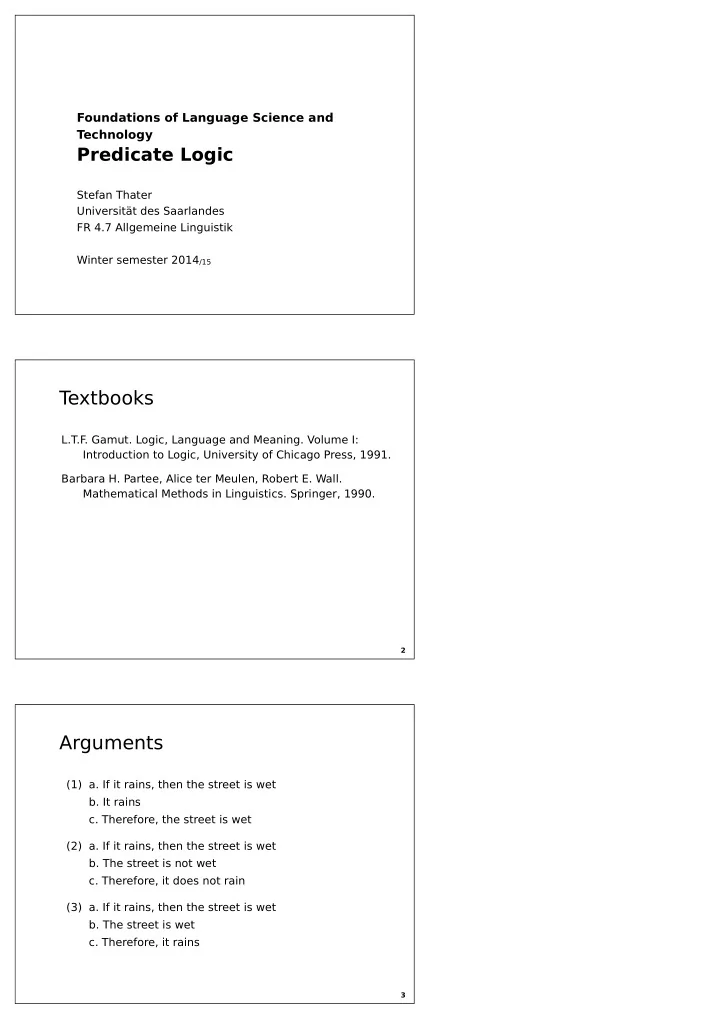
Arguments

(1) a. If it rains, then the street is wet

  • b. It rains
  • c. Therefore, the street is wet

(2) a. If it rains, then the street is wet

  • b. The street is not wet
  • c. Therefore, it does not rain

(3) a. If it rains, then the street is wet

  • b. The street is wet
  • c. Therefore, it rains

3

slide-2
SLIDE 2

(4) a. All man are mortal

  • b. Sokrates is a man
  • c. Therefore, Sokrates is mortal

Arguments

4

∀x(H(x) → M(x)) H(s) ∴ M(s)

■ Non-logical expressions:

Set of individual constants: CON (possibly empty)

Set of n-place relation constants: PREDn, for all n ≥ 0 (possibly empty)

■ Infinite set of individual variables: VAR (infinite set)

Predicate Logic – Vocabulary

5 ■ Terms: TERM = VAR ∪ CON ■ Atomic formulas:

R(t1,…, tn)' for R ∈ PREDn and t1, …, tn ∈ TERM

t1 = t2' for t1, t2 ∈ TERM

■ Well-formed formulas (WFF)

all atomic formulas are WFF

if φ and ψ are WFF, then ¬φ, (φ ∧ ψ), (φ ∨ ψ), (φ → ψ), (φ ↔ ψ) are WFF

if x ∈ VAR, and φ is a WFF, then ∀xφ and ∃xφ are WFF

nothing else is a WFF

Predicate Logic – Syntax

6

slide-3
SLIDE 3

Quantification

∃xA – “there is an x such that A” ∀xA – “for every x it is the case that A”

7

Exercise – Formalization

(1) John and Mary work

↦ work’(j) ∧ work’(m)

(2) A student works

↦ ∃x(student’(x) ∧ work’(x))

(3) A blond student works

↦ ∃x(student’(x) ∧ blond’(x) ∧ work’(x))

(4) A blond student works hard

↦ ∃x(student’(x) ∧ blond’(x) ∧ work-hard’(x))

8

Exercise – Translate into PL

(1) Mary loves a student

↦ ∃x(student’(x) ∧ love’(m, x))

(2) Every student works

↦ ∀x (student’(x) → work’(x))

(3) Nobody flunked

↦ ¬∃x flunk’(x)

(4) Barking dogs don’t bite

↦ ∀x ((dog’(x) ∧ bark’(x)) → ¬bite’(x))

9

slide-4
SLIDE 4

Scope

■ If ∀xφ (∃xφ) is a subformula of a formula ψ, then φ is the

scope of this occurrence of ∀x (∃x) in ψ.

■ We distinguish distinct occurrences of quantifiers as

there are formulae like ∀xA(x) ∧ ∀xB(x).

■ Examples:

∃x (∀y (T(y) ↔ x=y) ∧ F(x))

∀x A(x) ∧ ∀x B(x)

10

Free and Bound Variables

■ An occurrence of a variable x in a formula φ is free in φ

if this occurrence of x does not fall within the scope of a quantifier ∀x or ∃x in φ.

■ If ∀xψ (∃xψ) is a subformula of φ and x is free in ψ, then

this occurrence of x is bound by this occurrence of the quantifier ∀x (∃x).

■ Examples:

∀x(A(x) ∧ B(x)) – x occurs bound in B(x)

∀x A(x) ∧ B(x)'– x occurs free in B(x)

■ A sentence is a formula without free variables. 11 ■ Expressions of Predicate Logic are interpreted relative to

model structures and variable assignments.

■ Model structures are our “mathematical picture” of the

  • world. They provide interpretations for the non-logical

symbols (predicate symbols, individual constants).

■ Variable assignments provide interpretations for

variables.

Predicate Logic – Semantics

12

slide-5
SLIDE 5

■ Model structure: M = ⟨UM, VM⟩

UM is non-empty set – the “universe”

VM is an interpretation function assigning individuals (∈UM) to individual constants and n-ary relations over UM to n- place predicate symbols:

VM(P) ⊆ UMn'' if P is an n-place predicate symbol

VM(c) ∈ UM' ' if c is an individual constant

■ Assignment function for variables g: VAR → UM

Model structures

13

Model structures – Example

14

' M '= ⟨UM, VM⟩ ' UM '= { r1, r2, h1, h2 } 'VM(vincent)'= r1 ' VM(mia)'= r2 ' VM(rabbit)'= { r1, r2 } ' VM(white)'= { r2 } ' VM(hat)'= { h1, h2 } ' VM(in)'= { (r1, h1) }

Interpretation (terms)

Interpretation of terms with respect to a model structure M and a variable assignment g:

' ⎧ VM(α)' if α is an individual constant ⟦α⟧M,g =' ⎨ ' ⎩ g(α)' if α is a variable

15

slide-6
SLIDE 6

Interpretation (atomic formulas)

Interpretation of (atomic) formulas with respect to a model structure M and variable assignment g:

'⟦R(t1, ..., tn)⟧M,g'= 1 iff ⟨⟦t1⟧M,g, …, ⟦tn⟧M,g⟩ ∈ VM(R) ' ⟦t1 = t2⟧M,g' = 1 iff ⟦t1⟧M,g = ⟦t2⟧M,g

16

Is Vincent a rabbit?

⟦rabbit(vincent)⟧M,g = 1

iff ⟦vincent⟧M,g ∈ VM(rabbit)

iff VM(vincent) ∈ VM(rabbit)

17

' M '= (UM, VM) ' UM '= { r1, r2, h1, h2 } 'VM(vincent)'= r1 ' VM(mia)'= r2 ' VM(rabbit)'= { r1, r2 } ' VM(white)'= { r2 } ' VM(hat)'= { h1, h2 } ' VM(in)'= { (r1, h1) }

Interpretation (connectives)

Connectives are truth-functional: the truth-value of a complex expession is determined by the truth-values of their subformulas.

' ⟦¬φ⟧M,g = 1'iff '⟦φ⟧M,g = 0 ' ⟦φ ∧ ψ⟧M,g = 1'iff '⟦φ⟧M,g = 1 and ⟦ψ⟧M,g = 1 ' ⟦φ ∨ ψ⟧M,g = 1'iff '⟦φ⟧M,g = 1 or ⟦ψ⟧M,g = 1 ' ⟦φ → ψ⟧M,g = 1'iff '⟦φ⟧M,g = 0 or ⟦ψ⟧M,g = 1 ' ⟦φ ↔ ψ⟧M,g = 1'iff '⟦φ⟧M,g = ⟦ψ⟧M,g

18

slide-7
SLIDE 7

Truth-functional connectives

■ A connective is truth-functional iff the truth value of

any compound statement obtained by applying that connective is a function of the individual truth values of the constituent statements that form the compound.

■ Truth-functional connectives:

substituting sub-expressions with the same truth-value does not change the truth of the complete expression.

19

Truth-functional connectives

(1) John bumped his head and he [John] is crying (2) John bumped his head and it is raining (3) John is crying (4) It is raining

■ Assume that (3) and (4) have the same truth-value.

Then (1) and (2) must have the same truth-value

and is a truth-functional connective

20

Truth-functional connectives

(1) John is crying because he [John] bumped his head (2) John is crying because it is raining (3) John bumped his head (4) It is raining

■ Assume that (3) and (4) have the same truth-value.

(1) and (2) can have different truth-values

⇒ because is not truth-functional

21

slide-8
SLIDE 8

Is Vincent a white rabbit?

⟦rabbit(vincent) ∧ white(vincent)⟧M,g = 1

iff ⟦rabbit(vincent)⟧M,g = 1 and ⟦white(vincent)⟧M,g = 1

iff VM(vincent) ∈ VM(rabbit) and VM(vincent) ∈ VM(white)

22

' M '= (UM, VM) ' UM '= { r1, r2, h1, h2 } 'VM(vincent)'= r1 ' VM(mia)'= r2 ' VM(rabbit)'= { r1, r2 } ' VM(white)'= { r2 } ' VM(hat)'= { h1, h2 } ' VM(in)'= { (r1, h1) }

Interpretation (quantifiers)

We want:

⟦∀xA(x)⟧M,g = 1 iff for every d ∈ UM, d ∈ ⟦A⟧M,g

⟦∃xA(x)⟧M,g = 1 iff there is a d ∈ UM such that d ∈ ⟦A⟧M,g

23

Interpretation (quantifiers)

■ Interpretation of formulas with respect to a model

structure M and variable assignment g:

⟦∃xφ⟧M,g = 1 iff there is a d ∈ UM such that ⟦φ⟧M,g[x/d] = 1

⟦∀xφ⟧M,g = 1 iff for all d ∈ UM, ⟦φ⟧M,g[x/d] = 1

■ g[x/d] is the variable assignment which is identical to g

except that it assigns the individual d to variable x.

' ⎧ d' ' ' ' ' ' if x = y g[x/d](y) =' ⎨ ' ⎩ g[x/d](y) = g(y)' ' if x ≠ y

24

slide-9
SLIDE 9

' ⎧ d' ' ' ' ' ' if x = y g[x/d](y) ='⎨ ' ⎩ g[x/d](y) = g(y)'' if x ≠ y

Variable assignments

25

x y z u … g a b c d … g[x/a] a b c d … g[y/a] a a c d … g[y/g(z)] a c c d … g[y/a][u/a] a a c a … g[y/a][y/b] a b c d …

Predicate Logic: Semantics

Interpretation of formulas with respect to a model structure M and variable assignment g: ' ⟦R(t1, ..., tn)⟧M,g = 1'iff ⟨⟦t1⟧M,g, …, ⟦tn⟧M,g⟩ ∈ VM(R)

' ⟦t1 = t2⟧M,g = 1'iff ⟦t1⟧M,g = ⟦t2⟧M,g ' ⟦¬φ⟧M,g = 1'iff ⟦φ⟧M,g = 0 ' ⟦φ ∧ ψ⟧M,g = 1'iff ⟦φ⟧M,g = 1 and ⟦ψ⟧M,g = 1 ' ⟦φ ∨ ψ⟧M,g = 1'iff ⟦φ⟧M,g = 1 or ⟦ψ⟧M,g = 1 ' ⟦φ → ψ⟧M,g = 1'iff ⟦φ⟧M,g = 0 or ⟦ψ⟧M,g = 1 ' ⟦φ ↔ ψ⟧M,g = 1'iff ⟦φ⟧M,g = ⟦ψ⟧M,g ' ⟦∃xφ⟧M,g = 1'iff there is a d ∈ UM such that ⟦φ⟧M,g[x/d] = 1 ' ⟦∀xφ⟧M,g = 1'iff for all d ∈ UM, ⟦φ⟧M,g[x/d] = 1

26

Every rabbit is in a hat

⟦∀x(rabbit(x) → ∃y(hat(y) ∧ in(x, y))⟧M, g = 1

iff … [⇒ whiteboard]

27

' M '= (UM, VM) ' UM '= { r1, r2, h1, h2 } 'VM(vincent)'= r1 ' VM(mia)'= r2 ' VM(rabbit)'= { r1, r2 } ' VM(white)'= { r2 } ' VM(hat)'= { h1, h2 } ' VM(in)'= { (r1, h1) }

slide-10
SLIDE 10

Not every rabbit is white

⟦¬∀x(rabbit(x) → white(x))⟧M, g = 1

iff … [⇒ whiteboard]

28

' M '= (UM, VM) ' UM '= { r1, r2, h1, h2 } 'VM(vincent)'= r1 ' VM(mia)'= r2 ' VM(rabbit)'= { r1, r2 } ' VM(white)'= { r2 } ' VM(hat)'= { h1, h2 } ' VM(in)'= { (r1, h1) }

More Examples

■ ⟦∃x(∀x A(x) ∧ B(x))⟧M, g = 1 iff … ■ ⟦∀x A(x) ∧ B(x)⟧M, g = 1 iff … ■ ⟦∃x ∀y L(x, y)⟧M, g = 1 iff … ■ ⟦∀y ∃x L(x, y)⟧M, g = 1 iff … 29

True, Valid, Satisfiable

■ A formula φ is true in a model structure M iff

⟦φ⟧M,g = 1 for every variable assignment g

■ A formula φ is valid (⊨ φ) iff φ is true in all model

structures

■ A formula φ is satisfiable iff there is at least one

model structure M such that φ is true in M

30

slide-11
SLIDE 11

Satisfiable? Valid?

(1) ∀xF(x) → ∃xF(x) (2) ∃x∀yΦ → ∀y∃xΦ (3) ∃x(F(x) ∧ ¬F(x)) (4) ∃xF(x) ∨ ¬F(x)'

31

Entailment

■ A set of formulas Γ is (simultaneously) satisfiable

iff there is a model structure M such that every formula in Γ is true in M (“M satisfies Γ,” or “M is a model of Γ”)

■ Γ is contradictory if Γ is not satisfiable. ■ Γ entails a formula φ (Γ ⊨ φ) iff φ is true in every

model structure that satisfies Γ

32

Example [⇒ Blackboard]

(1) Not every blond student passed (2) Not every student passed

33

slide-12
SLIDE 12

Some logical laws

Quantifier negation

¬∀xφ ⇔ ∃x¬φ

Quantifier distribution

∀x(φ ∧ Ψ) ⇔ ∀xφ ∧ ∀xΨ

∃x(φ ∨ Ψ) ⇔ ∃xφ ∨ ∃xΨ

Quantifier (in-)dependence

∀x∀yφ ⇔ ∀y∀xφ

∃x∃yφ ⇔ ∃y∃xφ

∃x∀yφ ⇒ ∀y∃xφ' ' (but not vice versa)

34

Some logical laws

Quantifier movement

φ → ∀xΨ' ⇔ ∀x(φ → Ψ)

φ → ∃xΨ ' ⇔ ∃x(φ → Ψ)

∀xΨ → φ' ⇔ ∀x(Ψ → φ)

∃xΨ → φ' ⇔ ∃x(Ψ → φ)

… provided that x does not occur free in φ

35