SLIDE 1 18TH INTERNATIONAL CONFERENCE ON COMPOSITE MATERIALS
1 Introduction It is well known that color of wood-plastic composite (WPC) changes to lighter after outdoor
- exposure. Adding pigment is a general remedy to
- btain long-lasting appearance of WPC products. In
textile industry, direct and reactive dyes are synthetic dyes which are suitable for cellulosic
- dyeing. They not only provide colors to textiles but
also protect them from photo-degradation and light
- fastness. Recently, use of natural dye becomes an
interest in textile industry due to environmental
- concern. There is no much literature reported on
dyeing wood flour used in WPC and their influence
- n physical and mechanical properties. The aim of
this work is thus to improve appearance of wood- plastic composite by dyeing delignin wood flour with two types of synthetic dyes and one natural dye from Caesalpinia sappan bark. Influences of dyes on integrity of wood fibers and WPC’s mechanical properties with dyed wood fibers were investigated. 2 Experimental 2.1 Materials Rubber wood (Hevea brasiliensis) sawdust was ball milled and sieved (200-500 mesh size) to be 31-74 micron in particle size. High density polyethylene (HDPE, MFI of 20 g/10 min) was kindly supplied by PTT Chemical Public Co Ltd., Thailand. Maleated polyethelene (MAPE, maleic anhydride content of 0.9 wt%) was purchased from DuPont, USA. Solophenyl Bodeaux 3 BLE (C.I. Direct Red 83.1) and Novacron Red C-2G (C.I. Reactive Red 281) were supplied by Huntsman (Guangdong) Ltd. Caesalpinia sappan bark was received from a local
- mill. Other chemicals used were; Sodium chlorite,
Acetic acid, Sodium sulphate, Sodium carbonate anhydrous, and Aluminium sulphate. All materials were used as received. 2.2 Removing lignin and dyeing Method to remove lignin by Sodium chlorite (NaClO2) was performed following P.A. Ahlgren et
- al. [1]. Sodium chlorite (NaClO2) of 0.3 g and
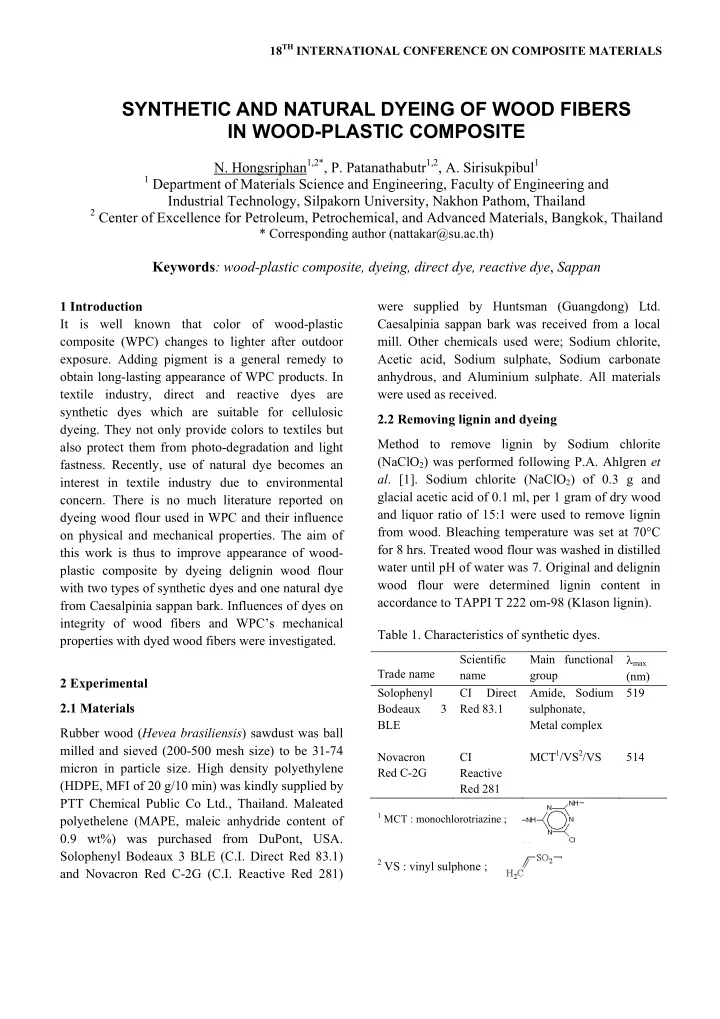
glacial acetic acid of 0.1 ml, per 1 gram of dry wood and liquor ratio of 15:1 were used to remove lignin from wood. Bleaching temperature was set at 70°C for 8 hrs. Treated wood flour was washed in distilled water until pH of water was 7. Original and delignin wood flour were determined lignin content in accordance to TAPPI T 222 om-98 (Klason lignin). Table 1. Characteristics of synthetic dyes.
Trade name Scientific name Main functional group λmax (nm) Solophenyl Bodeaux 3 BLE CI Direct Red 83.1 Amide, Sodium sulphonate, Metal complex 519 Novacron Red C-2G CI Reactive Red 281 MCT1/VS2/VS 514
1 MCT : monochlorotriazine ; 2 VS : vinyl sulphone ;
SYNTHETIC AND NATURAL DYEING OF WOOD FIBERS IN WOOD-PLASTIC COMPOSITE
- N. Hongsriphan1,2*, P. Patanathabutr1,2, A. Sirisukpibul1
1 Department of Materials Science and Engineering, Faculty of Engineering and
Industrial Technology, Silpakorn University, Nakhon Pathom, Thailand
2 Center of Excellence for Petroleum, Petrochemical, and Advanced Materials, Bangkok, Thailand
* Corresponding author (nattakar@su.ac.th)
Keywords: wood-plastic composite, dyeing, direct dye, reactive dye, Sappan
SLIDE 2 Table 1 presents characteristics of two types of synthetic dyes used in this study. Delignin wood flour was dyed with CI Direct Red 81.3 of 1% on weight of fiber (%o.w.f.) at liquor ratio 10:1 using Sodium sulphate as salt electrolyte. Delignin wood flour was dyed with CI Reactive Red 281 of 1%o.w.f. at liquor ratio 4:1 using Sodium carbonate and Sodium chloride to increase dye affinity. Caesalpinia sappan bark was grinded into small pieces and boiled in water (1:10 weight ratio, 80°C, 4 hrs) to receive dye solution (red). Delignin wood flour was dyed with dye solution using Aluminium sulphate 1.5%o.w.f. to improve dye affinity. In all dyeing process, delignin wood flour was dyed with upper 60% absorption ratio of the origin natural dye solution, which concentrations of dye solution before and after dyeing process were determined using a UV/VIS Spectrophotometer (PG Instruments Ltd.). Table 2. Sample codes and their compositions.
Sample Code Compositions Compositions ratio HDPE HDPE 100 MA-HDPE HDPE : MAPE 100 : 15 W-WPC HDPE : Original wood : MAPE 40 : 60 : 6 D-WPC HDPE : Delignin wood : MAPE 40 : 60 : 6 DR-WPC HDPE : Direct dyed wood : MAPE 40 : 60 : 6 RT-WPC HDPE : Reactive dyed wood : MAPE 40 : 60 : 6 SP-WPC HDPE : Sappan dyed wood : MAPE 40 : 60 : 6
2.3 Preparation of wood-plastic composite (WPC) Before compounding, wood flour were dried in an air-circulating oven at 80°C for 24 hours. Composites were prepared by compounding HDPE 40 wt% and wood 60 wt% with MAPE (6 wt% of fibers) as coupling agent in a twin screw extruder with a temperature profile of 150, 160, and 180C from feeding to die. Original wood, delignin, direct- dyed, reactive dyed, and Sappan-dyed WPC are denoted as WPC, D-WPC, DR-WPC, RT-WPC, and SP-WPC, respectively. Sample compositions are presented in Table 2. Extrudate were pelletized into pellets and injection molded into tensile and flexural specimens using an injection molding machine with nozzle temperature of 180°C and mold temperature
2.4 Characterization and testing Fiber integrity in all composites was characterized by Fourier transform infrared spectrophotometer (FTIR) and Thermogravimetric analyzer (TGA). FTIR spectra of sample were recorded on a Vertex 70, BRUKER in range 4,000-400 cm-1 using KBr
- disc. Spectra were obtained using 32 scan and a
resolution 4 cm-1. TGA measurements were analyzed using TGA/DSC1 STAR System, Mettler
- Toledo. Temperature program for tests were run
from 40°C to 700°C at heating rate 10°C/min in nitrogen atmosphere (20 ml/min). Tensile test was performed according to ASTM D- 638-03 using LR 50 K universal testing machine (Lloyd Instrument) equipped with 50 kN load cell and a crosshead speed of 5 mm/min. Ten measurements of each sample code were conducted to calculate the average and its standard deviation. Flexural test was performed according to ASTM D- 790-03 using LR 50 K universal testing machine (Lloyd Instrument) equipped with 50 kN load cell. Specimens were deflected in three-point loading mode until failure or until 5 percent strain was reached in the outer surface of test specimen with a crosshead speed of 1.8 mm/min. Morphology of composites was studied from their fracture surface by means of scanning electron microscopy (JSM 5410 LV). Samples were prepared by immersing specimen in liquid nitrogen and then breaking them. The fractured surfaces were sputter- coated with gold for observation.
SLIDE 3 3 3 A a re F p w F (L fo w in w (u re tr m 3 Results and 3.1 Content o After Chlorite about 70 wt% eduction of FTIR showin peaks of lign which is arom Fig.
Lignin inde following equ L where I is a p ntensities at with the pe unconjugated eference pe reatment wit modified woo d discussion
e treatment, % of original lignin in wo ng disappear nin at wave n matic skeleto
modified w ates normali ex), which uation: index ignin peak intensity 1,507 cm-1 eak at 1,73 d C=O) [3]. eak because th acid or dy
n Klason ligni lignin conte
rance of the number of 1,
ctra of origin wood fibers. ized FTIR p was calcula 10
1738 1507 ×
= I I x y of FTIR sp
38 cm-1 of This peak w it slightly
e in the same in was remov
as confirmed e characteris ,600-1,500 c [2]. nal and peaks of lig ated using 00 (
were normaliz f hemicellu was chosen a changed af en that lignin e range. ved the by stic cm-1 gnin the (1) eak zed uose as a fter n in F De com dy wh Fig Fig.2. Lignin Fig 3. Color elignin wood mpared to yeing, synthe hile Sappan g.3.
Direct-dyed Or
n index of wo r of wood and d flour had
etic dyed wo dyed one w
d Reacti riginal wood
d modified w significantly ubber wood
was dark re
ive dyed Delignin-w
dified wood. wood fibers. y lighter colo
was bright re ed as seen i
Sappan dyed wood
3
er ed in
SLIDE 4 3 F w h T w li R te re g d a th W D s b th c Fig and m 3.2 Integrity From TGA a with original higher tempe This result in weakened ce ignin sufficie RT-WPC h emperature. eactive dye good dye fi dyeing condi acid chlorite he highest o WPC had hig D-WPC. In welling and bonding to f
celluloses fro
modified woo y of wood fib as shown in F l wood flou erature than ndicates that elluloses eve ently [4]. Co had the lo The reason w had to be d ixation on ition weaken treatment.
gher onset de direct dyein then direct fibers or ev action co
rmograms of
bers from TG Fig.4, it is fo ur started to delignin an the acid ch en though it
was dyeing w done in alkal fiber surfac ned cellulose In contrast, dation tempe egradation te ng process, c dyes could ven be embe
f wood mposites. GA found that W decompose nd dyed WP lorite treatm t could remo
et degradat wood flour w li condition
es further af DR-WPC h erature and S emperature th celluloses w form hydrog edded betwe then damag
WPC e at PC. ment
PC, tion with for kali fter had SP- han were gen een ged pan dy in alu dy pig the nak dy 3.3 It WP cel dy dy no syn ten Sa pro fro con dy sho
the syn did Wh by res fro yeing process water cou uminium hyd ye to adhere t gment insolu ermal stabili ked delignin ye fixation wi 3 Mechanica is found th PC were low lluloses from yeing, tensile yed composit n-dyed com nthetic dyed nsile strength appan dyed
ndition had yed wood co
tained with ere were vo nthetic dyed d not wet fib hite traces o y XRF were sulted from
s, Aluminium uld form g droxide (Al( to the cellulo
ity of these n fibers, and ith mordant a al properties hat mechanic wer than orig m severe acid (Fig.5) and tes were ba
d composites h, especially d composite mong them f as discusse influence on
the presence
d composites bers as well
e Sodium ch incomplete ers. m sulphate ( gelatinous p (OH)3) that
thin layers c dyed fibers also strength as well. s and morph cal propertie ginal WPC d d chlorite tre flexural (Fig ack to closed However, d s were weak reactive dye es presente from fiber ed in TGA. n mechanical EM microgr
e of MAPE. wood fibers implying co as non-dye d fiber surfa
washing to (dye mordan precipitate o helps Sappe y rendering th could improv compared t hens fibers b hology es of delign due to weake
g.6) moduli o d to those o delignin an ker in term o ed composite ed the be strengthenin Thus, dyein l properties o raphs in Fig d fibers wa Nevertheles s observed
d composite aces identifie ese salts wer remove them nt)
en he ve to by in en er
nd
es. est ng ng
.7 as ss, in nts es. ed re m
SLIDE 5
5
Fig.5. Tensile properties of HDPE and WPC. Fig.6. Flexural properties of HDPE and WPC. Fig.7. SEM micrographs of WPE specimens; a) WPC ; b) D-WPC, c) DR-WPC ; d) RT-WPC. 4 Conclusions Lignin was removed from rubber wood flour 70 wt% after the acid chlorite treatment. After chlorite treatment, Young’s modulus and flexural modulus of delignin wood composites were lower due to celluloses was damaged during the acid treatment. Dyeing wood flour with different types of dyes affected not only appearance of wood composites but also their mechanical properties. Natural dye WPC presented the best mechanical properties among the dyed WPC due to dyeing process which is less hostile to wood fibers. References
[1] P.A. Ahlgren and D.A.I. Goring “Removal of wood components during chlorite delignification of black spruce”. Canadian Journal of Chemistry, Vol. 49, pp 1272-1275, 1971. [2] F. Xua, J. Sun, R. Sun, P. Fowler, and M. Baird “Comparative study of organosolv lignins from wheat straw”. Industrial Crops and Products, Vol. 23, No. 2, pp 180–193, 2006. [3] H. Yang, R. Yan, H. Chen, D. Lee, and C. Zheng “Characteristics of hemicellulose, cellulose and lignin pyrolysis”. Fuel, Vol.86, No. 12-13, pp 1781- 1788, 2007. [4] M. Hirota, N. Tamura, T. Saito, and A. Isogai “Oxidation of regenerated cellulose with NaCLO catalyzed by TEMPO and NaClO under acid-neutral conditions”. Carbohydrate Polymers, Vol. 78, No. 2, pp 330-335, 2009. (b) (a) (c) (d)