SLIDE 1 Syntax
John Goldsmith October 12, 2011 1 Syntax
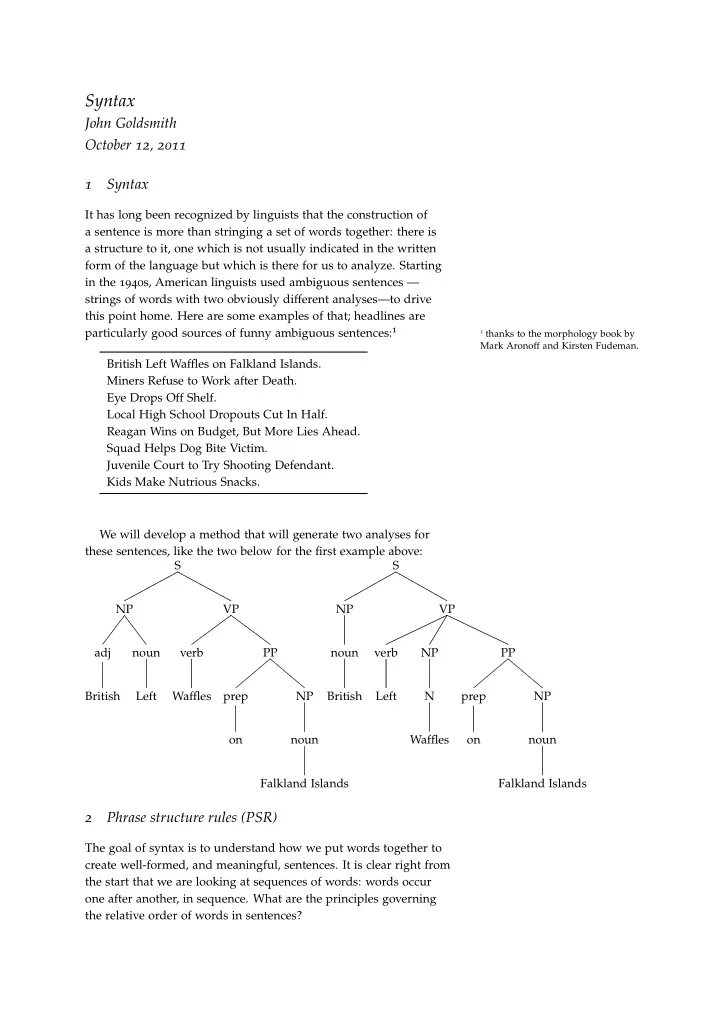
It has long been recognized by linguists that the construction of a sentence is more than stringing a set of words together: there is a structure to it, one which is not usually indicated in the written form of the language but which is there for us to analyze. Starting in the 1940s, American linguists used ambiguous sentences — strings of words with two obviously different analyses—to drive this point home. Here are some examples of that; headlines are particularly good sources of funny ambiguous sentences:1
1 thanks to the morphology book by
Mark Aronoff and Kirsten Fudeman.
British Left Waffles on Falkland Islands. Miners Refuse to Work after Death. Eye Drops Off Shelf. Local High School Dropouts Cut In Half. Reagan Wins on Budget, But More Lies Ahead. Squad Helps Dog Bite Victim. Juvenile Court to Try Shooting Defendant. Kids Make Nutrious Snacks. We will develop a method that will generate two analyses for these sentences, like the two below for the first example above: S VP PP NP noun Falkland Islands prep
verb Waffles NP noun Left adj British S VP PP NP noun Falkland Islands prep
NP N Waffles verb Left NP noun British
2 Phrase structure rules (PSR)
The goal of syntax is to understand how we put words together to create well-formed, and meaningful, sentences. It is clear right from the start that we are looking at sequences of words: words occur
- ne after another, in sequence. What are the principles governing
the relative order of words in sentences?
SLIDE 2 s y n t a x
2 Until the middle of the 20th century, thinking about this problem divided into two methods: in the first, individual words would be identified in the sentence by the role they played in a sentence. For example, in the sentence Lee sent a birthday present to Kim, Lee is the subject, present is the direct object, and sent is the verb. In the second approach, the sentence would be broken up into smaller and smaller pieces. In the mid 1950s, this second analytic approach was stood on its head, and linguists began to write synthetic rules that generated pieces of sentences. These pieces could be as simple as a word, or it could be very complex. These rules were formulated—first by Noam Chomsky— in a way that was inspired by mathematical
(1) S → NP VP is a rule that says that an S[entence] can be expanded as an NP (a Noun Phrase) followed by a Verb Phrase. And we will have to immediately write some other rules to provide an answer to what those things are. We will expand VP in this way: (2) VP → verb NP and we will expand NP in this way: (3) NP → det adj noun We will distinguish between lexical categories, such as noun, adj[ective], and det, and phrasal categories, such as S, NP, or VP. Lexical categories are the most specific things that our syntax will delve into, at least at the beginning; and our phrase structure rules begin with an initial symbol (for now, S), which is expanded by means of phrase-structure rules, until the bottom categories of the tree that is created consists entirely of lexical categories; these lexical categories then are filled out with lexical items of the appro- priate category (nouns, adjectives, and so on). We will use lower case letters to specify lexical categories: this is not standard notation, but it is convenient. We could write successive expansions in this way: expansion the operative rule S NP VP S → NP VP det adj noun VP NP → det adj noun det adj noun verb NP VP → verb NP det adj noun verb det adj noun NP → det adj noun but it is much more common to draw this as a tree: (4)
SLIDE 3 s y n t a x
3 S VP NP noun adj det verb NP noun adj det And this tree represents many millions of sentences, two of which are drawn here: S VP NP noun package adj wonderful det a verb brought NP noun delivery adj last det the S VP NP noun ingredient adj strange det a verb includes NP noun recipe adj favorite det my Big Idea: the motivation for positing the rule NP → det adj noun is that this sequence appears several times in the description of the English sentence, and we can make the overall description more compact if we posit this entity, the ‘NP’. The more times we are able to simplify our overall description by re-using a phrasal (non-lexical) category like NP, the better we believe our analysis is motivated. So, for example, there is another VP-expansion that is motivated by examples like send a big present to the new teacher. Instead of accounting for this with a new VP- expansion rules (5) VP → NP prep det adj noun, we write instead: (6) VP → NP PP (7) PP → prep NP,
SLIDE 4 s y n t a x
4 where prep is a lexical category of prepositions that includes such words as to, f or and with, and ‘PP’ marks a prepositional phrase. Thus the tree structure is not: (8) S VP noun adj det prep NP noun adj det verb NP noun adj det but rather: (9) S VP PP NP noun adj det prep NP noun adj det verb NP noun adj det
3 Alternative expansions of phrasal categories
We have just noted that there are two possible expansions for VP: (i) verb + NP and (ii) verb + NP + PP. In general, phrasal categories do have a lot of different, but related, ways of being expanded, and this fact is a central part of the motivation for talking about phrasal categories in the first place. Let us explore this. Now, there is an implicit independence assumption made when we posit a category such as NP or VP: no matter where that node is generated by phrase-structure rules, any of its expansions may appear in that position. There is a lot that is right about that as- sumption; but it is by no means the whole story, and to be perfectly blunt about it, it is far from true: it is, indeed, false. False but help-
2 Perhaps the first reference to this is
in Pittman 1948: if we do not view a sentence as being hierarchically broken into parts, “one is almost compelled to regard every morpheme in an utterance as pertinent to the descrip- tion of every other morpheme. But a good analysis in terms of immedi- ate constituents usually reduces the total possible environmental factors
- f a given morpheme or sequence of
morphemes to one: in other words, it states that the only pertinent environ- ment of a given immediate constituent is its concomitant (the other immediate constituent).” (p. 287)
For example, let us consider several possible expansions for NP in English: (10)
SLIDE 5 s y n t a x
5 (i) NP → noun Bananas are a good source of potassium. (ii) NP → det noun My doctor told me to exercise more. (iii) NP → adj noun Easy melodies make for good songs. (iv) NP → det adj noun The old ways are the best ways. (v) NP → det noun PP The road to Hell is paved with good intentions. By positing these five different, but related, rules that expand NP, we are saying that any NP, any place in a sentence, can have any
- f those five structures. To repeat: that is not entirely true, but it
is a good first step to take in approximating the way words are ‘distributed’ in English and in other languages. It is often the case that we can simplify our analysis of a phrasal category by saying that a part of its expansion is optional. Instead
- f saying that we have both rules (i) and (ii) above, we say that det
is optional, and the notation for that is a set of parentheses around the optional category: (11) NP → (det) noun. Looking at all of the expansions given in (12xx), we would nat- urally be led to the conclusion that a better form of the NP rule would be this: (12) NP → (det) (adj) noun (PP) (Discuss the consequences: more expansions predicted now.)
4 Ambiguous sentences
In analyzing ambiguous sentences, most of the time we assign two different syntactic structures, one with each of the intended interpretations, as we did with sentences (1a) and (1b), and in most
- f these cases, there are two or more words which are assigned
different lexical categories in the two cases. In the sentence we considered, “Left” was a noun in the intended sense—perhaps a noun derived from a verb, but in any event, it referred to a political party, or a coalition of parties. In the unintended sense, “Left” was the main verb of the sentence, the past tense of the verb leave. Our analysis, then, predicts that if we change the word “Left” into some other word, some word that is not both a verb and a noun, the sentence should become unambiguous and not funny at all. That is true: there is no humor in British Right Waffles on Falkland Islands, or in British Leave Waffles on Falkland Islands. The humor of the ambiguity arises out of the totally unexpected collision between two different syntactic structures, themselves the result of simple phrase-structure rules motivated by an enormous number of simple rules. By the way: not all ambiguities are like that; one of the most
- ver-used ambiguous sentences, I saw the man with the telescope,
is ambiguous in a strictly structural way. Is it the man with the telescope that I claim to have seen, or am I just talking about some
SLIDE 6 s y n t a x
6 man and the fact that I looked at him through the telescope? These two senses correspond to two different syntactic structures:
We do not always know when an ambiguous sentence is syntactically
- ambiguous. Is they are married ambigu-
- us? If not, where does the humor
come from in They’re married, but not to each other.? How about Kids make nutri- cious snacks? That is ambiguous, but it may not be syntactically ambiguous. And what about My father always beat
- me. . . at chess, at least.?
(13)(a) S VP NP PP NP noun telescope det the prep with det N man the verb saw NP pronoun I (b) S VP PP NP noun telescope det the prep with NP det N man the verb saw NP pronoun I Let’s consider another ambiguous sentence:
SLIDE 7 s y n t a x
7 S VP NP noun noun victim noun noun bite noun dog verb helps NP noun squad S VP S VP NP noun victim verb bite NP noun dog verb helps NP noun squad The second structure arises unambiguously if we put in some words that allow no other analysis — for example, if the sentence had been squad helps dog find master.
5 Constituents
Any string of words that is generated by a single phrasal node in a given sentence is called a constituent. To analyze a sentence is to assign a tree structure to it, and by doing so, to analyze a set of constituents in the sentence. A good part of syntactic analysis is finding the right constituency structure for a sentence (we some- times say, the right tree structure). The most direct way to apply tests for constituency is to use the independence assumption that I mentioned earlier: if a string
- f words is a constituent – an NP, let’s say – then it ought to be
possible to use that string of words in other sentences that seems
SLIDE 8 s y n t a x
8 structurally rather different. If a string of words if a direct object NP (the price of tea in Japan in the sentence we compute the price of rice in China), then it ought to be possible to put the same string
- f words in places where we are already pretty sure that NPs can
appear, such as in subject position of a simple sentence, or as the
(14) The price of tea in Japan drives economic conditions there. (15) I don’t know much about the price of tea in Japan.
- r other constuctions, such as the pseudo-cleft:
(16) What they study is the price of tea in Japan.
(17) It was the price of tea in Japan that was the most important factor, not the temperature in Seattle. What does this test suggest about the constituency of The con- gregation sent the family flowers? Is the family flowers a constituent? The fact that the following strings of words are not good sentences suggests strongly that it is not a constituent.
We will look shortly at the difference between John turned over the book and John jumped over the puddle. Can you tell if over the book or over the puddle is a constituent?
(18)(a) *What they sent was the family flowers. (b) *It was the family flowers that they sent.
6 More examples
A simple example illustrating constituent structure ambiguity: Fireproof clothing factory burns to ground. S VP burns to ground NP N N factory N clothing AP A (i) fireproof S VP burns to ground NP N N factory N? N clothing Adj (ii) fireproof This headline is funny because there are two interpretations of fireproof clothing factory, and the more natural one (more natural if we only consider that phrase) is contradicted by the larger context, the sentence. The more natural interpretation is that it concerns a
SLIDE 9 s y n t a x
9 clothing factory that is fireproof: fireproof then modifies (adds addi- tional information to) clothing factory; clothing factory is a constituent in which clothing modifies factory, and together, clothing factory refers to the same kind of thing that the word factory does. In short, when we analyze a noun phrase (roughly, a referring expression), one of the words within it expresses the type of thing that is referred to (here, factory). Typically, if any or all of the mod- ifying material is be removed, the larger sense is vaguer but still roughly the same: factory burns to ground. Factory is said to be the head of the phrase Fireproof clothing factory: it is the element whose removal would most change the meaning of the phrase. The non- head element of a constituent is often called the modifier, or satellite. We know which structure is which in fireproof clothing factory be- cause a non-head (or satellite) of a constituent C is not semantically modified by an element outside of that constituent. Structure (i) can be used to indicate a fireproof factory because factory is the head; that structure cannot be used to express a situation in which fireproof semantically modifies clothing. English is relatively unusual in how poorly it marks nouns and verbs as distinct from a morphological point of view, and this can lead to multiple syntactic analyses. Time flies is famously ambigu-
S VP NP kids V idle NP N teacher strikes S VP NP N kids AP A idle V strikes NP N teacher Verbs may take several arguments, and usually we can identify the different roles played by the arguments: consider I saw the man with the telescope.
SLIDE 10 s y n t a x
10 S VP NP the man with the telescope V saw NP (i) I S VP PP NP the telescope with NP the man V saw NP (ii) I A verb such as see has two arguments: roughly, the sighted per- son and the beheld object. In (i), the object is expressed with a 5- word expression, while in (ii) it is expressed with a 2-word expres-
- sion. In (ii), however, an instrument, the telescope, appears, which
modifies the seeing (rather than the object that is seen). It is freer to appear in different syntactic positions: With his telescope, Galileo saw the craters on the moon. The interest of the headline: GRANDMOTHER OF EIGHT
MAKES HOLE IN ONE relies on a structural difference: is
[hole in one] a single item, or does it form two “sister constituents” in the verb phrase, as in she put it in the bag (or “...puts beans in nose”) ? S VP NP N hole in one V makes NP grandmother of eight S VP PP NP N nose prep in NP N beans V puts NP grandmother of eight
SLIDE 11 s y n t a x
11 S VP NP N convicts Adj escaping V be Aux may NP N hitchhikers S VP NP N convicts V escaping Aux be may NP N hitchhikers Another nice way to sensitize oneself to syntactic structure is to look at garden-path sentences, like
- Fat people eat accumulates.
- The cotton clothing is usually made of grows in Mississippi.
- The girl told the story cried.
- The horse raced past the barn fell.
- I know the words to that song about the queen don’t rhyme.
S VP V accumulates NP S VP V eat NP N people NP N fat
SLIDE 12 s y n t a x
12
7 Auxiliary verbs
One of the most impressive and influential of the early generative analyses of English was Chomsky’s analysis of the English auxil-
- iary. Let’s consider a range of possible auxiliary verb combinations.
There is one thing that separates this data from the kind of data we have considered up to now. In the earlier examples, the choice
- f words that we made was essentially irrelevant; we included
words by selecting nouns where the phrase structure rules gener- ated “noun”, and likewise for the other categories. But here – each word or morpheme acts differently and uniquely. Why would we expectd phrase-structure rules to work here? Either we will have actual words in our phrase-structure rules, or we will have to create categories that contain only a single item. The two pretty much boil down to the same thing.
SLIDE 13 s y n t a x
13 You walk. John walk -s. John walk-ed. John may walk. John may have walk-ed. John has walk-ed. John is walk-ing. John may be walk-ing. John may have be-en walk-ing. Sentences with -ed: John may have walk-ed. John has walk-ed. John walk-ed. Sentences with -ing: John is walk-ing. John may be walk-ing. John may have be-en walk-ing. Sentences with 3rd p. sg -s: John walk -s. John is walk-ing. John has walk-ed. Sentences with -do: You do walk. John does walk. *John does walk-s. *John does may have walk-ed. *John does has/have walk-ed. *John does is/be walk-ing. *John does may be walk-ing. *John does may walk. *John do may have be-en walk-ing. Do you walk? Does John walk? May John walk? May John have walk-ed? Has John walk-ed? Is John walk-ing? May John be walk-ing? May John have be-en walk-ing? *You not walk. You do not walk. *John not walk -s. John does not walk. John may not walk. John may not have walk-ed. John has not walk-ed. John is not walk-ing. John may not be walk-ing. John may not have be-en walk-ing. You were amaze-d.
SLIDE 14 s y n t a x
14 John was amaze-d. John may be amaze-d. John may have be-en amaze-d. John has be-en amaze-d. John is be-ing amaze-d. John may be be-ing amaze-d. John may have be-en be-ing amaze-d. You were not amaze-d. John was not amaze-d. John may not be amaze-d. John may not have be-en amaze-d. John has not be-en amaze-d. John is not be-ing amaze-d. John may not be be-ing amaze-d. John may not have be-en be-ing amaze-d. Table 1: English auxiliary Let’s try to extract some basic generalizations concerning this data:
- No sentence with two words from the group called modal verbs:
may, can, will, would, may, should, shall is grammatical; but one word from this group can co-occur with the other auxiliary verbs, such as have, be.
- When auxiliaries appear, their left to right order is summarized
by a table: Modal verb have (perfective) be (progressive) be (passive) verb
- The auxiliary verb do does not appear when there is any other
auxiliary present: any of the auxiliaries we are exploring. It only appears when there are no others.
- However, the auxiliary do can appear along with the possessive
have and the real (not dummy) verb do: We do not have enough money to do that. Anyway, we do not do things like that.
- If the negative not is present, it appears after the left-most (i.e.,
the first) of all of these auxiliaries. And if we count the auxiliary do as belonging to this group (and we do!), then when there is a not, there must be an auxiliary. Chomsky’s account in Syntactic Structures (1957) was essentially the following: It’s a lot cleaner to the eye if we add some constituency: What is the right way to think about this? Is it position of a morpheme in a string, or is it something else?
SLIDE 15 s y n t a x
15 S → NP Aux VP Aux → Tense(Modal)(have − en)(be − ing) Tense
Modal V have be : 1 − 2 → 2 − 1
Figure 1: English auxiliary (after Chomsky 1957)
S NP John Aux Pres modal may have
be
VP V drink NP noun beer
Figure 2: Tree generated by rules in Figure 1
S NP John Aux Pres modal may perf have
prog be
VP verb drink NP noun beer
Figure 3: What is responsible for affix choice?
SLIDE 16 s y n t a x
16 S NP John Aux Pres modal may perf have prog be+en VP verb drinki+ng NP noun beer
Figure 4: After affix-hopping
S IP VP verb walk Tense
NP John S IP VP verb walk-s Tense NP John
Figure 5: When all that hops is Tense
SLIDE 17 s y n t a x
17 S IP VP VP V walk-ing verb stop Tense
NP John S NP John IP Pres Modal may S have S VP verb be+en S VP verb dream-ing
8 Constituents -2
Peacock was born to hustle, bustle, jostle, and command, but he had as well a clear-eyed sense of who in the English mathematical establishment could be counted on, who counted in, and who counted out. David Berlinsky, One, Two Three. p. 93.
8.1 NP Verb PP; NP Verb NP PP
The syntactic patterns NP Verb PP and NP Verb NP PP are very common patterns in English and other languages. Let’s take a look at several patterns of this general sort:
SLIDE 18 s y n t a x
18
8.2 He climbed over the wall
(19) S VP PP NP the wall prep
verb climbed NP He (a) What did he climb over? (b) Over what did he climb? (maybe) (c) Over the wall climbed the monkeys. (d) Over the wall the monkeys
(e) The wall was climbed over. (maybe) (f) This wall has never been climbed over. (g) He climbed over it. (h) He climbed over the wall and the hedges. The (b) example—if it is grammatical—is evidence that over and its following object VP forms a constituent; in the metaphor of syntactic movement, a preposition would only move with its object. (c) (which is, I think, unquestionably grammatical) makes the same point, but in the context of a different construction. (e) is a passive, in which the object of over has been passivized; this suggests a tight syntactic relationship between over and the preceding verb climb, and if (e) is not great, (f) is, and it makes the same point regarding
3 The point is often made in relation to
the contrast between This bed has been slept in and This bed has been slept under, where the first is much better than the second.
8.3 She put her name on the door
(20) S VP PP NP the door prep
NP her name verb put NP She (a) What did she put on the door? (b) Where did she put her name? (c) What did she put her name
(d) On the door, she put her name. (e) On the door, she put her name; on her desk, she put her new title. Movement:
SLIDE 19 s y n t a x
19 S S VP NP her name verb put NP she PP NP the door prep
Expansion: S VP PP there NP her name verb put NP She S VP PP NP the door prep
NP it verb put NP She Conjunction: S VP PP PP NP the windows prep
and PP NP the door prep
NP her name verb put NP She
8.4 They turned out the light: A
Now, let’s consider the sentence They turned out the light, which is also of the form NP V P NP. Does this have the same structure? – that is, is it:
S VP PP NP the light prep
verb turned NP They Figure 6: Wrong analysis!
The first sign that this is not the same structure is that this struc- ture is unavailable when we have it rather than the light (remember, this was fine with she put her name on it): (21) • *They turned out it.
SLIDE 20 s y n t a x
20
8.5 to turn on X
(22) The lion turned on his trainer, and it was several minutes before he could be removed from the cage. (23) (Not: ...turned his trainer on...) (24) The detective turn on her radio, and it was several minutes before she could tear herself away from what she was hearing. (25) (just as fine...The detective turned her radio on... ) Questions: Do we wish to assign different structures to these sentences, and if so, how? What do you notice about the stress or prominence of the word on in the two sentences?
8.6 They turned over the blanket.
Is this right? (26) S VP PP NP the blanket prep
verb turned NP They We can still say: (27) What did they turn over? but not: (28) *Over what did they turn?
(29) *It was over the blanket that they turned. So there is no evidence of pied-piping, of the preposition ‘moving’ along with the following NP. So Over the blanket does not behave like a constituent. And we can say: (30) They turned the blanket over.
SLIDE 21 s y n t a x
21 What is the right structure for that sentence? S VP PP prep
NP the blanket verb turned NP They S VP PP NP ? prep
NP the blanket verb turned NP They What do we find if the object is a pronoun?
4
4 These facts might remind us of the
similar ungrammaticality of *They gave Mary it, alongside of the fine They gave Mary some.
(31) • They turned it/him over.
8.7 They rolled it over/they rolled over it.
(32)(a) They jumped over the box. S VP PP NP the box prep
verb jumped NP They (b) They jumped over the box, not the blanket. S VP PP NP NP the blanket not NP the box, prep
verb jumped NP They
SLIDE 22 s y n t a x
22 (c) They jumped over the box, not over the blanket. S VP PP PP NP the blanket prep
not PP NP the box, prep
verb jumped NP They (d) They turned over the box. (e) They turned over the box, not the blanket. (f) **They turned over the box, not over the blanket.
8.8 They threw the garbage out the window.
S VP PP NP the window prep
NP the garbage verb threw NP They S VP PP NP the garbage prep
verb threw NP They
SLIDE 23 s y n t a x
23 S VP PP NP the prognosis prep about PP NP the doctor prep with V talked NP They S VP PP NP his father prep like V looks NP He (33)(a) They jumped over the box. (b) They turned over the box. (c) They jumped over the box, not over the the shoes. (d) **They turned over the box, not over the shoes. (e) They turned over the box, not the shoes. Verbs: look Somewhere I have notes on look.
SLIDE 24 s y n t a x
24 put the book
put it under the tree put it
put the coat
put the coat
put it
put
the coat. put *on the monkey the coat. put the decision
put it
put
the decision. put
*it. take the coat
take the coat
take it
take it
take
the coat. take *off the monkey the coat. drink the water. drink the water (all) up drink up the water drink *all up the water drink it up. *drink up it. drink the water
?* drink the water up
take
9 Productivity
It is particularly striking that we can generate all day long sentences that we have never heard before, and yet which are fine sentences. We need to formulate principles that can account for that ability. The two most striking characteristics of syntax is the meaningful- ness of the objects it accounts for (i.e., sentences), and the wide range of possible sentences each language generates.
10 Word categories
The classical Greeks gave us eight categories:
- 1. Noun (ónoma): inflected for case, and denoting.
- 2. Verb (rh¯
ema): no case inflection, but inflected for tense, person and number, indicating an activity or process
- 3. Participle: shares properties of verb and noun
- 4. Interjection
SLIDE 25 s y n t a x
25
- 5. Pronoun: a substitute for a noun, and marked for person
- 6. Preposition: placed before other words
- 7. Adverb: not inflected, modifying a verb
- 8. Conjunction: a word that binds together parts of the discourse
and filling gaps in interpretation. Syntax as we know it is possible because a large number of gen- eralizations about each language can be stated with respect to cat- egories, rather than individual words or morphemes. No one has seriously proposed that we learn actual series of words: but do we learn what words can do in our language, or do we learn what cat- egories of words can do? I suspect that most syntacticians would say that it is only the syntactic “behavior” (i.e., distribution) of categories of words that is of interest.
This is probably too strong a position,
- however. A complex example of this:
there are two gerundive patterns in English, both of which have verbs ending in -ing as the head element in an NP. The verbal pattern is found in John’s having frequently given the children gum was more of a problem than we ex- pected it would be; the nominal pattern is in John’s passing of the documents to the Russian attaché was a serious breach of
- ethics. In general, the nominal gerunds
permit nominal determiners (the, no, ...) while the verbal do not: *the having given help to convicted criminals was un- conscionable; but it is possible with this: this (*that) calling people on the phone at all hours has got to stop.
Most work in syntax is about generalizations that we can make about a given language with regard to entire categories, not indi- vidual words. And language is organized so that the same gram- matical position can (most of the time) be occupied either by a single, simple word, or by an indefinitely large expansion.
10.1 Sentences
“The best way to tell whether our sentences are complete or not is to ‘feel them out.’ Incomplete sentences do not make sense....It is really not difficult to tell a fragment from a complete sentence. We seem to ‘feel’ instinctively when a thought is stated completely....” Walcott et al, Growth in Thought and Expression, 1940.
There can hardly be something called syntax if we do not recognize the existence of sentences in language: but it is difficult to define what a sentence is. Most serious efforts either approach the task distributionally (and employ the sentence as the unit that makes sense out of our intuitions of grammaticality) or semantically (a sentence is an expression of a proposition, a notion whose charac- terization can be passed to philosophers). Otto Jespersen (1924): “A sentence is a (relatively) complete and independent human utterance—the completeness and indepen- dence being shown by its standing alone or its capacity of standing alone, i.e., of being uttered by itself.” Karl Sundén (1941) proposed, “A sentence is a portion of speech that is putting forward to the listener a state of things (a thing meant) as having validity, i.e., as being true.” This combines the first and the third approach (logical and social). Leonard Bloomfield (1933): “Each sentence is an inde- pendent linguistic form, not included by virtue of any grammatical construction in any larger linguistic form.”
11 Constituent structure
Constituent structure is the single most important notion in syn- tactic theory and analysis. It covers all relationships between the words of an utterance (typically within a sentence) that go beyond the notion of precedes and follows. We can be struck by the im- portance, the reality, and the significance of constituent structure when we are presented with ambiguous sentences (sometimes in
SLIDE 26 s y n t a x
26 a joke). Not all ambiguity involves constituent structure, though: e.g., the ambiguity in Kids make nutritious snacks relies on different grammatical roles that the single constituent (nutritious snacks) can play in the larger sentence (puppies make good friends, I made lunch). Similarly, My father always beat me...at chess, at least. is vaguely funny, because of the switch it induces with regard to the role played by the direct object (or perhaps the meaning of the two homonyms beat?). A simple example illustrating constituent structure ambiguity: Fireproof clothing factory burns to ground. S VP burns to ground NP noun noun factory noun clothing AP adj (i) fireproof S VP burns to ground NP N noun factory noun? noun clothing adj (ii) fireproof This headline is funny because there are two interpretations of fireproof clothing factory, and the more natural one (more natural if we only consider that phrase) is contradicted by the larger context, the sentence. The more natural interpretation is that it concerns a clothing factory that is fireproof: fireproof then modifies (adds addi- tional information to) clothing factory; clothing factory is a constituent in which clothing modifies factory, and together, clothing factory refers to the same kind of thing that the word factory does. In short, when we analyze a noun phrase (roughly, a referring expression), one of the words within it expresses the type of thing that is referred to (here, factory). Typically, if any or all of the mod- ifying material is be removed, the larger sense is vaguer but still roughly the same: factory burns to ground. Factory is said to be the head of the phrase Fireproof clothing factory: it is the element whose removal would most change the meaning of the phrase. The non- head element of a constituent is often called the modifier, or satellite. We know which structure is which in fireproof clothing factory be- cause a non-head (or satellite) of a constituent C is not semantically modified by an element outside of that constituent. Structure (i) can be used to indicate a fireproof factory because factory is the head; that structure cannot be used to express a situation in which fireproof semantically modifies clothing. English is relatively unusual in how poorly it marks nouns and verbs as distinct from a morphological point of view, and this can
SLIDE 27 s y n t a x
27 lead to multiple syntactic analyses. Time flies is famously ambigu-
S VP NP kids verb idle NP noun teacher strikes S VP NP noun kids AP adj idle verb strikes NP noun teacher Verbs may take several arguments, and usually we can identify the different roles played by the arguments: consider I saw the man with the telescope. S VP NP the man with the telescope V saw NP (i) I S VP PP NP the telescope with NP the man V saw NP (ii) I A verb such as see has two arguments: roughly, the sighted per- son and the beheld object. In (i), the object is expressed with a 5- word expression, while in (ii) it is expressed with a 2-word expres-
- sion. In (ii), however, an instrument, the telescope, appears, which
modifies the seeing (rather than the object that is seen). It is freer to appear in different syntactic positions: With his telescope, Galileo saw the craters on the moon. The interest of the headline: GRANDMOTHER OF EIGHT
MAKES HOLE IN ONE relies on a structural difference: is
[hole in one] a single item, or does it form two “sister constituents” in the verb phrase, as in she put it in the bag (or “...puts beans in nose”) ?
SLIDE 28 s y n t a x
28 S VP NP noun hole in one verb makes NP grandmother of eight S VP PP NP noun nose prep in NP noun beans verb puts NP grandmother of eight S VP NP noun convicts adj escaping verb be Aux may NP noun hitchhikers S VP NP noun convicts verb escaping Aux be may NP noun hitchhikers Another nice way to sensitize oneself to syntactic structure is to look at garden-path sentences, like
SLIDE 29 s y n t a x
29
- Fat people eat accumulates.
- The cotton clothing is usually made of grows in Mississippi.
- The girl told the story cried.
- The horse raced past the barn fell.
- I know the words to that song about the queen don’t rhyme.
S VP verb accumulates NP S VP verb eat NP noun people NP adj fat
12 Some of the basic phenomena of interest to syntactians
- 1. Cases where word-order interacts clearly with logical scope of
- perators such as negation. For example, in English:
Liberman 1975
- i. With no job, John would be happy. If he had no job (= if he
were unemployed), John would be happy.
- ii. With no job would John be happy. There is no job such that it
would make John happy (if it were given to him).
- 2. Basic word order: SVO and its permutations;
Joseph Greenberg in 1966 drew attention to the fact that the
- rder of constituents in sentences was not uniformly distributed
among all the logical possibilities. Focusing on subject (S), object (O), and verb (V), studies (such as Ruhlen 1975) have found distributions along these lines:
www.hku.hk/linguist
SOV SVO VSO VOS OVS OSV 52% 36% 10% 2% 0% 0.2%
Pullum 1981
VOS: Malagasy, Seediq (Austronesian) OSV: Kabardian (Northwest Caucasian OVS: Apalai, Hixkaryana (Carib)
13 English: SVO
Subject-Verb-Object
S=sentence, NP = Noun Phrase, VP = Verb Phrase
The police arrested E. Howard Hunt.
SLIDE 30 s y n t a x
30 S VP NP noun them verb saw NP She S VP NP E Howard Hunt verb arrested NP The police
14 Japanese: SOV
Japanese is a strictly verb-final language, with massive pro-drop and topic-marking (-wa). This combination is of great interest to many linguists. Tanaka-san
wa TOPIC ringo apple
tabemasu eat
- Mr. Tanaka eats the apple.
The preceding sentence would be a reasonable answer to the question: What does Tanaka-san eat? To answer, Who eats the apple?, you might say: ringo apple
TOPIC Tanaka-san
ga SUBJ tabemasu eat
- Mr. Tanaka eats the apple.
Consider:5
5 from nihongo.anthonet.com
Tanaka-san
ga SUBJ kono this ie house ni in sunde living imasu. is.
- Mr. Tanaka is staying in this house.
Tanaka-san Tanaka wa TOPIC sensei teacher desu. is. Tanaka is a teacher. sunde ← sum+te.
15 German: mixed SVO, SOV
First approximation: In main clauses, the finite verb appears in second position, and a major syntactic constituent precedes it. A separable prefix does not appear in second position, even it is lexically associated with the verb that is in second position. When a series of verbs occurs in a single clause, the logically highest one is that which appears in second position. None of
SLIDE 31 s y n t a x
31 this occurs in embedded clauses – or rather, in sentences with
S VP NP Rolf V heisst NP Er S VP NP Rolf V heisst NP Der junge Mann S VP NP Rolf V heisst NP Der junge Mann, der nicht mal weiss, wo er sein Auto geparkt hat [ex from www.dartmouth.edu/ german] Roughly: The old man comes today home. S VP nach Hause heute V kommt NP Der alte Mann S VP nach Hause heute kommt NP Der alte Mann S VP an - ge - kommen nach Hause heute ist NP Der alte Mann Der alte Mann ist gestern angekommen. (34) Der alte Mann will heute nach Hause kommen. (35) Heute kommt der alte mann anch Hause. (36) Ich wiess nicht, wann er heute ankommt.
ex from german.about.com
- 3. Movement, especially in formation of questions, and what is
(and is not) possible
15.1 Question movement
Questions are used by speakers for particular ends: they request an appropriate answer. We distinguish yes/no questions from content questions (or in English wh-questions):
SLIDE 32 s y n t a x
32 You have gone to court. Have you gone to court? When have you gone to court? Who did you talk to? Who did most of the talking? Why were you there? S VP VP V PP NP court to gone V have NP you S VP VP recently V PP NP court to gone V have NP you S VP VP V PP NP court to gone V have NP you when S VP VP V PP NP court to gone V e NP you have when S VP PP NP Custer P to V talked NP you S VP PP NP Custer P to V talked NP you who
SLIDE 33 s y n t a x
33 S VP PP NP Custer P to V talk NP you did who S VP S VP PP NP Custer P to V talk Aux should NP he NP him V told NP His parole officer S VP S VP PP NP e P to V talk Aux should NP he NP him V tell NP his parole officer did who
- 4. Special syntactic positions of pronouns and short, unstressed
elements
- 5. Different word orders in main and embedded clauses
- 6. Languages in which subjects (or arguments, more generally) may
be left implicit if context permits (pro-Drop languages).