Symbolic Execution Builds predicates that characterize Conditions - - PowerPoint PPT Presentation

symbolic execution
SMART_READER_LITE
LIVE PREVIEW

Symbolic Execution Builds predicates that characterize Conditions - - PowerPoint PPT Presentation

Symbolic Execution Builds predicates that characterize Conditions for executing paths Symbolic Execution and Proof of Effects of the execution on program state Properties Bridges program behavior to logic Finds important


slide-1
SLIDE 1

(c) 2007 Mauro Pezzè & Michal Young Ch 7, slide 1

Symbolic Execution and Proof of Properties

(c) 2007 Mauro Pezzè & Michal Young Ch 7, slide 3

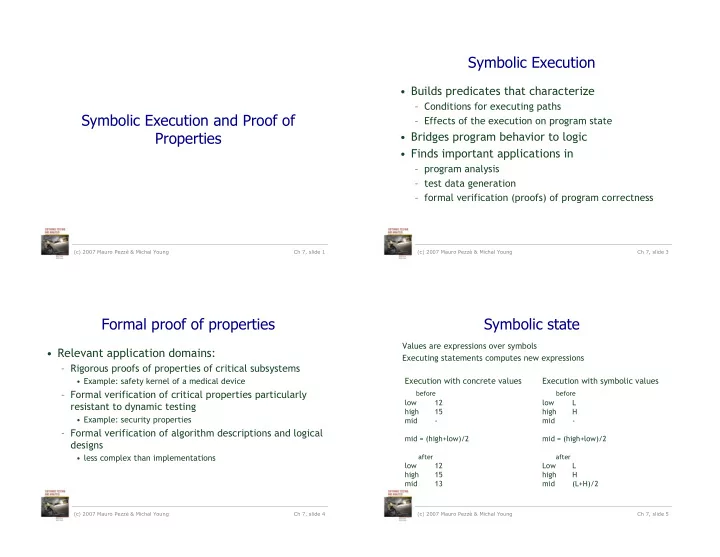
Symbolic Execution

  • Builds predicates that characterize

– Conditions for executing paths – Effects of the execution on program state

  • Bridges program behavior to logic
  • Finds important applications in

– program analysis – test data generation – formal verification (proofs) of program correctness

(c) 2007 Mauro Pezzè & Michal Young Ch 7, slide 4

Formal proof of properties

  • Relevant application domains:

– Rigorous proofs of properties of critical subsystems

  • Example: safety kernel of a medical device

– Formal verification of critical properties particularly resistant to dynamic testing

  • Example: security properties

– Formal verification of algorithm descriptions and logical designs

  • less complex than implementations

(c) 2007 Mauro Pezzè & Michal Young Ch 7, slide 5

Symbolic state

Execution with concrete values

before

low 12 high 15 mid

  • mid = (high+low)/2

after low 12 high 15 mid 13

Execution with symbolic values before

low L high H mid

  • mid = (high+low)/2

after Low L high H mid (L+H)/2

Values are expressions over symbols Executing statements computes new expressions

slide-2
SLIDE 2

(c) 2007 Mauro Pezzè & Michal Young Ch 7, slide 6

Dealing with branching statements

a sample program

char *binarySearch( char *key, char *dictKeys[ ], char *dictValues[ ], int dictSize) { int low = 0; int high = dictSize - 1; int mid; int comparison; while (high >= low) { mid = (high + low) / 2; comparison = strcmp( dictKeys[mid], key ); if (comparison < 0) { low = mid + 1; } else if ( comparison > 0 ) { high = mid - 1; } else { return dictValues[mid]; } } return 0;

Branching stmt

(c) 2007 Mauro Pezzè & Michal Young Ch 7, slide 7

Executing while (high >= low) {

before

low = 0 and high = (H-1)/2 -1 and mid = (H-1)/2 while (high >= low)!!

after

low = 0 and high = (H-1)/2 -1 and mid = (H-1)/2 and (H-1)/2 - 1 >= 0

Add an expression that records the condition for the execution of the branch (PATH CONDITION)

if the TRUE branch was taken

... and not((H-1)/2 - 1 >= 0)

if the FALSE branch was taken

(c) 2007 Mauro Pezzè & Michal Young Ch 7, slide 8

Summary information

  • Symbolic representation of paths may become

extremely complex

  • We can simplify the representation by replacing

a complex condition P with a weaker condition W such that P => W

  • W describes the path with less precision
  • W is a summary of P

(c) 2007 Mauro Pezzè & Michal Young Ch 7, slide 9

Example of summary information

(Referring to Binary search: Line 17, mid = (high+low)/2 )

  • If we are reasoning about the correctness of the binary search algorithm,

the complete condition: low = L and high = H and mid = M and M = (L+H)/2

  • Contains more information than needed and can be replaced with the

weaker condition: low = L and high = H and mid = M and L <= M <= H

  • The weaker condition contains less information, but still enough to reason

about correctness.

slide-3
SLIDE 3

(c) 2007 Mauro Pezzè & Michal Young Ch 7, slide 10

Weaker preconditions

  • The weaker predicate L <= mid <= H is chosen based on

what must be true for the program to execute correctly

  • It cannot be derived automatically from source code
  • it depends on our understanding of the code and our

rationale for believing it to be correct

  • A predicate stating what should be true at a given point

can be expressed in the form of an assertion

  • Weakening the predicate has a cost for testing:

– satisfying the predicate is no longer sufficient to find data that forces program execution along that path.

  • test data that satisfies a weaker predicate W is necessary to

execute the path, but it may not be sufficient

  • showing that W cannot be satisfied shows path infeasibility

(c) 2007 Mauro Pezzè & Michal Young Ch 7, slide 11

Loops and assertions

  • The number of execution paths through a program with

loops is potentially infinite

  • To reason about program behavior in a loop, we can

place within the loop an invariant:

– assertion that states a predicate that is expected to be true each time execution reaches that point.

  • Each time program execution reaches the invariant

assertion, we can weaken the description of program state:

– If predicate P represents the program state – and the assertion is W – we must first ascertain P => W – and then we can substitute W for P

(c) 2007 Mauro Pezzè & Michal Young Ch 7, slide 12

Pre- and post-conditions

  • Suppose:

– every loop contains an assertion – there is an assertion at the beginning of the program – a final assertion at the end

  • Then:

– every possible execution path would be a sequence

  • f segments from one assertion to the next.
  • Terminology:

– Precondition: The assertion at the beginning of a segment, – Postcondition: The assertion at the end of the segment

(c) 2007 Mauro Pezzè & Michal Young Ch 7, slide 13

Verifying program correctness

  • If for each program segment we can verify that

– Starting from the precondition – Executing the program segment – The postcondition holds at the end of the segment

  • Then

– We verify the correctness of an infinite number of program paths

slide-4
SLIDE 4

(c) 2007 Mauro Pezzè & Michal Young Ch 7, slide 14

Example

Forall{i,j} 0 <= i < j < size : dictKeys[i] <= dictKeys[j] Precondition: is sorted: Forall{i} 0 <= i < size : dictKeys[i] = key => low <= i <= high Invariant: in range

char *binarySearch( char *key, char *dictKeys[ ], char *dictValues[ ], int dictSize) { int low = 0; int high = dictSize - 1; int mid; int comparison; while (high >= low) { mid = (high + low) / 2; comparison = strcmp( dictKeys[mid], key ); if (comparison < 0) { low = mid + 1; } else if ( comparison > 0 ) { high = mid - 1; } else { return dictValues[mid]; } } return 0;

(c) 2007 Mauro Pezzè & Michal Young Ch 7, slide 15

Executing the loop once…

low = L and high = H Forall{i,j} 0 <= i < j < size : dictKeys[i] <= dictKeys[j] and Forall{k} 0 <= k < size : dictKeys[k] = key => L <= k <= H Initial values: Instantiated invariant: low = L and high = H and mid = M and Forall{i,j} 0 <= i < j < size : dictKeys[i] <= dictKeys[j] and Forall{k} 0 <= k < size : dictKeys[k] = key => L <= k <= H and H >= M >= L After executing: mid = (high + low)/2 ….

Invariant Forall{i} 0 <= i < size : dictKeys[i] = key => low <= i <= high Precondition Forall{i,j} 0 <= i < j < size dictKeys[i] <= dictKeys[j]

(c) 2007 Mauro Pezzè & Michal Young Ch 7, slide 16

…executing the loop once

low = M+1 and high = H and mid = M and Forall{i,j} 0 <= i < j < size : dictKeys[i] <= dictKeys[j] and Forall{k} 0 <= k < size : dictKeys[k] = key => L <= k <= H and H >= M >= L and dictkeys[M]<key After executing the loop The new instance of the invariant: Forall{i,j} 0 <= i < j < size : dictKeys[i] <= dictKeys[j] and Forall{k} 0 <= k < size : dictKeys[k] = key => M+1 <= k <= H If the invariant is satisfied, the loop is correct wrt the preconditions and the invariant

(c) 2007 Mauro Pezzè & Michal Young Ch 7, slide 17

From the loop to the end

If the invariant is satisfied, but the condition is false:

low = L and high = H and Forall{i,j} 0 <= i < j < size : dictKeys[i] <= dictKeys[j] and Forall{k} 0 <= k < size : dictKeys[k] = key => L <= k <= H and L > H

If the the condition satisfies the post-condition, the program is correct wrt the pre- and post-condition:

slide-5
SLIDE 5

(c) 2007 Mauro Pezzè & Michal Young Ch 7, slide 18

Compositional reasoning

  • Follow the hierarchical structure of a program

– at a small scale (within a single procedure) – at larger scales (across multiple procedures…)

  • Hoare triple:

[pre] block [post]

  • if the program is in a state satisfying the

precondition pre at entry to the block, then after execution of the block it will be in a state satisfying the postcondition post

(c) 2007 Mauro Pezzè & Michal Young Ch 7, slide 19

Reasoning about Hoare triples: inference

[I and C] S [I] [I] while(C){S} [I and notC] Inference rule says: if we can verify the premise (top), then we can infer the conclusion (bottom) premise conclusion

(c) 2007 Mauro Pezzè & Michal Young Ch 7, slide 20

Some other rules: if statement

[P and C] thenpart [Q] [P and notC] elsepart [Q] [P] if (C){thenpart} else {elsepart} [Q]

(c) 2007 Mauro Pezzè & Michal Young Ch 7, slide 21

Reasoning style

  • Summarize the effect of a block of program code (a

whole procedure) by a contract == precondition + postcondition

  • Then use the contract wherever the procedure is called

example summarizing binarySearch: (forall i,j, 0 <= i < j < size : keys[i] <= keys[j]) s = binarySearch(k, keys, vals, size) (s=v and exists i , 0 <= i , size : keys[i] = k and vals[i] = v)

  • r

(s=v and not exists i , 0 <= i , size : keys[i] = k)

slide-6
SLIDE 6

(c) 2007 Mauro Pezzè & Michal Young Ch 7, slide 22

Reasoning about data structures and classes

  • Data structure module = collection of

procedures (methods) whose specifications are strongly interrelated

  • Contracts: specified by relating procedures to

an abstract model of their (encapsulated) inner state example: Dictionary can be abstracted as {<key, value>} independent of the implementation as a list, tree, hash table, etc.

(c) 2007 Mauro Pezzè & Michal Young Ch 7, slide 23

Structural invariants

  • Structural characteristics that must be

maintained as specified as structural invariants (~loop invariants)

  • Reasoning about data structures

– if the structural invariant holds before execution – and each method execution preserve the invariant – …then the invariant holds for all executions

Example: Each method in a search tree class maintains the ordering of keys in the tree

(c) 2007 Mauro Pezzè & Michal Young Ch 7, slide 24

Abstraction function

  • maps concrete objects to abstract model states

Dictionary example [<k,v> in (dict) ]

  • = dict.get(k)

[ o = v ]

abstraction function

(c) 2007 Mauro Pezzè & Michal Young Ch 7, slide 25

Summary

  • Symbolic execution = bridge from an operational view
  • f program execution to logical and mathematical

statements.

  • Basic symbolic execution technique: execute using

symbols

  • Symbolic execution for loops, procedure calls, and data

structures: proceed hierarchically

– compose facts about small parts into facts about larger parts

  • Fundamental technique for

– Generating test data – Verifying systems – Performing or checking program transformations

  • Tools are essential to scale up