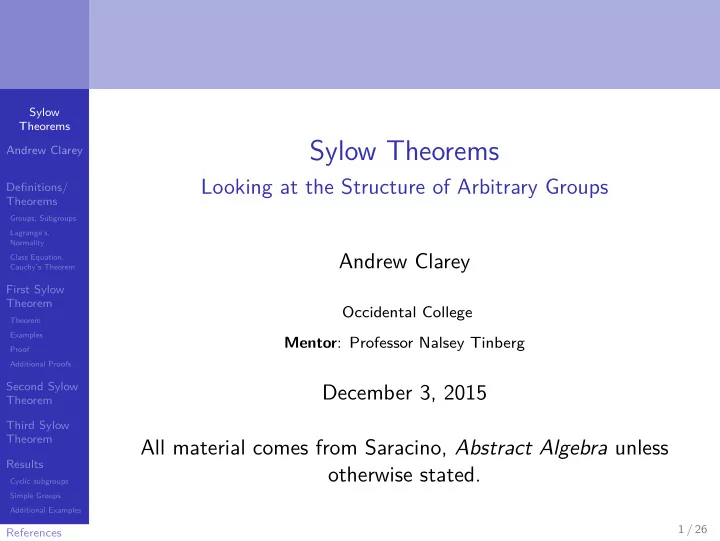
Sylow Theorems Andrew Clarey Looking at the Structure of Arbitrary - - PowerPoint PPT Presentation

sylow theorems
SMART_READER_LITE
LIVE PREVIEW

Sylow Theorems Andrew Clarey Looking at the Structure of Arbitrary - - PowerPoint PPT Presentation

Sylow Theorems Sylow Theorems Andrew Clarey Looking at the Structure of Arbitrary Groups Definitions/ Theorems Groups, Subgroups Lagranges, Normality Class Equation, Andrew Clarey Cauchys Theorem First Sylow Theorem Occidental


slide-1
SLIDE 1

Sylow Theorems Andrew Clarey Definitions/ Theorems

Groups, Subgroups Lagrange’s, Normality Class Equation, Cauchy’s Theorem

First Sylow Theorem

Theorem Examples Proof Additional Proofs

Second Sylow Theorem Third Sylow Theorem Results

Cyclic subgroups Simple Groups Additional Examples

References

Sylow Theorems

Looking at the Structure of Arbitrary Groups Andrew Clarey

Occidental College Mentor: Professor Nalsey Tinberg

December 3, 2015 All material comes from Saracino, Abstract Algebra unless

  • therwise stated.

1 / 26

slide-2
SLIDE 2

Sylow Theorems Andrew Clarey Definitions/ Theorems

Groups, Subgroups Lagrange’s, Normality Class Equation, Cauchy’s Theorem

First Sylow Theorem

Theorem Examples Proof Additional Proofs

Second Sylow Theorem Third Sylow Theorem Results

Cyclic subgroups Simple Groups Additional Examples

References

Overview

1

Definitions/ Theorems Groups, Subgroups Lagrange’s, Normality Class Equation, Cauchy’s Theorem

2

First Sylow Theorem Theorem Examples Proof Additional Proofs

3

Second Sylow Theorem

4

Third Sylow Theorem

5

Results Cyclic subgroups Simple Groups Additional Examples

6

References

2 / 26

slide-3
SLIDE 3

Sylow Theorems Andrew Clarey Definitions/ Theorems

Groups, Subgroups Lagrange’s, Normality Class Equation, Cauchy’s Theorem

First Sylow Theorem

Theorem Examples Proof Additional Proofs

Second Sylow Theorem Third Sylow Theorem Results

Cyclic subgroups Simple Groups Additional Examples

References

Definitions/Theorems

A set G is called a group [denoted (G, ∗)] if:

i) G has a binary operator ∗. We write a ∗ b as ab. ii) ∗ is associative iii) there is an element e ∈ G such that x ∗ e = e ∗ x = x, ∀x ∈ G iv) for each x ∈ G, ∃ y ∈ G such that x ∗ y = y ∗ x = e. We write y = x−1.

A group G is called cyclic if ∃ x ∈ G such that G = {xn|n ∈ Z} = x. Then x is called a generator. Example cyclic groups are Z, Zn. The order of a group G, denoted |G|, is the number of elements in the group.

3 / 26

slide-4
SLIDE 4

Sylow Theorems Andrew Clarey Definitions/ Theorems

Groups, Subgroups Lagrange’s, Normality Class Equation, Cauchy’s Theorem

First Sylow Theorem

Theorem Examples Proof Additional Proofs

Second Sylow Theorem Third Sylow Theorem Results

Cyclic subgroups Simple Groups Additional Examples

References

Definitions/Theorems

A subset H of a group (G, ∗) is called a subgroup of G if all h ∈ H form a group under ∗. Theorem: Let H be a nonempty subset of a group G. Then H is a subgroup iff:

i) ∀a, b ∈ H, ab ∈ H ii) ∀a ∈ H, a−1 ∈ H

We write H ≤ G. If H G, then a Left/Right coset of H in G is a subset

  • f the form aH/Ha where a ∈ G and

aH/Ha = {ah/ha|h ∈ H}. Two elements x, y ∈ G are conjugate if ∃g ∈ G such that y = g−1xg. If H G, then gHg−1 G is a conjugate subgroup of G, ∀g ∈ G.

4 / 26

slide-5
SLIDE 5

Sylow Theorems Andrew Clarey Definitions/ Theorems

Groups, Subgroups Lagrange’s, Normality Class Equation, Cauchy’s Theorem

First Sylow Theorem

Theorem Examples Proof Additional Proofs

Second Sylow Theorem Third Sylow Theorem Results

Cyclic subgroups Simple Groups Additional Examples

References

Definitions/Theorems

Lagrange’s Theorem: Let G be a finite group and let H G. Then |H| | |G|, as |G| = |H|[G : H] where [G : H] is the number of Left/Right cosets. Let H G. Then the number of Left/Right Cosets of H in G is [G : H], called the index. Let H G. Then we say H is a normal subgroup if ∀h ∈ H, g ∈ G, ghg−1 ∈ H. We write H G. Theorem: Let H G. Then the following are equivalent:

i) H G ii) gHg−1 = H, ∀g ∈ G iii) gH = Hg, ∀g ∈ G

5 / 26

slide-6
SLIDE 6

Sylow Theorems Andrew Clarey Definitions/ Theorems

Groups, Subgroups Lagrange’s, Normality Class Equation, Cauchy’s Theorem

First Sylow Theorem

Theorem Examples Proof Additional Proofs

Second Sylow Theorem Third Sylow Theorem Results

Cyclic subgroups Simple Groups Additional Examples

References

Definitions/Theorems

If H is the only subgroup in G of order |H| then H G. If H G then G/H is a group called the quotient group whose elements are of the form gH, ∀g ∈ G, and whose

  • peration is ∗ such that aH ∗ bH = (a ∗ b)H.

If G, H are groups, then we can define a function φ: G → H as a homomorphism if φ(g1g2) = φ(g1)φ(g2). Define a surjection φ from G → G/H where g → gH. The kernel of φ is given by Ker(φ) = {g ∈ G|φ(g) = eH}, where eH is the identity in H and it is a normal subgroup. The Normalizer of H G is the subset N(H) = {g ∈ G|gHg−1 = H}. The Center of a group G is the set of elements Z(G) = {a ∈ G|ag = ga, ∀g ∈ G}.

6 / 26

slide-7
SLIDE 7

Sylow Theorems Andrew Clarey Definitions/ Theorems

Groups, Subgroups Lagrange’s, Normality Class Equation, Cauchy’s Theorem

First Sylow Theorem

Theorem Examples Proof Additional Proofs

Second Sylow Theorem Third Sylow Theorem Results

Cyclic subgroups Simple Groups Additional Examples

References

Definitions/Theorems

The Centralizer of a g ∈ G is the set of elements Z(g) = {a ∈ G|ag = ga} Theorem: The Class Equation of a group G states: |G| = |Z(G)| + [G : Z(g1)] + · · · + [G : Z(gk)], g1, . . . , gk / ∈ Z(G), where each gi is a representative of a conjugacy class which contains at least 2 elements. Cauchy’s Theorem: Let G be an abelian group, and let p be a prime such that p | |G|. Then G contains an element

  • f order p. That is, ∃x ∈ G so that p is the lowest

non-zero number such that xp = e.

7 / 26

slide-8
SLIDE 8

Sylow Theorems Andrew Clarey Definitions/ Theorems

Groups, Subgroups Lagrange’s, Normality Class Equation, Cauchy’s Theorem

First Sylow Theorem

Theorem Examples Proof Additional Proofs

Second Sylow Theorem Third Sylow Theorem Results

Cyclic subgroups Simple Groups Additional Examples

References

First Sylow Theorem

A subgroup of a group G is called a p-Sylow subgroup if its order is pn, p a prime and n ∈ Z+, such that pn | |G| and pn+1 ∤ |G|. First Sylow Theorem: Let G be a finite group, p a prime, k ∈ Z+.

i) If pk | |G|, then G has a subgroup of order pk. In particular, G has a p-Sylow subgroup. ii) Let H be any p-Sylow subgroup of G. If K G, |K| = pk, then for some g ∈ G we have K ⊆ gHg−1. In particular, K is contained in some p-Sylow subgroup of G.

8 / 26

slide-9
SLIDE 9

Sylow Theorems Andrew Clarey Definitions/ Theorems

Groups, Subgroups Lagrange’s, Normality Class Equation, Cauchy’s Theorem

First Sylow Theorem

Theorem Examples Proof Additional Proofs

Second Sylow Theorem Third Sylow Theorem Results

Cyclic subgroups Simple Groups Additional Examples

References

Examples

Say |G| = 22 · 34 · 52 · 72. Then we know there will be at least

  • ne of each:

2-Sylow subgroup of order 4, 3-Sylow subgroup of order 81, 5-Sylow subgroup of order , 7-Sylow subgroup of order . We also know there will be subgroups of order 2, 3, 9, 27, 5, and 7.

9 / 26

slide-10
SLIDE 10

Sylow Theorems Andrew Clarey Definitions/ Theorems

Groups, Subgroups Lagrange’s, Normality Class Equation, Cauchy’s Theorem

First Sylow Theorem

Theorem Examples Proof Additional Proofs

Second Sylow Theorem Third Sylow Theorem Results

Cyclic subgroups Simple Groups Additional Examples

References

Examples

Let G = A4, a group of order 12 = 22 · 3 A4 = {e, (1, 2)(3, 4), (1, 3)(2, 4), (1, 4)(2, 3), (1, 2, 3), (1, 2, 4), (1, 3, 4), (1, 3, 2), (1, 4, 3), (1, 4, 2), (2, 3, 4), (2, 4, 3)} So, a 2-Sylow subgroup of G would be a subgroup of order 4, an example is: H = {e, (1, 2)(3, 4), (1, 3)(2, 4), (1, 4)(2, 3)} In fact this is the only one and therefore is normal, and all subgroups of order 2 and 4 are contained within it.

10 / 26

slide-11
SLIDE 11

Sylow Theorems Andrew Clarey Definitions/ Theorems

Groups, Subgroups Lagrange’s, Normality Class Equation, Cauchy’s Theorem

First Sylow Theorem

Theorem Examples Proof Additional Proofs

Second Sylow Theorem Third Sylow Theorem Results

Cyclic subgroups Simple Groups Additional Examples

References

Examples

Say G = SL2(Z3).1 Then |G| = 24 = 23 · 3 and −1 ≡ 2mod3. The only 2-Sylow subgroup is:

  • 1

1

  • ,
  • −1

1

  • ,
  • 1

1 1 −1

  • ,
  • −1

1 1 1

  • ,
  • −1

−1

  • ,
  • 1

−1

  • ,
  • −1

−1 −1 1

  • ,
  • 1

−1 −1 −1

  • and there are 4 3-Sylow subgroups:

1 1 1 , 1 1 1 , 1 −1 −1 , −1 1 −1

11 / 26

slide-12
SLIDE 12

Sylow Theorems Andrew Clarey Definitions/ Theorems

Groups, Subgroups Lagrange’s, Normality Class Equation, Cauchy’s Theorem

First Sylow Theorem

Theorem Examples Proof Additional Proofs

Second Sylow Theorem Third Sylow Theorem Results

Cyclic subgroups Simple Groups Additional Examples

References

Proof

We now prove that if pk | |G|, then G has a subgroup of order

  • pk. In particular, G has a p-Sylow subgroup, part i of the First

Sylow Theorem. Let G be a group, p a prime, k ∈ Z+ such that pk | |G|. We will proceed with induction on |G|. If |G| = 2 the result is trivial, and we are done. So, let’s assume the theorem is true for all groups of order less than |G| and show it is true for |G|. Case 1: Assume ∃H < G such that p ∤ [G : H]. |G| = [G : H]|H| so pk must divide |H|. By the inductive hypothesis, Since |H| < |G|, H has a subgroup of order pk, therefore G does as well.

12 / 26

slide-13
SLIDE 13

Sylow Theorems Andrew Clarey Definitions/ Theorems

Groups, Subgroups Lagrange’s, Normality Class Equation, Cauchy’s Theorem

First Sylow Theorem

Theorem Examples Proof Additional Proofs

Second Sylow Theorem Third Sylow Theorem Results

Cyclic subgroups Simple Groups Additional Examples

References

Proof

Case 2: Assume ∄H < G such that p ∤ [G : H]. So, ∀H < G, p | [G : H]. By the Class Equation: |G| = |Z(G)| + [G : Z(gi)]. Since p | |G| and p | [G : Z(gi)] ∀i, then p | |Z(G)|. ⇒ By Cauchy’s Theorem Z(G) has a subgroup of order p, say

  • A. Then A G.

So, |G/A| = |G|/p ⇒ pk−1 | |G/A|. But |G/A| < |G|. ⇒ The inductive hypothesis applies to G/A. So, G/A has a subgroup of order pk−1, say J.

13 / 26

slide-14
SLIDE 14

Sylow Theorems Andrew Clarey Definitions/ Theorems

Groups, Subgroups Lagrange’s, Normality Class Equation, Cauchy’s Theorem

First Sylow Theorem

Theorem Examples Proof Additional Proofs

Second Sylow Theorem Third Sylow Theorem Results

Cyclic subgroups Simple Groups Additional Examples

References

Proof

Define φ : G → G/A Let H = {g ∈ G|φ(gA) ∈ J}. H = ∅, eH = A. Then H ≤ G. Show that g1, g2 ∈ H ⇒ g1g−1

2

∈ H, i.e. Show g1g−1

2 A ∈ J

But, g1g−1

2 A = g1A(g2A)−1 ∈ J as J < G/A, and A < H as

A ∈ J. So, map φ : H → J by h → hA which is onto by definition. Then Ker(φ) : H ∩ A = A, and therefore H/A ∼ = J. So, J has the form H/A for some H < G, where pk−1 = |H/A| = |H|/|A| = |H|/p. So, |H| = pk as required.

14 / 26

slide-15
SLIDE 15

Sylow Theorems Andrew Clarey Definitions/ Theorems

Groups, Subgroups Lagrange’s, Normality Class Equation, Cauchy’s Theorem

First Sylow Theorem

Theorem Examples Proof Additional Proofs

Second Sylow Theorem Third Sylow Theorem Results

Cyclic subgroups Simple Groups Additional Examples

References

additional proof 1

We proceed by induction on |G|. If|G| = 2, the result is trivially

  • true. Now assume the statement is true for all groups of order

less than |G|. Case 1: If G has a proper subgroup H such that pk divides |H|, then, by our inductive assumption, H has a subgroup of order pk and we are done.

15 / 26

slide-16
SLIDE 16

Sylow Theorems Andrew Clarey Definitions/ Theorems

Groups, Subgroups Lagrange’s, Normality Class Equation, Cauchy’s Theorem

First Sylow Theorem

Theorem Examples Proof Additional Proofs

Second Sylow Theorem Third Sylow Theorem Results

Cyclic subgroups Simple Groups Additional Examples

References

additional proof 1

Case 2: We may assume that pk does not divide the order of any proper subgroup of G. Next, consider the class equation for G: |G| = |Z(G)| + [G : Z(gi)] where we sum over a representative of each conjugacy class. Since pk divides |G| = [G : Z(gi)]|Z(gi)| and pk does not divide |Z(gi)|, we know p must divide [G : Z(gi)], ∀gi / ∈ Z(G). Thus, from Cauchy’s Theorem, we see that Z(G) contains an element of order p, say x. Since x is in the center of G, x is a normal subgroup of G and we may form the factor group G/x. Now observe that pk−1 divides |G/x|. Thus, by the inductive hypothesis, |G/x| has a subgroup of order pk−1 and this subgroup has the form H/x where H is a subgroup of G. Finally, note that |H/x| = pk−1 and |x| = p imply that |H| = pk and this completes the proof.2

16 / 26

slide-17
SLIDE 17

Sylow Theorems Andrew Clarey Definitions/ Theorems

Groups, Subgroups Lagrange’s, Normality Class Equation, Cauchy’s Theorem

First Sylow Theorem

Theorem Examples Proof Additional Proofs

Second Sylow Theorem Third Sylow Theorem Results

Cyclic subgroups Simple Groups Additional Examples

References

additional proof 2

We divide the proof into two cases. Case 1: p divides the order of the center Z(G) of G. By Cauchy’s Theorem, Z(G) must have an element of order p, say

  • x. By induction, the quotient group G/x must have a

subgroup P of order pk−1. Then the pre-image of P in Z(G) is the desired subgroup of order pk. Case 2: assume that p does not divide the order of the center

  • f G. Again:

|G| = |Z(G)| + [G : Z(gi)], where the sum is over all the distinct conjugacy classes of G; that is, conjugacy class with more than one element. Since p fails to divide the order of the center, ∃i such that p ∤ [G : Z(gi)]. Then pk must divide the order of the subgroup Z(gi) as |G| = [G : Z(gi)]|Z(gi)|. Again, by induction, G will have a p-Sylow subgroup.3

17 / 26

slide-18
SLIDE 18

Sylow Theorems Andrew Clarey Definitions/ Theorems

Groups, Subgroups Lagrange’s, Normality Class Equation, Cauchy’s Theorem

First Sylow Theorem

Theorem Examples Proof Additional Proofs

Second Sylow Theorem Third Sylow Theorem Results

Cyclic subgroups Simple Groups Additional Examples

References

Second Sylow Theorem

Second Sylow Theorem: All p-Sylow subgroups of G are conjugate to each other. Consequently, a p-Sylow subgroup is normal iff it is the only p-Sylow subgroup. Proof : Let K, H be p-Sylow subgroups of G. Then by the second part

  • f the First Sylow Theorem K ⊆ gHg−1. But K and H have

the same order, so K = gHg−1. Next, if there is a p-Sylow subgroup H G and K is any p-Sylow subgroup, then K = gHg−1, so K = H. Therefore H is the only p-Sylow subgroup. Finally, if H is the only p-Sylow subgroup, then |gHg−1| = |H| ⇒ H = gHg−1 and H is normal.

18 / 26

slide-19
SLIDE 19

Sylow Theorems Andrew Clarey Definitions/ Theorems

Groups, Subgroups Lagrange’s, Normality Class Equation, Cauchy’s Theorem

First Sylow Theorem

Theorem Examples Proof Additional Proofs

Second Sylow Theorem Third Sylow Theorem Results

Cyclic subgroups Simple Groups Additional Examples

References

Third Sylow Theorem

We give the Third Sylow Theorem without proof: Third Sylow Theorem: Let H be any p-Sylow subgroup of G. Then the number of p-Sylow subgroups in G is [G : N(H)]. This number divides |G| and has the form 1 + jp for some j ≥ 0 and this number divides [G : H]. Note: [G : H] = [G : N(H)][N(H) : H]. These theorems allow us to look at the structure of arbitrary groups in order to try and classify them.

19 / 26

slide-20
SLIDE 20

Sylow Theorems Andrew Clarey Definitions/ Theorems

Groups, Subgroups Lagrange’s, Normality Class Equation, Cauchy’s Theorem

First Sylow Theorem

Theorem Examples Proof Additional Proofs

Second Sylow Theorem Third Sylow Theorem Results

Cyclic subgroups Simple Groups Additional Examples

References

Cyclic Theorem

Cyclic Theorem: Let G be a group of order pq, where p and q are primes and p < q. Then if p ∤ q − 1, G is cyclic. Examples: Every group of order 15 is cyclic. 15 = 3 · 5 and 3 ∤ 5 − 1 = 4. So by the theorem, all groups of order 15 are cyclic. Every group of order 35 is cyclic. 35 = 5 · 7 and 5 ∤ 7 − 1 = 6. So by the theorem, all groups of order 35 are cyclic. Every group of order 119 is cyclic. 119 = 7 · 17 and 7 ∤ 17 − 1 = 16. So by the theorem, all groups of order 119 are cyclic. (It can be proven that when p | q − 1, ∃ a non-abelian group of

  • rder pq. Moreover, all non-abelian groups of order pq are

isomorphic to each other.)

20 / 26

slide-21
SLIDE 21

Sylow Theorems Andrew Clarey Definitions/ Theorems

Groups, Subgroups Lagrange’s, Normality Class Equation, Cauchy’s Theorem

First Sylow Theorem

Theorem Examples Proof Additional Proofs

Second Sylow Theorem Third Sylow Theorem Results

Cyclic subgroups Simple Groups Additional Examples

References

Simple Groups

A group G is called simple if its only normal subgroups are {e} and G. Examples: No group of order 200 is simple. 200 = 23 · 52. Consider the 5-Sylow subgroup H of 25 elements. The number of 5-Sylow subgroups is [G : N(H)] = 1 + 5j | 8. The only possibility is 1, so H is the only 5-Sylow subgroup and is normal by the Second Sylow Theorem, and therefore G cannot be simple.

21 / 26

slide-22
SLIDE 22

Sylow Theorems Andrew Clarey Definitions/ Theorems

Groups, Subgroups Lagrange’s, Normality Class Equation, Cauchy’s Theorem

First Sylow Theorem

Theorem Examples Proof Additional Proofs

Second Sylow Theorem Third Sylow Theorem Results

Cyclic subgroups Simple Groups Additional Examples

References

Simple Groups

No group of order 56 is simple. 56 = 23 · 7. The number of 2-Sylow subgroups is 1 + 2k and divides 7, therefore is 1 or 7. The number of 7-Sylow subgroups is 1 + 7j and divides 8, and therefore is 1 or 8. If either is 1, then we are done. So, let’s say there are 8 7-Sylow

  • subgroups. They have trivial intersection, which gives

8 · 6 = 48 elements. But, 56 − 48 = 8 elements, which

  • nly allows for one 2-Sylow subgroup, and therefore this

2-Sylow subgroup is normal and the group is not simple.4

22 / 26

slide-23
SLIDE 23

Sylow Theorems Andrew Clarey Definitions/ Theorems

Groups, Subgroups Lagrange’s, Normality Class Equation, Cauchy’s Theorem

First Sylow Theorem

Theorem Examples Proof Additional Proofs

Second Sylow Theorem Third Sylow Theorem Results

Cyclic subgroups Simple Groups Additional Examples

References

groups of order 30

Let’s find all the groups of order 30 = 2 · 3 · 5 So, we know there are Sylow subgroups A, B, and C of order 2, 3, and 5 respectively. The number of 5-Sylow subgroups is [G : N(C)], so must divide 6. But it is also of the form 1 + 5j, so either 1 or 6. Similarly, the 3-Sylow subgroups are 1 + 3k | 10, either 1 or 10. Suppose there are six 5-Sylow subgroups and 10 3-Sylow

  • subgroups. Any two 5-Sylow subgroups must have trivial

intersection since they are both order 5. All six 5-Sylow groups would give 6 · 4 = 24 elements of order 5 in G. Similarly, the 3-Sylow subgroups give 20 elements of order 3 in G. By our assumption, this would imply |G| ≥ 44, which is impossible.

23 / 26

slide-24
SLIDE 24

Sylow Theorems Andrew Clarey Definitions/ Theorems

Groups, Subgroups Lagrange’s, Normality Class Equation, Cauchy’s Theorem

First Sylow Theorem

Theorem Examples Proof Additional Proofs

Second Sylow Theorem Third Sylow Theorem Results

Cyclic subgroups Simple Groups Additional Examples

References

groups of order 30

So, we know the group is not simple, but let’s continue to explore its structure. So, either there is only one 5-Sylow or one 3-Sylow subgroup. Therefore, either B or C is normal, and BC is a subgroup of G,

  • f order |B| · |C|/|B ∩ C| = 15. So BC is cyclic, say BC = x.

Since x has index 2 (as |G|/|BC| = 30/15 = 2) it is normal in G. If we let A = y, then G = xy since xy has order

  • 30. We must have yxy−1 = xt for some integer t. If we knew

the value of t, we could determine the structure of G.

24 / 26

slide-25
SLIDE 25

Sylow Theorems Andrew Clarey Definitions/ Theorems

Groups, Subgroups Lagrange’s, Normality Class Equation, Cauchy’s Theorem

First Sylow Theorem

Theorem Examples Proof Additional Proofs

Second Sylow Theorem Third Sylow Theorem Results

Cyclic subgroups Simple Groups Additional Examples

References

groups of order 30

So yxy−1 must have order 15, because x does, and therefore (t, 15) = 1, so t = 1, 2, 4, 7, 8, 11, 13, 14. We also have y(yxy−1)y−1 = yxty−1 = (yxy−1)t = (xt)t = xt2. So, x = xt2 ⇒ xt2−1 = e, and thus 15 | (t2 − 1). This rules

  • ut t = 2, 7, 8, 13, so there are at most four possibilities for t,

so at most four nonisomorphic groups of order 30. In fact, there are four: Z30, S3 × Z5, Z3 × D5, and D15.

25 / 26

slide-26
SLIDE 26

Sylow Theorems Andrew Clarey Definitions/ Theorems

Groups, Subgroups Lagrange’s, Normality Class Equation, Cauchy’s Theorem

First Sylow Theorem

Theorem Examples Proof Additional Proofs

Second Sylow Theorem Third Sylow Theorem Results

Cyclic subgroups Simple Groups Additional Examples

References

References

1 www.math.uconn.edu/∼kconrad/blurbs/grouptheory/

sylowpf.pdf

2 Contemporary Abstract Algebra, Gallian 3 www.math.drexel.edu/∼rboyer/courses/math533 03/

sylow thm.pdf

4 http://turnbull.mcs.st-and.ac.uk/∼colva/topics/ch3.pdf 5 Abstract Algebra: A First Course Second Edition, Saracino 26 / 26