Surround modulation (Series et al. 2003) Modeling Adult Visual - - PowerPoint PPT Presentation

surround modulation
SMART_READER_LITE
LIVE PREVIEW

Surround modulation (Series et al. 2003) Modeling Adult Visual - - PowerPoint PPT Presentation

Surround modulation (Series et al. 2003) Modeling Adult Visual Function Dr. James A. Bednar jbednar@inf.ed.ac.uk http://homepages.inf.ed.ac.uk/jbednar Apparent contrast Detection facilitated or Contour pops out reduces inhibited Many


slide-1
SLIDE 1

Modeling Adult Visual Function

  • Dr. James A. Bednar

jbednar@inf.ed.ac.uk http://homepages.inf.ed.ac.uk/jbednar

CNV Spring 2015: Modeling adult function 1

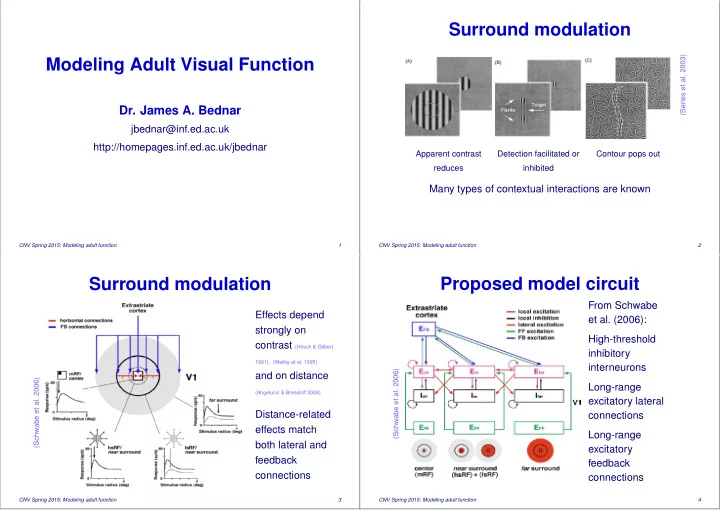
Surround modulation

Apparent contrast reduces Detection facilitated or inhibited Contour pops out

(Series et al. 2003)

Many types of contextual interactions are known

CNV Spring 2015: Modeling adult function 2

Surround modulation

(Schwabe et al. 2006)

Effects depend strongly on contrast (Hirsch & Gilbert

1991), (Weliky et al. 1995)

and on distance

(Angelucci & Bressloff 2006)

Distance-related effects match both lateral and feedback connections

CNV Spring 2015: Modeling adult function 3

Proposed model circuit

(Schwabe et al. 2006)

From Schwabe et al. (2006): High-threshold inhibitory interneurons Long-range excitatory lateral connections Long-range excitatory feedback connections

CNV Spring 2015: Modeling adult function 4

slide-2
SLIDE 2

GCAL-based SM model

V1 L2/3I V1 L2/3E V1 L4 (Antolik 2010; Antolik & Bednar 2015)

  • GCAL-based circuit for

surround modulation

  • Separate inhibitory

interneurons

  • Long-range excitatory

lateral connections

  • Separate simple and

complex cell layers

  • No feedback

connections; not published yet

(Philipp Rudiger)

CNV Spring 2015: Modeling adult function 5

SM model size tuning

(Antolik 2010)

Single-unit response to larger patterns typically increases, then decreases as inhibition is recruited

CNV Spring 2015: Modeling adult function 6

Diversity in size tuning

(Antolik 2010)

Model matches both typical and unusual size tuning responses

CNV Spring 2015: Modeling adult function 7

Diversity in OCTC tuning

(Antolik 2010)

Model matches both typical and unusual orientation-contrast tuning types

CNV Spring 2015: Modeling adult function 8

slide-3
SLIDE 3

The Tilt Aftereffect (TAE)

  • Bias in orientation perception after prolonged exposure
  • Allows model structure to be related to adult function
  • Classic explanation: “fatigue” – activated neurons get

tired, shifting the population average away

CNV Spring 2015: Modeling adult function 9

Measuring perceived orientation

  • = −16.8
  • = +22.5
  • = 0.0
  • = −3.0

Activation OR preference

Neuron 3:

= 0.6

Neuron 1:

Activation OR preference = 0.24

Neuron 2:

Activation OR preference = 1.0 Activation OR preference

Average:

  • Assumption: perception based on population average
  • Vector average good for cyclic quantities
  • Use average to decode perception, before and after

adaptation

CNV Spring 2015: Modeling adult function 10

TAE in Humans and LISSOM

−90

  • −60
  • −30
  • 30
  • 60
  • 90
  • Angle on Retina

−4

  • −2
  • 2
  • 4
  • Aftereffect Magnitude

Mitchell & Muir 1976 HLISSOM

  • Direct effect for

small angles

  • Indirect effect for

larger angles

  • Null effect at

training angle

  • Human, model

match closely

CNV Spring 2015: Modeling adult function 11

TAE Adaptation in LISSOM

Adaptation

− +

0◦

Direct

− +

10◦

Indirect

− +

60◦ Input pattern V1 Activity Histogram difference

  • Null at zero: More

inhibition, but no net change in perception

  • Direct effect: More

inhibition for angles <10◦ – Perception shifts from 10 to 14◦

  • Indirect effect: Less

inhibition for angles <60◦ – Perception shifts from 60 to 58◦

  • Due to synapses, not

tired neurons!

CNV Spring 2015: Modeling adult function 12

slide-4
SLIDE 4

McCollough effect test pattern

Before adaptation, this pattern should appear monochrome

CNV Spring 2015: Modeling adult function 13

Adaptation pattern

Stare alternately at the two patterns for 3 minutes, moving your gaze to avoid developing strong afterimages

CNV Spring 2015: Modeling adult function 14

McCollough effect

(McCollough 1965)

After adaptation:

  • Vertical bars

should be slightly magenta

  • Horizontal bars

should be slightly green

  • The effect should reverse if you tilt your head 90◦,

and disappear if you tilt 45◦.

CNV Spring 2015: Modeling adult function 15

McCollough effect: data

(Ellis 1977) (Landisman & Ts’o 2002)

2.3×5.3mm macaque V1

  • Effect measured in

humans at each angle between adaptation and test

  • Strength falls off

smoothly with angle

  • V1 is earliest

possible substrate – first area showing OR selectivity; has color map

CNV Spring 2015: Modeling adult function 16

slide-5
SLIDE 5

LISSOM RG Color V1 Model

(Bednar et al. 2005) Green Channel Red Channel

V1

ON OFF Luminosity Green/Red Red/Green

Color Image Retina LGN

  • Input: RGB images
  • Decomposed into

Red, Green or Red, Green, Blue channels (e.g. no blue in central fovea,

Calkins 2001)

  • Processed by

color opponent retinal ganglia

CNV Spring 2015: Modeling adult function 17

LISSOM OR + Color map

(Bednar et al. 2005)

  • Orientation map similar to animal maps
  • Color-selective cells occur in blobs
  • Needs study of preferences of neurons in each blob

CNV Spring 2015: Modeling adult function 18

Calculating McCollough Effect

  • Perceived color estimated as a vector average of all

units

  • Vector direction: + for red-selective units, - for

green-selective units

  • Weighted by activation level and amount of color

selectivity Result is a number from extreme red (positive) to extreme green (negative), with approximately 0 being monochrome.

CNV Spring 2015: Modeling adult function 19

Model McCollough Effect

−45 −30 −15 15 30 45 60 75 90 105 120 135 −6 −4 −2 2 4 6

  • rientation of the test pattern

strength of the ME (in the model)

CNV Spring 2015: Modeling adult function 20

slide-6
SLIDE 6

Compared with humans

−45 −30 −15 15 30 45 −0.2 0.2 0.4 0.6 0.8 1 1.2

  • rientation of the test pattern

strength of the ME simulated ME human data

CNV Spring 2015: Modeling adult function 21

Summary

  • GCAL can be compatible with actual circuit
  • Reproduces surprising features of surround modulation
  • Afterffects arise from Hebbian adaptation of lateral

connections

  • The same self-organizing processes can drive both

development and adaptation: both structure and function

  • Novel prediction: Indirect effect due to weight

normalization

  • Project: details of wiring for inverted Mexican Hat

CNV Spring 2015: Modeling adult function 22

McCollough Effect

Is the effect still present?

CNV Spring 2015: Modeling adult function 23

References

Angelucci, A., & Bressloff, P . C. (2006). Contribution of feedforward, lateral and feedback connections to the classical receptive field center and extra- classical receptive field surround of primate V1 neurons. Progress in Brain Research, 154, 93–120. Antolik, J. (2010). Unified Developmental Model of Maps, Complex Cells and Surround Modulation in the Primary Visual Cortex. Doctoral Dissertation, School of Informatics, The University of Edinburgh, UK. Antolik, J., & Bednar, J. A. (2015). A unified developmental model of maps, com- plex cells and surround modulation in the primary visual cortex. In prepa- ration.

CNV Spring 2015: Modeling adult function 23

slide-7
SLIDE 7

Bednar, J. A., De Paula, J. B., & Miikkulainen, R. (2005). Self-organization of color opponent receptive fields and laterally connected orientation maps. Neurocomputing, 65–66, 69–76. Calkins, D. J. (2001). Seeing with S cones. Progress in Retinal and Eye Research, 20 (3), 255–287. Ellis, S. R. (1977). Orientation selectivity of the McCollough effect: Analysis by equivalent contrast transformation. Perception and Psychophysics, 22 (6), 539–544. Hirsch, J. A., & Gilbert, C. D. (1991). Synaptic physiology of horizontal connections in the cat’s visual cortex. The Journal of Neuroscience, 11, 1800–1809. Landisman, C. E., & Ts’o, D. Y. (2002). Color processing in macaque striate cortex:

CNV Spring 2015: Modeling adult function 23

Relationships to ocular dominance, cytochrome oxidase, and orientation. Journal of Neurophysiology, 87 (6), 3126–3137. McCollough, C. (1965). Color adaptation of edge-detectors in the human visual

  • system. Science, 149 (3688), 1115–1116.

Mitchell, D. E., & Muir, D. W. (1976). Does the tilt aftereffect occur in the oblique meridian?. Vision Research, 16, 609–613. Schwabe, L., Obermayer, K., Angelucci, A., & Bressloff, P . C. (2006). The role of feedback in shaping the extra-classical receptive field of cortical neurons: A recurrent network model. The Journal of Neuroscience, 26 (36), 9117– 9129. Series, P ., Lorenceau, J., & Fregnac, Y. (2003). The “silent” surround of V1 recep-

CNV Spring 2015: Modeling adult function 23

tive fields: Theory and experiments. Journal of Physiology (Paris), 97 (4– 6), 453–474. Weliky, M., Kandler, K., Fitzpatrick, D., & Katz, L. C. (1995). Patterns of excitation and inhibition evoked by horizontal connections in visual cortex share a common relationship to orientation columns. Neuron, 15, 541–552.

CNV Spring 2015: Modeling adult function 23