SLIDE 1
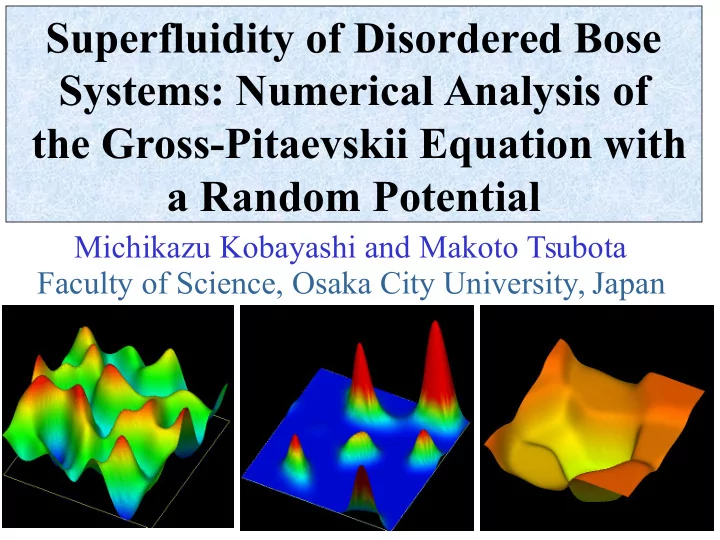
Superfluidity of Disordered Bose Systems: Numerical Analysis of the Gross-Pitaevskii Equation with a Random Potential
Michikazu Kobayashi and Makoto Tsubota Faculty of Science, Osaka City University, Japan
SLIDE 2
- How does disorder affect Bose-Einstein
condensation and its Superfluidity?
- What is the relation between BEC and
superfluidity?
- By adjusting with disorder, we may divide
BEC from superfluidity and understand this relation!
- We investigate this problem by the Gross-
Pitaevskii(GP) equation with a random potential
Motivation
SLIDE 3 Dynamics of two dimensional Bose system
Bose field operator →macroscopic wave function
- f BEC and its fluctuation
) x ( ˆ ) x ( ) x ( ˆ ϕ + Φ = Ψ
neglecting the fluctuation ⇒equation of the macroscopic wave function(GP equation)
) t , x ( ) t , x ( g ) x ( U m 2 ) t , x ( t i
2 2 2
Φ Φ + + µ − ∇ − = Φ ∂ ∂
SLIDE 4
U(x) : random potential
The average number of wave is regulated to be about 4 in a direction. One example of U(x)
1 2 3 4 5 6 7 8 |U(k)|2/V Wave number L/λ R0 Fourier transformation of U(x) (we take 100 ensemble average)
Of course, U(k) decays above the wave number 4
SLIDE 5
Ground state of GP equation
Parameter: strength of the random potential R .
R / μ= 50 R / μ= 70 R / μ= 20
Wave function localizes as R increases
SLIDE 6
Parameter: coherence length ξ of the wave function.
) gn ~ ( m 2 / µ µ = ξ
ξ / λ= 2 ξ / λ= 3 ξ / λ= 1
Wave function localizes as ξ decreases
λ: Characteristic width of the random potential
SLIDE 7
Ground state depends on the shape of the random potential even at same parameters
ξ / λ= 2 R / μ= 50
SLIDE 8
The superfluid density of ground states
0.2 0.4 0.6 0.8 1 1 1.5 2 2.5 3 The dependence on ξ ρ /ρ ρ /ρ ξ/λ s
Superfluidity is depressed as the ground states localizes 100 ensemble average at same R 0
0.2 0.4 0.6 0.8 1 40 80 120 160 200 The dependence on R ρ /ρ ρ /ρ R /µ s
SLIDE 9 Dynamics of vortex pairs in applied velocity field
π π
amplitude phase Phase becomes to be complicated / t = µ
16 . / t = µ
R / μ= 50 ξ / λ= 2
5 . 1 m 2 v = µ
v
SLIDE 10
π π
23 . / t = µ 40 . / t = µ Vortex pair nucleates! (Branch cut of the phase) amplitude phase
SLIDE 11 Dynamics of vortex pairs
0.2 0.4 0.6 0.8 1 1.2 1.4 0.5 1 1.5 2 2.5 0.5 1 1.5 2 The dependence on the velocity field ρ /ρ χ /ρ Vortex pairs n /n or χ(trans)/ρ The average number of vortex pairs (2m 2m/µ)1/2v
T
0.2 0.4 0.6 0.8 1 1.2 1.4 1 1.5 2 2.5 3 The dependence of the critical velocity
(2m/µ)1/2v ξ/λ
c
Nucleation of vortex pairs destroys superfluidity The critical velocity is small as the wave function localizes
SLIDE 12 Conclusion
- By using GP equation with a random potential,
the superfluid density in disordered system can be calculated.
- The dynamics of vortex pairs in applied field
can be calculated
- We will expand this calculation to 3-dimension.