Study about the impact of Pr effect on the validity of Boussinesq - - PDF document

study about the impact of pr effect on the validity of
SMART_READER_LITE
LIVE PREVIEW

Study about the impact of Pr effect on the validity of Boussinesq - - PDF document

Transactions of the Korean Nuclear Society Virtual Spring Meeting July 9-10, 2020 Study about the impact of Pr effect on the validity of Boussinesq approximation in molten salt natural circulation Dong Hun Lee, In Cheol Bang* Department of


slide-1
SLIDE 1

Study about the impact of Pr effect on the validity of Boussinesq approximation in molten salt natural circulation

Dong Hun Lee, In Cheol Bang* Department of Nuclear Engineering., Ulsan National Institute of Science and Technology (UNIST)., 50 UNIST-gil., Ulju-gun., Ulsan., Republic of Korea *Corresponding author: +82-52-217-2915, +82-52-217-2429, icbang@unist.ac.kr

  • 1. Introduction

Natural circulation that has been studied as a key phenomenon for a purely passive safety occurs owing to the buoyancy resulting from density differences between the heat source and heat sink that system can become independent of the external pumping power even in severe accidents. There have been several studies about natural circulation in the molten salt to investigate the flow characteristics for improving heat transfer effectively and passive safety as a heat transfer fluid. [1-3] Molten Salt reactor (MSR) is an innovative system that uses the concept of liquid fuel, and they are highly safe and useful reactor which is understudying in many countries. On the one hand, molten salt has high heat capacity, high boiling temperature, and low vapor pressure that can be efficiently operated at a high temperature. On the

  • ther hand, a pump is not required owing to the low

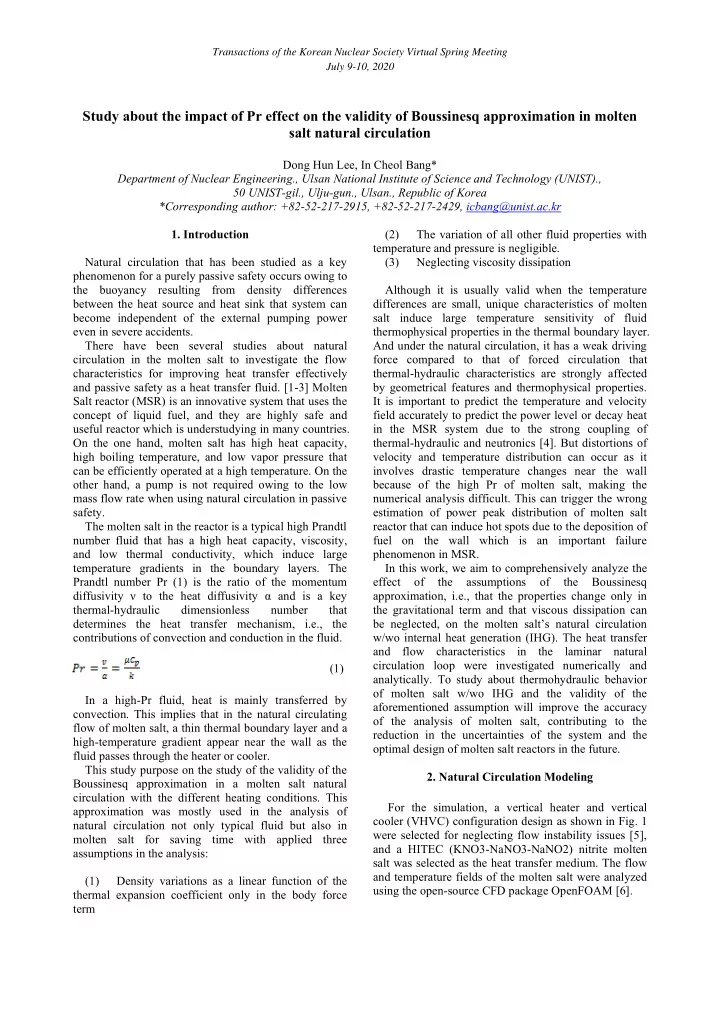
mass flow rate when using natural circulation in passive safety. The molten salt in the reactor is a typical high Prandtl number fluid that has a high heat capacity, viscosity, and low thermal conductivity, which induce large temperature gradients in the boundary layers. The Prandtl number Pr (1) is the ratio of the momentum diffusivity ν to the heat diffusivity α and is a key thermal-hydraulic dimensionless number that determines the heat transfer mechanism, i.e., the contributions of convection and conduction in the fluid. (1) In a high-Pr fluid, heat is mainly transferred by

  • convection. This implies that in the natural circulating

flow of molten salt, a thin thermal boundary layer and a high-temperature gradient appear near the wall as the fluid passes through the heater or cooler. This study purpose on the study of the validity of the Boussinesq approximation in a molten salt natural circulation with the different heating conditions. This approximation was mostly used in the analysis of natural circulation not only typical fluid but also in molten salt for saving time with applied three assumptions in the analysis: (1) Density variations as a linear function of the thermal expansion coefficient only in the body force term (2) The variation of all other fluid properties with temperature and pressure is negligible. (3) Neglecting viscosity dissipation Although it is usually valid when the temperature differences are small, unique characteristics of molten salt induce large temperature sensitivity of fluid thermophysical properties in the thermal boundary layer. And under the natural circulation, it has a weak driving force compared to that of forced circulation that thermal-hydraulic characteristics are strongly affected by geometrical features and thermophysical properties. It is important to predict the temperature and velocity field accurately to predict the power level or decay heat in the MSR system due to the strong coupling of thermal-hydraulic and neutronics [4]. But distortions of velocity and temperature distribution can occur as it involves drastic temperature changes near the wall because of the high Pr of molten salt, making the numerical analysis difficult. This can trigger the wrong estimation of power peak distribution of molten salt reactor that can induce hot spots due to the deposition of fuel on the wall which is an important failure phenomenon in MSR. In this work, we aim to comprehensively analyze the effect

  • f

the assumptions

  • f

the Boussinesq approximation, i.e., that the properties change only in the gravitational term and that viscous dissipation can be neglected, on the molten salt’s natural circulation w/wo internal heat generation (IHG). The heat transfer and flow characteristics in the laminar natural circulation loop were investigated numerically and

  • analytically. To study about thermohydraulic behavior
  • f molten salt w/wo IHG and the validity of the

aforementioned assumption will improve the accuracy

  • f the analysis of molten salt, contributing to the

reduction in the uncertainties of the system and the

  • ptimal design of molten salt reactors in the future.
  • 2. Natural Circulation Modeling

For the simulation, a vertical heater and vertical cooler (VHVC) configuration design as shown in Fig. 1 were selected for neglecting flow instability issues [5], and a HITEC (KNO3-NaNO3-NaNO2) nitrite molten salt was selected as the heat transfer medium. The flow and temperature fields of the molten salt were analyzed using the open-source CFD package OpenFOAM [6].

Transactions of the Korean Nuclear Society Virtual Spring Meeting July 9-10, 2020

slide-2
SLIDE 2
  • Fig. 1. Molten Salt VHVC domain for analysis

The CFD analysis of molten salt was conducted to understand the single-phase flow characteristics of natural circulation in the high-Pr fluid. The pre-built solver buoyantSimpleFoam for steady-state, buoyant, turbulent flows were selected with different thermophysical properties model. To analyze the validity of the Boussinesq approximation for molten salt’s natural circulation, simulations with both models for the mass, momentum, and energy equations were

  • conducted. The boundary and initial conditions of the

simulation are listed in Table I. The initial temperature was set to 573 K, which is above the melting point of HITEC (~415K), and the loop was operated at 1 atm. Various values of uniform external heat flux in the heater and internal heat generation were set, and the heat sink was specified as a constant wall temperature.

TABLE I: CFD initial and boundary conditions Domain parameter Value Working fluid HITEC (KNO3-NaNO3-NaNO2) Heating Condition External uniform heat flux, Internal Heat Generation (1250–2500 W) Cooler condition Constant wall temperature Initial temperature 573 K

  • 3. Results and Discussions

This section discusses flow and temperature behavior and the validity of the Boussinesq approximation of the molten salt natural circulation with different heating condition.

  • Figs. 2 and 3 showed the temperature and velocity

fields of both models in 1250 W external heating conditions in radial direction of pipe. Both models showed the thin thermal boundary layer, which is characteristic of high Pr fluids. The flow characteristics

  • f molten salt were induced due to the high-temperature

gradients near the wall, which cause a local density gradient that flows near the wall region and drags the bulk region. Velocity profiles reflected this fluid’s motion; the velocity of the fluid near the wall became faster than in the bulk region when molten salt passed the heater inlet to the outlet. Significant velocity gradients between near the wall and the bulk region was generated because of an effect of the viscous shearing forces due to high viscous characteristics. To investigate the temperature sensitivity of thermophysical properties near the wall, each field of the temperatures and velocities of both models was compared. Both models showed a very similar temperature trend. However, the velocity difference between the two models was significant near the wall. The magnitude of bulk region velocity is similar in both cases but, the significant

  • vershoot in the velocity profile is observed near the

wall region in the non-Boussinesq case. This means that the weak driving force of natural circulation is easily affected by the temperature sensitivity

  • f

thermophysical properties that affect the performance of the natural circulation near-wall region. Rapid change of temperature in the thermal boundary layer induces a large variation of viscosity, it means that the non- Boussinesq model showed more high viscosity in the near-wall region. High viscosity induced more shear viscous stress effect in the near-wall region, it generated the velocity differences of the bulk region and the near- wall region were bigger than the constant model. Further increase of buoyancy forces enhances the differences in the core and the viscous layer, which means that the Boussinesq model showed less heat

  • transfer. Therefore, the application of the Boussinesq

approximation in the analysis of the natural circulation

  • f molten salts shows distortion occurring at heat

transfer, especially in the velocity fields near the wall.

Transactions of the Korean Nuclear Society Virtual Spring Meeting July 9-10, 2020

slide-3
SLIDE 3
  • 0.5

0.0 0.5 0.00 0.02 0.04 0.06 0.08 0.10 0.12 0.14

Velocity [m/s] Radial Distance Heater Inlet Heater Middle Heater Outlet

(a)

  • 0.5

0.0 0.5 0.00 0.02 0.04 0.06 0.08 0.10 0.12 0.14

Velocity [m/s] Radial Distance Heater Inlet Heater Middle Heater Outlet

(b)

  • Fig. 2. Radial velocity fields on the heater according to the Boussinesq model (a) and non-Boussinesq model (b)
  • 0.5

0.0 0.5 600 640 680 720 760 800

Temperature [K] Radial Distance Heater Inlet Heater Middle Heater Outlet

(a)

  • 0.5

0.0 0.5 600 640 680 720 760 800

Temperature [K] Radial Distance Heater Inlet Heater Middle Heater Outlet

(b)

  • Fig. 3. Radial temperature fields on the heater according to the Boussinesq model (a) and non-Boussinesq model (b)
  • 0.5

0.0 0.5 810 820 830 840 850

Temperature [K] Radial Distance Heater Inlet Heater Middle Heater Outlet

(a)

  • 0.5

0.0 0.5 790 800 810 820 830 840 850 860 870

Temperature [K] Radial Distance Heater Inlet Heater Middle Heater Outlet

(b)

  • Fig. 4. Radial temperature fields on the heater according to the Boussinesq model (a) and non-Boussinesq model (b)

Transactions of the Korean Nuclear Society Virtual Spring Meeting July 9-10, 2020

slide-4
SLIDE 4
  • 0.5

0.0 0.5 0.00 0.05 0.10 0.15 0.20

Velocity [m/s] Radial Distance Heater Inlet Heater Middle Heater Outlet

(a)

  • 0.5

0.0 0.5 0.0 0.1 0.2 0.3

Velocity [m/s] Radial Distance Heater Inlet Heater Middle Heater Outlet

(b)

  • Fig. 5. Radial velocity fields on the heater according to the Boussinesq model (a) and non-Boussinesq model (b)
  • Figs. 4 and 5 showed the temperature and velocity

fields of both models in internal heat generation

  • conditions. The characteristics of a flow with distributed

heat source depart significantly from heat transfer theory and theory of boundary layer developed for external heat flux conditions. For IHG conditions, temperature and velocity profiles become uniform than external heat flux condition, it means that the overall effect on temperature and velocity are dominant rather than local phenomena. That is, the dependence on the effect of Prandtl numbers becomes minimal.

  • 4. Conclusion

Focused on the validity of Boussinesq approximation with Prandtl number aspects of natural circulation with different heating conditions, VHVC rectangular loop was simulated using OpenFOAM. For molten salt as a coolant, the Boussinesq approximation is not valid because the large temperature differences in the boundary layer have a significant effect on a drastic change of thermophysical properties: near the wall of molten salt flows. Especially, high viscosity was generated due to a high-temperature gradient that induced more shear viscous stress effect that resulted in more velocity differences in the near-wall region. As a result, it was confirmed that the velocity and temperature fields showed different flow behavior in the near the wall region, which implies that the Boussinesq approximation used for most natural circulation analyses can cause distortion due to the high Pr of molten salts, and therefore has a problem of validity. However, the molten salt circulation with internal heat generation deviates from the general boundary layer theory so that the Prandtl number effect becomes slight in the case of IHG condition because overall influence was dominant. This study conducted an analysis of the flow characteristics near the walls, which are important for the design of molten salt reactors, e.g., to predict the

  • ccurrence of local hot spots caused by fuel deposition

during circulation. As future works, due to the difference near-wall velocity behavior in external wall heat flux case and due to the symmetry/asymmetry of the velocity profile in IHG case, flow stability analyzes will conduct using transient conditions to investigate the validity of Boussinesq approximation. ACKNOWLEDGMENTS This work was financially supported by the Human Resources Development of the Korea Institute of Energy Technology Evaluation and Planning (KETEP) grant funded by the Korea Government Ministry of Trade Industry and Energy (MOTIE) (No. 20194030202400)) REFERENCES

[1]

  • A. Kasam and E. Shwageraus, “Approximate Heat

Transfer Solution for the Breed and Burn Molten Salt Reactor,” in Proceedings of M&C 2017, 2017. [2]

  • A. Pini, A. Cammi, and L. Luzzi, “Analytical and

numerical investigation of the heat exchange effect

  • n the dynamic behaviour of natural circulation with

internally heated fluids,” Chem. Eng. Sci., vol. 145,

  • pp. 108–125, 2016.

[3]

  • Y. S. Jeong, S. Bin Seo, and I. C. Bang, “Natural

convection heat transfer characteristics of molten salt with internal heat generation,” Int. J. Therm. Sci., vol. 129, no. December 2017, pp. 181–192, 2018. [4]

  • P. R. Rubiolo, M. T. Retamales, and J. Giraud, “High

Temperature Thermal Hydraulics Modeling of a Molten Salt: Application To a Molten Salt Fast Reactor (Msfr),” ESAIM Proc. Surv., vol. 58, no. December 2017, pp. 98–117, 2019. [5]

  • P. K. Vijayan, “Experimental observations on the

general trends of the steady state and stability behaviour of single-phase natural circulation loops,”

  • Nucl. Eng. Des., vol. 215, no. 1–2, pp. 139–152,

2002. [6]

  • C. J. Greenshields, “OpenFOAM user guide version

5,” OpenFOAM Found. Ltd, no. July, p. U-94, 2017. Transactions of the Korean Nuclear Society Virtual Spring Meeting July 9-10, 2020