Student: Yu Cheng (Jade) Math 612 Final Presentation Draft April - - PDF document

student yu cheng jade math 612 final presentation draft
SMART_READER_LITE
LIVE PREVIEW

Student: Yu Cheng (Jade) Math 612 Final Presentation Draft April - - PDF document

Student: Yu Cheng (Jade) Math 612 Final Presentation Draft April 27, 2011 Problem: Show that n ( x ) is irreducible over Q . Proof: First we want to show that n ( x ) Z [ x ] . This is proved in class by induction. The root of unity


slide-1
SLIDE 1

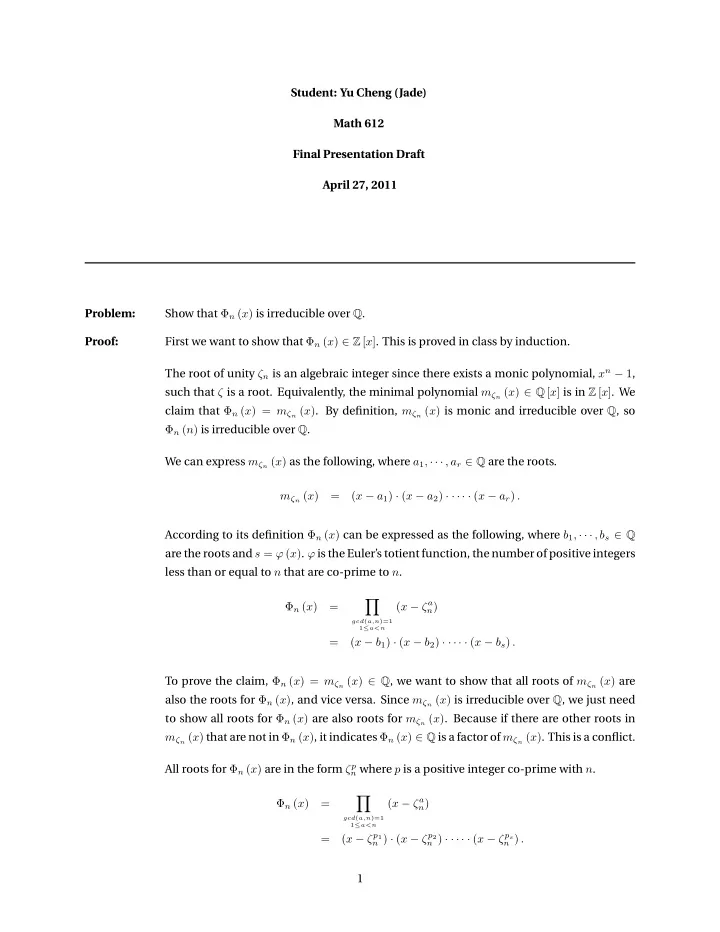
Student: Yu Cheng (Jade) Math 612 Final Presentation Draft April 27, 2011 Problem: Show that Φn (x) is irreducible over Q. Proof: First we want to show that Φn (x) ∈ Z [x]. This is proved in class by induction. The root of unity ζn is an algebraic integer since there exists a monic polynomial, xn − 1, such that ζ is a root. Equivalently, the minimal polynomial mζn (x) ∈ Q [x] is in Z [x]. We claim that Φn (x) = mζn (x). By definition, mζn (x) is monic and irreducible over Q, so Φn (n) is irreducible over Q. We can express mζn (x) as the following, where a1, · · · , ar ∈ Q are the roots. mζn (x) = (x − a1) · (x − a2) · · · · · (x − ar) . According to its definition Φn (x) can be expressed as the following, where b1, · · · , bs ∈ Q are the roots and s = ϕ (x). ϕ is the Euler’s totient function, the number of positive integers less than or equal to n that are co-prime to n. Φn (x) =

  • gcd(a,n)=1

1≤a<n

(x − ζa

n)

= (x − b1) · (x − b2) · · · · · (x − bs) . To prove the claim, Φn (x) = mζn (x) ∈ Q, we want to show that all roots of mζn (x) are also the roots for Φn (x), and vice versa. Since mζn (x) is irreducible over Q, we just need to show all roots for Φn (x) are also roots for mζn (x). Because if there are other roots in mζn (x) that are not in Φn (x), it indicates Φn (x) ∈ Q is a factor of mζn (x). This is a conflict. All roots for Φn (x) are in the form ζp

n where p is a positive integer co-prime with n.

Φn (x) =

  • gcd(a,n)=1

1≤a<n

(x − ζa

n)

= (x − ζp1

n ) · (x − ζp2 n ) · · · · · (x − ζps n ) .

1

slide-2
SLIDE 2

So the problem is converted to proving an arbitrary ζp

n is a root for mζn (x). We will prove

this by contradiction. Let’s assume that ζp

n is not a root for mζn (x). Since ζp n is a root in

xn − 1 we have the following relation. xn − 1 = mζn (x) · g (x) ⇒ g (ζp

n) = 0.

We can consider ζn as a root for polynomial g (xp). Since mζn (x) is the minimal polyno- mial of ζn, mζn (x) has to be a factor in g (xp). g (xp) = mζn (x) · h (x) . Let’s take the polynomials on both sides and mod p. g′ (xp) = m′

ζn (x) · h′ (x)

g′ (xp) , m′

ζn (x) , h′ (x) ∈ Qp [x] .

According to proposition 35 in Dummit & Foote, if a field F has a characteristic p, then for any a, b ∈ F we have the following. ap + bp = (a + b)p apbp = (ab)p . Hence, we derive that g′ (xp) = [g′ (x)]p. g′ (xp) = c0 + c1xp + c2 (xp)2 + c3 (xp)3 + · · · = c0 + c1xp + c2

  • x2p + c3
  • x3p + · · ·

=

  • c0 + c1x + c2x2 + c3x3 · · ·

p = [g′ (x)]p . Plug this in the earlier equation. [g′ (x)]p = m′

ζn (x) · h′ (x) .

Since Qp is a UFD, there is only one way to factorize a polynomial in Qp . Therefore,m′

ζn (x)

and g′ (x) have to share at least one common factor I (x) ∈ Qp [x]. Recall that we have xn − 1 = mζn (x) · g (x). We can mod p on both sides of this equation as well. (xn − 1) mod p = m′

ζn (x) · g′ (x)

= [I (x)]2 · J (x) I (x) , J (x) ∈ Qp [x] . 2

slide-3
SLIDE 3

This indicates that (xn − 1) mod p has duplicate roots in Qp. Furthermore, xn−1 has dupli- cate roots in Qp since (xn − 1) mod p is a factor in xn − 1. Now, let’s evaluate the derivative polynomial of xn − 1. Dx (xn − 1) = nxn−1 According to proposition 33 in Dummit & Foote, a polynomial f (x) has a multiple root α if and only if α is also a root of Dxf (x). But xn − 1 does not share any common factor with nxn−1 for p being relatively prime to n. So, we’ve derived a contradiction. Namely, xn − 1 cannot have duplicated roots in Qp. Therefore, ζp

n has to be a root in mζn (x) rather than a root in g (x), for xn−1 = mζn (x)·g (x).

At this point, we’ve shown all roots in Φn (x) are also roots in mζn (x), and hence Φn (x) = mζn (x). Since mζn (x) is irreducible over Q, Φn (x) is irreducible over Q. 3