Structure Interactions in a Fully Coupled Form Ali EKEN & Mehmet - - PowerPoint PPT Presentation

structure interactions in a fully coupled form
SMART_READER_LITE
LIVE PREVIEW

Structure Interactions in a Fully Coupled Form Ali EKEN & Mehmet - - PowerPoint PPT Presentation

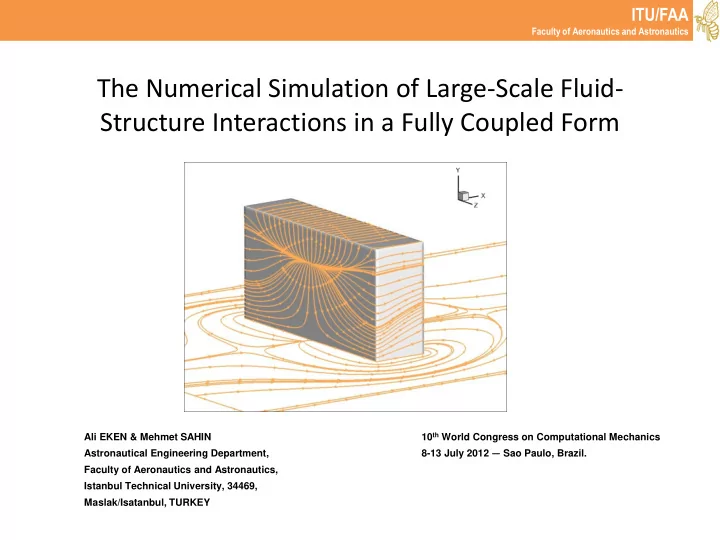
ITU/FAA Faculty of Aeronautics and Astronautics The Numerical Simulation of Large-Scale Fluid- Structure Interactions in a Fully Coupled Form Ali EKEN & Mehmet SAHIN 10 th World Congress on Computational Mechanics 8-13 July 2012 Sao


slide-1
SLIDE 1

The Numerical Simulation of Large-Scale Fluid- Structure Interactions in a Fully Coupled Form

Ali EKEN & Mehmet SAHIN 10th World Congress on Computational Mechanics Astronautical Engineering Department, 8-13 July 2012 — Sao Paulo, Brazil. Faculty of Aeronautics and Astronautics, Istanbul Technical University, 34469, Maslak/Isatanbul, TURKEY

ITU/FAA

Faculty of Aeronautics and Astronautics

slide-2
SLIDE 2

Contents

  • Motivations
  • Coupling Strategies - A Review
  • Numerical Modelling
  • Finite Element Structure Solver
  • ALE Based Finite Volume Fluid Solver
  • Test Case I: An Oscillating Circular Cylinder
  • Fluid-Structure Interaction
  • Fluid-Structure Coupling
  • Fluid-Structure Solver Validation
  • Test Case II: Vortex-induced vibrations of an elastic bar
  • Test Case III: 3-D Elastic Solid in a Steady Channel Flow
  • Conclusions and Future Work

WCCM 2012 2

ITU/FAA

Faculty of Aeronautics and Astronautics

slide-3
SLIDE 3

Motivations

WCCM 2012 3

ITU/FAA

Faculty of Aeronautics and Astronautics

FSI - the interaction of some movable or deformable structure with an internal or surrounding fluid flow

  • Engineering and biomedical applications.

FSI for a 3d parachute Trimarchi at al., (2011). Membrane wing fluid structure interaction Stanford at al., (2008). Vascular fluid structure interaction Bazilevs at al., (2010).

slide-4
SLIDE 4

Coupling Strategies - A Review

Partitioned (Staggered) Methods

  • Separate solvers for the fluid and solid domains.
  • More freedom in selecting optimized separate solvers.
  • Slow convergence for fixed-point iterations.
  • May diverge for strong interactions when deformations are large and the

fluid to solid density is close to 1.

  • The incompressibility constraint cannot be satisfied with standart

alternating FSI iterations for Dirichlet fluid boundary conditions.

WCCM 2012 4

ITU/FAA

Faculty of Aeronautics and Astronautics

slide-5
SLIDE 5

Coupling Strategies - A Review

Fully Coupled (Monolithic) Methods

  • The fluid and solid equations are discretized and solved simultaneously as

a single equation system.

  • Requires solution of a large system of coupled nonlinear algebraic

equations.

  • Believed to be more robust than partitioned methods , but also believed

to be more computationally expensive for large scale problems.

  • Competitive even for weak FSI with improved preconditioners.

WCCM 2012 5

ITU/FAA

Faculty of Aeronautics and Astronautics

slide-6
SLIDE 6

The Computational Method

Finite Element Structure Solver

  • St. Venant-Kirchhoff material model for large displacements.
  • Isoparametric quadrilateral/hexahedral finite element formulation.
  • Generalized- method for time integration.

ALE Fluid Solver

  • The incompressible Navier-Stokes equations for the fluid domain.
  • Arbitrary Lagrangian-Eulerian formulation based on the side-centered

unstructured finite volume method.

A Fully Coupled Solution Approach

  • The fluid and solid equations are discretized and solved simultaneously as

a single nonlinear algebraic equation system for the entire domain.

WCCM 2012 6

ITU/FAA

Faculty of Aeronautics and Astronautics

slide-7
SLIDE 7

Equations of Solid Motion

The governing equations with respect to the initial configuration Galerkin Finite Element Formulation Displacement Boundary Conditions Traction Boundary Conditions

ITU/FAA

Faculty of Aeronautics and Astronautics

WCCM 2012 7

slide-8
SLIDE 8

Finite Element Discretization

The tangent stiffness matrix The Mass Matrix Surface Tractions

ITU/FAA

Faculty of Aeronautics and Astronautics

and nonlinear parts

WCCM 2012 8

Linear

slide-9
SLIDE 9

The Resulting System of Equations

The modified nonlinear system with the generalized- method The displacements and velocities at the intermediate point Newmark approximations are used for the values at and .

ITU/FAA

Faculty of Aeronautics and Astronautics

WCCM 2012 9

slide-10
SLIDE 10

Equations of Fluid Motion

The incompressible N-S equations on deforming meshes

The momentum equation The continuity equation No-slip wall boundary condition Inflow boundary condition Outflow boundary condition

ITU/FAA

Faculty of Aeronautics and Astronautics

WCCM 2012 10

slide-11
SLIDE 11

Numerical Discretization

Side centered finite volume method

  • A Stable numerical scheme with exact mass conservation
  • No ad-hoc modifications for pressure-velocity coupling
  • Very efficient multigrid solvers are available

(a) Two-dimensional dual volume (b) Three-dimensional dual volume

ITU/FAA

Faculty of Aeronautics and Astronautics

WCCM 2012 11

slide-12
SLIDE 12

Numerical Discretization Cont’d

The contributions for the x-momentum equation for the right element: The time derivation is the volume of the pyramid between points

ITU/FAA

Faculty of Aeronautics and Astronautics

WCCM 2012 12

slide-13
SLIDE 13

Numerical Discretization Cont’d

The convective term due to fluid motion the area vectors of the dual volume triangular surfaces. the velocity vectors defined at the mid-point of each dual volume area.

ITU/FAA

Faculty of Aeronautics and Astronautics

WCCM 2012 13

slide-14
SLIDE 14

The convective term due to mesh motion First-order backward difference for grid velocity

Numerical Discretization Cont’d

ITU/FAA

Faculty of Aeronautics and Astronautics

Geometric conservation law satisfied.

WCCM 2012 14

slide-15
SLIDE 15

Numerical Discretization Cont’d

ITU/FAA

Faculty of Aeronautics and Astronautics

The pressure term 2nd order Taylor series expansion is used for the pressure values at .

ECCOMAS 2012 15

slide-16
SLIDE 16

Numerical Discretization Cont’d

ITU/FAA

Faculty of Aeronautics and Astronautics

The viscous term Gauss-Green theorem is used for the gradient terms:

ECCOMAS 2012 16

slide-17
SLIDE 17

TEST CASE I: An Oscillating Circular Cylinder

ITU/FAA

Faculty of Aeronautics and Astronautics

  • The location of the cylinder center
  • Amplitude and frequency of the oscillation
  • Time step
  • Reynolds number
  • 70,667 quadrilateral elements
  • 71,349 vertices
  • 354,699 total DOF

WCCM 2012 17

slide-18
SLIDE 18

TEST CASE I: An Oscillating Circular Cylinder

ITU/FAA

Faculty of Aeronautics and Astronautics

t=20.0s t=21.0s t=22.0s t=23.0s

WCCM 2012 18

The computed u-velocity vector component contours with streamtraces.

slide-19
SLIDE 19

TEST CASE I: An Oscillating Circular Cylinder

ITU/FAA

Faculty of Aeronautics and Astronautics

The comparion of cd and cl plots with results from Wan and Turek (JCP, 2007).

WCCM 2012 19

slide-20
SLIDE 20

Fluid Structure Coupling

Fluid domain Solid Domain Fluid-Structure Interface

ITU/FAA

Faculty of Aeronautics and Astronautics

Grid velocity Fluid and solid velocities at interface Fluid and solid stresses at interface

WCCM 2012 20

slide-21
SLIDE 21

The Fully Coupled System

the common fluid-structure interface. u fluid velocity p pressure d solid displacements q mesh displacement

ITU/FAA

Faculty of Aeronautics and Astronautics

WCCM 2012 21

slide-22
SLIDE 22

The Fully Coupled System

The modified system

ITU/FAA

Faculty of Aeronautics and Astronautics

Remove the zero block for preconditioning Three banded matrix Zero block removed

WCCM 2012 22

slide-23
SLIDE 23

The Fully Coupled System

Matrix contains contributions from the right and left elements only.

  • Maximum three non-zero entries per row
  • Significant reduction in computing time and memory requirement

The Iterative Solver

  • Restricted additive Schwarz preconditioned GMRES(m) algorithm.
  • Block-incomplete factorization coupled with the reverse Cuthill-McKee
  • rdering within each partitioned sub-domains
  • Sub-iterations to handle non-linearity due to unknown vertex locations

at (n+1).

  • PETSc library for preconditioners, Krylov subspace algorithm,

GMRES(m) algorithm and matrix-matrix multiplications.

ITU/FAA

Faculty of Aeronautics and Astronautics

WCCM 2012 23

slide-24
SLIDE 24

Parallelization and Efficiency

ITU/FAA

Faculty of Aeronautics and Astronautics

WCCM 2012 24

slide-25
SLIDE 25

TEST CASE II: Vortex-induced vibrations of an elastic bar

ITU/FAA

Faculty of Aeronautics and Astronautics

  • An elastic bar behind a rigid circular cylinder
  • The control point A (0.6, 0.2).

Two subcases with different inflow speeds:

  • FSI1 corresponds to a steady state solution with
  • FSI3 corresponds to an unsteady flow solution with

WCCM 2012 25

Hron and Turek, (2006)

slide-26
SLIDE 26

TEST CASE II: Vortex-induced vibrations of an elastic bar

ITU/FAA

Faculty of Aeronautics and Astronautics

Boundary Conditions:

  • Parabolic inflow velocity
  • Natural(traction-free) outlet boundary
  • FSI boundary

WCCM 2012 26

slide-27
SLIDE 27

TEST CASE II: Vortex-induced vibrations of an elastic bar

ITU/FAA

Faculty of Aeronautics and Astronautics

The computational mesh:

  • 78,921 quadrilateral elements (7053 for solid)
  • 79,806 nodes
  • 375,216 total DOF

Local refinement on boundary

WCCM 2012 27

slide-28
SLIDE 28

TEST CASE II: Vortex-induced vibrations of an elastic bar

ITU/FAA

Faculty of Aeronautics and Astronautics

The time variation of the computed tip displacement for FSI3.

WCCM 2012 28

slide-29
SLIDE 29

TEST CASE II: Vortex-induced vibrations of an elastic bar

ITU/FAA

Faculty of Aeronautics and Astronautics

Displacements at point A:

Present solution for FSI1 Present solution for FSI3

WCCM 2012 29

slide-30
SLIDE 30

TEST CASE II: Vortex-induced vibrations of an elastic bar

ITU/FAA

Faculty of Aeronautics and Astronautics

WCCM 2012 30

t = 5.185 t = 5.140 t = 5.150 t = 5.240 t = 5.275 t = 5.230 A B C D E F

slide-31
SLIDE 31

. . . . . .

TEST CASE II: Vortex-induced vibrations of an elastic bar

ITU/FAA

Faculty of Aeronautics and Astronautics

  • Period of oscillation

WCCM 2012 31

A (t = 5.140) A B (t = 5.150) B C (t = 5.185) C D (t = 5.230) D E (t = 5.240) E F (t = 5.275) F

slide-32
SLIDE 32

TEST CASE III: 3D elastic solid in a steady channel flow

ITU/FAA

Faculty of Aeronautics and Astronautics

  • An elastic beam is immersed in a rectangular channel.
  • The configuration is symmetric in the xy-plane.
  • The control point A := (0.45, 0.15, 0.15).
  • based on an average

inflow velocity.

WCCM 2012 32

Richter, (2012)

slide-33
SLIDE 33

TEST CASE III: 3D elastic solid in a steady channel flow

ITU/FAA

Faculty of Aeronautics and Astronautics

Boundary Conditions:

  • Parabolic inflow velocity
  • Natural(traction-free) outlet boundary
  • FSI boundary

WCCM 2012 33

slide-34
SLIDE 34

TEST CASE III: 3D elastic solid in a steady channel flow

ITU/FAA

Faculty of Aeronautics and Astronautics

The computational mesh:

  • 362224 hexahedral elements
  • 374,523 nodes
  • 4,096,651 total DoF

WCCM 2012 34

slide-35
SLIDE 35

TEST CASE III: 3D elastic solid in a steady channel flow

ITU/FAA

Faculty of Aeronautics and Astronautics

Upwind Downwind

  • The computed streamtraces on the solid walls at

WCCM 2012 35

slide-36
SLIDE 36

TEST CASE III: 3D elastic solid in a steady channel flow

ITU/FAA

Faculty of Aeronautics and Astronautics

  • The streamtraces at
  • The color shows the magnitude of the u-velocity component.

WCCM 2012 36

slide-37
SLIDE 37

TEST CASE III: 3D elastic solid in a steady channel flow

ITU/FAA

Faculty of Aeronautics and Astronautics

  • The computed isobaric surfaces at
  • The color shows the magnitude of pressure.

WCCM 2012 37

slide-38
SLIDE 38

TEST CASE III: 3D elastic solid in a steady channel flow

ITU/FAA

Faculty of Aeronautics and Astronautics

Displacements at point A.

  • Displacement contours at
  • The color shows the magnitude of x-displacement.

WCCM 2012 38

slide-39
SLIDE 39

Conclusions and Future Work

  • A parallel unstructured fluid structure interaction (FSI) code has been

developed, and successfuly tested for a 2D and a 3D benchmark configuration.

  • The fluid solver is based on the solution of the incompressible Navier-

Stokes equations using an ALE formulation.

  • The solid solver is based on the nonlinear elastic St. Venant Kirchhoff

material model.

  • Currently we use only one level preconditioned iterative solver for the

whole coupled system. In the future, we will investigate multi-level monolitic approaches.

ITU/FAA

Faculty of Aeronautics and Astronautics

WCCM 2012 39

slide-40
SLIDE 40

Acknowledgement

The authors gratefully acknowledge the use of the Chimera machine at the Faculty of Aeronautics and Astronautics at ITU, the computing resources provided by the National Center for High Performance Computing of Turkey (UYBHM) under grant number 10752009 and the computing facilities at TUBITAK ULAKBIM, High Performance and Grid Computing Center. The authors also would like to thank Thomas Richter at the University of Heidelberg for performing the 3D validation case.

ITU/FAA

Faculty of Aeronautics and Astronautics

WCCM 2012 40