Statistical NLP Spring 2011 Lecture 8: Word Alignment Dan Klein - - PDF document

statistical nlp
SMART_READER_LITE
LIVE PREVIEW

Statistical NLP Spring 2011 Lecture 8: Word Alignment Dan Klein - - PDF document

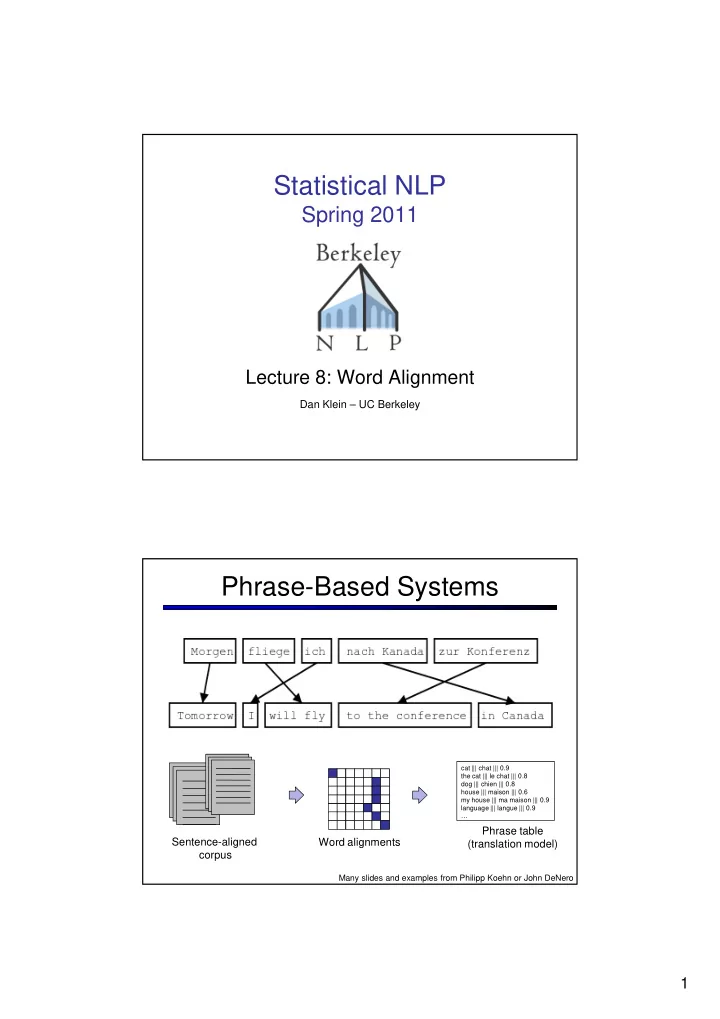
Statistical NLP Spring 2011 Lecture 8: Word Alignment Dan Klein UC Berkeley Phrase-Based Systems cat ||| chat ||| 0.9 the cat ||| le chat ||| 0.8 dog ||| chien ||| 0.8 house ||| maison ||| 0.6 my house ||| ma maison ||| 0.9 language


slide-1
SLIDE 1

1

Statistical NLP

Spring 2011

Lecture 8: Word Alignment

Dan Klein – UC Berkeley

Phrase-Based Systems

Sentence-aligned corpus

cat ||| chat ||| 0.9 the cat ||| le chat ||| 0.8 dog ||| chien ||| 0.8 house ||| maison ||| 0.6 my house ||| ma maison ||| 0.9 language ||| langue ||| 0.9 …

Phrase table (translation model) Word alignments

Many slides and examples from Philipp Koehn or John DeNero

slide-2
SLIDE 2

2

The Pharaoh “Model”

[Koehn et al, 2003] Segmentation Translation Distortion

Phrase-Based Decoding

slide-3
SLIDE 3

3

Phrase Translation

  • If monotonic, almost an HMM; technically a semi-HMM
  • If distortion… now what?

for (fPosition in 1…|f|) for (lastPosition < fPosition) for (eContext in eContexts) for (eOption in translations[fPosition]) … combine hypothesis for (lastPosition ending in eContext) with eOption

Non-Monotonic Phrasal MT

slide-4
SLIDE 4

4

Pruning: Beams + Forward Costs

Problem: easy partial analyses are cheaper

Solution 1: use beams per foreign subset Solution 2: estimate forward costs (A*-like)

The Pharaoh Decoder

slide-5
SLIDE 5

5

Hypotheis Lattices Word Alignment

slide-6
SLIDE 6

6

Word Alignment

  • Unsupervised Word Alignment
  • Input: a bitext: pairs of translated sentences
  • Output: alignments: pairs of

translated words

When words have unique sources, can represent as a (forward) alignment function a from French to English positions

nous acceptons votre opinion . we accept your view .

slide-7
SLIDE 7

7

1-to-Many Alignments IBM Model 1 (Brown 93)

  • Alignments: a hidden vector called an alignment specifies which

English source is responsible for each French target word.

slide-8
SLIDE 8

8

A:

IBM Models 1/2

Thank you , I shall do so gladly .

1 3 7 6 9

1 2 3 4 5 7 6 8 9

Model Parameters

Transitions: P( A2 = 3) Emissions: P( F1 = Gracias | EA1 = Thank )

Gracias , lo haré de muy buen grado .

8 8 8 8

E: F:

Evaluating TMs

How do we measure quality of a word-to-word model?

Method 1: use in an end-to-end translation system

Hard to measure translation quality Option: human judges Option: reference translations (NIST, BLEU) Option: combinations (HTER) Actually, no one uses word-to-word models alone as TMs

Method 2: measure quality of the alignments produced

Easy to measure Hard to know what the gold alignments should be Often does not correlate well with translation quality (like perplexity in LMs)

slide-9
SLIDE 9

9

Alignment Error Rate

Alignment Error Rate

  • Problems with Model 1

There’s a reason they designed models 2-5! Problems: alignments jump around, align everything to rare words Experimental setup:

Training data: 1.1M sentences of French-English text, Canadian Hansards Evaluation metric: alignment error Rate (AER) Evaluation data: 447 hand- aligned sentences

slide-10
SLIDE 10

10

Intersected Model 1

Post-intersection: standard

practice to train models in each direction then intersect their predictions [Och and Ney, 03]

Second model is basically

a filter on the first

Precision jumps, recall drops End up not guessing hard

alignments Model P/R AER Model 1 E→F 82/58 30.6 Model 1 F→E 85/58 28.7 Model 1 AND 96/46 34.8

Joint Training?

Overall:

Similar high precision to post-intersection But recall is much higher More confident about positing non-null alignments

Model P/R AER Model 1 E→F 82/58 30.6 Model 1 F→E 85/58 28.7 Model 1 AND 96/46 34.8 Model 1 INT 93/69 19.5

slide-11
SLIDE 11

11

Monotonic Translation

Le Japon secoué par deux nouveaux séismes Japan shaken by two new quakes

Local Order Change

Le Japon est au confluent de quatre plaques tectoniques Japan is at the junction of four tectonic plates

slide-12
SLIDE 12

12

IBM Model 2

  • Alignments tend to the diagonal (broadly at least)
  • Other schemes for biasing alignments towards the diagonal:

Relative vs absolute alignment Asymmetric distances Learning a full multinomial over distances

EM for Models 1/2

  • Model 1 Parameters:

Translation probabilities (1+2) Distortion parameters (2 only)

  • Start with

uniform, including

  • For each sentence:

For each French position j

Calculate posterior over English positions (or just use best single alignment) Increment count of word fj with word ei by these amounts Also re-estimate distortion probabilities for model 2

  • Iterate until convergence
slide-13
SLIDE 13

13

Example Phrase Movement

Des tremblements de terre ont à nouveau touché le Japon jeudi 4 novembre. On Tuesday Nov. 4, earthquakes rocked Japan once again

slide-14
SLIDE 14

14

A:

The HMM Model

Thank you , I shall do so gladly .

1 3 7 6 9

1 2 3 4 5 7 6 8 9

Model Parameters

Transitions: P( A2 = 3 | A1 = 1) Emissions: P( F1 = Gracias | EA1 = Thank )

Gracias , lo haré de muy buen grado .

8 8 8 8

E: F:

The HMM Model

Model 2 preferred global monotonicity We want local monotonicity:

Most jumps are small

HMM model (Vogel 96)

Re-estimate using the forward-backward algorithm Handling nulls requires some care

What are we still missing?

  • 2 -1 0 1 2 3
slide-15
SLIDE 15

15

HMM Examples AER for HMMs

Model AER Model 1 INT 19.5 HMM E→F 11.4 HMM F→E 10.8 HMM AND 7.1 HMM INT 4.7 GIZA M4 AND 6.9