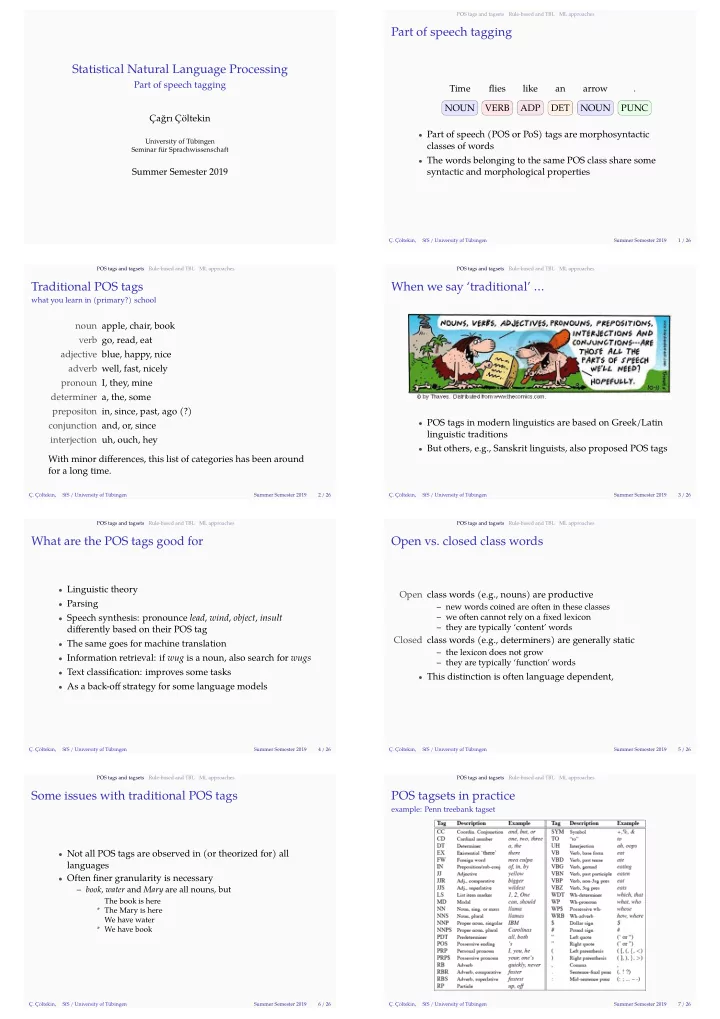
Statistical Natural Language Processing 4 / 26 the lexicon does not - - PDF document

statistical natural language processing
SMART_READER_LITE
LIVE PREVIEW

Statistical Natural Language Processing 4 / 26 the lexicon does not - - PDF document

Statistical Natural Language Processing 4 / 26 the lexicon does not grow Closed class words (e.g., determiners) are generally static they are typically content words we often cannot rely on a fjxed lexicon new words coined


slide-1
SLIDE 1

Statistical Natural Language Processing

Part of speech tagging Çağrı Çöltekin

University of Tübingen Seminar für Sprachwissenschaft

Summer Semester 2019

POS tags and tagsets Rule-based and TBL ML approaches

Part of speech tagging

Time NOUN fmies VERB like ADP an DET arrow NOUN . PUNC

  • Part of speech (POS or PoS) tags are morphosyntactic

classes of words

  • The words belonging to the same POS class share some

syntactic and morphological properties

Ç. Çöltekin, SfS / University of Tübingen Summer Semester 2019 1 / 26 POS tags and tagsets Rule-based and TBL ML approaches

Traditional POS tags

what you learn in (primary?) school

noun apple, chair, book verb go, read, eat adjective blue, happy, nice adverb well, fast, nicely pronoun I, they, mine determiner a, the, some prepositon in, since, past, ago (?) conjunction and, or, since interjection uh, ouch, hey With minor difgerences, this list of categories has been around for a long time.

Ç. Çöltekin, SfS / University of Tübingen Summer Semester 2019 2 / 26 POS tags and tagsets Rule-based and TBL ML approaches

When we say ‘traditional’ …

  • POS tags in modern linguistics are based on Greek/Latin

linguistic traditions

  • But others, e.g., Sanskrit linguists, also proposed POS tags

Ç. Çöltekin, SfS / University of Tübingen Summer Semester 2019 3 / 26 POS tags and tagsets Rule-based and TBL ML approaches

What are the POS tags good for

  • Linguistic theory
  • Parsing
  • Speech synthesis: pronounce lead, wind, object, insult

difgerently based on their POS tag

  • The same goes for machine translation
  • Information retrieval: if wug is a noun, also search for wugs
  • Text classifjcation: improves some tasks
  • As a back-ofg strategy for some language models

Ç. Çöltekin, SfS / University of Tübingen Summer Semester 2019 4 / 26 POS tags and tagsets Rule-based and TBL ML approaches

Open vs. closed class words

Open class words (e.g., nouns) are productive

– new words coined are often in these classes – we often cannot rely on a fjxed lexicon – they are typically ‘content’ words

Closed class words (e.g., determiners) are generally static

– the lexicon does not grow – they are typically ‘function’ words

  • This distinction is often language dependent,

Ç. Çöltekin, SfS / University of Tübingen Summer Semester 2019 5 / 26 POS tags and tagsets Rule-based and TBL ML approaches

Some issues with traditional POS tags

  • Not all POS tags are observed in (or theorized for) all

languages

  • Often fjner granularity is necessary

– book, water and Mary are all nouns, but

The book is here * The Mary is here We have water * We have book

Ç. Çöltekin, SfS / University of Tübingen Summer Semester 2019 6 / 26 POS tags and tagsets Rule-based and TBL ML approaches

POS tagsets in practice

example: Penn treebank tagset

Ç. Çöltekin, SfS / University of Tübingen Summer Semester 2019 7 / 26

slide-2
SLIDE 2

POS tags and tagsets Rule-based and TBL ML approaches

POS tagsets in practice

example 2: STTS tagset

POS description examples … … … KOUI subordinating conjunction um [zu leben], anstatt [zu fragen] KOUS subordinating conjunction weil, daß, damit, wenn, ob KON coordinative conjunction und, oder, aber KOKOM particle of comparison, no clause als, wie NN noun Tisch, Herr, [das] Reisen NE proper noun Hans, Hamburg, HSV PDS substituting demonstrative dieser, jener PIS substituting indefjnite pronoun keiner, viele, man, niemand PIAT attributive indefjnite kein [Mensch], irgendein [Glas] PIDAT attributive indefjnite [ein] wenig [Wasser], PPER irrefmexive personal pronoun ich, er, ihm, mich, dir PPOSS substituting possessive pronoun meins, deiner PPOSAT attributive possessive pronoun mein [Buch], deine [Mutter] PRELS substituting relative pronoun [der Hund,] der PRELAT attributive relative pronoun [der Mann ,] dessen [Hund] … … …

Ç. Çöltekin, SfS / University of Tübingen Summer Semester 2019 8 / 26 POS tags and tagsets Rule-based and TBL ML approaches

POS tagset choices

  • The choice of tagsets depends on the language and

application

  • Example tag set sizes (for English)

– Brown corpus, 87 tags – Penn treebank 45 tags – BNC, 61 tags

  • Difgerences can be large, for Chinese Penn treebank has 34

tags, but tagsets with about 300 tags exist

  • For other languages, the choice varies roughly between

about 10 to a few hundred

Ç. Çöltekin, SfS / University of Tübingen Summer Semester 2019 9 / 26 POS tags and tagsets Rule-based and TBL ML approaches

Shift towards more ‘universal’ tag sets

  • The variation in POS tagset choices often makes it diffjcult

to

– compare alternative approaches – use the same tools on difgerent languages of data sets

  • There has been a recent trend for ‘universal’ tag sets
  • The result is a smaller POS tag set (back to the tradition)
  • But often supplemented with morphological features

Ç. Çöltekin, SfS / University of Tübingen Summer Semester 2019 10 / 26 POS tags and tagsets Rule-based and TBL ML approaches

POS tagsets in recent practice

example: Universal Dependencies tag set

ADJ adjective ADP adposition ADV adverb AUX auxiliary CCONJ coordinating conjunction DET determiner INTJ interjection NOUN noun NUM numeral PART particle PRON pronoun PROPN proper noun PUNCT punctuation SCONJ subordinating conjunction SYM symbol VERB verb X other

Ç. Çöltekin, SfS / University of Tübingen Summer Semester 2019 11 / 26 POS tags and tagsets Rule-based and TBL ML approaches

Morphological features

  • Annotating words with morphological features has been

common in (non-English) NLP

  • Morphological features give additional sub-categorization

information for the word

  • For example

nouns typically have number and case feature verbs typically have tense, aspect, modality voice features adjectives typically have degree

  • Morphological feature sets change depending on the

language (typology)

Ç. Çöltekin, SfS / University of Tübingen Summer Semester 2019 12 / 26 POS tags and tagsets Rule-based and TBL ML approaches

Morphological features

an example

Time NOUN

num=sing

fmies VERB

num=sing pers=3 tense=pres

like ADP an DET

def=ind

arrow NOUN

num=sing

. PUNC

Ç. Çöltekin, SfS / University of Tübingen Summer Semester 2019 13 / 26 POS tags and tagsets Rule-based and TBL ML approaches

POS tags are ambiguous

Time NOUN NOUN fruit fmies VERB NOUN fmies like ADP VERB like an DET DET an arrow NOUN NOUN apple . PUNC PUNC . Part of speech tagging is essentially an ambiguity resolution problem.

Ç. Çöltekin, SfS / University of Tübingen Summer Semester 2019 14 / 26 POS tags and tagsets Rule-based and TBL ML approaches

POS tag ambiguity

More examples

  • Some words are highly ambiguous

ADJ the back door NOUN on our back ADV take it back VERB we will back them

  • The garden-path sentences are often POS ambiguities

– The old man the boats – The complex houses married and single soldiers and their families

Ç. Çöltekin, SfS / University of Tübingen Summer Semester 2019 15 / 26

slide-3
SLIDE 3

POS tags and tagsets Rule-based and TBL ML approaches

POS tagging: strategies

POS tagging can be solved in a number of difgerent methods

  • Rule-based methods: ‘constraint grammar’ (CG)
  • Transformation based: Brill tagger
  • Machine-learning approaches

Typical statistical approaches involve sequence learning methods:

– Hidden Markov models – Conditional random fjelds – (Recurrent) neural networks

Ç. Çöltekin, SfS / University of Tübingen Summer Semester 2019 16 / 26 POS tags and tagsets Rule-based and TBL ML approaches

Rule-based POS tagging

typical approach

  • Using a tag lexicon, start with assigning all possible tags to

each word

  • Eliminate tags based on hand-crafted rules
  • Rules typically rely on the words and (potential) tags of

the words in the context

  • Result is not always full disambiguation, some ambiguity

may remain

  • Some probabilistic constraints may also be applied

Ç. Çöltekin, SfS / University of Tübingen Summer Semester 2019 17 / 26 POS tags and tagsets Rule-based and TBL ML approaches

Rule-based POS tagging

an example

  • Among others, the word that can be

SCONJ we know that it is bad ADV it is not that bad

An example rule for disambiguation (simplifjed):

1 if the next word is ADJ 2 and the next word is sentence fjnal 3 and the previous word is not a verb like ‘ consider ’ 4 then eliminate SCONJ 5 else eliminate ADV

  • The rules above prefer SCONJ for cases like I consider that

funny.

Ç. Çöltekin, SfS / University of Tübingen Summer Semester 2019 18 / 26 POS tags and tagsets Rule-based and TBL ML approaches

Transformation based tagging (TBL)

  • The idea: learn a sequence of rules (similar to CG) using a

tagged corpus

  • The rules transform an initial POS assignment to

(approximately) the POS tag assignment in the training corpus

  • During test time apply the rules in the same order

Ç. Çöltekin, SfS / University of Tübingen Summer Semester 2019 19 / 26 POS tags and tagsets Rule-based and TBL ML approaches

Learning in TBL

  • 1. Start with most likely tags for each word
  • 2. Find the best rule that improves the tagging accuracy,
  • 3. Repeat 2 for all possible rules
  • Rules need to be restricted, often templates are used. For

example: Change tag x to tag y if

– the preceding/following word is tagged z – the preceding word tagged v and the following word is tagged z – the preceding word tagged v and the following word is tagged z and two words before is tagged t

Ç. Çöltekin, SfS / University of Tübingen Summer Semester 2019 20 / 26 POS tags and tagsets Rule-based and TBL ML approaches

Transformation based learning

An example

Time NOUN NOUN NOUN fmies NOUN VERB VERB like VERB VERB ADP an DET DET DET arrow NOUN NOUN NOUN . PUNC PUNC PUNC

  • Start with most likely POS tags
  • Apply: change NOUN to VERB if preceding word is NOUN and …
  • Apply: change VERB to ADP if preceding word is tagged as VERB
  • Stop when none of the rules improve the result

Ç. Çöltekin, SfS / University of Tübingen Summer Semester 2019 21 / 26 POS tags and tagsets Rule-based and TBL ML approaches

ML methods for POS tagging

  • POS tagging is a typical example of ‘sequence labeling’
  • Many of the ML methods introduced earlier can be used

for POS tagging

  • Sequence learning methods are more suitable, since the

tags depend on the neighboring tags

– Hidden Markov models (HMMs) – Hidden Markov max-ent models (HMMEMs) – Conditional random fjelds (CRFs) – Recurrent neural networks (RNNs)

Ç. Çöltekin, SfS / University of Tübingen Summer Semester 2019 22 / 26 POS tags and tagsets Rule-based and TBL ML approaches

POS tagging using Hidden Markov models (HMM)

S

Time NOUN fmies VERB like ADP an DET arrow NOUN . PUNC

  • The tags are hidden
  • Probability of a tag depends on the previous tag
  • Probability of a word at a given state depends only on the

current tag

  • Parameters of the model can be learned

supervised from a tagged corpus (e.g., MLE) unsupervised using EM (Baum-Welch algorithm)

Ç. Çöltekin, SfS / University of Tübingen Summer Semester 2019 23 / 26

slide-4
SLIDE 4

POS tags and tagsets Rule-based and TBL ML approaches

RNNs for POS tagging

Time fmies like an arrow .

embedding embedding embedding embedding embedding embedding

h1 h2 h3 h4 h5 h6

classifjer classifjer classifjer classifjer classifjer classifjer

NOUN VERB ADP DET NOUN PUNC

Ç. Çöltekin, SfS / University of Tübingen Summer Semester 2019 24 / 26 POS tags and tagsets Rule-based and TBL ML approaches

POS tagging accuracy

  • Tagging each word with the most probable tag gives

around 90 % accuracy

  • State-of-the art POS taggers (for English) achieve

95 %–97 %

  • Human agreement on annotation also seems to be around

97 %: not a lot of space for improvement

– at least for well-studied resource-rich languages

Ç. Çöltekin, SfS / University of Tübingen Summer Semester 2019 25 / 26 POS tags and tagsets Rule-based and TBL ML approaches

Summary

  • POS is an old idea in linguistics
  • POS tags have uses in both linguistics, and practical

applications

  • Common methods for automatic POS tagging include

– rule-based – transformation-based – statistical (more on this next week)

methods Next: Mon/Fri Vector representations

Ç. Çöltekin, SfS / University of Tübingen Summer Semester 2019 26 / 26