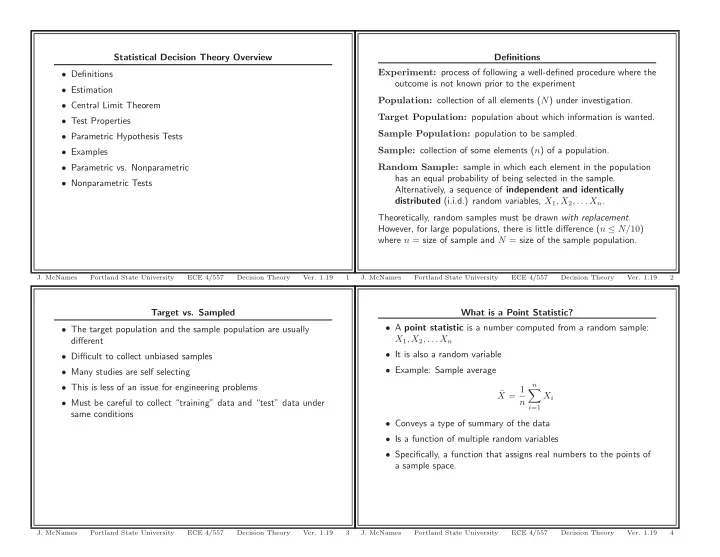
Statistical Decision Theory Overview Definitions Experiment: process - - PowerPoint PPT Presentation

statistical decision theory overview definitions
SMART_READER_LITE
LIVE PREVIEW

Statistical Decision Theory Overview Definitions Experiment: process - - PowerPoint PPT Presentation

Statistical Decision Theory Overview Definitions Experiment: process of following a well-defined procedure where the Definitions outcome is not known prior to the experiment Estimation Population: collection of all elements ( N ) under


slide-1
SLIDE 1

Target vs. Sampled

  • The target population and the sample population are usually

different

  • Difficult to collect unbiased samples
  • Many studies are self selecting
  • This is less of an issue for engineering problems
  • Must be careful to collect “training” data and “test” data under

same conditions

  • J. McNames

Portland State University ECE 4/557 Decision Theory

  • Ver. 1.19

3

Statistical Decision Theory Overview

  • Definitions
  • Estimation
  • Central Limit Theorem
  • Test Properties
  • Parametric Hypothesis Tests
  • Examples
  • Parametric vs. Nonparametric
  • Nonparametric Tests
  • J. McNames

Portland State University ECE 4/557 Decision Theory

  • Ver. 1.19

1

What is a Point Statistic?

  • A point statistic is a number computed from a random sample:

X1, X2, . . . Xn

  • It is also a random variable
  • Example: Sample average

¯ X = 1 n

n

  • i=1

Xi

  • Conveys a type of summary of the data
  • Is a function of multiple random variables
  • Specifically, a function that assigns real numbers to the points of

a sample space.

  • J. McNames

Portland State University ECE 4/557 Decision Theory

  • Ver. 1.19

4

Definitions Experiment: process of following a well-defined procedure where the

  • utcome is not known prior to the experiment

Population: collection of all elements (N) under investigation. Target Population: population about which information is wanted. Sample Population: population to be sampled. Sample: collection of some elements (n) of a population. Random Sample: sample in which each element in the population has an equal probability of being selected in the sample. Alternatively, a sequence of independent and identically distributed (i.i.d.) random variables, X1, X2, . . . Xn. Theoretically, random samples must be drawn with replacement. However, for large populations, there is little difference (n ≤ N/10) where n = size of sample and N = size of the sample population.

  • J. McNames

Portland State University ECE 4/557 Decision Theory

  • Ver. 1.19

2

slide-2
SLIDE 2

Example 1: MATLAB Code

function [] = PrctilePlot(); FigureSet(1,’LTX’); p = 0:0.1:100; y = prctile(1:10,p); h = plot(p,y); set(h,’LineWidth’,1.5); xlim([0 100]); ylim([0 11]); xlabel(’p (%)’); ylabel(’pth percentile’); box off; grid on; AxisSet(8); print -depsc PrctilePlot;

  • J. McNames

Portland State University ECE 4/557 Decision Theory

  • Ver. 1.19

7

More Definitions Order Statistic of rank k, X(k): statistic that takes as its value the kth smallest element x(k) in each observation (x1, x2, . . . xn)

  • f (X1, X2, . . . Xn)

pth Sample Quantile: number Qp that satisfies

  • 1. The fraction of Xis that are strictly less than Qp is ≤ p
  • 2. The fraction of Xis that are strictly greater than Qp is ≤ 1 − p.
  • If more than one value meets criteria, choose average of

smallest and largest.

  • There are other estimates of quantiles that do not assign 0%

and 100% to the smallest and largest observations

  • J. McNames

Portland State University ECE 4/557 Decision Theory

  • Ver. 1.19

5

Sample Mean and Variance Sample Mean: ¯ X = ˆ µX = 1 n

n

  • i=1

Xi Sample Variance: s2

X = ˆ

σ2

X =

1 n − 1

n

  • i=1

(Xi − ¯ X)2 Sample Standard Deviation: sX = ˆ σX =

  • s2

X

  • J. McNames

Portland State University ECE 4/557 Decision Theory

  • Ver. 1.19

8

Example 1: MATLAB’s Prctile Function

10 20 30 40 50 60 70 80 90 100 1 2 3 4 5 6 7 8 9 10 11 p (%) pth percentile

  • J. McNames

Portland State University ECE 4/557 Decision Theory

  • Ver. 1.19

6

slide-3
SLIDE 3

Central Limit Theorem Let Yn be the sum of n i.i.d. random variables X1, X2, . . . , Xn, let µYn be the mean of Yn, and σ2

Yn be the variance of Yn. As n → ∞,

the distribution of the z-score Z = Yn − µYn σYn approaches the standard normal distribution.

  • In many cases, it is assumed that the random sample was drawn

from a normal distribution

  • This is justified by the central limit theorem (CLT)
  • There are many variations
  • Key conditions:

1 RV’s Xi must have finite mean 2 RV’s must have finite variance

  • RV’s can have any distribution as long as they meet this criteria
  • J. McNames

Portland State University ECE 4/557 Decision Theory

  • Ver. 1.19

11

Point vs. Interval Estimators

  • Our discussion so far has generated point estimates
  • Given a random sample, we estimate a single descriptive statistic
  • Usually preferred to have interval estimates

– Example: “We are 95% confident the unknown mean lies between 1.3 and 2.7.” – Usually more difficult to obtain – Consist of 2 statistics (each endpoint of the interval) and a confidence coefficient

  • Also called a confidence interval
  • J. McNames

Portland State University ECE 4/557 Decision Theory

  • Ver. 1.19

9

Central Limit Theorem Continued

  • For large sums, the normal approximation is frequently used

instead of the exact distribution

  • Also “works” empirically when Xi not identically distributed
  • Xi must be independent
  • For most data sets, n = 30 is generally accepted as large enough

for the CLT to apply

  • This is remarkable considering the theorem only applies as n → ∞
  • The center of the distribution becomes normally distributed more

quickly (i.e., with smaller n) than the tails

  • J. McNames

Portland State University ECE 4/557 Decision Theory

  • Ver. 1.19

12

Biased Estimation

  • An estimator ˆ

θ is an unbiased estimator of the population parameter θ if E[ˆ θ] = θ

  • Sample mean of a random sample is an unbiased estimate of

population (true) mean

  • Sample variance s2

X = 1 n−1

n

i=1(Xi − ¯

X)2 is unbiased estimate

  • f true (population) variance

– Why

1 n−1?

– We lose one degree of freedom by estimating E[X] with ¯ X – Is one of your homework problems

  • sX is a biased estimate of the true population standard deviation
  • J. McNames

Portland State University ECE 4/557 Decision Theory

  • Ver. 1.19

10

slide-4
SLIDE 4

Example 3: CLT Applied to Binomial RV

−2.5 −2 −1.5 −1 −0.5 0.5 1 1.5 2 2.5 0.5 1 1.5 2 2.5 3 3.5 PDF Estimate Normalized Binomial Histogram for z N:5 NS:1000 Binomial Estimated Gaussian

  • J. McNames

Portland State University ECE 4/557 Decision Theory

  • Ver. 1.19

15

Example 2: Central Limit Theorem for Binomial RV E[Y ] = np σ2

Y = np(1 − p)

  • A sum of Bernoulli random variables, Y = n

i=1 Xi, has a

binomial distribution

  • Xi are Bernoulli random variables that take on either a 1 with

probability p or a 0 with probability 1 − p

  • Define

Z = Y − E[Y ] σY

  • Let us approximate the PDF of Z from a random sample of 1000

points

  • How good is the PDF of Z approximated by a normal distribution?
  • J. McNames

Portland State University ECE 4/557 Decision Theory

  • Ver. 1.19

13

Example 3: CLT Applied to Binomial RV

−3 −2 −1 1 2 3 0.5 1 1.5 2 2.5 PDF Estimate Normalized Binomial Histogram for z N:10 NS:1000 Binomial Estimated Gaussian

  • J. McNames

Portland State University ECE 4/557 Decision Theory

  • Ver. 1.19

16

Example 3: CLT Applied to Binomial RV

−1.5 −1 −0.5 0.5 1 1.5 0.5 1 1.5 2 2.5 3 3.5 4 4.5 5 PDF Estimate Normalized Binomial Histogram for z N:2 NS:1000 Binomial Estimated Gaussian

  • J. McNames

Portland State University ECE 4/557 Decision Theory

  • Ver. 1.19

14

slide-5
SLIDE 5

Example 3: CLT Applied to Binomial RV

−4 −3 −2 −1 1 2 3 4 0.1 0.2 0.3 0.4 0.5 0.6 0.7 0.8 0.9 PDF Estimate Normalized Binomial Histogram for z N:100 NS:1000 Binomial Estimated Gaussian

  • J. McNames

Portland State University ECE 4/557 Decision Theory

  • Ver. 1.19

19

Example 3: CLT Applied to Binomial RV

−4 −3 −2 −1 1 2 3 0.2 0.4 0.6 0.8 1 1.2 1.4 1.6 1.8 2 PDF Estimate Normalized Binomial Histogram for z N:20 NS:1000 Binomial Estimated Gaussian

  • J. McNames

Portland State University ECE 4/557 Decision Theory

  • Ver. 1.19

17

Example 3: CLT Applied to Binomial RV

−3 −2 −1 1 2 3 4 0.1 0.2 0.3 0.4 0.5 PDF Estimate Normalized Binomial Histogram for z N:1000 NS:1000 Binomial Estimated Gaussian

  • J. McNames

Portland State University ECE 4/557 Decision Theory

  • Ver. 1.19

20

Example 3: CLT Applied to Binomial RV

−3 −2 −1 1 2 3 0.2 0.4 0.6 0.8 1 1.2 1.4 1.6 PDF Estimate Normalized Binomial Histogram for z N:30 NS:1000 Binomial Estimated Gaussian

  • J. McNames

Portland State University ECE 4/557 Decision Theory

  • Ver. 1.19

18

slide-6
SLIDE 6

legend([h(2) h(1)],’Binomial Estimated’,’Gaussian’); st = sprintf(’print -depsc CLTBinomial%04d’,np); eval(st); drawnow; %fprintf(’Pausing...\n’); pause; end;

  • J. McNames

Portland State University ECE 4/557 Decision Theory

  • Ver. 1.19

23

Example 3: CLT Applied to Binomial RV

−3 −2 −1 1 2 3 0.1 0.2 0.3 0.4 0.5 PDF Estimate Normalized Binomial Histogram for z N:5000 NS:1000 Binomial Estimated Gaussian

  • J. McNames

Portland State University ECE 4/557 Decision Theory

  • Ver. 1.19

21

Example 4: CLT Applied to Exponential RV

−5 −4 −3 −2 −1 1 2 3 4 5 0.1 0.2 0.3 0.4 0.5 0.6 0.7 0.8 0.9 1 PDF Estimate Normalized Exponential Sum Histogram for z N:1 NS:1000 Exponential Sum Estimated Gaussian

  • J. McNames

Portland State University ECE 4/557 Decision Theory

  • Ver. 1.19

24

Example 3: MATLAB Code

function [] = CLTBinomial(); close all; FigureSet(1,’LTX’); NP = [2,5,10,20,30,100,1000,5000]; % No. histograms NS = 1000; % No. Samples p = 0.5; % Probability of 1 for cnt = 1:length(NP), np = NP(cnt); r = binornd(np,p,NS,1); % Random sample of NS sums mu = np*p; s2 = np*p*(1-p); z = (r-mu)/sqrt(s2); figure; FigureSet(1,’LTX’); Histogram(z,0.1,0.20); hold on; x = -5:0.02:5; y1 = 1/sqrt(2*pi).*exp(-x.^2/2); h = plot(x,y1,’r’); x2 = 0:np; y2 = binopdf(x2,np,p); x2 = (x2-mu)/sqrt(s2); %h = goodstem(x2,y2,’g’); %set(h,’LineWidth’,1.5); hold off; %set(gca,’XLim’,[-5 5]); st = sprintf(’Normalized Binomial Histogram for z N:%d NS:%d’,np,NS); title(st); box off; AxisSet(8); h = get(gca,’Children’);

  • J. McNames

Portland State University ECE 4/557 Decision Theory

  • Ver. 1.19

22

slide-7
SLIDE 7

Example 4: CLT Applied to Exponential RV

−5 −4 −3 −2 −1 1 2 3 4 5 0.1 0.2 0.3 0.4 0.5 0.6 PDF Estimate Normalized Exponential Sum Histogram for z N:10 NS:1000 Exponential Sum Estimated Gaussian

  • J. McNames

Portland State University ECE 4/557 Decision Theory

  • Ver. 1.19

27

Example 4: CLT Applied to Exponential RV

−5 −4 −3 −2 −1 1 2 3 4 5 0.1 0.2 0.3 0.4 0.5 0.6 PDF Estimate Normalized Exponential Sum Histogram for z N:2 NS:1000 Exponential Sum Estimated Gaussian

  • J. McNames

Portland State University ECE 4/557 Decision Theory

  • Ver. 1.19

25

Example 4: CLT Applied to Exponential RV

−5 −4 −3 −2 −1 1 2 3 4 5 0.05 0.1 0.15 0.2 0.25 0.3 0.35 0.4 0.45 0.5 PDF Estimate Normalized Exponential Sum Histogram for z N:20 NS:1000 Exponential Sum Estimated Gaussian

  • J. McNames

Portland State University ECE 4/557 Decision Theory

  • Ver. 1.19

28

Example 4: CLT Applied to Exponential RV

−5 −4 −3 −2 −1 1 2 3 4 5 0.1 0.2 0.3 0.4 0.5 PDF Estimate Normalized Exponential Sum Histogram for z N:5 NS:1000 Exponential Sum Estimated Gaussian

  • J. McNames

Portland State University ECE 4/557 Decision Theory

  • Ver. 1.19

26

slide-8
SLIDE 8

Example 4: CLT Applied to Exponential RV

−5 −4 −3 −2 −1 1 2 3 4 5 0.1 0.2 0.3 0.4 0.5 PDF Estimate Normalized Exponential Sum Histogram for z N:1000 NS:1000 Exponential Sum Estimated Gaussian

  • J. McNames

Portland State University ECE 4/557 Decision Theory

  • Ver. 1.19

31

Example 4: CLT Applied to Exponential RV

−5 −4 −3 −2 −1 1 2 3 4 5 0.1 0.2 0.3 0.4 0.5 PDF Estimate Normalized Exponential Sum Histogram for z N:30 NS:1000 Exponential Sum Estimated Gaussian

  • J. McNames

Portland State University ECE 4/557 Decision Theory

  • Ver. 1.19

29

Example 4: CLT Applied to Exponential RV

−5 −4 −3 −2 −1 1 2 3 4 5 0.1 0.2 0.3 0.4 0.5 PDF Estimate Normalized Exponential Sum Histogram for z N:5000 NS:1000 Exponential Sum Estimated Gaussian

  • J. McNames

Portland State University ECE 4/557 Decision Theory

  • Ver. 1.19

32

Example 4: CLT Applied to Exponential RV

−5 −4 −3 −2 −1 1 2 3 4 5 0.05 0.1 0.15 0.2 0.25 0.3 0.35 0.4 0.45 0.5 PDF Estimate Normalized Exponential Sum Histogram for z N:100 NS:1000 Exponential Sum Estimated Gaussian

  • J. McNames

Portland State University ECE 4/557 Decision Theory

  • Ver. 1.19

30

slide-9
SLIDE 9

Approximate Confidence Intervals Let Yn be the sum of n i.i.d. random variables X1, X2, . . . , Xn, Yn =

n

  • i=1

Xi and let µX be the mean of Xi and σ2

X be the variance of Xi. As

n → ∞, the distribution of Z = Yn − nµX

  • nσ2

X

= ¯ X − µX σX/√n approaches the standard normal distribution.

  • J. McNames

Portland State University ECE 4/557 Decision Theory

  • Ver. 1.19

35

Example 4: MATLAB Code

function [] = CLTExponential(); close all; FigureSet(1,’LTX’); NP = [1,2,5,10,20,30,100,1000,5000]; % No. histograms NS = 1000; % No. Samples p = 0.5; % Probability of 1 lambda = 2; % Exponential Parameter for cnt = 1:length(NP), np = NP(cnt); r = exprnd(1/lambda,np,NS); % Random sample of NS sums if np~=1, r = sum(r); end; mu = np/lambda; s2 = np/lambda^2; z = (r-mu)/sqrt(s2); figure; FigureSet(1,’LTX’); Histogram(z,0.1,0.20); hold on; x = -5:0.02:5; y1 = 1/sqrt(2*pi).*exp(-x.^2/2); h = plot(x,y1,’r’); x2 = 0:np; y2 = binopdf(x2,np,p); x2 = (x2-mu)/sqrt(s2); hold off; set(gca,’XLim’,[-5 5]); st = sprintf(’Normalized Exponential Sum Histogram for z N:%d NS:%d’,np,NS); title(st); AxisSet(8);

  • J. McNames

Portland State University ECE 4/557 Decision Theory

  • Ver. 1.19

33

Approximate Confidence Intervals Continued 1 Thus, we may approximate the probability that Z is within an interquantile range Pr

  • −z1−α/2 ≤

¯ X − µX σX/√n ≤ z1−α/2

  • = 1 − α

Note −z1-α/2 = zα/2 because the normal distribution is symmetric about the mean. This can be rearranged as Pr

  • ¯

X − z1−α/2 σX √n ≤ µX ≤ ¯ X + z1−α/2 σX √n

  • = 1 − α
  • σX is seldom known
  • Usually approximate with usual sample estimate

ˆ σX =

  • s2

X

  • J. McNames

Portland State University ECE 4/557 Decision Theory

  • Ver. 1.19

36

box off; h = get(gca,’Children’); legend([h(2) h(1)],’Exponential Sum Estimated’,’Gaussian’); st = sprintf(’print -depsc CLTExponential%04d’,np); eval(st); drawnow; end;

  • J. McNames

Portland State University ECE 4/557 Decision Theory

  • Ver. 1.19

34

slide-10
SLIDE 10

Hypothesis Testing

  • Hypothesis testing or statistical decision theory is an important

part of statistical inference

  • Hypothesis testing is the process of inferring from a sample

whether a given statement is true

  • The statement is called the hypothesis
  • Examples

– “Women are more likely than men to have automobile accidents” – “Machine A is more likely to produce faulty parts than Machine B” – “Rabbits can distinguish between red flowers and blue flowers” – “The defendant is guilty”

  • The hypothesis is always a true/false statement
  • Test does not determine the degree of truth of the statement
  • J. McNames

Portland State University ECE 4/557 Decision Theory

  • Ver. 1.19

39

Approximate Confidence Continued 2

zα/2 z1−α/2

  • α controls the probability of making a mistake
  • Recall −z1-α/2 = zα/2
  • The probability of a point falling in the red region is α
  • Called the level of significance
  • Important concept for Hypothesis testing
  • J. McNames

Portland State University ECE 4/557 Decision Theory

  • Ver. 1.19

37

Hypothesis Testing: Step 1 Step 1: State the hypotheses in terms of the population.

  • There are always two
  • Usually, the statement that we would like to prove is called the

alternative hypothesis or research hypothesis (denoted H1)

  • Negation of the alternative hypothesis is called the null

hypothesis (denoted H0)

  • The test is always biased in favor of the null hypothesis

– If data strongly disagree with H0, we reject H0 – If sample doesn’t conflict with H0 or if there is insufficient data, H0 is not rejected – Failure to reject H0 does not imply H0 is true – Sometimes the phrase “Accept the null hypothesis” is used. Don’t be misled by this

  • J. McNames

Portland State University ECE 4/557 Decision Theory

  • Ver. 1.19

40

Example 5: Approximate Confidence Intervals A random sample of 32 parts at a manufacturing plant had an average diameter of 3.2 mm and a sample standard deviation of 1.7 mm. What is the approximate 95% confidence interval for the true mean of the part? Hint: norminv(1-0.05/2) = 1.96.

  • J. McNames

Portland State University ECE 4/557 Decision Theory

  • Ver. 1.19

38

slide-11
SLIDE 11

Hypothesis Testing Example Continued Step 3: Pick the decision rule. The necessary quantiles of a normal distribution are given by z0.05/2 = −1.9600 z1−0.05/2 = 1.9600 z0.01/2 = −2.5758 z1−0.01/2 = 2.5758 Step 4: Evaluate T and make decision. T = ¯ X − µ σ/√n = 523 − 500 97/ √ 100 = 2.3711 We reject H0 at the 0.05 significance level. We fail to reject H0 at the 0.01 significance level.

  • J. McNames

Portland State University ECE 4/557 Decision Theory

  • Ver. 1.19

43

Hypothesis Testing: Steps 2–4 Step 2: Select a test statistic T.

  • Want test statistic to take on some values when H0 is true
  • Want to taken on others when H1 is true
  • Want to be sensitive indicator of whether the data agree or

disagree with H0

  • Test statistic is usually chosen such that its distribution is known

(at least approximately) when H0 is true Step 3: Pick the decision rule.

  • Choose a decision rule in terms of the possible values of T
  • Usually accompanied by the level of significance α

Step 4: Based on the random sample, evaluate T and make a decision

  • J. McNames

Portland State University ECE 4/557 Decision Theory

  • Ver. 1.19

41

Hypothesis Testing: Definitions

Upper Tailed Test Two Tailed Test Lower Tailed Test

zα z1−α zα/2 z1−α/2

  • Critical Region: the set of all points in the sample space that

result in the decision to reject H0

  • Acceptance Region: the set of all points in the sample space not

in the critical region

  • Upper-Tailed Test: H0 is rejected for large values of T
  • Lower-Tailed Test: H0 is rejected for small values of T
  • Two-Tailed Test: H0 is rejected for large or small values of T
  • J. McNames

Portland State University ECE 4/557 Decision Theory

  • Ver. 1.19

44

Hypothesis Testing Example The average lifetime of a sample of 100 integrated circuits (IC) is 523 days with a standard deviation of 97 days. If µ is the mean lifetime of all the IC’s produced by the company, test the hypothesis µ = 500 days against the alternative hypothesis µ = 500 days using levels of significance 0.05 and 0.01. Step 1: The hypotheses are stated in terms of the population. H0: µ = 500 days H1: µ = 500 days Step 2: Select a test statistic T. Since n = 100, we can assume the CLT applies and let us use as our test statistic T = ¯ X − µ s/√n By the CLT, we know the distribution is approximately normal.

  • J. McNames

Portland State University ECE 4/557 Decision Theory

  • Ver. 1.19

42

slide-12
SLIDE 12

Hypothesis Testing: p-Value

  • Selection of critical region depends only on user’s preference
  • p-value:

– Smallest significance level at which H0 would be rejected for the observed T – Probability that the sample outcome could have been more extreme than the observed one when H0 is true

  • Especially small p-values indicate H0 is strongly rejected
  • Especially large p-values indicate data is consistent with H0
  • Usually stated along with the name of the test and the level of

significance, α

  • In two-tailed tests the p-value can be stated as twice the smaller
  • f the one-tailed p values
  • J. McNames

Portland State University ECE 4/557 Decision Theory

  • Ver. 1.19

47

Hypothesis Testing: More Definitions

  • Type I Error: Error of rejecting H0 when it is true

– Denoted α – Sometimes called a false positive

  • Type II Error: Error of accepting H0 when it is false

– Denoted β – Sometimes called a false negative

  • Level of Significance: maximum probability of rejecting H0

when it is true (type I error) – Denoted α

  • Power: probability of rejecting H0 when it is false.

– Denoted 1 − β – This is the probability of not making a type II error. – Sometimes called the true positive rate

  • Null Distribution: the PDF of T when H0 is true.
  • J. McNames

Portland State University ECE 4/557 Decision Theory

  • Ver. 1.19

45

Testing Sample Means

  • Let T = ¯

X = 1

n

n

i=1 Xi

  • Let n be the size of the sample
  • Xi are i.i.d.

Then T = z = ¯ X − µX

σX √n

= ¯ X − µ ¯

X

σ ¯

X

has a distribution that is approximately normal.

  • E[ ¯

X] = E[X]

  • σ2

¯ X = 1 nσ2 X

  • If σ ¯

X is not known, the estimated standard deviation s ¯ X can be

used

  • s2

X = 1 n−1

n

i=1(Xi − ¯

X)2

  • s2

¯ X = 1 ns2 X ≈ σ2 ¯ X

  • J. McNames

Portland State University ECE 4/557 Decision Theory

  • Ver. 1.19

48

Hypothesis Testing: Error Table Summary H0 is True H0 is False Fail to Reject H0 1 − α (TN) β (type II error, FN) Reject H0 α (type I error, FP) 1 − β (power, TP)

  • The user selects α
  • Generally,

– α = 0.05 interpreted as probably significant – α = 0.01 interpreted as highly significant

  • α = 0.05: 5 times in 100 we would make a type I error
  • α = 0.01: 1 time in 100 we would make a type I error
  • Often β is unknown
  • J. McNames

Portland State University ECE 4/557 Decision Theory

  • Ver. 1.19

46

slide-13
SLIDE 13

Testing Proportions

  • Consider a binary criterion or test that yields either a success or

failure.

  • Let T = ˆ

p where ˆ p is the proportion of successes

  • Let n be the size of the sample
  • Let p denote the proportion of “true” successes (if the test were

applied to the entire population) Then z = ˆ p − p

  • p(1−p)

n

has a distribution that is approximately normal.

  • σ2 = p(1−p)

n

  • J. McNames

Portland State University ECE 4/557 Decision Theory

  • Ver. 1.19

51

Example 6: Sample Means An IC manufacturer knows that their integrated circuits have a mean maximum operating frequency of 500 MHz with a standard deviation

  • f 50 MHz. With a new process, it is claimed that the maximum
  • perating frequency can be increased. To test this claim, a sample of

50 IC’s were tested and it was found that the average maximum

  • perating frequency was 520 MHz. Can we support the claim at the

0.01 significance level? Hint: z1−0.01 = 2.3263 and z0.9977 = 2.8284.

  • J. McNames

Portland State University ECE 4/557 Decision Theory

  • Ver. 1.19

49

Example 7: Testing Proportions A student in ECE 4/557 class creates an algorithm to predict whether Intel’s stock will increase or decrease. The algorithm is tested on the closing price over a period of 31 days (1 month). The algorithm correctly predicted increases and decreases in 20 of the 31 days. Determine whether the results are significant (better than chance) at the 0.05 and 0.01 significance levels. Hints: z1−0.05/2 = 1.96, z1−0.01/2 = 2.5758, z1−0.05 = 1.6449, z1−0.01 = 2.3263, z0.9470 = 1.6164.

  • J. McNames

Portland State University ECE 4/557 Decision Theory

  • Ver. 1.19

52

Example 6: Workspace

  • J. McNames

Portland State University ECE 4/557 Decision Theory

  • Ver. 1.19

50

slide-14
SLIDE 14

Small Sample Mean Tests Suppose we have a random sample of n observations X1, X2, . . . Xn that is drawn independently from a normal population with mean µ and standard deviation σ. As before, the sample mean and standard deviation are given by ¯ X = 1 n

n

  • i=1

Xi sX =

  • 1

n − 1

n

  • i=1

(Xi − ¯ X)2 and the estimated standard deviation of ¯ X is given by s ¯

X = sX √n Then

the normalized random variable T = ¯ X − µ s ¯

X

is distributed as the student’s t distribution with n − 1 degrees of freedom.

  • J. McNames

Portland State University ECE 4/557 Decision Theory

  • Ver. 1.19

55

Example 7: Workspace

  • J. McNames

Portland State University ECE 4/557 Decision Theory

  • Ver. 1.19

53

Small Sample Mean Tests Comments

  • The approach is the same as before
  • Only difference: different distribution
  • t distribution is symmetric
  • MATLAB functions: tinv, tcdf, & tpdf
  • Confidence intervals for µ: ¯

X ± t(1 − α/2; n − 1)s ¯

X

  • For large n, the t distribution is approximately normal
  • J. McNames

Portland State University ECE 4/557 Decision Theory

  • Ver. 1.19

56

Small Sampling Theory

  • Test statistics are often chosen as sums of values in a sample so

that CLT applies and the normal distribution can be assumed

  • Only considered valid for large samples (say n > 30)
  • For small samples, many other tricks can be used
  • If the values being recorded are known to come from a Gaussian

distribution, the t tests can be used

  • J. McNames

Portland State University ECE 4/557 Decision Theory

  • Ver. 1.19

54

slide-15
SLIDE 15

Example 9: Small Sample Mean Tests Choose between the alternatives H0 :µ ≤ 20 H1 :µ > 20 when α is to be controlled at 0.05, n = 13, ¯ X = 24 and sX = 5. Hints: tinv(0.95,12) = 1.7823 and 1-tcdf(2.88,12) = 0.0069.

  • J. McNames

Portland State University ECE 4/557 Decision Theory

  • Ver. 1.19

59

Small Sample Mean Tests Concise Summary T = ¯ X − µ s ¯

X

H0: µ = µ0 If |T| ≤ t(1 − α/2; n − 1), conclude H0 H1: µ = µ0 If |T| > t(1 − α/2; n − 1), conclude H1 H0: µ ≥ µ0 If T ≥ t(α; n − 1), conclude H0 H1: µ < µ0 If T < t(α; n − 1), conclude H1 H0: µ ≤ µ0 If T ≤ t(1 − α; n − 1), conclude H0 H1: µ > µ0 If T > t(1 − α; n − 1), conclude H1

  • J. McNames

Portland State University ECE 4/557 Decision Theory

  • Ver. 1.19

57

Example 10: Small Sample Mean Tests Choose between the alternatives H0 :µ = 10 H1 :µ = 10 when α is to be controlled at 0.02, n = 15, ¯ X = 14 and sX = 6. Hints: tinv(1-0.02/2,14) = 2.6245 and 2*(1-tcdf(2.582,14)) = 0.0217.

  • J. McNames

Portland State University ECE 4/557 Decision Theory

  • Ver. 1.19

60

Example 8: Small Sample Mean Tests Students in ECE 4/557 chose 10 pairs of numbers “close to 5.” The mean of the first set of numbers was 4.8837 with a sample standard deviation of 0.3165. The second set had ¯ X = 5.1198 and sX = 0.3157. Assuming each set was drawn from a normal distribution, determine whether each set was drawn from a distribution with a mean of 5. Hints: tinv(1-0.05/2,9) = 2.2622, 1-tcdf(abs((4.8837-5)/(0.3165/sqrt(10))),9)=0.1376, 1-tcdf(abs((5.1198-5)/(0.3157/sqrt(10))),9)=0.1304.

  • J. McNames

Portland State University ECE 4/557 Decision Theory

  • Ver. 1.19

58

slide-16
SLIDE 16

Example 11: Two Population Means Students in ECE 4/557 chose 10 pairs of numbers “close to 5.” The mean of the first set of numbers was ¯ X = 4.8837 with a sample standard deviation of sX = 0.3165. The second set had ¯ Y = 5.1198 and sY = 0.3157. Assuming each set was drawn from a normal distribution, determine whether each was drawn from a distribution with the same mean. Hint: s = 0.0999, tinv(1-0.05/2,18) = 2.101.

  • J. McNames

Portland State University ECE 4/557 Decision Theory

  • Ver. 1.19

63

Comparing Two Population Means Let there be two normal populations with two means µX and µY and the same standard deviation σ. The means µx and µy are to be compared for the two populations. Define estimators of the two sample means and the common standard deviation as follows ¯ X = 1 nx

nx

  • i=1

Xi ¯ Y = 1 ny

ny

  • i=1

Yi s2 = nx

i=1(Xi − ¯

X)2 + ny

i=1(Yi − ¯

Y )2 nx + ny − 2 The variance of the difference σ2

¯ X− ¯ Y can be estimated as

s2

¯ X− ¯ Y = s2

1 nx + 1 ny

  • J. McNames

Portland State University ECE 4/557 Decision Theory

  • Ver. 1.19

61

Example 12: Two Population Means Obtain a 95% confidence interval for µX − µY when nX = 10 ¯ X = 14

  • (Xi − ¯

X)2 = 105 nY = 20 ¯ Y = 8

  • (Yi − ¯

Y )2 = 224 Hints: tinv(0.05/2,28) = -2.0484.

  • J. McNames

Portland State University ECE 4/557 Decision Theory

  • Ver. 1.19

64

Comparing Two Population Means Summary T = ¯ X − ¯ Y s ¯

X− ¯ Y

has a t distribution with nx + ny − 2 degrees of freedom Confidence Limits: ( ¯ X − ¯ Y ) ± t(1 − α/2; nx + nY − 2)s ¯

X− ¯ Y

Hypothesis Tests: H0: µX = µY If |T| ≤ t(1 − α/2; nX + nY − 2), conclude H0 H1: µX = µY If |T| > t(1 − α/2; nX + nY − 2), conclude H1 H0: µX ≥ µY If T ≥ t(α; nX + nY − 2), conclude H0 H1: µX < µY If T < t(α; nX + nY − 2), conclude H1 H0: µX ≤ µY If T ≤ t(1 − α; nX + nY − 2), conclude H0 H1: µX > µY If T > t(1 − α; nX + nY − 2), conclude H1

  • J. McNames

Portland State University ECE 4/557 Decision Theory

  • Ver. 1.19

62

slide-17
SLIDE 17

Population Variance Inference Summary T = (n − 1)s2 σ2 Confidence Limits: (n − 1)s2 χ2(1 − α/2; n − 1) ≤ σ2 ≤ (n − 1)s2 χ2(α/2; n − 1) Hypothesis Tests: H0: σ2 = σ2 If χ2(α/2; n − 1) ≤ T ≤ χ2(1 − α/2; n − 1), H1: σ2 = σ2 conclude H0. Otherwise, conclude H1 H0: σ2 ≥ σ2 If T ≥ χ2(α; n − 1), conclude H0 H1: σ2 < σ2 If T < χ2(α; n − 1), conclude H1 H0: σ2 ≤ σ2 If T ≤ χ2(1 − α; n − 1), conclude H0 H1: σ2 > σ2 If T > χ2(1 − α; n − 1), conclude H1

  • J. McNames

Portland State University ECE 4/557 Decision Theory

  • Ver. 1.19

67

Example 13: Two Population Means Choose between the alternatives H0 :µ1 = µ2 H1 :µ1 = µ2 with 0.10 level of confidence. Same data as the previous example. Hints: tinv(0.95,28) = 1.07011 and 1-tcdf(4.52,28) = 0.000051.

  • J. McNames

Portland State University ECE 4/557 Decision Theory

  • Ver. 1.19

65

Example 14: Population Variance Inference Obtain a 98% confidence interval for σ2. The data consists of 10 points with s = 4. Hints: chi2inv(0.01,9) = 2.088 and chi2inv(0.99,9) = 21.666.

  • J. McNames

Portland State University ECE 4/557 Decision Theory

  • Ver. 1.19

68

Population Variance Inference When sampling from a normal population and the sample variance is given by s2, (n − 1)s2 σ2 is distributed as χ2 with n − 1 degrees of freedom.

  • The χ2 is just another distribution
  • It is also the distribution of n

i=1 X2 i where Xi ∼ N(0, 1) (i.e.

Xis are RV’s drawn from a standard normal distribution) and n is the degrees of freedom

  • χ2 is not symmetric
  • The rules and concepts are the same
  • J. McNames

Portland State University ECE 4/557 Decision Theory

  • Ver. 1.19

66

slide-18
SLIDE 18

Example 15: Two Population Variances Obtain a 90% confidence interval for σ2

X/σ2 Y when the data are

nX = 16 nY = 21 s2

X = 54.2

s2

Y = 17.8

Hints: finv(0.05,15,20) = 0.4296, finv(0.95,15,20) = 2.2033.

  • J. McNames

Portland State University ECE 4/557 Decision Theory

  • Ver. 1.19

71

Comparing Two Population Variances Let independent samples be drawn from two normal populations with means and variances µX and σ2

X and µY and σ2 Y , respectively. The

sample variances are s2

X =

1 nX − 1

nX

  • i=1

(Xi − ¯ X)2 s2

Y =

1 nY − 1

nY

  • i=1

(Yi − ¯ Y )2 Then

s2

X

σ2

X

s2

Y

σ2

Y

is distributed as F(nx − 1, nY − 1). The F test is sensitive to departures from the normality assumption.

  • J. McNames

Portland State University ECE 4/557 Decision Theory

  • Ver. 1.19

69

Example 16: Two Population Variances Choose between the alternatives H0 :σ2

X = σ2 Y

H1 :σ2

X = σ2 X

with α controlled at 0.02. nX = 16 nY = 21 s2

X = 54.2

s2

Y = 17.8

Hints: finv(0.01,15,20) = 0.2966, finv(0.99,15,20) = 3.09.

  • J. McNames

Portland State University ECE 4/557 Decision Theory

  • Ver. 1.19

72

Comparing Two Population Variances Summary T = s2

X

s2

Y

Confidence Limits: s2

X

s2

Y

1 F(1 − α/2; nX − 1, nY − 1) ≤ σ2

X

σ2

Y

≤ s2

X

s2

Y

1 F(α/2; nX − 1, nY − 1) Hypothesis Tests:

H0: σ2

X = σ2 Y

If F(α/2; nX-1, nY -1) ≤ T ≤ F(1 − α/2; nX-1, nY -1), H1: σ2

X = σ2 Y

conclude H0. Otherwise, conclude H1 H0: σ2

X ≥ σ2 Y

If T ≥ F(α; nX − 1, nY − 1), conclude H0 H1: σ2

X < σ2 Y

If T < F(α; nX − 1, nY − 1), conclude H1 H0: σ2

X ≤ σ2 Y

If T ≤ F(1 − α; nX − 1, nY − 1), conclude H0 H1: σ2

X > σ2 Y

If T > F(1 − α; nX − 1, nY − 1), conclude H1

  • J. McNames

Portland State University ECE 4/557 Decision Theory

  • Ver. 1.19

70

slide-19
SLIDE 19

Parametric vs. Nonparametric

  • Parametric methods

– depend on knowledge of F(x) – The parameter values may be unknown – How can we be certain F(x) is really what we think it is? – If we are certain, the parametric test is probably the most powerful – All tests discussed so far are parametric – Good for light tails, poor for heavy tails (outliers)

  • Nonparametric = distribution free

– No assumption about F(x) – Apply to all distributions – Always work well – Usually best with heavy tails (outliers)

  • J. McNames

Portland State University ECE 4/557 Decision Theory

  • Ver. 1.19

75

Parametric versus Nonparametric Introduction

  • After a model for an experiment has been defined, to conduct a

test, the probabilities associated with the model must be found

  • This can be very hard
  • Statisticians have often changed the model slightly to solve for the

probabilities

  • Change is slight enough to ensure model is realistic
  • Can then find exact solutions to approximate problems
  • This is parametric statistics
  • Includes tests we have discussed
  • J. McNames

Portland State University ECE 4/557 Decision Theory

  • Ver. 1.19

73

Nonparametric Defined A statistical method is nonparametric if it satisfies at least one of the following criteria

  • 1. May be used on nominal data
  • 2. May be used on ordinal data
  • 3. May be used on interval or ratio data where the distribution is

unspecified

  • J. McNames

Portland State University ECE 4/557 Decision Theory

  • Ver. 1.19

76

Parametric versus Nonparametric Introduction Continued

  • Caught momentum in the late 1930s
  • Makes few assumptions
  • Simple methods to find good approximation of probabilities
  • Can the find approximate solutions to exact problems
  • Safer than parametric methods
  • Use when price of making wrong decision is high
  • Often require less computation
  • Most of the theory is fairly simple
  • Often more powerful than parametric methods
  • J. McNames

Portland State University ECE 4/557 Decision Theory

  • Ver. 1.19

74

slide-20
SLIDE 20

Example 17: Binomial Test A company estimates that 20% of the die they manufacture are faulty. A new method is developed to reduce the number of faulty die. Out of 29 die, only 3 were faulty. Is it safe to conclude that the new method reduces the number of faulty die at a 0.05 level of significance? What is the p value? Hint: binocdf(3,29,0.20) = 0.1404.

  • J. McNames

Portland State University ECE 4/557 Decision Theory

  • Ver. 1.19

79

More Definitions Unbiased Test: test in which the probability of rejecting H0 when H0 is false is always greater than or equal to the probability of rejecting H0 when H0 is true Consistent Test: test in which the power approaches 1 as the sample size approaches infinity for some fixed level of significance α > 0 Conservative Test: test in which the actual level of significance is smaller than the stated level Robust Test: test that is approximately valid even if the assumptions behind the method are not true

  • The t test is robust against normality
  • J. McNames

Portland State University ECE 4/557 Decision Theory

  • Ver. 1.19

77

Example 18: Binomial Test A circuit is expected to produce a true output (1) 80% of the time. The technician suspects the circuit is not working. Out of 682 clock cycles, the circuit produced 520 true outputs. With a 0.01 level of significance, can we say the circuit is not working? What is the p value? Hints: binocdf(520,682,0.8) = 0.0091.

  • J. McNames

Portland State University ECE 4/557 Decision Theory

  • Ver. 1.19

80

The Binomial Test

  • Goal: Is p∗ the probability of Class 1?
  • Data: Two classes: Class 1 or Class 2 (not both)
  • Definitions

– n1 = observations in class 1 – n2 = observations in class 2 – n = number of observations

  • Assumptions

– The n trials are independent – Each trial has a probability p of generating class 1

  • Test statistic: n1
  • Null Distribution: Binomial with probability p
  • J. McNames

Portland State University ECE 4/557 Decision Theory

  • Ver. 1.19

78

slide-21
SLIDE 21

Binomial Confidence Intervals on p

  • Same data and assumptions as before
  • p is unknown
  • What is the x% confidence interval on p?
  • Can be obtained directly from MATLAB’s binofit function
  • J. McNames

Portland State University ECE 4/557 Decision Theory

  • Ver. 1.19

83

Example 19: Binomial Test A researcher finds what they believe is a significant leading indicator of the outcome of Trail Blazers’ games. The indicator was used to prospectively generate a correct outcome in 11 out of 15 games. Determine whether the results are significant (better than chance) at the 0.05 significance level. Hints: 1-binocdf(10,15,0.5) = 0.0592, 1-binocdf(11,15,0.5) = 0.0176.

  • J. McNames

Portland State University ECE 4/557 Decision Theory

  • Ver. 1.19

81

Example 21: Binomial Confidence Intervals Twenty students were selected at random to see if they could do nodal analysis in ECE 221. Seven students could successfully complete the

  • problems. What is a 95% confidence interval of p, the proportion of

students in the class who could do nodal analysis? Answer: [phat,pci] = binofit(7,20) ˆ p = 0.35 and with 95% confidence 0.1539 ≤ p ≤ 0.5922

  • J. McNames

Portland State University ECE 4/557 Decision Theory

  • Ver. 1.19

84

Example 20: Binomial Test A student in ECE 4/557 class creates an algorithm to predict whether Intel’s stock will increase or decrease. The algorithm is tested on the closing price over a period of 31 days (1 month). The algorithm correctly predicted increases and decreases in 20 of the 31 days. Determine whether the results are significant (better than chance) at the 0.05 significance level. Hints: 1-binocdf(19,31,0.5) = 0.0592, 1-binocdf(20,31,0.5) = 0.0354.

  • J. McNames

Portland State University ECE 4/557 Decision Theory

  • Ver. 1.19

82

slide-22
SLIDE 22

The Sign Test

  • Goal: Does one variable in a pair (X, Y ) tend to be larger than

the other?

  • Data:

– If X > Y classified as + – If X < Y , classified as − – If X = Y , classified as 0

  • Definitions:

– n = No. of untied pairs – p = stated P(X = Y )

  • Assumptions:

– The data is i.i.d. – The measurement scale is at least ordinal

  • Test statistic: T = No. of +’s
  • Null Distribution: Binomial with probability 1

2

  • J. McNames

Portland State University ECE 4/557 Decision Theory

  • Ver. 1.19

87

The Quantile Test

  • Goal: Is x∗ the p∗ quantile of F(X)?
  • Data: x1, x2, . . . , xn
  • Definitions:

– n = No. observations – p = stated probability p

  • Assumptions:

– The data is i.i.d. – The measurement scale is at least ordinal

  • Test statistic: T = No. observations ≤ x∗
  • Null Distribution: Binomial with probability p
  • J. McNames

Portland State University ECE 4/557 Decision Theory

  • Ver. 1.19

85

Example 23: Sign Test A student develops a new method of analyzing DC circuits containing

  • p amps. He wishes to determine whether the new method is faster

than the method described in class. He selects 10 problems and measures the time required to solve the problem using each of the

  • methods. He receives the following results
  • 8 = No. +’s
  • 1 = No. −’s
  • 1 = No. ties

Is the new method faster with a 0.05 level of significance? What is the p value? Hints: 1-binocdf(8,9,0.5)=0.002 ,1-binocdf(7,9,0.5) = 0.0195.

  • J. McNames

Portland State University ECE 4/557 Decision Theory

  • Ver. 1.19

88

Example 22: Quantile Test It has been well established that the upper quartile of exam scores at Portland State is 85%. A statistics professor is concerned about grade inflation and randomly selects an exam score from 15 classes. She

  • btains the following data

72 63 91 87 82 93 78 79 82 85 46 60 94 87 86 Hypotheses H0: The upper quartile is 85% H1: The upper quartile is not 85% Hints: binocdf(8,15,0.75) = 0.0566, binocdf(9,15,0.75) = 0.1484.

  • J. McNames

Portland State University ECE 4/557 Decision Theory

  • Ver. 1.19

86

slide-23
SLIDE 23

Example 24: Kolmogorov Test MATLAB was used to generate an exponential random variable. The Kolmogorov-Smirnov Test was used as follows.

lambda = 2; N = 25; rand(’state’,5); R = exprnd(1/lambda,N,1); F = 1-exp(-lambda*R); CDF = [R F]; [H,P] = kstest(R,CDF,0.05)

MATLAB returned H = 0 (do not reject null hypothesis) and P = 0.0747 (p value).

  • J. McNames

Portland State University ECE 4/557 Decision Theory

  • Ver. 1.19

91

Other Binomial Tests Other nonparametric tests are available based on the binomial

  • distribution. See me for details.
  • Confidence Interval for a Quantile: Given data, find

P(X(r) ≤ xp∗ ≤ X(s)) = 1 − α where r,s, p∗, and α are specified

  • Tolerance Limits:

– How large should n be to ensure with 95% confidence 90% of the data lies between X(r) and X(s)? – What proportion of the population lies between X(r) and X(s) with 95% confidence?

  • McNemar Test for Significance of Changes: All data pairs

(X, Y ) are binary. Does P(0, 1) = P(1, 0)? – Let X = state before a treatment – Let Y = state after a treatment – Did the treatment have an effect?

  • J. McNames

Portland State University ECE 4/557 Decision Theory

  • Ver. 1.19

89

Example 24: Kolmogorov Test Plot

0.1 0.2 0.3 0.4 0.5 0.6 0.7 0.8 0.9 1 0.2 0.4 0.6 0.8 1 x S(x) Exponential Emperical Distribution Function N:25

  • J. McNames

Portland State University ECE 4/557 Decision Theory

  • Ver. 1.19

92

Kolmogorov Test

  • Goal: Was the data drawn from a distribution with F ∗(x)?
  • Data: X1, X2, . . . , Xn
  • Definitions:

– n = No. points – S(x) is the empirical distribution function

  • Assumptions:

– The sample is a random sample

  • Test statistic:

– Two sided: T = maxx |F ∗(x) − S(x)| – Lower: T + = maxx F ∗(x) − S(x) – Upper: T − = maxx S(x) − F ∗(x)

  • Null Distribution: Ask MATLAB
  • J. McNames

Portland State University ECE 4/557 Decision Theory

  • Ver. 1.19

90

slide-24
SLIDE 24

Example 25: Smirnov Test Distribution Functions Plot

−2 −1.5 −1 −0.5 0.5 1 1.5 0.2 0.4 0.6 0.8 1 x S(x) Exponential and Normal Distribution Function N:50 Exponential Normal

  • J. McNames

Portland State University ECE 4/557 Decision Theory

  • Ver. 1.19

95

Smirnov Test

  • Goal: Was the data (X, Y ) drawn from the same distribution?
  • Data: (X1, Y1), (X2, Y2), . . . , (Xn, Yn)
  • Definitions:

– n = No. points – S(x) is the empirical distribution function

  • Assumptions:

– The sample is a random sample

  • Test statistic:

– Two sided: T = maxx |SX(x) − SY (x)| – Lower: T + = maxx SX(x) − SY (x) – Upper: T − = maxx SY (x) − SX(x)

  • Null Distribution: Ask MATLAB
  • J. McNames

Portland State University ECE 4/557 Decision Theory

  • Ver. 1.19

93

Example 25: MATLAB Code

  • J. McNames

Portland State University ECE 4/557 Decision Theory

  • Ver. 1.19

96

Example 25: Smirnov Test MATLAB was used to generate 50 points from an exponential distribution and a gaussian distribution. Both had zero mean and unit variance.

lambda = 2; N = 50; rand(’state’,5); R1 = exprnd(1/lambda,N,1); R1 = R1 - 1/lambda; R1 = R1*lambda; R2 = randn(N,1); [H,P] = kstest2(R1,R2)

MATLAB returned H = 1 (reject null hypothesis) and P = 0.0089 (p value).

  • J. McNames

Portland State University ECE 4/557 Decision Theory

  • Ver. 1.19

94

slide-25
SLIDE 25

Tests for Normality

  • See lillietest for testing against normal populations
  • Also popular is the chi-squared goodness of fit test
  • J. McNames

Portland State University ECE 4/557 Decision Theory

  • Ver. 1.19

97